

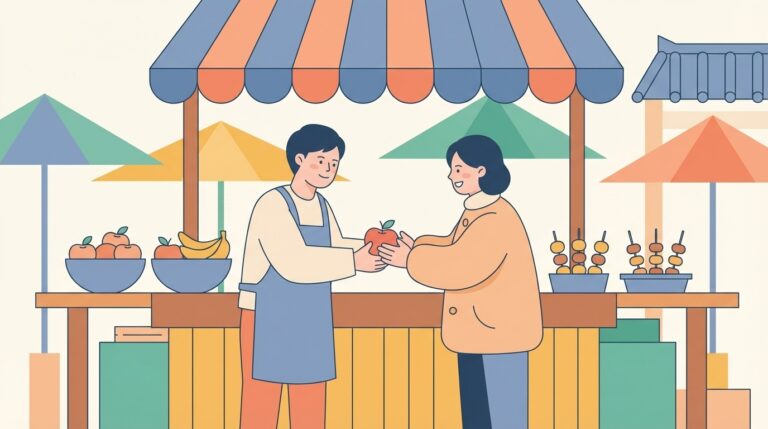
Phase 1: Welcome to the Korean Market Vibe!
Hello! I’m your Daily Hangul Editor.
Picture this: You’re watching your favorite K-Drama, and the protagonist is wandering through a bustling traditional market. They flash a bright smile, casually chat with the vendor, and suddenly, an extra handful of strawberries magically appears in their bag. The English subtitles might just say “Thank you,” but was it really just a simple thank you? Not quite.
Welcome to the thrilling, heartwarming world of Heungjeong (흥정, haggling) and Deom (덤, extra freebies). In Korea, traditional markets like Gwangjang or Mangwon aren’t just places to buy groceries; they are dynamic arenas of social interaction. If you just pay the sticker price and walk away, you’re missing out on half the fun and the underlying cultural affection known as Jeong (정).
This guide isn’t just theory. It’s built from the real experiences of my advanced students who wanted to go beyond textbook Korean and interact with local vendors like true Seoulites. Let’s dive in and unlock your insider status!
Phase 2: Core Expressions Deep Dive
1. 사장님, 이거 조금만 빼주시면 안 돼요?
- Pronunciation: sajangnim, igeo jogeumman ppaejusimyeon an dwaeyo? (Sound-alike guide: ‘ppae’ sounds like a sharp, tense ‘peh’, similar to the start of ‘pedal’ but with more air pressure.)
- Meaning: Literal: “Boss, can’t you take off a little bit for this?” / Real nuance: “Could you give me a small discount?”
- K-Culture Moment: In K-Variety shows, whenever celebrities are given a tight budget for a market mission, you’ll see them clasping their hands and using this exact phrase with an exaggerated, pleading smile.
- Editor’s Insight: The beauty here lies in the verb 빼다 (to subtract/take out). It sounds much softer and more conversational than the textbook word 깎다 (to cut/discount).
- Situation Spectrum:
- Traditional Market Vendors: ✅ (Perfect)
- Small independent shops: ⚠️ (Read the room first)
- Department Stores/Chain Cafes: 🚫 (Never)
- 🤔 Think About It: Why do Koreans frequently use negative questions (안 돼요? / “Can’t you?”) to ask for favors? It’s a linguistic strategy to soften the blow. Giving the listener an easy way out (“No, I can’t”) actually makes the request sound less demanding. Does your native language have a similar buffering tactic?
2. 에이~ 정인데 덤으로 조금만 더 주세요!
- Pronunciation: ei~ jeong-inde deom-euro jogeumman deo juseyo! (Sound-alike guide: ‘ei’ is a playful ‘Ayyy’, and ‘jeong’ sounds like ‘jung’.)
- Meaning: Literal: “Come on~ It’s jeong, so please give me a little more as deom!” / Real nuance: “Be a pal and throw in a little extra for me!”
- K-Culture Moment: Imagine buying a big plate of Tteokbokki at a street stall. You say this, and the vendor dramatically sighs but scoops an extra fried dumpling onto your plate.
- Editor’s Insight: This phrase is the ultimate “Insider” move. By invoking Jeong (affection/bond), you shift the transaction from a cold business deal to a warm human interaction.
- Situation Spectrum:
- Market Food Stalls: ✅
- Buying bulk produce: ✅
- High-end restaurants: 🚫
- 🤔 Think About It: How does tying a commercial transaction to a social bond (Jeong) change the dynamic between buyer and seller in Korean culture?
3. 앞으로 단골 할게요, 잘해주세요~
- Pronunciation: apeuro dangol halgeyo, jalhaejuseyo~ (Sound-alike guide: ‘dangol’ sounds like ‘dan-goal’.)
- Meaning: Literal: “I will be a regular from now on, please treat me well~” / Real nuance: “Give me a good deal, and I promise I’ll keep coming back!”
- K-Culture Moment: Frequently used by college students trying to secure extra meat at a local K-BBQ joint near their university.
- Editor’s Insight: Koreans value long-term loyalty over one-off transactions. Promising to be a 단골 (regular customer) is essentially promising future revenue in exchange for a current perk.
- Situation Spectrum:
- Neighborhood restaurants: ✅
- Markets: ✅
- Tourist traps where you’ll obviously never return: ⚠️ (Vendors might see right through it!)
- 🤔 Think About It: Is customer loyalty rewarded informally in your home country, or is it strictly tracked through point systems and apps?
Phase 3: Textbook vs. Real Korean
| Situation | 📖 Textbook Korean | 🗣️ Real Korean | 💡 Why Different? |
|---|---|---|---|
| Asking for a discount | 가격을 좀 할인해 주시겠습니까? (Could you discount the price?) | 사장님, 조금만 빼주세요~ (Boss, take a little off~) | ‘할인’ (discount) feels too formal and corporate for a bustling market. |
| Asking for extra | 이것을 무료로 더 주실 수 있나요? (Can you give me more of this for free?) | 덤 좀 챙겨주세요~ (Please pack some extra deom~) | ‘무료’ (free) sounds transactional. ‘덤’ implies generosity and warmth. |
| Promising loyalty | 앞으로 자주 방문하겠습니다. (I will visit often in the future.) | 여기 단골 할게요! (I’ll be a regular here!) | ‘단골’ emphasizes a personal, emotional relationship rather than just foot traffic. |
Phase 4: Cultural Context — K-Culture Deep Dive
4-1. Non-verbal Nuances & Nunchi
When haggling in Korea, your body language is just as important as your vocabulary.
– The Tone: Do not use a stern or demanding voice. Market haggling should be playful. Use a slightly elevated, friendly pitch (a subtle hint of Aegyo).
– The Nunchi: Read the room. If the vendor looks exhausted or there’s a huge line of angry customers behind you, it is not the time to haggle for a 500-won discount. Wait for a relaxed moment.
4-2. The K-Travel Connection: Market Vibes
If you travel to Gwangjang Market or Namdaemun, you’ll notice a distinct chaotic energy. Vendors yelling out to passersby, the sizzling sound of Bindaetteok (mung bean pancakes), and the vibrant colors of fresh produce. In this environment, speaking perfectly formal Korean actually creates a barrier. Using market-specific colloquialisms helps you blend in and shows respect for their specific micro-culture.
Phase 5: Practical Roleplay Scenario
Setting: Friday afternoon at Mangwon Market. The air smells like sweet fried chicken and fresh fruit. You are standing in front of a fruit stall bursting with bright red strawberries.
Characters:
– YOU: A foreign resident living in Seoul. You love strawberries but you’re on a budget.
– Halmeoni (Grandma Vendor, 70s): Sweet but shrewd. She calls everyone “Student.”
Dialogue:
Halmeoni: 아이고, 학생~ 딸기 방금 들어왔어. 엄청 달아!
(Aigo, haksaeng~ ttalgi banggeum deureowasseo. eomcheong dala!)
[Aigo, student~ Strawberries just came in. So sweet!]
YOU: 우와, 진짜 맛있어 보이네요. 한 바구니에 얼마예요?
(Uwa, jinjja masisseo boineyo. han bagunie eolmayeyo?)
[Wow, they look really delicious. How much for one basket?]
Halmeoni: 한 바구니에 만 원! 마트보다 훨씬 싸~
(Han bagunie man won! mateuboda hwolssin ssa~)
[10,000 won for one basket! Way cheaper than the supermarket~]
YOU: 음… 제가 혼자 살아서 한 바구니는 너무 많은데…
(Eum… jega honja saraseo han bagunineun neomu maneunde…)
[Hmm… I live alone so one basket is too much…]
Halmeoni: 에이, 두고두고 먹으면 되지! 내가 많이 담았어.
(Ei, dugodugo meogeumyeon doeji! naega mani damasseo.)
[Ey, you can save it for later! I packed a lot.]
🔀 Your Turn! How should you respond?
– A) “아, 그럼 그냥 하나 주세요.” (Ah, then just give me one. – Safe, textbook response.)
– B) “사장님, 그럼 이거 만 원에 할 테니까, 저기 귤 두 개만 덤으로 주시면 안 돼요?” (Boss, then I’ll take this for 10,000 won, so could you give me two tangerines over there as deom?)
– C) “너무 비싸요. 깎아주세요.” (Too expensive. Discount please.)✅ Best Choice: B
Why? In traditional markets, asking for a slight deom (bonus) when buying a large portion is often more successful and culturally appreciated than asking to lower the flat price.
⚠️ Choice C Analysis: Saying “Too expensive” bluntly can offend the vendor’s pride in their produce.
(Assuming you chose B)
Halmeoni: (Laughs) 아이고, 외국인 학생이 ‘덤’도 아네? 알았어, 옛다 귤 세 개!
(Aigo, oegugin haksaengi ‘deom’do ane? arasseo, yetda gyul se gae!)
[(Laughs) Oh my, a foreign student knows about ‘deom’? Alright, here you go, three tangerines!]
YOU: 우와, 감사합니다! 저 단골 할게요!
(Uwa, gamsahamnida! jeo dangol halgeyo!)
[Wow, thank you! I’ll be a regular!]
🎭 Bonus K-Food Roleplay: The Street Food Stall
Vendor: 떡볶이 1인분 나왔습니다~
YOU: 사장님, 혹시 튀김 부스러기 조금만 올려주실 수 있나요?
(Boss, by any chance, could you put a little bit of fried tempura crumbs on top?)
Vendor: 그럼요~ 맛있게 먹어요!
Phase 6: 10-Second Shadowing Drill
Practice these lines with the right emotion and rhythm! The slashes (/) indicate where to pause naturally.
- 🥺 (Pleadingly) 사장님~ / 이거 / 조금만 / 빼주시면 안 돼요?
(sajangnim~ / igeo / jogeumman / ppaejusimyeon an dwaeyo?) - 😉 (Playfully) 에이~ / 정인데 / 덤으로 하나만 / 더 주세요!
(ei~ / jeong-inde / deom-euro hanaman / deo juseyo!) - 😊 (Brightly) 저 / 앞으로 여기 / 단골 할게요!
(jeo / apeuro yeogi / dangol halgeyo!)
Phase 7: K-Culture Mini Dictionary
| 한국어 (Korean) | Romanization | English | Cultural Context |
|---|---|---|---|
| 덤 | deom | Extra freebie | An extra portion given freely by the seller to show appreciation. |
| 흥정 | heungjeong | Haggling/Bargaining | The act of negotiating price, viewed more as a social interaction in markets. |
| 정 (情) | jeong | Affection/Bond | The deep, unspoken emotional connection and warmth between people. |
| 인심 | insim | Generosity | Often used as “인심이 좋다” (good generosity) to describe vendors who give huge portions. |
| 단골 | dangol | Regular customer | A customer who frequently visits the same shop, establishing a trusting relationship. |
Phase 8: Traveler’s Survival Kit 🎒
Navigating a Korean market? You absolutely need these phrases in your back pocket.
🆘 Survival Phrase #1: Finding the Price
– 🇰🇷 “이거 얼마예요?” (igeo eolmayeyo? – How much is this?)
– 💡 Pro Tip: If you can’t catch the numbers they say rapidly in Korean, simply open the calculator app on your phone and hand it to them. It’s a universally understood market language!🆘 Survival Phrase #2: Confirming Payment Methods
– 🇰🇷 “카드 되나요?” (kadeu doenayo? – Do you accept cards?)
– 💡 Pro Tip: Many traditional stalls prefer cash or direct bank transfers (계좌이체).📌 Editor’s Travel Note
– Cash vs Card: While Korea is largely a cashless society, traditional markets are the exception. Always carry around 20,000 to 50,000 KRW in cash for street food and small market purchases.
– Tipping: Korea has NO tipping culture. If you leave extra money on the counter, the vendor will likely chase you down the street to return it!
Phase 9: Critical Thinking Corner — “A Step Deeper”
🧠 Think Deeper: Food, Generosity & Korean Identity
In heavily modernized, hyper-capitalist South Korea, where everything is digitized and precisely measured, the concept of Deom in traditional markets stands out as an anomaly. Why does a vendor willingly give away profit? Because in Korean culture, food is intricately tied to the concept of Jeong (collective affection). Sharing food—or giving extra food—is the ultimate expression of caring. The Deom is not a financial miscalculation; it is a social investment. It says, “I see you not just as a wallet, but as a person, and I want you to be full.”
💬 Your Turn: Does your culture have a tradition where vendors give “a little extra” to customers? How is business mingled with community building where you’re from? Share in the comments!
Phase 10: FAQ & Mistake Prevention
Q: Can I haggle at an underground subway shopping mall (like Goto Mall)?
Yes! While you shouldn’t ask for a discount at branded stores, independent clothing stalls in underground malls often expect light haggling, especially if you buy multiple items or pay in cash.
Q: What should I call the vendor? Is ‘Ajumma’ okay?
Avoid using Ajumma (아줌마), as it can sometimes carry a dismissive or overly familiar nuance nowadays.
– Safest bet: 사장님 (Sajangnim – Boss/Owner).
– For food stalls run by older women: 이모 / 이모님 (Imo / Imonim – Auntie) feels much more affectionate and respectful.
❌ Common Mistake: Demanding a discount at a chain store or franchise (e.g., Olive Young, Starbucks, convenience stores).
✅ How to fix it: Understand that heungjeong only applies to owner-operated stalls and traditional markets where the seller sets the price on the spot.
Phase 11: Summary & Action Items
📌 One-Liner Summary: Haggling in Korea isn’t just about saving money; it’s about using phrases like “조금만 빼주세요” and asking for “덤” to experience authentic Korean Jeong.
🎯 Action Missions:
– 🥉 Bronze: Stand in front of a mirror and practice “사장님~ 단골 할게요!” with your best friendly smile.
– 🥈 Silver: Drop a comment below using the word Deom or Jeong to describe a warm experience you’ve had.
– 🥇 Gold: Next time you visit a Korean market or an independent mom-and-pop shop, try asking for a small discount or an extra item using today’s phrases!
🎥 K-Culture Mission: Go to YouTube, search for “광장시장 먹방 (Gwangjang Market Mukbang),” and see if you can spot vendors casually tossing extra food onto the creators’ plates!
Phase 12: Interactive Quiz 🧠
1. Situational Judgment: You are buying 3 vintage t-shirts from a stall in Dongdaemun. The total is 45,000 won. Which is the most natural way to ask for a 5,000 won discount?
– A) 5천 원 할인해 주시겠습니까?
– B) 사장님, 세 장 사니까 4만 원으로 조금만 빼주세요~
– C) 너무 비싸요. 4만 원에 주세요.
2. Fill in the Blank: “제가 앞으로 자주 올게요! 여기 ______ 할게요!” (Hint: Regular customer)
3. True or False: It is culturally appropriate to tip a market vendor for giving you excellent Deom.
4. Roleplay Application: If the vendor says “안 돼, 남는 게 없어” (No, I won’t have any profit left) with a serious face after you ask for a discount, what is the best cultural response?
– A) Argue the price of the raw materials.
– B) Smile, accept the original price, and say “네, 알겠습니다! 많이 파세요~” (Okay, I understand! Sell a lot~)
– C) Walk away immediately without saying anything.
(Check the comments for the answers!)
Frequently Asked Questions (FAQ)
Q: What does "사장님, 이거 조금만 빼주시면 안 돼요?" mean in Korean and how do you pronounce it?
A: In Korean, "사장님, 이거 조금만 빼주시면 안 돼요?" is pronounced [sajangnim, igeo jogeumman ppaejusimyeon an dwaeyo? (Sound-alike guide: 'ppae' sounds like a sharp, tense 'peh', similar to the start of 'pedal' but with more air pressure.] and means: Literal: "Boss, can't you take off a little bit for this?" / Real nuance: "Could you give me a small discount?"
Q: What does "에이~ 정인데 덤으로 조금만 더 주세요!" mean in Korean and how do you pronounce it?
A: In Korean, "에이~ 정인데 덤으로 조금만 더 주세요!" is pronounced [ei~ jeong-inde deom-euro jogeumman deo juseyo! (Sound-alike guide: 'ei' is a playful 'Ayyy', and 'jeong' sounds like 'jung'.] and means: Literal: "Come on~ It's jeong, so please give me a little more as deom!" / Real nuance: "Be a pal and throw in a little extra for me!"
Q: What does "앞으로 단골 할게요, 잘해주세요~" mean in Korean and how do you pronounce it?
A: In Korean, "앞으로 단골 할게요, 잘해주세요~" is pronounced [apeuro dangol halgeyo, jalhaejuseyo~ (Sound-alike guide: 'dangol' sounds like 'dan-goal'.] and means: Literal: "I will be a regular from now on, please treat me well~" / Real nuance: "Give me a good deal, and I promise I'll keep coming back!"







