

Phase 1: Empathy
Hello! I’m your Daily Hangul Editor.
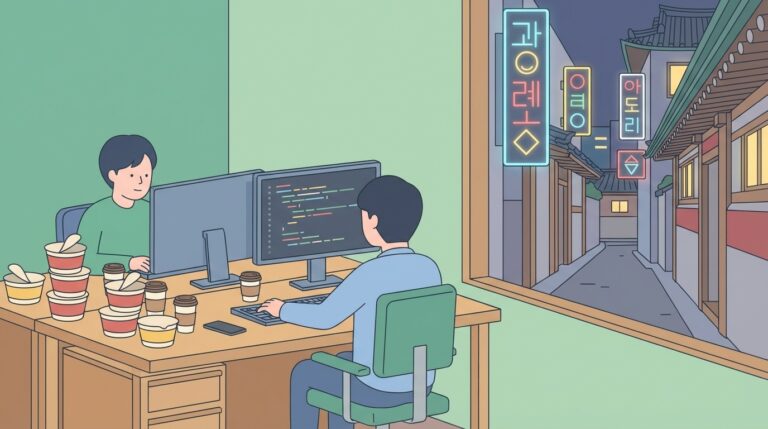
Picture this: You are at the Busan Indie Connect (BIC) Festival. The AC is blasting, the neon lights of hundreds of booths are flashing, and you’ve just finished showcasing the pixel-art roguelike game you’ve spent the last two years building. A representative from a major Korean game publisher takes off their headphones, looks at you, and says something that sounds like… “You ground your soul?”
Wait, what? Are they cursing your game, or praising it?
If you’re operating in the Korean indie game scene—whether you’re pitching to publishers, reading Steam reviews in Korean, or networking in Pangyo (Korea’s Silicon Valley)—textbook Korean won’t cut it. The gaming industry here moves at lightning speed, and its language is a vibrant, intense mix of internet slang, developer jargon, and hyper-expressive idioms.
Today, we are going to learn the real survival vocabulary of Korean indie game development. Let’s decode the secret language of developers so you can navigate pitches, user feedback, and after-parties like a true insider.
(Note: This guide is based on real interactions and late-night developer rants from the indie studios of Hongdae and Pangyo!)
Phase 2: Core Expressions Deep Dive
1. 영혼을 갈아 넣다
- Pronunciation: [yeonghoneul gara neota] — ‘gara’ sounds like a pirate growling “Garrr-a!”
- Meaning: (Literal) To grind one’s soul and put it in. / (Real nuance) To pour one’s blood, sweat, and tears into a project; to work excruciatingly hard (often implying crunch mode).
- K-Culture Moment: You’ll hear this constantly in Korean dev vlogs or post-mortems. When a solo dev releases an update with insanely detailed pixel animations, Korean gamers will comment: “개발자님, 픽셀에 영혼을 갈아 넣으셨네요” (Dev, you ground your soul into these pixels).
- Editor’s Insight: This phrase captures the intense, sometimes grueling work ethic of Korean creators. It’s a badge of honor. It feels exhausting, yet intensely proud.
- Situation Spectrum:
- Casual (Dev friends): ✅
- Semi-formal (Pitching your passion): ✅
- Formal (Extremely strict corporate): ⚠️ (A bit too dramatic, but acceptable in creative fields)
- 🤔 Think About It: Why do Koreans use such a visceral word as “grinding” (갈다) for hard work? How does this reflect the notorious “crunch culture” in global game development vs. the Korean “야근” (overtime) culture?
2. 입질이 오다
- Pronunciation: [ipjiri oda] — ‘ip’ sounds like ‘eep’ in jeep, ‘jil’ rhymes with chill.
- Meaning: (Literal) To get a bite (fishing). / (Real nuance) To get traction, interest, or a positive signal from a publisher or the market.
- K-Culture Moment: You are drinking cheap draft beer (생맥주) with your team after sending out 50 pitch decks. Suddenly, your lead programmer checks their email and gasps: “야, 넥슨 쪽에서 입질이 오는데?” (Hey, we’re getting a bite from Nexon?)
- Editor’s Insight: It implies the suspense of waiting. You cast your line (the game), and finally, the bobber moves. It’s not a signed contract yet, but it’s the thrill of the first sign of interest.
- Situation Spectrum:
- Casual (Team members): ✅
- Semi-formal (Industry peers): ✅
- Formal (To the publisher directly): 🚫 (Never tell the fish they are biting!)
- 🤔 Think About It: Fishing metaphors are huge in Korean business. “Throwing bait” (미끼를 던지다) means marketing. Does your native language use hunting or fishing metaphors for business?
3. 떡상하다
- Pronunciation: [tteoksanghada] — ‘tteok’ (like the rice cake) + ‘sang’ (song with an ‘ah’ sound).
- Meaning: (Literal) To rise like rice cakes (crypto slang). / (Real nuance) To skyrocket in popularity, sales, or positive reviews.
- K-Culture Moment: A famous Korean game streamer (like on Chzzk or AfreecaTV) accidentally plays your indie game. The next morning, your Steam wishlists have jumped by 10,000. Your community manager screams: “우리 게임 완전 떡상했어요!” (Our game totally skyrocketed!)
- Editor’s Insight: Originally from the stock/crypto market, this word has fully infiltrated gaming. It’s the ultimate dream of every indie developer. The opposite is 나락가다 (to go to hell/rock bottom).
- Situation Spectrum:
- Casual (Gamers/Friends): ✅
- Semi-formal (Internal meetings): ✅
- Formal (Investor reports): 🚫 (Use “급성장했습니다” – experienced rapid growth instead)
- 🤔 Think About It: The Korean gaming community moves in massive waves. A single viral clip can make or break a game overnight. How does internet culture dictate success in your country’s indie scene?
Phase 3: Textbook vs. Real Korean
| Situation | 📖 Textbook Korean | 🗣️ Real Korean | 💡 Why the Difference? |
|---|---|---|---|
| Explaining your hard work | 저희 팀은 아주 열심히 만들었습니다. | 저희 팀, 이번 아트워크에 영혼을 갈아 넣었습니다. | “Hard work” is expected; “grinding your soul” shows artistic obsession. |
| Receiving Publisher Interest | 퍼블리셔가 저희에게 관심이 있습니다. | 퍼블리셔 쪽에서 슬슬 입질이 오네요. | Business is treated like a tactical game/fishing; slang adds a sense of savvy. |
| Game gets overwhelmingly positive reviews | 게임 평가가 아주 좋습니다. | 스팀 평가 압도적 긍정적 떴어요! 폼 미쳤다! | Steam’s exact UI translation (“Overwhelmingly Positive”) becomes everyday slang. |
| Avoiding Pay-to-Win | 결제 시스템이 없습니다. | 과금 유도 없는 착한 게임입니다. | Gamers are traumatized by greedy mechanics; they personify games as “kind” (착한). |
(Bottom Note: As C1 learners, using words like ‘착한 게임’ (kind game) instead of ‘결제 시스템’ (payment system) shows you truly understand the sentiment of Korean gamers, not just the dictionary definitions.)
Phase 4: Cultural Context — K-Culture Deep Dive
4-1. Non-verbal Nunchi (눈치) in Pitching
When pitching to Korean publishers, the exchange of business cards (명함) is a sacred ritual. Use two hands, read the card for a few seconds, and place it respectfully on the table. But here’s the Nunchi test: If a publisher plays your game, nods silently, and says, “긍정적으로 검토해 보겠습니다” (We will review it positively), do not pop the champagne. In high-context Korean business culture, outright saying “No” is considered rude. “We will review it” is often a polite rejection, unless they immediately follow up with specific questions about your timeline or budget.
4-2. The “PC Bang” & Streamer Ecosystem
In Korea, an indie game’s success isn’t just about Steam reviews; it’s heavily tied to broadcast culture. If a prominent streamer on Chzzk or AfreecaTV plays your game, their viewers will flood your Steam page. Developers often design “streamer-friendly” features specifically for the Korean market. Furthermore, indie devs will secretly visit PC Bangs (internet cafes) just to peek at what gamers are playing in real-time. If you hear “PC방 점유율 올랐다” (PC Bang market share went up), it means you’ve made it into the mainstream.
Phase 5: Real-Life Roleplay Scenario
Setting: Friday night, 8:00 PM. A smoky Korean BBQ restaurant in Haeundae, Busan, right after the BIC (Busan Indie Connect) Festival. The table is cluttered with Soju bottles and grilling pork belly. You are sitting with your Korean dev friend (Min-su) and a scout from a mid-sized publisher (Mr. Kim).
Characters:
– YOU: An expat indie developer looking for funding.
– Min-su (32): Your local dev buddy. Energetic, knows the scene.
– Mr. Kim (40): Publisher rep. Polite but sharp.
(The meat is sizzling. Min-su pours a shot of Soju for Mr. Kim, using two hands.)
Min-su: 야, 오늘 피칭 진짜 고생했어! 고기는 내가 쏜다! 🥩
(Ya, oneul piching jinjja gosaenghaesseo! Gogineun naega ssonda!)
[Hey, you worked really hard on the pitch today! The meat is on me!]
YOU: 고마워, 민수. 퍼블리셔 분들 앞에서 말할 때 심장이 터지는 줄 알았어.
(Gomawo, Min-su. Peobeullisyeo bundeul apeseo malhal ttae simjangi teojineun jul arasseo.)
[Thanks, Min-su. I thought my heart was going to explode when speaking in front of the publishers.]
Min-su: 에이, 무슨 소리야. 스팀 위시리스트 보니까 벌써 유저들 입질이 오던데?
(Ei, museun soriya. Seutim wisiriseuteu bonikka beolsseo yujeodeul ipjiri odeonde?)
[Come on, what are you talking about. Looking at the Steam wishlists, you’re already getting a bite from users!]
YOU: 진짜? 아직 데모 버전인데 다행이다.
(Jinjja? Ajik demo beojeoninde dahaengida.)
[Really? It’s still just a demo version, what a relief.]
(🎭 Stage Direction: Mr. Kim raises his Soju glass towards you with a warm smile.)
Mr. Kim: 스튜디오 대표님, 이번 게임 아트워크에 아주 영혼을 갈아 넣으셨던데요? 퀄리티가 엄청납니다.
(Seutyudio daepyonym, ibeon geim ateuwokeue aju yeonghoneul gara neouseotdeondeyo? Kwollitiga eomcheongnamnida.)
[Studio CEO, I see you ground your soul into the artwork this time? The quality is incredible.]
🔀 Your Turn! How do you respond to this high praise?
– A) “네, 제가 정말 고생 많이 했습니다. 저 대단하죠?” (Yes, I suffered a lot. Aren’t I great?)
– B) “과찬이십니다. 팀원들이 밤낮없이 고생해 준 덕분입니다.” (You flatter me. It’s all thanks to my team working day and night.)
– C) “당연하죠! 우리 떡상할 겁니다!” (Of course! We’re going to skyrocket!)✅ Best Choice: B — Why? Humility is key in Korean networking. Deflecting the praise to your team’s hard work shows stellar leadership. Option A sounds arrogant, and Option C is too casual for a potential investor.
YOU: 과찬이십니다. 팀원들이 밤낮없이 고생해 준 덕분입니다.
(Gwachanisimnida. Timwondeuri bamnat-eopsi gosaenghae jun deokbunimnida.)
[You flatter me. It’s all thanks to my team working day and night.]
Mr. Kim: 하하, 겸손하시네요. 그런데 BM(비즈니스 모델)은 어떻게 기획 중이신가요?
(Haha, gyeomsonhasineyo. Geureonde BM-eun eotteoke gihoek jung-isingayo?)
[Haha, you’re humble. By the way, how are you planning the BM (Business Model)?]
YOU: 과금 유도 없이, 깔끔하게 스팀 패키지로 갈 생각입니다.
(Gwageum yudo eopsi, kkalkkeumhage seutim paekijiro gal saenggagimnida.)
[I’m planning to go clean with a Steam package, without any pay-to-win mechanics.]
Min-su: 오, 요즘 유저들이 제일 좋아하는 ‘착한 게임’이네!
(O, yojeum yujeodeuri jeil joahaneun ‘chakhan geim’ine!)
[Oh, that’s the ‘generous/kind game’ style users love the most these days!]
Mr. Kim: 좋습니다. 저희 쪽에서도 긍정적으로 검토해 보겠습니다. 다음 주에 미팅 한 번 더 하시죠.
(Joseumnida. Jeohoe jjogeseodo geungjeongjeogeuro geomtohae bogetseumnida. Daeum jue miting han beon deo hasijo.)
[Good. We will review it positively on our end too. Let’s have another meeting next week.]
(Editor’s note: He asked for a follow-up meeting! The “긍정적 검토” here is real!)
Phase 6: 10-Second Shadowing Drill
Practice making your pitch sound authentic. Pay attention to the pauses (/) and emotional tones.
- 😤 Determined: 이번 프로젝트에 / 제 영혼을 / 싹 다 갈아 넣었습니다!
(ibeon peurojekteue / je yeonghoneul / ssak da gara neoeotseumnida!) -
😊 Excited: 어제 데모 올렸는데 / 벌써 유저들한테서 / 입질이 오네요!
(eoje demo ollyeonneunde / beolsseo yujeodeulhanteseo / ipjiri oneyo!)
Phase 7: K-Culture Mini Dictionary (Indie Dev Edition)
| Korean | Romanization | English | Contextual Meaning |
|---|---|---|---|
| 과금 유도 | gwageum yudo | Pay-to-win mechanics | Inducing users to spend money. Heavy monetization. |
| 혜자 게임 | hyeja geim | Generous game | A game that gives a lot of value/content for its price. Derived from the generous “Hyeja” brand bento boxes. |
| 창렬 | changnyeol | Rip-off | The opposite of Hyeja. A game that is overpriced and lacks content. |
| 크런치 | keureonchi | Crunch mode | The intense overtime period before a game launch. |
| 압긍 | ap-geung | Overwhelmingly Positive | Short for 압도적으로 긍정적 (Overwhelmingly Positive) on Steam reviews. |
Phase 8: Traveler Survival Kit (Game Event Edition)
Are you visiting Korea for G-Star (Busan) or PlayX4 (Ilsan)? Here are your survival phrases for networking on the show floor.
🆘 Survival Expression #1: Asking to Play
– 🇰🇷 “혹시 시연해 볼 수 있나요?” (hoksi siyeonhae bol su innayo?)
– 🗣️ Meaning: Can I demo/play this?
– 📍 Where to use: Any indie game booth.🆘 Survival Expression #2: Networking
– 🇰🇷 “명함 한 장 부탁드려도 될까요?” (myeongham han jang butakdeuryeodo doelkkayo?)
– 🗣️ Meaning: Could I ask for a business card?
– 📍 Where to use: When you meet a dev or publisher you want to connect with later.🆘 Survival Expression #3: Praising the Game
– 🇰🇷 “타격감이 진짜 좋네요!” (tagyeokgami jinjja jonneyo!)
– 🗣️ Meaning: The hit satisfaction/impact feel is really good!
– 📍 Where to use: A huge compliment in Korea. “타격감” (sense of impact) is deeply valued by Korean gamers.📌 Editor’s Travel Note
– Navigating Events: Download Naver Map or KakaoMap. Google Maps does not provide walking directions in Korea!
– Swag Culture: Indie booths in Korea hand out a LOT of free merch (굿즈) if you follow their Twitter/X or wishlist them on Steam. Bring an extra tote bag.
Phase 9: Critical Thinking Corner — “Going One Step Deeper”
Language & Power in the Korean Game Industry
In traditional Korean corporate culture, language strictly reflects hierarchy—determined by age and title (e.g., using hyper-formal honorifics to the CEO). However, the Korean indie game scene is actively rebelling against this. To foster creativity and break away from the top-down “crunch culture” of the “3N” megacorporations (Nexon, Netmarble, NCSoft), many indie studios adopt 수평적 소통 (horizontal communication).
In these studios, developers drop traditional titles and instead use English nicknames (like “Alex님” instead of “김 팀장님/Team Leader Kim”). They use polite language (존댓말) but remove the rigid hierarchical markers. This isn’t just a linguistic shift; it’s a structural attempt to create a psychologically safe space where a junior artist can comfortably tell a veteran programmer that their code is causing the game to crash.
💬 Your Turn: Does the tech or gaming industry in your country have a different “language” compared to traditional corporate environments? Share your thoughts in the comments!
Phase 10: FAQ & Common Mistakes
Q: Can I use “영혼을 갈아 넣다” to my boss/investor?
Yes, but with caution! It shows extreme passion, but it is technically slang. If you are in a highly formal banking/investment meeting, stick to “최선을 다했습니다” (We did our absolute best). If you are pitching to a creative publisher, “갈아 넣었습니다” adds the perfect touch of authentic passion.
Q: What if I don’t drink alcohol at the networking after-party?
It is 100% fine. The aggressive drinking culture in Korea is fading fast, especially in the young IT/gaming sector. Just politely say: “제가 술을 잘 못해서요. 콜라로 하겠습니다!” (I can’t drink well. I’ll have Cola!).
❌ Common Mistake: Taking “검토해 보겠습니다” (We will review it) literally from a publisher.
✅ Do This Instead: Understand that it might mean “No.” Look for follow-up actions. If they don’t ask for your pitch deck or set a next meeting date right then, they are letting you down gently.
Phase 11: Summary & Action Items
💡 One-Liner Summary: To survive the Korean indie game scene, show your passion by “grinding your soul” (영혼을 갈아 넣다) and wait for the publishers to “take the bait” (입질이 오다)!
🚀 Action Missions:
– 🥉 Bronze (Solo): Stand in front of a mirror, look exhausted but proud, and say “제 영혼을 갈아 넣었습니다!” 3 times.
– 🥈 Silver (Online): Go to the Steam page of a famous Korean indie game (like Sanabi or Skul: The Hero Slayer) and read the Korean reviews. Can you spot “갓겜” (God game) or “떡상”?
– 🥇 Gold (Real Life): If you’re developing a game, tweet an update with the hashtag #indiedev and add: “이번 업데이트에 영혼을 갈아 넣었습니다! 🎮🇰🇷”
🎯 K-Culture Mission: Watch a YouTube video of a Korean streamer playing an indie game. Watch the live chat. When the game does something amazing, count how many times viewers type “폼 미쳤다” (Form is crazy) or “입질 오네”.
Phase 12: Quiz — Interactive Challenge
1. Situational Judgment: You are presenting your game at BIC. A famous publisher plays your demo, smiles, and says nothing specific, just: “네, 잘 봤습니다. 내부적으로 긍정적으로 검토해 보겠습니다.” What should you do?
– A) Start celebrating! You got the deal!
– B) Demand to sign a contract right now.
– C) Say thank you, give them your card, but keep your expectations grounded. It’s likely a polite formality.
2. Fill in the Blank: Our game has no pay-to-win mechanics! It is a ( ______ ) 게임!
– A) 창렬 (Changnyeol)
– B) 나락 (Narak)
– C) 착한 (Chakhan)
3. True or False: If an indie dev says “팀원들을 갈아 넣었다” (I ground up my team members), they are confessing to a violent crime.
– (True / False)
🗝️ Click for Answers
1. C (In high-context Korean business, direct rejections are avoided. “We’ll review it positively” is the default polite exit.)
2. C (착한 게임 means “Kind game”, referring to fair monetization.)
3. False (It just means they made their team work an insane amount of overtime during crunch mode!)
Frequently Asked Questions (FAQ)
Q: What does "영혼을 갈아 넣다" mean in Korean and how do you pronounce it?
A: In Korean, "영혼을 갈아 넣다" is pronounced [yeonghoneul gara neota] and means: (Literal) To grind one's soul and put it in. / (Real nuance) To pour one's blood, sweat, and tears into a project; to work excruciatingly hard (often implying crunch mode).
Q: What does "입질이 오다" mean in Korean and how do you pronounce it?
A: In Korean, "입질이 오다" is pronounced [ipjiri oda] and means: (Literal) To get a bite (fishing). / (Real nuance) To get traction, interest, or a positive signal from a publisher or the market.
Q: What does "떡상하다" mean in Korean and how do you pronounce it?
A: In Korean, "떡상하다" is pronounced [tteoksanghada] and means: (Literal) To rise like rice cakes (crypto slang). / (Real nuance) To skyrocket in popularity, sales, or positive reviews.







