

Phase 1: Empathy (Immersive Opening)
Hello! I’m your Daily Hangul Editor, your local Korean friend and veteran tutor.
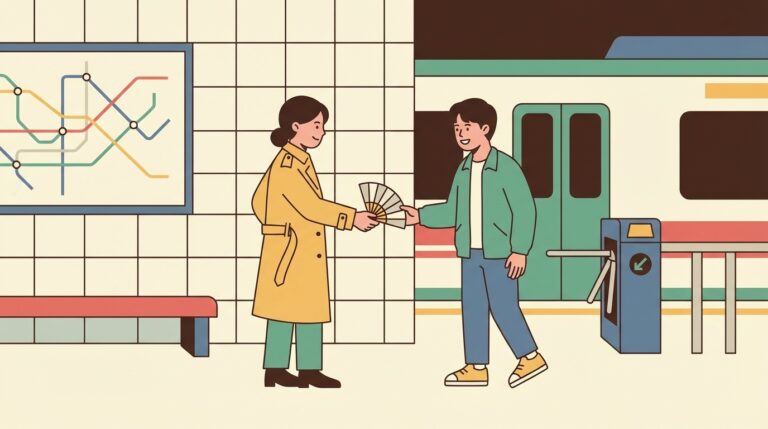
Picture this: You just moved to Seoul. It’s suddenly freezing, and you urgently need a space heater. You download that famous orange app (Karrot / Danggeun Market) that every single Korean uses for second-hand trading. You find a great deal! You meet a stranger at Exit 3 of Hongdae Station. They hand you the heater. It looks okay, but you want to ask one crucial question: “Does this actually work?”
But wait… your mind goes blank. Do you just point at it and say “Okay?”
Second-hand trading (Jik-geo-rae) is a massive part of modern Korean culture. From college students buying used K-Pop photocards to grandmas selling vintage pots, everyone is doing it. Knowing this one simple phrase won’t just save you from buying a broken item—it will instantly make you look like a true local who knows how to survive in Korea.
Don’t worry, this guide is built on real experiences from my beginner students who survived their first Korean street trades. Let’s dive in!
Phase 2: Core Expressions Deep Dive
1. 작동 잘 돼요? (Does it work well?)
- Pronunciation: [jak-dong jal dwae-yo?]
- Sound guide: ‘jak’ sounds like Jack, ‘dong’ like dongle, ‘jal’ like jalapeño, ‘dwae-yo’ rhymes with may-yo.
- Meaning: Literal: Does the operation go well? / Real meaning: Does it work properly?
- K-Culture Moment: You are buying a used K-Pop lightstick (Eung-won-bong) outside the concert stadium. You need to make sure it actually lights up before you pay! You press the button and ask, “작동 잘 돼요?”
- Editor’s Insight: This phrase is the absolute gold standard for electronics, toys, or anything with a battery. It sounds polite but gets straight to the point.
- Situation Spectrum:
- Casual (to a friendly seller): ✅
- Semi-formal (standard polite): ✅
- Formal (to a boss): ⚠️ (You wouldn’t usually buy used items from your boss!)
- 🤔 Think About It: Why do Koreans use a somewhat mechanical word like ‘작동’ (operation) even for simple things like a hair straightener? In Korean, verbs describing the ‘state’ of an object are very specific compared to the English “do” or “work.”
2. 하자 없어요? (Are there any defects?)
- Pronunciation: [ha-ja eop-seo-yo?]
- Sound guide: ‘ha-ja’ sounds like ha-jah!, ‘eop’ like up, ‘seo-yo’ like so-yo.
- Meaning: Literal: Is there no defect? / Real meaning: Are there any scratches or flaws?
- K-Culture Moment: You are buying a rare, out-of-print K-Drama DVD box set. You inspect the corners of the box and ask this to make sure it’s in mint condition.
- Editor’s Insight: ‘하자’ (Ha-ja) means flaw or defect. This is a must-know keyword when looking at clothes, photocards, or furniture.
- Situation Spectrum:
- Casual/Standard: ✅
3. 네, 잘 돼요. (Yes, it works well.)
- Pronunciation: [ne, jal dwae-yo]
- Meaning: Yes, it works great.
- Editor’s Insight: If you are the one selling your used items before leaving Korea, this is exactly what you should say when the buyer asks you!
Phase 3: Textbook vs. Real Korean
| Situation | 📖 Textbook Korean | 🗣️ Real Korean | 💡 Why is it different? |
|---|---|---|---|
| Checking an item | 기계가 정상적으로 작동합니까? (Does the machine operate normally?) | 작동 잘 돼요? (Works well?) | Koreans love efficiency! We drop the subject (“machine”) and use shorter, verb-heavy sentences. |
| Asking about flaws | 흠집이 있습니까? (Are there scratches?) | 하자 없죠? (No defects, right?) | ‘하자’ is the universally accepted slang/jargon in the Korean second-hand market. |
| Paying | 현금으로 지불하겠습니다. (I will pay with cash.) | 계좌이체 할게요. (I’ll do a bank transfer.) | Korea is a cashless society. 99% of second-hand trades are done via quick mobile bank transfers! |
Phase 4: Cultural Context — K-Culture Deep Dive
4-1. The “Danggeun” Nunchi (Non-verbal cues)
When meeting for a second-hand trade in Korea, it is usually a very quick, slightly awkward 2-minute encounter. You bow slightly, exchange the item, quickly check it, transfer the money, say “Thank you,” and walk away fast.
Nunchi (reading the room) is key here: do not hold the seller hostage for 15 minutes testing a $5 toaster on the street. Check the main buttons quickly, ask “작동 잘 돼요?” to get verbal confirmation, and trust the process.
4-2. The “Are you a Carrot?” Phenomenon
The biggest second-hand app in Korea is called Danggeun Market (당근마켓), which translates to “Carrot Market.” Because people use nicknames and don’t know what the other person looks like, it has created a hilarious modern K-Culture trope.
People stand awkwardly near subway exits, looking at their phones, making eye contact with strangers, and whispering: “혹시… 당근이세요?” (By any chance… are you a Carrot?)
You will see this parodied in countless Korean variety shows, K-Dramas, and YouTube sketches. It’s a shared cultural experience for anyone living in Korea today!
Phase 5: Real-Life Roleplay Scenario
Setting: 7:00 PM, outside Sinchon Station Exit 2. The wind is chilly. You are meeting a local college student to buy a used portable fan for the upcoming humid Korean summer.
Characters:
* YOU: An exchange student, trying out second-hand trading for the first time.
* Seller (Ji-hoon): A 20-something college student wearing a thick black padded jacket (the unofficial uniform of Korean college students).
Dialogue:
YOU: 저기요… 혹시 당근이세요? 🥕
(jeo-gi-yo… hok-si dang-geun-i-se-yo?)
[Excuse me… by any chance, are you Carrot?]
(🎭 Stage Direction: You approach cautiously, showing your phone screen.)
Ji-hoon: 아, 네! 안녕하세요. 여기 선풍기요.
(a, ne! an-nyeong-ha-se-yo. yeo-gi seon-pung-gi-yo.)
[Ah, yes! Hello. Here is the fan.]
YOU: 감사합니다. 근데 이거…
(gam-sa-ham-ni-da. geun-de i-geo…)
[Thank you. By the way, this…]
🔀 YOUR TURN! What should you say next to check the item?
* A) “기계가 정상적으로 작동합니까?” (Very textbook)
* B) “작동 잘 돼요?” (Natural & street-smart)
* C) “이거 진짜 싸네요!” (Wow, this is really cheap!)✅ Best Choice: B — It’s perfectly natural, polite, and gets exactly the information you need.
⚠️ Why not A? Ji-hoon might think you are a robot or a news anchor.
⚠️ Why not C? It’s nice, but it doesn’t confirm if the item actually works!
(Continuing with Choice B)
YOU: 작동 잘 돼요?
(jak-dong jal dwae-yo?)
[Does it work well?]
Ji-hoon: 네, 잘 돼요. 어제까지 제가 썼어요.
(ne, jal dwae-yo. eo-je-kka-ji je-ga sseos-seo-yo.)
[Yes, it works well. I used it until yesterday.]
YOU: 아, 다행이네요. 현금 드릴게요.
(a, da-haeng-i-ne-yo. hyeon-geum deu-ril-ge-yo.)
[Ah, that’s a relief. I’ll give you cash.]
Ji-hoon: 네, 감사합니다. 안녕히 가세요!
(ne, gam-sa-ham-ni-da. an-nyeong-hi ga-se-yo!)
[Yes, thank you. Goodbye!]
(🎭 Stage Direction: Both of you do a quick, awkward 45-degree bow and walk away in opposite directions rapidly.)
Phase 6: 10-Second Shadowing Drill
Practice this out loud so you won’t freeze when you meet your seller!
- 😊 저기요, / 이거 / 작-동 / 잘 돼요?
- (jeo-gi-yo, / i-geo / jak-dong / jal dwae-yo?)
- Tip: Raise your pitch slightly at the end of “돼요?” to make it sound like a friendly question.
Phase 7: K-Culture Mini Dictionary
| Korean | Romanization | English | Cultural Context |
|---|---|---|---|
| 당근 | dang-geun | Carrot | Slang for second-hand trade, originating from the app ‘Danggeun Market’. |
| 직거래 | jik-geo-rae | Direct trade | Meeting face-to-face to trade, ensuring no scams occur. |
| 네고 | ne-go | Negotiation | Asking for a discount. Often you’ll see “네고 불가” (No Nego) on listings! |
| 쿨거래 | kul-geo-rae | Cool trade | A fast, hassle-free transaction without annoying questions. Koreans love this! |
Phase 8: Traveler’s Survival Kit
Even if you are in Korea for just a week, you might need to buy a cheap adapter or sell your T-Money card before leaving. Here are your survival phrases for any market or street stall!
🆘 Survival Phrases for Trading & Shopping
1. 🇰🇷 “이거 얼마예요?” (i-geo eol-ma-ye-yo?)
– 🗣️ English: How much is this?
2. 🇰🇷 “현금 드릴게요.” (hyeon-geum deu-ril-ge-yo.)
– 🗣️ English: I will pay in cash.
3. 🇰🇷 “조금만 깎아주세요~” (jo-geum-man kka-kka-ju-se-yo~)
– 🗣️ English: Please give me a little discount~📌 Editor’s Travel Note:
Koreans usually pay for second-hand goods via instant bank transfers using their banking apps. As a traveler or beginner without a Korean bank account, always carry crisp 10,000 won bills (현금) and let the seller know in advance: “I don’t have a Korean bank account, can I pay in cash?”
Phase 9: Critical Thinking — “One Step Deeper”
🧠 Think Deeper: Trust in Korean Society
Why is meeting a complete stranger at a subway station at night to buy a used phone considered completely safe in Korea? This reflects Korea’s incredibly high-trust society. Just like people leave their laptops on cafe tables to go to the restroom, the second-hand market relies on community trust. The apps use GPS to ensure you are only trading with neighbors in your actual vicinity, turning an anonymous transaction into a community interaction.
💬 Your Turn: How is second-hand trading done in your country? Do people meet in person, or is everything shipped by mail? Share in the comments!
Phase 10: FAQ & Avoiding Misunderstandings
Q: Can I test the item for 10 minutes on the street?
No! Unless it’s a very expensive item like a laptop, Korean 쿨거래 (Cool Trade) culture dictates that you check the basics quickly (under 2 minutes), trust the seller, and leave. Taking too long is considered lacking nunchi.
Q: Should I use formal or casual language with the seller?
Always use standard polite Korean (ending in ~요 / -yo). Even if the seller looks younger than you, they are a stranger. Using informal language (Banmal) will make you seem incredibly rude.
❌ Common Mistake: Saying “당근!” (Carrot!) instead of “당근이세요?” (Are you a carrot?)
✅ How to fix it: “당근!” just means you are shouting “Carrot!” like a crazy person. Add the polite ending “~이세요?” to ask if they are the person from the app.
Phase 11: Summary & Action Items
One-Liner Summary: Before you hand over your cash for that used item, always ask “작동 잘 돼요? (Does it work well?)” to secure a safe and perfect trade!
Your Action Missions:
* 🥉 Bronze (Solo): Look at your TV or laptop right now and ask it out loud: “작동 잘 돼요?”
* 🥈 Silver (Online): Go to a K-Drama clip on YouTube that features Danggeun Market and spot the awkward bowing!
* 🥇 Gold (Real Life): Download a Korean second-hand app (like Karrot) if you are in Korea, browse the English tags, and try buying a cheap $2 item just for the experience!
Phase 12: Quiz — Interactive Challenge
1. Situational Judgment: You are buying a used K-Pop album. It doesn’t have batteries, so you just want to know if there are any scratches or missing pages. What should you ask?
* A) 작동 잘 돼요? (jak-dong jal dwae-yo?)
* B) 하자 없어요? (ha-ja eop-seo-yo?)
* C) 당근이세요? (dang-geun-i-se-yo?)
2. True or False – K-Culture Edition:
In Korea, it is normal to haggle (negotiate) for 20 minutes during an in-person second-hand trade.
(Answers hidden below!)
Click to reveal answers!
1. B) 하자 없어요? (Since a book/album doesn’t “operate”, you check for defects/flaws!)
2. False! Korean trades are known as ‘Cool Trades’ (쿨거래). Haggling is usually done via chat before meeting. Meeting in person is just for a quick exchange!
Frequently Asked Questions (FAQ)
Q: What does "작동 잘 돼요? (Does it work well?)" mean in Korean and how do you pronounce it?
A: In Korean, "작동 잘 돼요? (Does it work well?)" is pronounced [jak-dong jal dwae-yo?] and means: a key conversational Korean expression covered in this lesson.
Q: What does "하자 없어요? (Are there any defects?)" mean in Korean and how do you pronounce it?
A: In Korean, "하자 없어요? (Are there any defects?)" is pronounced [ha-ja eop-seo-yo?] and means: a key conversational Korean expression covered in this lesson.
Q: What does "네, 잘 돼요. (Yes, it works well.)" mean in Korean and how do you pronounce it?
A: In Korean, "네, 잘 돼요. (Yes, it works well.)" is pronounced [ne, jal dwae-yo] and means: Yes, it works great.







