

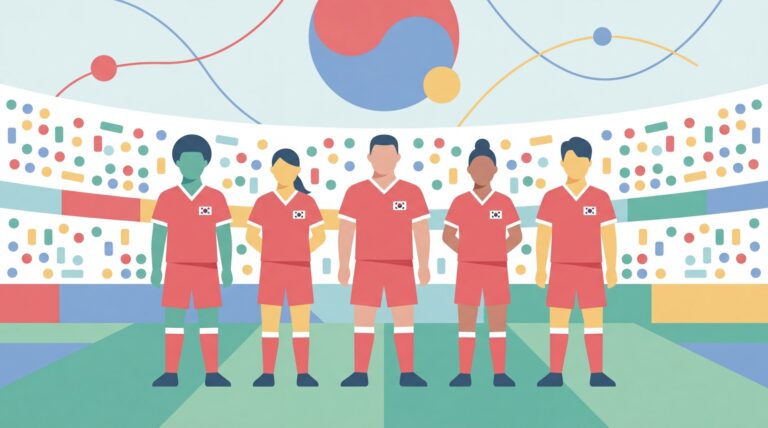
Phase 1: Empathy (Welcome to the Real Korea!)
Hello! I’m your lead editor at Daily Hangul.
Picture this: It’s a Friday night in Seoul. You’re crammed into a bustling fried chicken joint (치킨집) in Hongdae. The air smells of grease, spicy sauce, and cold draft beer. On the giant TV screen, the South Korean national basketball team is playing a crucial match. A player makes a spectacular dunk, and the crowd goes absolutely wild.
But here’s the catch—the player who just scored the winning points doesn’t look traditionally Korean.
Suddenly, the table next to you erupts into a debate. One guy shouts, “He’s wearing the Taegeuk mark! He’s our pride!” His friend shakes his head, “I don’t know, man. It still feels like we just hired a mercenary to win medals.”
If you’re studying Korean at a C2 level, you already know how to order food and understand K-Dramas. But do you understand the complex, shifting landscape of Korean identity? Today, we are diving deep into a topic that touches the very core of Korean society: Public sentiment regarding naturalized athletes on the national team (귀화 선수의 국가대표 발탁).
If you want to move beyond textbook pleasantries and engage in deep, intellectual conversations with Koreans about society, nationalism, and diversity, you need the vocabulary and the cultural intuition we’re about to cover. Let’s get started!
Phase 2: Core Expressions for Deep Societal Debates
To hold your own in a debate about national identity, you need high-level vocabulary. Here are the core expressions you must know.
1. 귀화 (Gwihwa)
- Pronunciation: [Gwi-hwa] — Imagine the “Gwi” sounding like “Gwee” (rhymes with ‘we’ with a G) and “hwa” like a soft breath out.
- Meaning: Naturalization (Literal: Becoming/Transforming into).
- K-Culture Moment: You’ll hear this constantly on the 9 PM News when a foreign athlete passes the rigorous ‘Special Naturalization’ (특별귀화) process just in time for the Olympics.
- Editor’s Insight: This isn’t just about getting a passport. In the context of sports, it carries a heavy expectation. If a gwihwa athlete underperforms, the public backlash is often much harsher than it is for native-born athletes.
- Situation Spectrum:
- Casual Friends: ✅
- News/Formal debates: ✅
- Everyday small talk: ⚠️ (A bit heavy for ordering coffee!)
- 🤔 Think About It: Why does Korea have a fast-track “Special Naturalization” for athletes who can win medals, while the path to citizenship for foreign factory workers who have lived in Korea for 10 years is incredibly difficult? What does this say about the value of “national prestige” (국위선양)?
2. 태극마크를 달다 (Taegeuk-makeureul dalda)
- Pronunciation: [Tae-geuk-ma-keu-reul dal-da]
- Meaning: To wear the Taegeuk mark (Literal) / To represent the national team (Real nuance).
- K-Culture Moment: The tear-jerking climax of any Korean sports documentary. The athlete crying, looking at the Korean flag (Taegeukgi) patched onto their chest.
- Editor’s Insight: You don’t just “join” the national team in Korea; you “bear the mark.” It implies carrying the weight, history, and expectations of 50 million people. When a naturalized athlete “wears the mark,” older generations often question if they truly understand its weight.
- Situation Spectrum:
- Sports commentary/News: ✅
- Passionate fan conversations: ✅
- Office emails: 🚫
- 🤔 Think About It: Does your language have a poetic phrase for joining the national team, or is it purely functional (e.g., “making the roster”)?
3. 순혈주의 (Sunhyeoljuui)
- Pronunciation: [Sun-hyeol-ju-ui] — ‘Sun’ (rhymes with ‘moon’), ‘hyeol’ (like ‘hyul’), ‘ju-ui’ (joo-ee).
- Meaning: Pureblood-ism / Ethno-nationalism.
- K-Culture Moment: This word is the elephant in the room. It rarely appears in upbeat K-Pop or romantic K-Dramas, but it dominates the socio-political comment sections on Naver and Daum.
- Editor’s Insight: Korea has long prided itself on being a 단일민족 (danilminjok – single ethnic nation). Sunhyeoljuui is the societal hurdle that naturalized athletes face. Even if they sing the national anthem perfectly, some people will always view them as outsiders because of this deep-rooted concept.
- Situation Spectrum:
- Academic discussions/Debates: ✅
- Deep talks over Soju: ✅
- Light conversation: 🚫 (It’s a heavy, critical term).
- 🤔 Think About It: How is a nation’s identity defined? Is it blood, shared culture, or shared civic values?
Phase 3: Textbook vs. Real Korean (The Comment Section Reality)
When debating sports and naturalization, textbooks teach you diplomacy. Real life teaches you raw emotion.
| Situation | 📖 Textbook Korean | 🗣️ Real Korean (Internet/Bars) | 💡 Why the difference? |
|---|---|---|---|
| Welcoming an athlete | 귀화 선수의 국가대표 발탁을 환영합니다. (I welcome the selection of the naturalized athlete.) | 실력만 좋으면 우리나라 선수지 뭐! (If they’re good, they’re our player!) | Koreans value extreme pragmatism in sports. Skill often overrides heritage for the younger generation. |
| Expressing doubt | 그 선수가 한국 문화에 적응할지 걱정됩니다. (I am worried if they will adapt to Korean culture.) | 용병이랑 다를 게 뭐야? (What’s the difference between them and a mercenary?) | ‘용병’ (mercenary) is a harsh but common slang term for foreign players perceived to be playing purely for money/medals, lacking patriotism. |
| National pride | 한국의 위상을 높여주기를 바랍니다. (I hope they elevate Korea’s status.) | 제발 국뽕 좀 채워주라! (Please fill me up with Gukppong!) | ‘국뽕’ (Gukppong: Nation + Heroin) is a C2-level slang for intoxicating national pride. It’s used humorously and seriously. |
Phase 4: Cultural Context — K-Culture Deep Dive
4-1. Non-verbal Cue: The National Anthem (애국가)
When a naturalized athlete stands on the podium, the Korean camera directors will always zoom in on their mouth. Why? The public is watching to see if the athlete has memorized the Korean national anthem (애국가 – Aegukga) and if they place their hand correctly over their heart. If a naturalized player sings it passionately, public sentiment (국민 정서) shifts positively overnight. It proves their Nunchi (눈치) and respect for the culture.
4-2. K-Culture Connection: Naver Sports Comments (The Real Arena)
While K-Dramas portray a beautifully polished Korea, the comment sections of Naver Sports are the raw, unfiltered pulse of society.
When a naturalized player is selected, you will see a generational clash in the comments:
* Boomers (50s+): Often express discomfort. “Can they really feel the spirit of Korea?” (한국의 정서를 알까?)
* MZ Generation (20s-30s): Highly pragmatic. “Who cares about blood? If they score goals and get us military exemptions/medals, they are 100% Korean!” (혈통이 밥 먹여주냐?)
* Critical View: Notice how acceptance is highly conditional. An athlete is fully accepted only as long as they are winning.
Phase 5: Real-life Roleplay Scenario
Setting: It’s the FIBA Asia Cup. You are at a sports pub in Itaewon with two Korean coworkers. The Korean national basketball team features a newly naturalized American-born player. The player just missed a crucial free throw.
Characters:
* YOU: A foreign expat working in Seoul, fluent in Korean.
* Manager Park (45): Traditional, slightly conservative.
* Ji-eun (28): Your peer, practical and progressive.
Dialogue:
Manager Park: 아유, 참! 저래서 귀화 선수는 안 된다니까. 절실함이 없어, 절실함이!
(A-yu, cham! Jeoraeseo gwihwa seonsuneun an doendanikka. Jeolsilhami eopseo, jeolsilhami!)
[English] Ugh! This is why naturalized players don’t work. They have no desperation, no desperation at all!
Ji-eun: 에이, 부장님. 그게 무슨 말씀이세요. 아까 10점이나 혼자 넣었잖아요.
(Ei, bujangnim. Geuge museun malsseumiseyo. Akka sip-jeomina honja neoeotjanhayo.)
[English] Come on, Manager. What are you saying? He scored 10 points all by himself earlier.
Manager Park: 아니, 실력을 떠나서… 태극마크의 무게를 아냐는 거지. 외국인 눈에는 어떻게 보여? ○○씨 생각은 어때?
(Ani, sillyeogeul tteonaseo… Taegeukmakeuui mugereul anyaneun geoji. Oegugin nuneneun eotteoke boyeo? OO-ssi saenggageun eottae?)
[English] No, apart from skill… I’m saying, does he know the weight of the Taegeuk mark? How does it look to a foreigner’s eyes? What do you think, OO?
🔀 Your Turn! How do you answer Manager Park?
- A) “부장님 말이 맞아요. 외국인은 한국을 이해 못 해요.” (Manager, you are right. Foreigners can’t understand Korea.)
- B) “무슨 소리예요? 시대가 어느 잰데 아직도 그런 순혈주의적인 생각을 하세요?” (What are you talking about? What era are we in that you still have such pureblood-centric thoughts?)
- C) “글쎄요, 저희 나라도 처음엔 이민자 출신 국가대표에 대해 논란이 많았어요. 근데 결국 융화되더라고요. 시간이 필요한 것 같아요.”
✅ Best Choice: C
Why? As an advanced C2 speaker, you know how to navigate Korean workplace hierarchy (눈치) while expressing a profound intellectual point. Choice C validates the difficulty of the transition, draws on your global perspective, and gently suggests progress without directly attacking the older manager’s pride.
⚠️ Choice B Analysis: While grammatically perfect and perhaps morally right to some, directly accusing a superior of “순혈주의” (ethno-nationalism) at a pub will instantly kill the mood (갑분싸 – sudden chill) and damage your relationship.
Phase 6: 10-Second Shadowing Drill
Let’s practice a smooth, native-like response to use in these debates. Pay attention to the pauses!
😤 Firmly, but reasonably:
솔직히 / 실력만 좋으면 / 국적은 상관없다고 / 생각해요.
(Soljiki / sillyeongman joeumyeon / gukjeogeun sanggwaneoptdago / saenggakaeyo.)
“Honestly, if their skills are good, I don’t think nationality matters.”
Phase 7: K-Culture Mini Dictionary (Sports Nationalism Edition)
| 한국어 (Korean) | Romanization | English | Cultural Context |
|---|---|---|---|
| 단일민족 | danilminjok | Single ethnic group | The historical belief that all Koreans share one bloodline. A core component of traditional Korean identity. |
| 용병 | yongbyeong | Mercenary | Originally meaning hired soldiers, used in sports for foreign players in domestic leagues. Often carries a negative nuance of “only here for the money.” |
| 국뽕 | gukppong | Extreme national pride | A slang portmanteau of 국가 (Nation) + 히로뽕 (Philopon/Meth). Refers to being “intoxicated” with national pride. Can be used mockingly or affectionately. |
| 혼혈 | honhyeol | Mixed-race | Literally “mixed blood.” While becoming more accepted, it still carries historical stigma compared to the more politically correct ‘다문화’ (multicultural). |
Phase 8: Traveler Survival Kit (Sports Pub Edition)
Even if you’re just visiting Korea, watching a sports match at a pub or stadium is a must-do cultural experience. Here are your survival phrases!
🆘 Survival Expressions for Game Night
– 🇰🇷 “한국 팀 응원석이 어디예요?” (Hanguk tim ungwonseogi eodiyeyo?)
– 🗣️ English: Where is the cheering section for the Korean team?
– 📍 Where to use: At a soccer/baseball stadium ticket booth or inside the venue.
- 🇰🇷 “생맥주 500 두 잔 주세요!” (Saengmaekju obaek du jan juseyo!)
- 🗣️ English: Two 500cc draft beers, please!
- 📍 Where to use: Fried chicken joints (치킨집) or sports pubs.
📌 Editor’s Travel Note
– Dress Code: If the national soccer team is playing, wear RED. Korea’s cheering squad is the “Red Devils” (붉은 악마). You will instantly make 50 friends if you wear red in a pub.
– Baseball Culture: Korean domestic baseball is famous for its player-specific cheer songs (응원가). It’s essentially a giant outdoor karaoke session!
Phase 9: Critical Thinking Corner — “One Step Deeper”
Language & Power: Who gets to be “Us” (우리)?
In Korean, the concept of “Us” (우리 – Uri) is incredibly powerful. Koreans don’t say “my country” (내 나라); they say “our country” (우리나라). They don’t say “my mom” (내 엄마); they say “our mom” (우리 엄마).
But as Korea rapidly ages and relies more on immigration, the linguistic boundary of “우리” is being tested. When a naturalized athlete misses a goal, malicious comments often drop the “우리” and revert to calling them “그 외국인” (that foreigner). The language itself reveals who is truly considered part of the in-group and who is merely conditionally accepted. As a learner, observing when Koreans use “우리” with you is the ultimate indicator of your social integration.
💬 Your Turn: Does your language have a word that instantly divides people into “us” versus “them”? How does your country treat naturalized athletes when they win versus when they lose? Share in the comments!
Phase 10: FAQ & Avoiding Mistakes
Q: Can I ask a Korean friend if they believe in “pureblood” (순혈주의)?
A: Yes, but tread carefully. Among the younger MZ generation, asking about sunhyeoljuui is a great academic conversation starter. However, don’t accuse someone of having it. Frame it generally: “한국 사회는 아직 순혈주의가 강한 편인가요?” (Is pureblood-ism still strong in Korean society?)
Q: Is ‘외국인 선수’ (Foreign Player) the same as ‘귀화 선수’ (Naturalized Player)?
A: No! This is a massive mistake.
❌ Common Mistake #1: Calling a naturalized national team member a “외국인 선수”.
✅ Do this instead: Once they get the passport, they are a ‘귀화 선수’ or simply a ‘한국 선수’. Calling them a foreigner after they’ve sworn allegiance to Korea can be seen as highly offensive to their fans and dismissive of their citizenship.
Phase 11: Summary & Action Items
One-Liner Summary: The debate over naturalized athletes in Korea is a tug-of-war between extreme pragmatism for winning and deeply rooted ethno-nationalism (순혈주의).
Action Mission 3 Steps:
– 🥉 Bronze: Say today’s shadowing sentence out loud 3 times. Feel the rhythm of the debate!
– 🥈 Silver: Go to a Korean news site (Naver/Daum Sports) and search for “귀화 선수”. Read the headlines and try to spot words from our dictionary.
– 🥇 Gold: Next time you watch a sports game with a Korean friend, casually drop: “한국은 귀화 선수에 대해 어떻게 생각해요?” (What does Korea think about naturalized athletes?)
K-Culture Mission: Find a documentary clip on YouTube about Ra Gun-ah (Ricardo Ratliffe), a famous naturalized basketball player for Korea. Observe the comments and see if you can spot the word “국위선양” (enhancing national prestige).
Phase 12: Quiz — Interactive Challenge
1. Situational Judgment: You are watching the Olympics with your Korean boss. A naturalized athlete wins Gold. What is the safest, most polite C2-level response?
* A) 국뽕이 차오르네요! (I’m full of Gukppong!)
* B) 와, 대박. 용병 최고! (Wow, jackpot. Mercenary is the best!)
* C) 귀화 선수라도 국위선양을 하니 정말 자랑스럽습니다. (Even as a naturalized athlete, I am so proud they are enhancing national prestige.)
2. True or False — K-Culture Edition:
* Koreans will generally accept a naturalized athlete much faster if they are seen crying during the Korean National Anthem. (T/F)
(Click below to see the answers)
Answers
1. C is the correct answer. It uses advanced, formal vocabulary (국위선양) appropriate for a boss. ‘A’ is too slangy for a boss, and ‘B’ uses ‘용병’, which is insulting.
2. True. Nunchi and visible displays of patriotism (like respecting the anthem/flag) rapidly accelerate public acceptance in Korea.
Frequently Asked Questions (FAQ)
Q: What does "귀화 (Gwihwa)" mean in Korean and how do you pronounce it?
A: In Korean, "귀화 (Gwihwa)" is pronounced [Gwi-hwa] and means: Naturalization (Literal: Becoming/Transforming into).
Q: What does "태극마크를 달다 (Taegeuk-makeureul dalda)" mean in Korean and how do you pronounce it?
A: In Korean, "태극마크를 달다 (Taegeuk-makeureul dalda)" is pronounced [Tae-geuk-ma-keu-reul dal-da] and means: To wear the Taegeuk mark (Literal) / To represent the national team (Real nuance).
Q: What does "순혈주의 (Sunhyeoljuui)" mean in Korean and how do you pronounce it?
A: In Korean, "순혈주의 (Sunhyeoljuui)" is pronounced [Sun-hyeol-ju-ui] and means: Pureblood-ism / Ethno-nationalism.







