

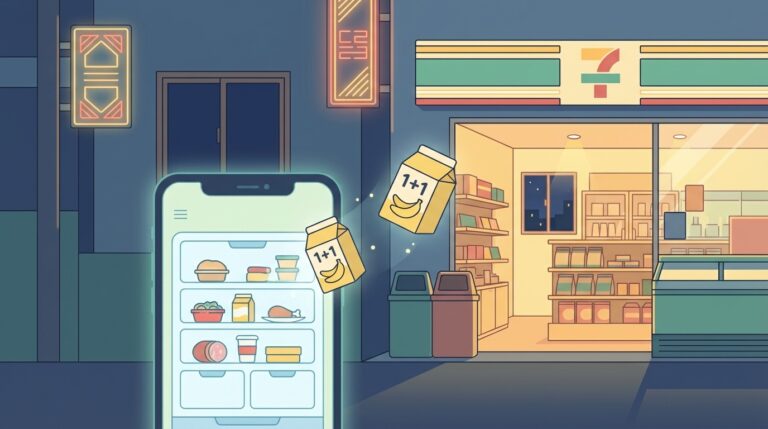
Phase 1: The ‘Main Character’ Convenience Store Moment
Hello there! I’m your Daily Hangul Editor.
You’ve probably seen this scene in countless K-Dramas: The protagonist, fresh off a stressful day, walks into a brightly lit convenience store (편의점). They grab three sausages because of a “2+1” sign, pay, but only eat one at the window seat while sighing deeply.
Wait a minute. What happened to the other two? Did they just leave them there? Did the cashier take them?
Nope. Welcome to the magic of the hyper-digitized Korean convenience store ecosystem. In Korea, if you buy a “1+1” or “2+1” promotional item but don’t want to carry or consume the extra ones immediately, you don’t have to give them up. You can literally store them in the cloud using the convenience store’s mobile app (famously known as GS25’s “나만의 냉장고” or “My Fridge”).
At a C2 (Advanced) level, you already know how to buy things. But mastering the “My Fridge” storage system? That transitions you from a mere expat to a verified, savvy local. Let’s dive into the language that unlocks this ultimate K-convenience hack.
Phase 2: Core Expressions Deep Dive
Here are the essential phrases you need to sound like a local when saving your promotional items.
1. 이거 하나는 어플에 보관할게요.
- Pronunciation: igeo hananeun eopeure bogwanhalgeyo. [ee-geo ha-na-neun uh-peul-eh bo-gwan-hal-ge-yo]
- Meaning: I’ll store this one in the app. (Literal: As for this one, I will store it in the application.)
- K-Culture Moment: Picture a cramped GS25 in Gangnam. You’re buying a 1+1 iced Americano pouch but only have one cup of ice. You confidently scan your barcode and say this. The part-timer gives you a nod of respect.
- Editor’s Insight: “어플” (app) is the localized pronunciation of “application.” Koreans rarely say “앱” (app) in casual spoken Korean; “어플” feels much more natural.
- Situation Spectrum:
- Convenience store staff (Casual/Polite): ✅
- Formal business settings: 🚫 (You wouldn’t use this outside of retail/app contexts!)
- 🤔 Think About It: Why is “보관하다” (to store/keep) used here instead of “저장하다” (to save)? In Korean, 저장하다 is mostly for digital files (saving a document), while 보관하다 implies keeping a physical object safe for later retrieval.
2. 나머지 킵(keep)해 주세요.
- Pronunciation: nameoji kip-hae juseyo. [nah-muh-ji keep-hae ju-se-yo]
- Meaning: Please keep the rest for me.
- K-Culture Moment: You are in a rush. The subway is coming in 3 minutes. You slap the 2+1 items on the counter, show your app barcode, and drop this line. It’s fast, efficient, and peak bbali-bbali (빨리빨리) culture.
- Editor’s Insight: Yes, it’s Konglish! Adding “~하다” (to do) to English verbs is a common way to create new verbs in Korean. “킵하다” is universally understood in retail and bar settings (like keeping a bottle of whiskey).
- Situation Spectrum:
- Convenience store staff (Casual/Polite): ✅
- Semi-formal: ⚠️ (A bit slangy, but totally acceptable in retail)
- 🤔 Think About It: English loanwords often fill the “efficiency gap” in Korean. “킵하다” is shorter than “보관해 주세요.” Does your native language borrow English words purely for speed?
3. 나중에 다른 지점에서 교환할게요.
- Pronunciation: najunge dareun jijome-seo gyohwanhalgeyo. [na-joong-eh da-reun ji-jum-eh-suh gyo-hwan-hal-ge-yo]
- Meaning: I’ll exchange (redeem) it at another branch later.
- K-Culture Moment: The true beauty of this system! You store a banana milk in Seoul and redeem it from your app at a branch in Busan during your weekend trip.
- Editor’s Insight: “교환하다” literally means “to exchange,” but in this context, it means redeeming the digital voucher for the physical product.
Phase 3: Textbook vs. Real Korean
| Situation | 📖 Textbook Korean | 🗣️ Real Korean | 💡 Why the difference? |
|---|---|---|---|
| Storing the extra item | 하나는 나중에 가져가겠습니다. (I will take one later.) | 하나는 어플에 넣어주세요. (Please put one in the app.) | “넣어주세요” (put it in) visualizes the app as a literal fridge space. |
| Asking if you can store it | 남은 물건을 보관할 수 있습니까? (Is it possible to store the remaining items?) | 이거 킵 되나요? (Can I keep this?) | Retail Korean prioritizes absolute brevity. |
| Redeeming the item | 저장된 증정품을 받으러 왔습니다. (I came to receive the saved promotional item.) | 어플 바코드 찍어주세요. (Please scan the app barcode.) | Locals just present the barcode; no lengthy explanation is needed. |
Bottom Note: At a C2 level, you want to strip away the clunky textbook grammar. Using “킵 되나요?” shows you understand the rhythm of everyday Korean commerce.
Phase 4: Cultural Context — K-Culture Deep Dive
4-1. The Non-Verbal “Nunchi” at the Counter
In Korea, the convenience store checkout is a high-speed dance. True nunchi (눈치) means having your phone unlocked, the convenience store app opened, and the barcode brightly displayed before the cashier even finishes scanning your physical items. Fumbling for your app while a line forms behind you? That’s a major faux pas in the land of bbali-bbali.
4-2. The Convenience Store as an Extension of the Home (혼족 Culture)
Why did this “My Fridge” system even become a thing? It perfectly reflects Korea’s demographic shift towards single-person households (혼족 – hon-jok).
If you live in a tiny studio apartment (원룸) in Seoul, your actual fridge is probably the size of a microwave. You don’t have space to hoard 2+1 deals. Thus, the corporate convenience store network essentially acts as a decentralized pantry for millions of young Koreans. When you watch K-Dramas and see characters constantly eating at the convenience store, it’s not just product placement; for many, the store is their dining room and storage unit.
Phase 5: Real-Life Roleplay Scenario
Setting: Friday night, 11:30 PM. You just survived a heavy company dinner (회식 – hoesik) in Jongno. You and your favorite Korean coworker duck into a CU convenience store to buy hangover drinks (숙취해소제 – Condition or Dawn 808), which are almost always 2+1.
Characters:
– YOU: An expat professional. Your stomach is full of Samgyeopsal and Soju.
– Ji-hoon (지훈): Your 30-something Korean coworker, slightly tipsy and holding three bottles of hangover drinks.
– Cashier (알바생): A tired university student working the night shift.
Dialogue:
지훈: 대리님, 이거 2+1이니까 제가 두 병 마실게요. 하나 드세요.
(daerinim, igeo 2+1inikka jaega du byeong masilgeyo. hana deuseyo.)
(Assistant Manager, these are 2+1 so I’ll drink two. You have one.)
YOU: 어휴, 지훈 씨. 저도 배불러서 지금 못 마셔요.
(eohyu, ji-hoon ssi. jeodo baebulleoseo jigeum mot masyeoyo.)
(Phew, Ji-hoon. I’m too full to drink it right now either.)
지훈: 아, 그럼 이거 하나는 어떡하죠? 그냥 두고 갈까요?
(ah, geureom igeo hananeun eotteokhajo? geunyang dugo galkkayo?)
(Ah, then what do we do with this one? Should we just leave it?)
🔀 Your Turn! How do you handle the 2+1 situation like a pro?
– A) “알바생 주면 좋아할 거예요.” (The part-timer will like it if we give it to them.)
– B) “제 어플에 킵할게요. 내일 아침에 마셔야겠어요.” (I’ll keep it in my app. I’ll need to drink it tomorrow morning.)
– C) “환불해 주세요.” (Please refund it.)✅ Best Choice: B — You show off your ultimate local knowledge!
⚠️ Choice A Analysis: While friendly, some cashiers might feel burdened or aren’t allowed to consume items on shift.
⚠️ Choice C Analysis: You can’t partial-refund a promotional deal.
(Continuing with Choice B)
YOU: (Turning to the cashier) 이거 두 개만 결제하고, 하나는 어플에 넣어주세요.
(igeo du gaeman gyeolje-hago, hananeun eopeure neoeojuseyo.)
(I’ll just pay for these two, and please put the remaining one in the app.)
알바생: 네, 포인트 적립 바코드 먼저 보여주시겠어요?
(ne, pointeu jeongnip bakodeu meonjeo boyeojusigesseoyo?)
(Yes, could you show me your point accumulation barcode first?)
(🎭 Stage Direction: You swiftly present your phone screen.)
지훈: 와, 대리님… 완전 한국 사람 다 되셨네요!
(wa, daerinim… wanjeon hanguk saram da doesyeonneyo!)
(Wow, Assistant Manager… you’ve become completely Korean!)
Phase 6: 10-Second Shadowing Drill
Let’s perfect the rhythm! Follow the intonation (/) and the emotion tags.
😊 결제해 주시고요, / 나머지 하나는 / 어플에 킵할게요!
(gyeoljehae jusigoyo, / nameoji hananeun / eopeure kipalgeyo!)
Translation: Please process the payment, and I’ll keep the remaining one in the app!
Pro-tip: Don’t pause between “어플에” and “킵할게요.” It should flow like one word: eopeure-kipalgeyo.
Phase 7: K-Culture Mini Dictionary
| 한국어 | Romanization | English | Cultural Context |
|---|---|---|---|
| 1+1 (원플러스원) | won-peulleoseu-won | Buy One Get One Free | Never say “One plus one” with English phonetics. It’s “won-peul-leo-seu-won.” There’s also 2+1 (투플러스원). |
| 증정품 | jeungjeongpum | Promotional/Gift item | The official term for the free item you get in a 1+1 deal. |
| 알바생 | albasang | Part-time worker | Derived from the German “Arbeit.” The backbone of the Korean retail industry. |
| 나만의 냉장고 | namanui naengjanggo | My Fridge | The iconic GS25 app feature that started the digital storage revolution. |
| 혼족 | hon-jok | Single-person household | A demographic shaping modern K-economy, making single-serving deals highly popular. |
Phase 8: Traveler’s Survival Kit
Even if you don’t have a Korean phone number to set up the “My Fridge” app, you will encounter this situation. Cashiers will constantly ask you if you want to store items or earn points.
🆘 Survival Expression #1: Declining politely
– 🇰🇷 “어플 없어요. 그냥 다 가져갈게요.” (eopeul eopsseoyo. geunyang da gajyeogalgeyo.)
– 🗣️ Meaning: I don’t have the app. I’ll just take them all.
– 📍 Where to use: Any convenience store when asked “적립하시겠어요?” (Would you like to earn points/store this?)🆘 Survival Expression #2: Clarifying the deal
– 🇰🇷 “이거 교차 증정 되나요?” (igeo gyocha jeungjeong doenayo?)
– 🗣️ Meaning: Can I mix and match for the free item?
– 📍 Where to use: When you want to buy 2+1 ice creams but want different flavors!📌 Editor’s Travel Note
– App Requirements: To use apps like GS25 (우딜/우리동네GS), CU (포켓CU), or 7-Eleven, you generally need an ARC (Alien Registration Card) and a registered Korean phone number for identity verification.
– Pro-Tip for Tourists: If you can’t use the app, and you really can’t carry the +1 item, it is entirely acceptable to hand it to the next person in line or say “증정품은 안 받을게요” (I won’t take the promotional item).
Phase 9: Critical Thinking — “One Step Deeper”
Language & Power / Hyper-Efficiency in Modern Korea
🧠 Think Deeper:
The convenience store storage system is a fascinating microcosm of modern Korean society. It merges the Korean obsession with Jeong (정 – the warmth of giving extra, seen in 1+1 deals) with extreme digital efficiency. However, linguistically, notice how transactional the language is. Phrases like “어플에 넣어주세요” strip away the excessive politeness usually required in Korean formal interactions. In the convenience store, efficiency is politeness. Prolonging the interaction with beautiful, formal textbook Korean is actually seen as inconsiderate to the cashier and the people waiting behind you. The most polite thing you can do is be fast.💬 Your Turn: Does your country have a retail system that perfectly reflects its cultural values (like efficiency, politeness, or saving space)? Let me know in the comments!
Phase 10: FAQ & Avoiding Mistakes
Q: “Can I use ‘킵할게요 (I’ll keep it)’ with my boss at work?”
A: No! 🚫 While “keep” is widely used in retail and bars, if your boss asks you what to do with extra office supplies, you should say “보관하겠습니다” (I will store them). Using Konglish slang with senior management sounds unprofessional.
Q: “Do I have to redeem the item at the exact same store?”
A: Usually, no. The beauty of the app is that it’s a nationwide network. You can store a water bottle in Seoul and claim it in Jeju Island, provided the Jeju branch has that specific item in stock.
❌ Common Mistake: Trying to scan the “storage barcode” after you have already paid with your credit card.
✅ Do this instead: Present your app barcode before or at the exact same time you hand over your credit card. The POS system needs to register the app request during the transaction, not after the receipt is printed!
Phase 11: Summary & Action Items
One-Liner Summary: Ditch the textbook and use “어플에 넣어주세요” or “킵할게요” to digitally store your 1+1 convenience store items like a true Seoulite.
Your Missions:
– 🥉 Bronze (Solo): Say “이거 하나는 어플에 보관할게요” out loud 3 times in front of the mirror, aiming for zero hesitation.
– 🥈 Silver (Online): Find a YouTube vlog of someone living in Korea (searching “편의점 털기” or “나만의 냉장고”) and spot the exact moment they scan their app.
– 🥇 Gold (Real World): If you are in Korea, download the ‘우리동네GS’ or ‘포켓CU’ app, set it up, and successfully ‘keep’ an item tonight!
K-Culture Mission: The next time you watch a K-Drama where characters drink outside a convenience store, look closely at their table. Are they drinking a 2+1 item? Did they leave one behind? Now you know the secret behind the scenes!
Phase 12: Interactive Quiz
1. Situational Judgment: You are buying three 2+1 milk cartons. You only want to carry two home. What is the most natural thing to say to the cashier while showing your phone?
– A) 남은 하나는 영원히 제 어플리케이션에 저장해주시겠습니까?
– B) 나머지 하나는 킵할게요.
– C) 알바생님, 하나 가지세요.
💡 Click for the answer
Answer: B. It’s the most natural, efficient, and locally used phrase. A is awkwardly formal and sounds like a robot from the 19th century. C is a nice thought, but B is what you actually say to use the app system.
2. True or False – K-Culture Edition: In Korea, you must always redeem your app-stored convenience store item at the exact same branch where you originally bought it.
💡 Click for the answer
Answer: False. You can redeem it at almost any branch of that franchise across the country, as long as they have the item in stock. That’s the magic of the cloud fridge!
Frequently Asked Questions (FAQ)
Q: What does "이거 하나는 어플에 보관할게요." mean in Korean and how do you pronounce it?
A: In Korean, "이거 하나는 어플에 보관할게요." is pronounced [igeo hananeun eopeure bogwanhalgeyo. [ee-geo ha-na-neun uh-peul-eh bo-gwan-hal-ge-yo] and means: I'll store this one in the app. (Literal: As for this one, I will store it in the application.)
Q: What does "나머지 킵(keep)해 주세요." mean in Korean and how do you pronounce it?
A: In Korean, "나머지 킵(keep)해 주세요." is pronounced [nameoji kip-hae juseyo. [nah-muh-ji keep-hae ju-se-yo] and means: Please keep the rest for me.
Q: What does "나중에 다른 지점에서 교환할게요." mean in Korean and how do you pronounce it?
A: In Korean, "나중에 다른 지점에서 교환할게요." is pronounced [najunge dareun jijome-seo gyohwanhalgeyo. [na-joong-eh da-reun ji-jum-eh-suh gyo-hwan-hal-ge-yo] and means: I'll exchange (redeem) it at another branch later.






