

Phase 1: Empathy (The K-Drama Autumn Fantasy)
Hello! This is your Daily Hangul Editor.
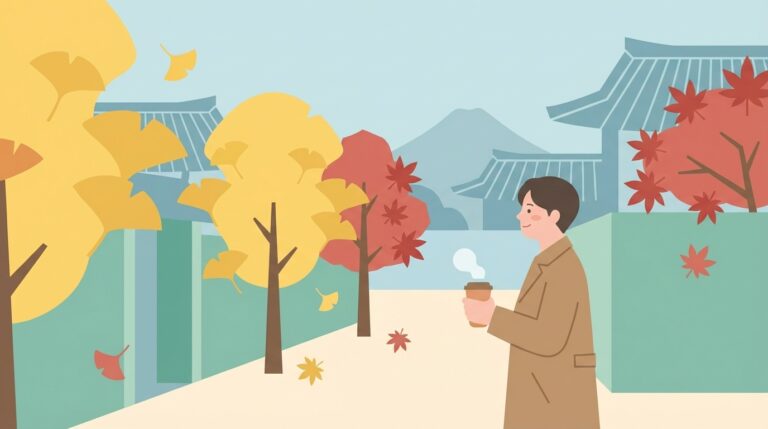
Imagine this: You’re walking down a beautiful, tree-lined street in Seoul. The air is crisp, and the leaves are a stunning mix of crimson and gold. It feels exactly like that iconic scene from the K-Drama Goblin (도깨비), where Gong Yoo catches a falling maple leaf. You want to turn to your Korean friend and express how breathtaking the trees look.
But then… your brain freezes. “Tree… is 나무 (namu). Red is… 빨간 (ppalgan). Wow, red tree!”
You say it out loud, and your friend giggles. It’s not wrong, but it completely breaks that cinematic, romantic vibe!
If you want to sound like a true local and not just a textbook-reading tourist, you need to know how Koreans actually talk about the changing seasons. This guide is based on real questions from intermediate (B1) students who wanted to upgrade their “weather small talk.” Let’s dive in and make your Korean sound as beautiful as the autumn leaves!
Phase 2: Core Expressions Deep Dive
1. 가을 단풍이 예쁘게 들었어요.
- Pronunciation: ga-eul dan-pung-i ye-ppeu-ge deu-reos-seo-yo. (‘eu’ sounds like the disgusted ‘ugh’ sound you make when stepping in gum)
- Meaning: (Literal) Autumn foliage has beautifully entered. / (Real Nuance) The autumn leaves have changed colors beautifully.
- K-Culture Moment: You’ll hear this non-stop on Korean news weather forecasts or when coworkers make small talk while waiting for the elevator in October.
- Editor’s Insight: Notice the verb 들다 (to enter/to seep into). Koreans don’t say the leaves “changed” (바뀌다). We say the color has “seeped into” the leaves naturally. It’s a very poetic way of looking at nature!
- Situation Spectrum:
- Close friends (Casual): ✅ (단풍 예쁘게 들었다!)
- Coworkers (Semi-formal): ✅
- Boss/Elders (Formal): ✅
- 🤔 Think About It: Why does Korean use passive-like, nature-focused verbs like ‘들다’ for weather, instead of active verbs? Does your native language treat nature as an active agent or a passive object?
2. 주말에 단풍놀이 갈래요?
- Pronunciation: ju-ma-re dan-pung-no-ri gal-lae-yo?
- Meaning: (Literal) Do you want to go autumn foliage playing on the weekend? / (Real Nuance) Shall we go see the autumn leaves this weekend?
- K-Culture Moment: This is the ultimate autumn date or family outing proposal! From Seoraksan Mountain to local parks, Koreans treat leaf-viewing as a national event.
- Editor’s Insight: 놀이 means ‘play’ or ‘game’. We attach it to seasonal events, like 벚꽃놀이 (cherry blossom viewing) or 뱃놀이 (boating). It shows that viewing nature isn’t just looking—it’s an activity, a festival!
- Situation Spectrum:
- Close friends (Casual): ✅ (단풍놀이 갈래?)
- Coworkers (Semi-formal): ⚠️ (Usually reserved for closer work friends)
- Boss/Elders (Formal): 🚫 (Too casual to ask a boss)
- 🤔 Think About It: Koreans love turning nature viewing into a group activity. How do people in your culture celebrate changing seasons?
3. 아침저녁으로 제법 쌀쌀하네요.
- Pronunciation: a-chim-jeo-nyeo-geu-ro je-beop ssal-ssal-ha-ne-yo. (For ‘ss’, tense your tongue against your teeth like a hissing snake)
- Meaning: (Literal) Morning and evening it’s quite chilly. / (Real Nuance) It gets pretty chilly in the mornings and evenings.
- K-Culture Moment: When a K-Pop idol writes a fan café post in October, it ALWAYS starts with: “우리 팬들, 날씨가 쌀쌀해졌으니 감기 조심하세요!” (Our fans, it’s gotten chilly so be careful not to catch a cold!)
- Editor’s Insight: 쌀쌀하다 is that specific “crisp, chilly, need-a-cardigan” feeling. It’s not fully “cold” (춥다) yet. Mastering the difference between 쌀쌀하다 and 춥다 is the hallmark of a B1 speaker!
- Situation Spectrum:
- Close friends (Casual): ✅ (제법 쌀쌀하네.)
- Coworkers (Semi-formal): ✅
- Boss/Elders (Formal): ✅
- 🤔 Think About It: Mentioning the weather and health (catching a cold) is a standard Korean greeting. Why is showing concern for someone’s physical health considered a polite greeting in Korea?
Phase 3: Textbook vs. Real Korean
| Situation | 📖 Textbook Korean | 🗣️ Real Korean | 💡 Why is it different? |
|---|---|---|---|
| Seeing a bright red tree | 나뭇잎이 빨갛습니다. (The leaves are red.) | 와, 단풍 미쳤다! (Wow, the foliage is crazy!) | Koreans use “미쳤다” (crazy) casually to express extreme awe or perfection. |
| Feeling the cool breeze | 바람이 차갑습니다. (The wind is cold.) | 날씨 완전 가을가을하네~ (The weather is totally autumn-autumn~) | Repeating a noun like an adjective (가을가을하다) is a trendy, cute way to express a seasonal vibe. |
| Asking a friend out | 가을 산책을 합시다. (Let’s do an autumn walk.) | 단풍 구경 가자! (Let’s go foliage sightseeing!) | ‘구경’ (sightseeing/looking around) is a heavily used word in daily life for any casual observation. |
Bottom Note: While “미쳤다” is fun and very native-like, be careful to only use it with close friends! B1 learners should stick to “정말 예쁘네요!” around older people.
Phase 4: Cultural Context — K-Culture Deep Dive
4-1. Non-Verbal Nunchi (눈치) in Autumn
When you go ‘단풍놀이’ (foliage viewing), taking pictures is 90% of the activity. If you see a couple struggling to take a selfie with the trees, using your Nunchi to step in and say, “찍어드릴까요?” (Shall I take a picture for you?) will instantly make you a local hero. Also, expect them to take 20 photos of you in return from various dramatic angles!
4-2. The K-Drama Connection: The Deoksugung Stonewall Myth
If you’re talking about autumn leaves in Seoul, you can’t ignore the Deoksugung Palace Stonewall Walkway (덕수궁 돌담길). It’s famous for its stunning ginkgo trees and yellow leaves. However, there’s a famous Korean urban legend: “If a couple walks down this path together, they will break up.”
Why? Historically, the Family Court (where couples got divorced) was located at the end of this street! Nowadays, K-Dramas often use this location for romantic (but melancholic) autumn encounters. If you mention this myth to a Korean friend while looking at the yellow leaves, they will be incredibly impressed by your cultural knowledge!
Phase 5: Real-life Roleplay Scenario
Setting: Saturday afternoon, 2 PM. You are sitting by the window in a cozy, aesthetic café in Samcheong-dong. Outside, the yellow ginkgo leaves are falling softly.
Characters:
– YOU: An exchange student who has been studying Korean for a year.
– Minji (28): Your Korean language exchange partner. Energetic and loves taking photos.
Minji: 와, 창밖 좀 봐요. 단풍이 진짜 예쁘게 들었네요! 🍁
(Wa, chang-bak jom bwa-yo. dan-pung-i jin-jja ye-ppeu-ge deu-reot-ne-yo!)
[Wow, look out the window. The autumn leaves have turned so beautifully!]
(🎭 Stage Direction: Minji pulls out her smartphone and snaps a quick photo of the window)
YOU: 맞아요. 길거리가 완전 노란색이에요.
(Ma-ja-yo. gil-geo-ri-ga wan-jeon no-ran-sae-gi-e-yo.)
[You’re right. The street is completely yellow.]
Minji: 그쵸? 아, 우리 커피 다 마시고 단풍놀이 겸 산책 좀 할까요?
(Geu-chyo? A, u-ri keo-pi da ma-si-go dan-pung-no-ri gyeom san-chaek jom hal-kka-yo?)
[Right? Oh, after we finish our coffee, shall we go for a walk to enjoy the foliage?]
YOU: 좋아요! 덕수궁 돌담길 어때요?
(Jo-a-yo! deok-su-gung dol-dam-gil eo-ttae-yo?)
[Sounds good! How about the Deoksugung Stonewall Walkway?]
Minji: 헉! 거기 연인끼리 걸으면 헤어진다는 전설 있는 거 알아요? 우리 사귀는 사이도 아닌데 뭐 어때요! 가요! 😆
(Heok! geo-gi yeon-in-kki-ri geo-reu-myeon he-eo-jin-da-neun jeon-seol it-neun geo a-ra-yo? U-ri sa-gwi-neun sa-i-do a-nin-de mwo eo-ttae-yo! Ga-yo!)
[Gasp! Do you know the legend that couples who walk there break up? We aren’t even dating, so who cares! Let’s go!]
YOU: 하하, 저도 그 얘기 들었어요.
(Ha-ha, jeo-do geu yae-gi deu-reos-seo-yo.)
[Haha, I heard that story too.]
Minji: 아, 근데 밖에 바람 부니까 좀 쌀쌀하네요. 겉옷 챙겨왔어요?
(A, geun-de ba-kke ba-ram bu-ni-kka jom ssal-ssal-ha-ne-yo. geo-dot chaeng-gyeo-wa-sseo-yo?)
[Ah, but it’s a bit chilly because the wind is blowing outside. Did you bring an outer jacket?]
🔀 Your Turn! How should you respond?
– A) 네, 챙겼어요. (Yes, I brought it.)
– B) 아니요, 추워요. 안 갈래요. (No, it’s cold. I don’t want to go.)
– C) 깜빡했어요. 제법 쌀쌀하니까 따뜻한 거 하나 테이크아웃 해서 갈까요?✅ Best Choice: C — Reason: Option A is grammatically correct but a bit dry. Option C (“I forgot. It’s quite chilly, so should we get something warm to-go?”) uses the B1 keyword “쌀쌀하다” naturally and suggests a cultural norm (holding a hot drink while walking in the cold).
⚠️ Choice B Analysis: Directly refusing a fun outing just because it’s cold can sound a bit abrupt and kill the mood.
Phase 6: 10-Second Shadowing Drill
Practice this sentence focusing on the intonation and pauses. Imagine you are staring at a breathtaking mountain full of red and orange trees!
😲 우와, / 단풍이 / 정~~~말 / 예쁘게 들었어요!
(u-wa, / dan-pung-i / jeong~~~mal / ye-ppeu-ge deu-reos-seo-yo!)
Tip: Stretch the ‘정’ in ‘정말’ to emphasize your amazement. Make your voice go slightly higher at the end to sound cheerful!
Phase 7: K-Culture Mini Dictionary
| Korean | Romanization | English | Cultural Context |
|---|---|---|---|
| 단풍 | dan-pung | Autumn foliage | Specifically refers to leaves changing colors, mostly maples. |
| 은행나무 | eun-haeng-na-mu | Ginkgo tree | The yellow trees lining Seoul’s streets. Beautiful, but the fallen berries smell terrible! |
| 가을 타다 | ga-eul ta-da | To feel sentimental in autumn | A common phrase meaning the autumn atmosphere makes you feel lonely or reflective. |
| 일교차 | il-gyo-cha | Daily temperature range | You’ll hear “일교차가 큽니다” on every news broadcast in autumn. Layer your clothes! |
| 인생샷 | in-saeng-syat | Shot of a lifetime | The ultimate goal of 단풍놀이. Getting that perfect, Instagram-worthy photo. |
Phase 8: Traveler’s Survival Kit
If you are visiting Korea during autumn (September-November), these survival phrases are lifesavers when you’re out exploring palaces or national parks.
🆘 Survival Phrase #1: Asking for a photo
– 🇰🇷 “사진 한 장만 찍어주시겠어요?”
– 🗣️ (sa-jin han jang-man jji-geo-ju-si-get-seo-yo?)
– 📍 Where to use: Palaces (Gyeongbokgung), Namsan Tower, Parks.
– 💡 Pro Tip: Hand them your phone with the camera app already open. Don’t be surprised if they start directing your poses!🆘 Survival Phrase #2: Surviving the chilly wind
– 🇰🇷 “따뜻한 음료수 있어요?”
– 🗣️ (tta-tteu-tan eum-nyo-su i-sseo-yo?)
– 📍 Where to use: Convenience stores, Cafes.
– 💡 Pro Tip: Inside Korean convenience stores (CU, GS25), look for the heated glass cabinet (온장고). It holds hot canned coffees, teas, and soy milks!📌 Editor’s Travel Note
– Best Apps: Naver Map or KakaoMap. Google Maps doesn’t work well for walking directions in Korea!
– Clothing: The “일교차” (temperature difference between day and night) in autumn is huge. Wear layers! A trench coat or a light cardigan is the unofficial Korean autumn uniform.
Phase 9: Critical Thinking Corner — “A Step Deeper”
Media vs Reality: The Fleeting Illusion of Korean Autumn
🧠 Think Deeper:
If you watch K-Dramas, autumn seems like a long, romantic season spanning months, where everyone wears stylish coats and walks slowly through golden leaves. The reality? Korean autumn is notoriously, heartbreakingly short. Locals joke that Korea’s seasons are actually “Spring, Suuuuuummer, Au-tu, Wiiiiiinter.” Because it disappears so fast, the cultural obsession with Danpung-nori (foliage viewing) makes sense. It’s a race against time! If you delay your weekend trip, the leaves might be gone by next week, blown away by the freezing winter wind. This fleeting nature makes Koreans appreciate the beauty of autumn even more passionately.💬 Your Turn: Does your country have a season that is beautiful but incredibly short? How do people rush to celebrate it? Let me know in the comments!
Phase 10: FAQ & Avoiding Mistakes
Q: Can I use “예쁘게 들었어요” to my boss?
Yes! It is polite and natural. Small talk about the weather is the safest and most appreciated topic in Korean corporate culture.
Q: Why can’t I just say “나무가 빨개요” (The tree is red)?
It’s not grammatically wrong, but it sounds like a toddler pointing at a coloring book. “단풍” specifically encompasses the romantic, seasonal change of the leaves.
❌ Common Mistake #1: Saying “가을에 나무가 아파요” (The tree is sick in autumn) because you think changing colors means it’s dying.
✅ Do this instead: Stick to “단풍이 들었어요.” Koreans view autumn as a beautiful transformation, not a decay!❌ Common Mistake #2: Confusing 춥다 (Cold) and 쌀쌀하다 (Chilly).
✅ Do this instead: If you need a winter padding jacket, it’s 춥다. If you just need a cardigan or light jacket, it’s 쌀쌀하다.
Phase 11: Summary & Action Items
One-Liner Summary: Don’t say “red tree”—use 단풍이 예쁘게 들었어요 to sound like a poetic, fluent Korean speaker this autumn!
Action Mission 3 Steps:
– 🥉 Bronze (Solo): Look out your window (or at a picture of autumn) and say “와, 단풍이 예쁘게 들었네!” out loud 3 times.
– 🥈 Silver (Online): Leave a comment on a Korean YouTube vlog or Instagram post showing autumn scenery using today’s phrase.
– 🥇 Gold (Real Life): Next time you grab coffee with a Korean friend, complain about the morning weather: “요즘 아침엔 제법 쌀쌀하죠?”
🍂 Special K-Culture Mission:
Go to Google Street View or KakaoMap Road View. Drop the pin at “Deoksugung Palace” (덕수궁) or “Naejangsan National Park” (내장산) during the autumn months. Imagine walking there and practicing today’s lines!
Phase 12: Quiz — Interactive Challenge
1. Situational Judgment: You step out of your hotel in Seoul at 8 AM in late October. You shiver slightly and zip up your light jacket. What is the most natural thing to say to your travel buddy?
– A) 한겨울이네요. (It’s mid-winter.)
– B) 날씨가 제법 쌀쌀하네요. (The weather is quite chilly.)
– C) 단풍놀이 갈래요? (Wanna go foliage viewing?)
2. Fill in the Blank:
“주말에 설악산으로 ________ 가려고요!” (I’m planning to go to Seoraksan Mountain this weekend to view the autumn leaves!)
– A) 벚꽃놀이
– B) 물놀이
– C) 단풍놀이
3. True or False (K-Culture Edition):
“Walking down the Deoksugung Stonewall Walkway with your partner in autumn is considered a lucky sign for a long-lasting relationship in Korea.” (T/F)
4. Roleplay Branch: In Phase 5, if you chose Option B (“No, it’s cold. I don’t want to go”), how would Minji most likely react culturally?
– A) She would respect your boundary and never ask again.
– B) She might feel a bit rejected (서운하다) because you shot down the suggestion directly without offering a “warm” alternative.
– C) She would force you to go anyway.
(Answers: 1. B, 2. C, 3. False – It’s a myth that couples break up!, 4. B)
Happy studying, and stay warm this autumn! 🍂
Frequently Asked Questions (FAQ)
Q: What does "가을 단풍이 예쁘게 들었어요." mean in Korean and how do you pronounce it?
A: In Korean, "가을 단풍이 예쁘게 들었어요." is pronounced [ga-eul dan-pung-i ye-ppeu-ge deu-reos-seo-yo. ('eu' sounds like the disgusted 'ugh' sound you make when stepping in gum] and means: (Literal) Autumn foliage has beautifully entered. / (Real Nuance) The autumn leaves have changed colors beautifully.
Q: What does "주말에 단풍놀이 갈래요?" mean in Korean and how do you pronounce it?
A: In Korean, "주말에 단풍놀이 갈래요?" is pronounced [ju-ma-re dan-pung-no-ri gal-lae-yo?] and means: (Literal) Do you want to go autumn foliage playing on the weekend? / (Real Nuance) Shall we go see the autumn leaves this weekend?
Q: What does "아침저녁으로 제법 쌀쌀하네요." mean in Korean and how do you pronounce it?
A: In Korean, "아침저녁으로 제법 쌀쌀하네요." is pronounced [a-chim-jeo-nyeo-geu-ro je-beop ssal-ssal-ha-ne-yo. (For 'ss', tense your tongue against your teeth like a hissing snake] and means: (Literal) Morning and evening it's quite chilly. / (Real Nuance) It gets pretty chilly in the mornings and evenings.







