

Hello! I’m the Lead Editor of Daily Hangul, your veteran tutor and local cultural navigator.
Have you ever been scrolling through social media, staring at photos of your favorite K-pop idol who just enlisted in the military? Fans from all over the world are crying, but then you see Korean fans leaving comments like: “LOL, even my bias became an Ajussi in that uniform!”
Wait a minute… he’s only 22! He was just wearing designer clothes and dancing flawlessly on stage yesterday. Why is he suddenly a middle-aged man (Ajussi)?
Today, we are diving deep into one of the most hilarious, relatable, and deeply ingrained parts of Korean military culture: “군복 입으면 아저씨 된다 (Wearing a military uniform makes you an Ajussi).”
If you watch K-dramas like D.P. or just want to understand the Korean fans’ jokes when your favorite actor or idol enlists, you need to know this cultural secret. Let’s decode it together!
Phase 2: Core Expressions Deep Dive
1. 군복 입으면 다 아저씨 된다
- Pronunciation: [Gun-bok ee-beu-myeon da a-jeo-ssi doen-da]
- Sound-alike guide: Goon-bok (like ‘goon’ + ‘bok’ choy) ee-beu-myun (the ‘eu’ sounds like the disgusted sound you make when stepping in gum) dah ah-juh-ssee dwen-dah.
- Meaning: (Literal) If you wear a military uniform, everyone becomes an Ajussi. / (Real nuance) The military uniform magically strips away your cool, stylish aura and makes you act like a lazy, unbothered middle-aged man.
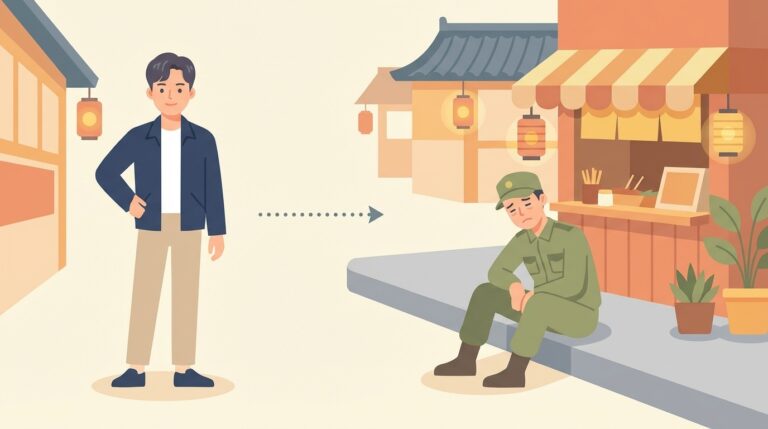
- K-Culture Moment: This is most often used for 예비군 (Yebigun, Reserve Forces). Men in their 20s usually dress up to look cool. But the moment they have to wear their old military uniform for annual reserve training, they stop caring. They walk with a slouch, sit on dusty curbs, and yawn loudly.
- Editor’s Insight: This phrase isn’t about physical age. It’s about the “vibe.” It’s a playful tease. It means “You look totally unglamorous right now!”
- Situation Spectrum:
[🚫 Never] ———— [⚠️ Be Careful] ———— [✅ Go Ahead]
- Close friends (Casual): ✅ (Perfect for teasing a friend going to reserve training)
- Co-workers (Semi-formal): ⚠️ (Only if you are close)
- Boss/Elders (Formal): 🚫 (Do not say this to a senior!)
- 🤔 Think About It: Why is “Ajussi” used to describe behavior rather than just age? How do middle-aged men act in your culture compared to young men?
Phase 3: Textbook vs Real Korean
Let’s see how this concept shifts from the textbook to the streets of Seoul.
| Situation | 📖 Textbook Korean | 🗣️ Real Korean | 💡 Why is it different? |
|---|---|---|---|
| Teasing a friend in uniform | 군복을 입으니 나이가 들어 보입니다. (You look older in a uniform.) | 야, 완전 아재 다 됐네! (Hey, you’ve completely become an Ajae!) | “Ajae” (아재) is a trendy slang version of Ajussi, implying someone who makes dad jokes and lacks fashion sense. |
| Asking about military service | 군대에 다녀오셨습니까? (Have you been to the military?) | 군필이세요? (Are you Gun-pil?) | “Gun-pil” (군필) is a super common abbreviation for “completed military service.” Koreans love shortening words for efficiency! |
💡 Bottom Note: For B1 learners, using the word 아재 (Ajae) instead of Ajussi when joking with a male Korean friend in his 20s or 30s will make you sound incredibly fluent and witty!
Phase 4: Cultural Context — K-Culture Deep Dive
4-1. The “Ajussi” Posture (Non-verbal cues)
When Korean men wear the reserve uniform, their body language completely changes.
– The walk: Dragging their combat boots instead of walking briskly.
– The sitting: An absolute disregard for dirt. They will sit on subway stairs, street curbs, or grassy patches without a second thought.
– The gaze: A thousand-yard stare into the void, thinking about what to eat for dinner.
4-2. K-Pop Connection: The “Gomushin” and the Return
In K-Pop fandom culture, when an idol enlists, fans affectionately call themselves 고무신 (Gomushin – Rubber shoes), which is an old term for a woman waiting for her soldier boyfriend.
When the idol posts their first photo in uniform, fans usually experience two phases:
1. “Wow, he looks so manly!” (K-Drama fantasy)
2. “Wait, why does he look like a neighborhood uncle who just woke up?” (The Ajussi reality)
Critical Point: Idols are trained to have perfect posture and speak with bright, high-pitched voices. In the military, they adopt the low, gruff, loud tone required of soldiers. The contrast between “glamorous idol” and “exhausted soldier” is jarring but highly endearing to fans.
Phase 5: Real-Life Roleplay Scenario
Setting: Friday afternoon, Line 2 Subway in Seoul. You are heading to Hongdae with your Korean friend, Min-ji. Across from you, a guy in his mid-20s wearing a woodland camouflage uniform is sleeping with his head tilted back, mouth slightly open.
Characters:
– YOU: A B1 Korean learner, a huge K-pop fan who thinks soldiers look like K-drama heroes.
– Min-ji (25): Your Korean friend whose brother just went to the military.
(Dialogue)
Min-ji: 앗, 저기 예비군 아저씨 잔다. 피곤한가 보네. 😴
(As, jeogi yebigun ajeossi janda. Pigonhanga bone.)
[Oh, that reserve Ajussi is sleeping. He must be tired.]
YOU: 아저씨? 저 사람 우리 또래 같은데?
(Ajeossi? Jeo saram uri ttorae gateunde?)
[Ajussi? He looks like he’s our age?]
Min-ji: 한국에서는 아무리 잘생긴 20대라도 군복만 입으면 다 아저씨 돼. 너 최애 아이돌도 군대 가면 저렇게 될걸? ㅋㅋㅋ
(Hangugeseoneun amuri jalsaenggin isipdaerado gunbokman ibeumyeon da ajeossi dwae. Neo choeae aidoldo gundae gamyeon jeoreoke doelgeol? lol)
[In Korea, no matter how handsome a 20-something is, if he wears a uniform, he becomes an Ajussi. Even your favorite idol will look like that when he enlists!]
🔀 Your Turn! How will you respond?
– A) “아닙니다. 군인들은 훌륭합니다.” (Too formal/robotic)
– B) “헐… 내 최애는 절대 안 그래! 송중기처럼 멋있을 거야!” (Gasp… My bias will never be like that! He’ll be cool like Song Joong-ki!)
– C) “야! 내 아이돌 욕하지 마!” (Hey! Don’t insult my idol! – Too aggressive)✅ Best Choice: B — It’s natural, brings up a universally understood K-drama reference (Descendants of the Sun), and uses the casual slang “헐 (Heol)” to show playful shock!
Phase 6: 10-Second Shadowing Drill
Let’s practice delivering the punchline like a true native! Focus on the pauses (/) and intonation.
😆 아무리 / 잘생겨도 / 군복 입으면 / 아~저씨 같아요!
(a-mu-ri / jal-saeng-gyeo-do / gun-bok ee-beu-myeon / a~jeo-ssi ga-ta-yo!)
“No matter how handsome they are, if they wear a uniform, they look like an Ah~jussi!”
Pro-tip: Stretch out the “아 (A)” in Ajussi slightly to add a teasing flavor!
Phase 7: K-Culture Mini Dictionary
| Korean | Romanization | English | Context |
|---|---|---|---|
| 예비군 | yebigun | Reserve forces | Men who finished active duty but must do annual refresher training for a few days. The prime suspects of the “Ajussi” syndrome. |
| 군필 | gun-pil | Served in the military | A crucial status for Korean men. Sometimes required on resumes or a hot topic on blind dates. |
| 미필 | mi-pil | Not yet served | Men who haven’t gone to the military yet. |
| 고무신 (곰신) | gomushin (gomsin) | “Rubber shoes” | Slang for a girlfriend waiting for her soldier boyfriend. |
Phase 8: Traveler Survival Kit
Even if you aren’t talking to an idol, you will see MANY soldiers walking around Seoul, especially near Seoul Station or Yongsan Station (major transit hubs for military bases).
🆘 Survival Phrases for Encounters with Soldiers
– 🇰🇷 “실례지만, 사진 좀 찍어주실 수 있나요?” (Sillyejiman, sajin jom jjigeojusil su innayo?)
– 🗣️ Sound: Shil-lye-jee-man, sa-jin jom jjee-geo-joo-shil soo in-na-yo?
– 📍 Where: Any tourist spot!
– 💡 Pro Tip: Soldiers on vacation (Hyuga) are everywhere at tourist spots with their friends or girlfriends. They are usually very polite and taking a photo for a foreigner is a fun story for them to take back to the base!
📌 Editor’s Travel Note
– Never secretly photograph soldiers: Taking photos of Korean military personnel or bases without permission is strictly prohibited and can get you in trouble.
– Discounts: You might see signs saying “군인 할인” (Military Discount) in restaurants or movie theaters. Sadly, this is only for Korean active-duty soldiers!
Phase 9: Critical Thinking Corner — “One Step Deeper”
🧠 Think Deeper: Media vs Reality (K-Drama vs Real Korea)
If you watched Crash Landing on You or Descendants of the Sun, you probably picture Korean soldiers as perfectly groomed heroes with flawless skin, wearing tailored uniforms while saving the world. But the reality of Korean conscription is quite different. Regular soldiers are tired 20-somethings who miss their moms, crave a good hamburger, and just want to sleep.
This gap between media and reality is why Koreans joke about the “Ajussi” transformation. It’s a collective coping mechanism—a way to find humor in a tough, mandatory duty that takes away the golden years of a young man’s youth.
💬 Your Turn: Does your country have mandatory military service? Is there a big difference between how soldiers are shown in movies versus real life? Tell me in the comments!
Phase 10: FAQ & Common Mistakes
Q: Can I call a young soldier “군인 아저씨 (Gunin Ajussi)” to his face?
A: NO! 🚫 Unless you are a 5-year-old child! In the past, kids were taught to say “Thank you, Soldier Uncle (Ajussi).” But if an adult calls a 20-year-old soldier “Ajussi” to his face, it can hurt his feelings or sound slightly condescending.
Q: So how do I refer to them?
A: If you must address them, just say “저기요 (Excuse me)” or “군인 분 (Soldier person – polite).”
❌ Common Mistake: Trying to compliment a soldier by saying “아저씨 멋있어요 (Ajussi, you are cool).”
✅ Do This Instead: Just smile and say “안녕하세요 (Hello)” or “수고하십니다 (Thank you for your hard work/trouble).” They will deeply appreciate the latter!
Phase 11: Summary & Action Items
One-Liner Summary: In Korea, the military uniform is the ultimate equalizer—it hilariously turns even the most stylish young guys into lazy, relaxed “Ajussis.”
Action Mission:
– 🥉 Bronze (Solo): Look in the mirror and say, “군복 입으면 다 아저씨 돼!” with a dramatic sigh.
– 🥈 Silver (Online): Find a photo of a K-pop idol in military uniform and leave a playful comment: “군복 입어도 안 아저씨 같아요! (Even in uniform, he doesn’t look like an Ajussi!)”
– 🥇 Gold (Real-world): Next time you watch a K-drama and see a soldier slouching or eating snacks aggressively, point and yell, “아재다! (It’s an Ajae!)”
K-Culture Mission: Watch an episode of the K-drama D.P. on Netflix. Pay attention to how the soldiers walk and talk when they are on base versus when they are out in Seoul on a mission.
Phase 12: Interactive Quiz
1. Fill in the Blank:
When a Korean man finishes his active military duty, he is called ______.
(A) 군인 (Gunin)
(B) 군필 (Gun-pil)
(C) 미필 (Mi-pil)
2. True or False – K-Culture Edition:
It is completely fine and polite for a 30-year-old foreigner to walk up to a 21-year-old Korean soldier and say, “안녕하세요, 군인 아저씨! (Hello, Soldier Ajussi!)” (T/F)
3. Situational Judgment:
Your Korean male friend is complaining that he has to go to “Yebigun” (Reserve training) this weekend and says he feels so old. What is the most natural Korean response?
(A) 축하합니다! (Congratulations!)
(B) 야, 완전 아재 다 됐네! (Hey, you’ve completely become an Ajae!)
(C) 군대는 위험해요. (The military is dangerous.)
Click to see the Answers!
1. (B) 군필 (Gun-pil) – It means you completed the service.
2. False – Only young children call them “Soldier Ajussi.” Adults should avoid it!
3. (B) – It’s the perfect playful tease for a friend going to reserve training!
Frequently Asked Questions (FAQ)
Q: What does "군복 입으면 다 아저씨 된다" mean in Korean and how do you pronounce it?
A: In Korean, "군복 입으면 다 아저씨 된다" is pronounced [Gun-bok ee-beu-myeon da a-jeo-ssi doen-da] and means: (Literal) If you wear a military uniform, everyone becomes an Ajussi. / (Real nuance) The military uniform magically strips away your cool, stylish aura and makes you act like a lazy, unbothered middle-aged man.







