

Phase 1: Empathy (Welcome to the Real Korea!)
Hello there! This is your Daily Hangul editor.
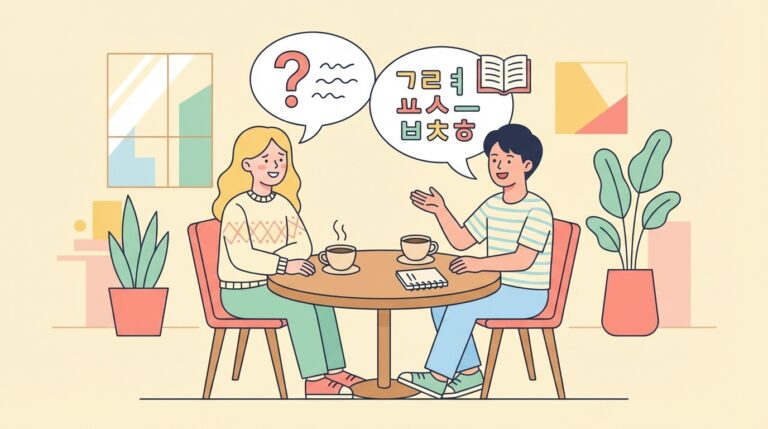
Picture this: You are watching a K-Drama. The main characters are sitting in a cozy cafe in Hongdae. One says to the other, “난 얼죽아! 너는 아아?” (Nan eoljuk-a! Neoneun ah-ah?)
The subtitles simply say, “I’ll have an iced coffee! What about you?” But you pause. Wait a minute… I know ‘coffee’ is 커피 (keopi). What on earth is ‘ah-ah’?
If you’ve ever felt like your Korean textbook didn’t prepare you for actual conversations with locals, you are not alone! Koreans love abbreviations (줄임말 – julimmal). We shorten everything from coffee orders to K-Pop terms. But as a beginner, it can feel incredibly overwhelming.
Don’t worry. Today, I’m going to teach you exactly how to survive these moments. We aren’t just going to memorize vocabulary; we are going to learn how to confidently say, “I have no idea what you just said, please explain it!” like a true insider.
Phase 2: Core Expressions Deep Dive
Here are the top 3 survival phrases you need when Koreans start speaking in “code.”
1. 줄임말은 너무 어려워요. (Abbreviations are too hard.)
- Pronunciation: julimmal-eun / neomu / eoryeowoyo.
- Tip: The ‘어’ (eo) sounds like the ‘u’ in “uh-oh.”
- Meaning: (Literal) Abbreviated words are too difficult. -> (Real nuance) “I’m a learner, please go easy on the slang!”
- K-Culture Moment: Imagine you are at a K-Pop fan meeting, and the fans are shouting shortened slang. You turn to the fan next to you, smile warmly, and say this. It instantly breaks the ice, and they’ll probably think it’s adorable that you’re trying!
- Editor’s Insight: This phrase isn’t a complaint. It’s an honest, slightly cute confession. Koreans know their slang is crazy fast, so they will immediately understand and adjust their Korean for you.
- Situation Spectrum:
[🚫 절대 금지] ———— [⚠️ 주의] ———— [✅ 자유롭게]
- Casual (Friends): ✅
- Semi-formal (Coworkers): ✅
- Formal (Strict Boss/Elders): ⚠️ (Better to just ask for the meaning respectfully)
- 🤔 Think About It: Why do you think people invent slang and abbreviations? Does it make a group of people feel more connected? Does your native language have text slang that confuses parents?
2. 그게 무슨 뜻이에요? (What does that mean?)
- Pronunciation: geuge / museun / tteusieyo?
- Tip: ‘뜻’ (tteut) has a strong, tense ‘tt’ sound. Imagine the tight ‘t’ in “stop.”
- Meaning: What is the meaning of that?
- K-Culture Moment: You’re at a Korean fried chicken pub (Chimaek place). Your friend says a random new slang word. You tilt your head and naturally drop this phrase.
- Editor’s Insight: This is your #1 Swiss Army knife phrase. You can use it for words, gestures, or even situations you don’t understand.
- Situation Spectrum:
[🚫 절대 금지] ———— [⚠️ 주의] ———— [✅ 자유롭게]
- Casual (Friends): ✅ (Drop the ‘요’ and say “그게 무슨 뜻이야?”)
- Semi-formal (Coworkers): ✅
- Formal (Boss/Elders): ⚠️ (Use “무슨 말씀이신지 잘 모르겠습니다” to be extra polite)
3. 원래 단어가 뭐예요? (What is the original word?)
- Pronunciation: wollae / daneoga / mwoyeyo?
- Tip: ‘뭐’ (mwo) sounds like “mwoh,” blending m and w quickly.
- Meaning: What is the original word/phrase?
- K-Culture Moment: You’re watching a Korean variety show with a local friend, and they are playing a “Guess the abbreviation” game. You want to know the full, proper Korean phrase to actually study it.
- Editor’s Insight: This shows you are a serious learner! You don’t just want the translation; you want to know how the abbreviation was made. Koreans love explaining this.
- Situation Spectrum:
[🚫 절대 금지] ———— [⚠️ 주의] ———— [✅ 자유롭게]
- Casual: ✅
- Semi-formal: ✅
- Formal: 🚫
Phase 3: Textbook vs. Real Korean
How does standard textbook Korean compare to what you’ll actually hear in the streets of Seoul?
| Situation | 📖 Textbook Korean | 🗣️ Real Korean | 💡 Why is it different? |
|---|---|---|---|
| Trying to understand a new slang word. | 이해하지 못했습니다. (I did not understand.) | 엥? 그게 무슨 뜻이에요? (Huh? What does that mean?) | Textbook Korean is too robotic. Adding “엥?” (Eng? – equivalent to “Huh?”) shows genuine, natural curiosity. |
| Complaining about difficult words. | 이 단어는 발음이 어렵습니다. (This word’s pronunciation is difficult.) | 아~ 줄임말 진짜 너무 어려워요~ (Ah~ Abbreviations are seriously so hard~) | Koreans express emotion by dragging out sounds (“아~”) and using “진짜” (really/seriously) for emphasis. |
| Ordering an Iced Americano. | 아이스 아메리카노 한 잔 주세요. (One Iced Americano, please.) | 아아 하나요! (One Ah-ah!) | The “Pali-pali” (Hurry up) culture values extreme efficiency, especially during busy cafe rushes! |
Phase 4: Cultural Context — K-Culture Deep Dive
4-1. The Art of “Nunchi” (눈치)
When someone uses a word you don’t know, don’t freeze and stare at the floor! In Korea, reading the room (Nunchi) is key. Smile, make light eye contact, and comfortably admit you don’t know. If you confidently say, “줄임말 너무 어려워요!” with a laugh, Koreans will actually find your honesty charming and will eagerly become your personal Korean teacher.
4-2. The “Pali-Pali” (빨리빨리) Food Culture
Koreans do everything fast. Internet speeds are fast, deliveries are fast, and yes, ordering food is incredibly fast. When office workers rush into a cafe after lunch, they don’t have time to say “Iced Americano.” It becomes “아아” (Ah-ah). Hot Americano? “뜨아” (Tteu-ah). Spicy Chicken with Mayonnaise Rice Bowl? “치마요” (Chi-mayo).
Abbreviations in food culture aren’t just slang; they are a survival tool for the busy modern Korean worker. Understanding this helps you see that these shortened words aren’t meant to confuse you—they are just a byproduct of a highly efficient society!
Phase 5: Real-World Roleplay Scenario
Setting: 12:30 PM. A bustling, trendy cafe in Gangnam. You just finished lunch with your Korean coworker, Min-su. The line at the cafe is long, and the barista is moving at lightning speed.
Characters:
– YOU: A beginner Korean learner, working in Seoul for 3 months.
– Min-su (30): Friendly, talks very fast, loves iced coffee.
Dialogue:
Min-su: 대리님, 커피 뭐 드실래요? 전 얼죽아라서 무조건 아아! ☕
(Daerinim, keopi mwo deusillaeyo? Jeon eoljuk-araseo mujogeon ah-ah!)
[Assistant Manager, what coffee will you drink? I’m ‘Eol-juk-a’ so definitely ‘Ah-ah’!]
(🎭 Stage Direction: Min-su looks at the menu quickly and pulls out his credit card)
YOU: 네? 얼죽아… 아아?
(Ne? Eol-juk-a… ah-ah?)
[Excuse me? Eol-juk-a… ah-ah?]
Min-su: 아! 맞다. 외국인이시죠. 한국어 줄임말이에요!
(Ah! Matda. Oeguginisijyo. Hangugeo julimmarieyo!)
[Ah! Right. You’re a foreigner. It’s a Korean abbreviation!]
🔀 YOUR TURN! How do you respond?
– A) (Just nod and pretend to understand) “아… 네. 저도 그거요.”
– B) “한국어 줄임말은 너무 어려워요. 원래 단어가 뭐예요?”
– C) “영어 쓰세요!” (Speak English!)✅ Best Choice: B — Why? It politely admits your limit but shows an active desire to learn. Min-su will gladly explain that “얼죽아” means “Even if I freeze to death, Iced Americano” and “아아” is “Iced Americano.”
⚠️ Choice A Analysis: Pretending to understand is a common mistake! You might end up drinking something you hate.
🌟 Bonus Mini-Roleplay: K-Pop Concert
Fan next to you: “오늘 무대 진짜 대박이지 않아요? 완전 입덕 위기!”
YOU: “입덕…? 🥺 그게 무슨 뜻이에요?”
Fan: (Gasping excitedly) “Ah! It means ‘joining the fandom’! Are you a new fan too?”
By simply asking what it means, you just made a new concert buddy!
Phase 6: 10-Second Shadowing Drill
Let’s practice the flow of these sentences. Speak out loud with the exact emotion marked!
- 🥺 (Looking slightly confused)
그게 / 무슨 / 뜻이에요?
(geuge / museun / tteusieyo?) -
😅 (Laughing awkwardly but brightly)
한국어 줄임말은 / 너무 / 어려워요!mu / eoryeowoyo!)
(hangugeo julimmal-eun / neo -
🤔 (Curious and eager to learn)
원래 단어가 / 뭐예요?
(wollae daneoga / mwoyeyo?)
Phase 7: K-Culture Mini Dictionary
Master these terms and impress your Korean friends!
| Korean | Romanization | English | Cultural Context |
|---|---|---|---|
| 줄임말 | julimmal | Abbreviation | Koreans shorten phrases by taking the first letter of each word. |
| 아아 | ah-ah | Iced Americano | The unofficial national drink of modern Korea. |
| 치맥 | chimaek | Chicken + Maekju (Beer) | A cultural staple, often enjoyed by the Han River. |
| 눈치 | nunchi | Social awareness / Reading the room | The ability to gauge others’ moods and situations quickly. |
| 인싸 | inssa | Insider (Social butterfly) | Someone who knows all the latest trends and slang! |
Phase 8: Traveler’s Survival Kit
Traveling to Korea? You will definitely encounter shortened words on menus and signs. Here is your survival kit!
🆘 Survival Phrases for Cafes & Restaurants
– 🇰🇷 “이거 제일 유명한 거예요?” (igeo jeil yumyeonghan geoyeyo? – Is this the most famous one?)
– 🇰🇷 “안 맵게 해주세요.” (an maepge haejuseyo – Please make it not spicy.)
– 🇰🇷 “이거 무슨 고기예요?” (igeo museun gogiyeyo? – What kind of meat is this?)
– 📍 Where to use: Cafes, street food stalls, local diners.
– 💡 Pro Tip: If you see a menu item with a short, weird name (like ‘치밥’ – Chibap), point to it and use today’s phrase: “이거 원래 단어가 뭐예요?”
📌 Editor’s Travel Note:
Don’t be afraid to use translation apps like Papago. However, translators often fail at Korean slang! If Papago gives you a weird translation (like translating ‘Ah-ah’ as a screaming sound), that’s your cue to ask a local: “그게 무슨 뜻이에요?”
Phase 9: Critical Thinking Corner — “One Step Deeper”
🧠 Think Deeper: Language in the Fast Lane (Language & Culture)
The Korean “Pali-pali” (Hurry up) mindset isn’t just about walking fast or fast internet; it deeply affects the language itself. By shortening “Iced Americano” (아이스 아메리카노 – 7 syllables) to “Ah-ah” (아아 – 2 syllables), Koreans save time in their busy daily lives.
However, this creates a unique social phenomenon. Knowing the latest abbreviations makes you part of the “In-group” (인싸). It connects the youth but can sometimes alienate older generations or foreigners. Abbreviations in Korea aren’t just lazy speech; they are a living, breathing map of what society is currently obsessed with.
💬 Your Turn: Does your culture have a “hurry” mindset? Do young people in your country create abbreviations that confuse older generations? Let me know in the comments!
Phase 10: FAQ & Avoiding Mistakes
Q: Is it rude to tell a Korean that their language is “too hard”?
A: Not at all! Saying “줄임말은 너무 어려워요” is seen as humble and cute. Koreans are very proud of their language but also acknowledge it is notoriously difficult for foreigners. They will appreciate your effort.
Q: Can I use “그게 무슨 뜻이에요?” to my boss?
A: Yes, but your tone matters. Don’t say it aggressively. Say it softly with a slight head bow. For a safer, highly formal version, say: “제가 뜻을 잘 몰라서 그러는데, 설명해주실 수 있나요?” (I don’t quite know the meaning, could you explain it?)
❌ Common Mistake #1: Pretending to understand slang just to be polite.
✅ Do This Instead: Stop them immediately with a smile and ask “원래 단어가 뭐예요?” Pretending to understand can lead to massive miscommunications, especially with food orders or meeting times!
Phase 11: Summary & Action Items
One-Liner Summary: When Korean slang hits you fast, don’t freeze—confidently admit it’s hard and ask for the meaning to turn confusion into a fun cultural exchange!
🏆 Your Action Missions:
– 🥉 Bronze (Solo): Stand in front of a mirror and practice saying “그게 무슨 뜻이에요?” with a curious, friendly smile.
– 🥈 Silver (Online): Go to a K-Pop music video on YouTube and find a Korean comment with an abbreviation. Reply with: “한국어 줄임말은 어려워요. 무슨 뜻이에요?”
– 🥇 Gold (Real World): Next time you are at a Korean restaurant or cafe, find an abbreviated word on the menu and ask the staff what the original word is!
What is the weirdest or funniest Korean abbreviation you have heard so far? Share it with us below! 👇
Phase 12: Interactive Quiz!
Test your new survival skills!
1. Situational Judgment: Your Korean friend texts you “오늘 치맥 콜?” (Chimaek call today?). You know ‘call’ means ‘yes/agree’, but you forgot what ‘치맥’ is. What is the most natural reply for an A2 learner?
– A) 안녕히 계세요. (Goodbye.)
– B) 치맥이 무슨 뜻이에요? (What does Chimaek mean?)
– C) 저는 영어를 좋아해요. (I like English.)
2. Fill in the Blank:
“저는 외국인이에요. 한국어 ( ______ )은 너무 어려워요!”
(I am a foreigner. Korean abbreviations are too hard!)
3. True or False – K-Culture Edition:
In Korea, it is considered rude to ask someone to explain slang because you should already know it. (T/F)
(Answers: 1. B, 2. 줄임말 (julimmal), 3. False! Koreans love explaining their slang culture to foreigners.)
Frequently Asked Questions (FAQ)
Q: What does "줄임말은 너무 어려워요. (Abbreviations are too hard.)" mean in Korean and how do you pronounce it?
A: In Korean, "줄임말은 너무 어려워요. (Abbreviations are too hard.)" is pronounced [julimmal-eun / neomu / eoryeowoyo.] and means: a key conversational Korean expression covered in this lesson.
Q: What does "그게 무슨 뜻이에요? (What does that mean?)" mean in Korean and how do you pronounce it?
A: In Korean, "그게 무슨 뜻이에요? (What does that mean?)" is pronounced [geuge / museun / tteusieyo?] and means: a key conversational Korean expression covered in this lesson.
Q: What does "원래 단어가 뭐예요? (What is the original word?)" mean in Korean and how do you pronounce it?
A: In Korean, "원래 단어가 뭐예요? (What is the original word?)" is pronounced [wollae / daneoga / mwoyeyo?] and means: a key conversational Korean expression covered in this lesson.







