

Master the Korean “If”: Making Weekend Plans Like a Local
Phase 1: Empathy & The K-Culture Moment
Hello! This is your Daily Hangul Editor.
Picture this: You are watching your favorite K-Drama. The main characters are standing under the gray sky. He looks at her and says, “If it snows on the first snowfall… I will confess my feelings.” (Cue the OST! 🎶)
Conditions and assumptions—saying “If X happens, let’s do Y”—are everywhere in Korean daily life. But step away from the drama screen and walk into a bustling Seoul office on a Friday afternoon. You won’t hear about the first snow. Instead, you’ll hear: “비가 안 오면 등산 가자!” (If it doesn’t rain, let’s go hiking!)
Hiking (등산) is practically a national sport in Korea. If you don’t know how to naturally suggest or respond to these conditional plans, you might end up missing out on the best weekend bonding (and the delicious Makgeolli that comes after!). This guide is based on real struggles my B1 intermediate students face when moving from textbook grammar to real-life “Ifs.” Let’s dive in!
Phase 2: Core Expressions Deep Dive
1. 비가 안 오면 등산 가자
- Pronunciation: Biga an omyeon deungsan gaja [Bee-ga an oh-myun deung-san ga-ja]
- Meaning: (Literal) If rain doesn’t come, let’s go mountain climbing. / (Real Nuance) Let’s go hiking if it doesn’t rain!
- K-Culture Moment: Friday afternoon, a KakaoTalk message pops up in the group chat. Your Korean friend, fully equipped in neon-colored outdoor gear (등산복), is ready to conquer Bukhansan Mountain.
- Editor’s Insight: The grammar
~(으)면means “If.” By adding it to the verb stem (오다 -> 오 + 면), you create a condition. It sounds incredibly natural and active. - Situation Spectrum:
[🚫 절대 금지] ———— [⚠️ 주의] ———— [✅ 자유롭게]- Casual (Friends): ✅
- Semi-formal (Coworkers): ⚠️ (Change ‘가자’ to ‘가요’)
- Formal (Boss): 🚫 (Too direct to suggest to a boss like this)
- 🤔 Think About It: Korea is 70% mountainous. Why do you think hiking is such a popular bonding activity for Koreans, rather than just going to a pub?
2. 내일 날씨 좋으면 한강 갈래?
- Pronunciation: Naeil nalssi joeumyeon hangang gallae? [Nae-il nal-ssi jo-eu-myun han-gang gal-lae?]
- Meaning: If the weather is good tomorrow, wanna go to the Han River?
- K-Culture Moment: The classic Seoulite weekend! Ordering fried chicken and beer (Chimaek) delivered right to your picnic mat at Yeouido Hangang Park.
- Editor’s Insight: Notice we drop the subject and the particle. Textbooks say “날씨가 좋으면”, but in speech, “날씨 좋으면” flows much faster and sounds like a true local.
3. 혹시 괜찮으시면…
- Pronunciation: Hoksi gwaenchaneusimyeon… [Hok-shi gwaen-chan-eu-shi-myun…]
- Meaning: If you don’t mind… / If it’s okay with you…
- K-Culture Moment: In a business meeting, or when a K-Drama second lead is gently offering to drive the heroine home.
- Editor’s Insight:
혹시(by any chance) softens the blow. Korean culture values not being a burden to others, so this is your golden ticket for making polite suggestions without pressure.
Phase 3: Textbook vs. Real Korean
| Situation | 📖 Textbook Korean | 🗣️ Real Korean | 💡 Why the difference? |
|---|---|---|---|
| Stating a condition | 만약 비가 오지 않는다면 (If it does not rain) | 비 안 오면 (If it doesn’t rain) | Koreans love efficiency. Dropping ‘만약’ (if) and using the short negative ‘안’ is much faster. |
| Asking about free time | 시간이 있으시면 (If you have time) | 시간 되시면 / 시간 날 때 (If time allows) | “시간 되다” (time works out) shifts the focus away from the person to the schedule, feeling less intrusive. |
| Reacting to a plan | 그것은 좋은 생각입니다. (That is a good idea.) | 오, 콜! / 좋아요! (Oh, Call! / Sounds good!) | “콜” (Call) comes from poker/gaming, adapted into everyday slang meaning “I’m in!” |
Bottom Note: As a B1 learner, try swapping “만약 ~한다면” for a simple “~(으)면” in your daily conversations. It immediately upgrades your fluency!
Phase 4: Cultural Context — K-Culture Deep Dive
4-1. Non-verbal Cues: The “Weather App” Huddle
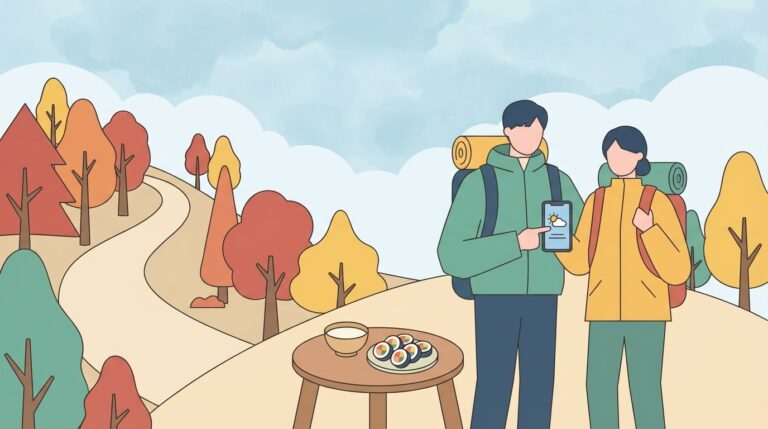
When Koreans say “비가 안 오면,” they usually don’t just say it. They pull out their smartphones, open a weather app, and show it to you. It’s a collective decision-making process. Sharing the screen builds intimacy and shared anticipation for the plan.
4-2. K-Travel & Food: The Summit Feast (정상에서의 만찬)
Let’s talk about the specific unit: Hiking (등산). In Korea, hiking isn’t just exercise; it’s a culinary journey. If you agree to “비가 안 오면 등산 가자”, expect to wake up early. Once you reach the peak (정상), the real magic happens.
People unpack Kimbap (김밥), cup noodles (컵라면) with hot water carried in thermoses, and sliced cucumbers (오이) for hydration. And the ultimate reward? A cold bowl of Makgeolli (막걸리 – rice wine) paired with Pajeon (파전 – green onion pancake) at a restaurant at the bottom of the mountain. The condition “If we go hiking” naturally implies “We will eat a lot afterwards.”
Phase 5: Real-life Roleplay Scenario
Setting: Friday, 5:00 PM. The breakroom at your Seoul office. Outside, the sky is slightly cloudy. You are getting coffee with your friendly Korean coworker, Minsoo.
Characters:
– YOU: A foreign professional who has been working in Korea for 6 months. You want to experience real local life.
– Minsoo (32): Your upbeat coworker who owns way too much neon hiking gear.
Dialogue:
Minsoo: 이번 주말에 뭐 해요? 약속 있어요?
(Ibeon jumare mwo haeyo? Yaksok isseoyo?)
[What are you doing this weekend? Do you have plans?]
YOU: 아니요, 특별한 계획은 없어요. 집에서 쉴까 해요.
(Aniyo, teukbyeolhan gyehoegeun eopseoyo. Jibeseo swilkka haeyo.)
[No, no special plans. I’m thinking of resting at home.]
Minsoo: 에이~ 주말인데 집에만 있으면 심심하잖아요!
(Ei~ Jumarinde jibeman isseumyeon simsimhajannayo!)
[Hey~ It’s the weekend, if you just stay home it’s boring!]
(🎭 Stage Direction: Minsoo pulls out his phone and opens the weather app.)
Minsoo: 보니까 내일 오전에 비가 잠깐 오고 그친대요. 비가 안 오면 같이 등산 가자! 북한산 어때요?
(Bonikka naeil ojeone biga jamkkan ogo geuchindaeyo. Biga an omyeon gachi deungsan gaja! Bukhansan eottaeyo?)
[Looking at this, it says it’ll rain briefly tomorrow morning and stop. If it doesn’t rain, let’s go hiking together! How about Bukhansan?]
YOU: 북한산요? 저 등산화가 없는데요…
(Bukhansanyo? Jeo deungsanhwaga eomneundeyo…)
[Bukhansan? I don’t have hiking shoes…]
Minsoo: 괜찮아요! 등산로 입구에서 빌릴 수 있어요. 혹시 괜찮으시면 제가 알아볼까요?
(Gwaenchanayo! Deungsanlo ipgueseo billil su isseoyo. Hoksi gwaenchaneusimyeon jaega arabolkkayo?)
[It’s okay! You can rent them at the trail entrance. If you don’t mind, shall I look into it?]
🔀 Your Turn! How do you reply?
– A) “네, 좋아요. 하지만 비 오면 안 갈 거예요.” (Grammatically correct, but sounds a bit too blunt/cold.)
– B) “오, 콜! 정상에서 막걸리 사주시면 갈게요!” (Witty, shows you understand the culture!)
– C) “저는 등산 싫어해요. 다른 거 해요.” (Too direct. Might break the Nunchi!)✅ Best Choice: B — Reason: Using “콜” (Call) makes you sound like a local, and jokingly making a condition (“If you buy Makgeolli…”) builds great rapport!
⚠️ Choice C Analysis: ‘Too direct’ can be risky. If you genuinely hate hiking, use Phase 2’s혹시 괜찮으시면...to politely suggest an alternative, like “혹시 괜찮으시면 카페 가는 건 어때요?”
YOU: 오, 콜! 정상에서 막걸리 사주시면 갈게요!
(O, kol! Jeongsangeseo makgeolli sajusimyeon galgeyo!)
[Oh, call! If you buy me Makgeolli at the top, I’ll go!]
Minsoo: ㅋㅋㅋㅋ 당연하죠! 파전까지 제가 쏩니다!
(Kkkk dangyeonhajyo! Pajeonkkaji jaega ssomnida!)
[Hahaha of course! I’ll even treat you to Pajeon!]
Phase 6: 10-Second Shadowing Drill
Practice your timing and intonation! Follow the emotion tags.
😊 내일 / 비가 안 오면 / 등산 가자! (Naeil / biga an omyeon / deungsan gaja!)
🥺 혹시 / 괜찮으시면 / 같이 갈래요? (Hoksi / gwaenchaneusimyeon / gachi gallayo?)
😤 파전 사주시면 / 무조건 / 갈게요! (Pajeon sajusimyeon / mujogeon / galgeyo!)
Tip: Keep the 면 slightly elongated and high-pitched to show you are pausing to set the condition!
Phase 7: K-Culture Mini Dictionary
| Korean | Romanization | English | Context |
|---|---|---|---|
| 등산복 | deungsanbok | Hiking clothes | Koreans take outdoor gear seriously. It’s almost a fashion statement! |
| 막걸리 | makgeolli | Rice wine | The traditional reward after a long hike. Usually paired with Jeon (pancakes). |
| 쏘다 | ssoda | To treat (someone) | Literally “to shoot,” but used as “I’ll pay for the meal.” (내가 쏠게!) |
| 콜 | kol | Deal! / I’m in! | Derived from poker, used when enthusiastically agreeing to a plan. |
| 눈치 | nunchi | Social sense | Reading the room. If someone says “비 오면…”, you need Nunchi to know if they want to cancel. |
Phase 8: Traveler’s Survival Kit
If you are traveling in Korea and want to hit the trails, keep these in your back pocket!
🆘 Survival Expression #1: Checking the Plan
– 🇰🇷 “내일 비 오면 어떻게 해요?” (Naeil bi omyeon eotteoke haeyo?)
– 🗣️ English Pronunciation: Nae-il bee o-myun uh-ddu-keh hae-yo?
– 📍 Where to use: With your tour guide or Korean friends when the weather looks iffy.
– 💡 Pro Tip: Koreans almost always have a “Plan B” (플랜B) ready!🆘 Survival Expression #2: Renting Gear
– 🇰🇷 “등산화 대여 되나요?” (Deungsanhwa daeyeo doenayo?)
– 🗣️ English Pronunciation: Deung-san-hwa dae-yeo doe-na-yo?
– 📍 Where to use: At rental shops near major mountain entrances (like Bukhansan or Hallasan).📌 Editor’s Travel Note
– Useful Apps: ‘KakaoMap’ or ‘Naver Map’ are much better than Google Maps for finding hiking trailheads in Korea.
– Safety First: Korean mountains are beautiful but very rocky. Sneakers are okay for small hills (동네 뒷산), but real Deungsanhwa (hiking boots) are highly recommended for larger mountains!
Phase 9: Critical Thinking Corner — A Step Deeper
Media vs. Reality: The K-Drama Illusion of Weekends
In K-Dramas, weekends are often portrayed as romantic strolls through Han River parks, stylish cafe-hopping, or dramatic confessions in the rain. However, the reality of a Korean weekend, especially for office workers, is often split into two extremes: complete exhaustion (staying in bed all day) or intense, stamina-building activities like hiking (등산). Language reflects this shared reality. Making plans with “비가 안 오면…” (If it doesn’t rain) isn’t just about the weather; it’s a mutual acknowledgment of the limited, precious time they have to recharge outside the office.
💬 Your Turn: How do people in your culture spend their precious weekend mornings? Do you have an equivalent to the Korean “hiking obsession”? Let us know in the comments!
Phase 10: FAQ & Avoiding Misunderstandings
Q: Can I use “등산 가자” (Let’s go hiking) with my boss?
A: 🚫 No! “~가자” is casual (Banmal). If you want to make a suggestion to a boss or someone older, use “~가시죠” (Let’s go – very formal) or gently ask “등산 가시는 거 어때요?” (How about going hiking?).
Q: How do I know if they genuinely want to go, or if they are just being polite?
A: Nunchi time! If they say, “비 안 오면 가요…” and let their voice trail off, they might be secretly hoping for rain! If they actively send you KakaoMap links, they are 100% serious.
❌ Common Mistake #1: Using the past tense before
~(으)면incorrectly to talk about future plans.
E.g., Don’t say “비가 안 왔으면 등산 가자.” (If it didn’t rain…).
✅ Do this: Use the present tense stem for future conditions: “비가 안 오면 등산 가자.”
Phase 11: Summary & Action Items
One-Liner Summary: Use ~(으)면 (If) to naturally suggest plans and conditions, and remember that “콜!” (Call) is the best way to enthusiastically say “I’m in!”
Your Action Missions:
– 🥉 Bronze (Solo): Look out the window right now. Say “비가 안 오면…” and finish the sentence out loud with something you want to do!
– 🥈 Silver (Online): Comment below with a Korean sentence using ~(으)면.
– 🥇 Gold (Real World): Next time a Korean friend suggests a plan, respond with an enthusiastic “오, 콜!”
🧗 K-Culture Mission:
Open Google Maps or KakaoMap and search for “Bukhansan National Park” (북한산). Imagine yourself at the peak, and say out loud: “정상에 도착하면 막걸리 마실 거예요!” (If I reach the top, I will drink Makgeolli!)
Phase 12: Quiz — Interactive Challenge
1. Situational Judgment: Your coworker asks if you want to eat Samgyeopsal after work. You want to go, but ONLY if you finish work early. What do you naturally say?
A) 일찍 끝나다 삼겹살 먹어요.
B) 일찍 끝나면 삼겹살 먹어요.
C) 일찍 끝날 때 삼겹살 먹어요.
2. True or False — K-Culture Edition:
“Koreans usually wear simple jeans and t-shirts when hiking mountains like Bukhansan.” (T / F)
3. Fill in the Blank:
“혹시 ________ 같이 카페 갈래요?” (If you don’t mind, do you want to go to a cafe together?)
(Hint: gwaen-chan-eu-shi-myun)
(Answers: 1: B – ~(으)면 sets the perfect condition. / 2: False – They love colorful, professional hiking gear! / 3: 괜찮으시면)
Frequently Asked Questions (FAQ)
Q: What does "비가 안 오면 등산 가자" mean in Korean and how do you pronounce it?
A: In Korean, "비가 안 오면 등산 가자" is pronounced [Biga an omyeon deungsan gaja [Bee-ga an oh-myun deung-san ga-ja] and means: (Literal) If rain doesn't come, let's go mountain climbing. / (Real Nuance) Let's go hiking if it doesn't rain!
Q: What does "내일 날씨 좋으면 한강 갈래?" mean in Korean and how do you pronounce it?
A: In Korean, "내일 날씨 좋으면 한강 갈래?" is pronounced [Naeil nalssi joeumyeon hangang gallae? [Nae-il nal-ssi jo-eu-myun han-gang gal-lae?] and means: If the weather is good tomorrow, wanna go to the Han River?
Q: What does "혹시 괜찮으시면..." mean in Korean and how do you pronounce it?
A: In Korean, "혹시 괜찮으시면..." is pronounced [Hoksi gwaenchaneusimyeon... [Hok-shi gwaen-chan-eu-shi-myun...] and means: If you don't mind... / If it's okay with you...







