Phase 1: Empathy & Immersion — The K-Culture Cold Open
Hello! I’m your Daily Hangul Editor, your personal Korean language tutor and local cultural navigator.
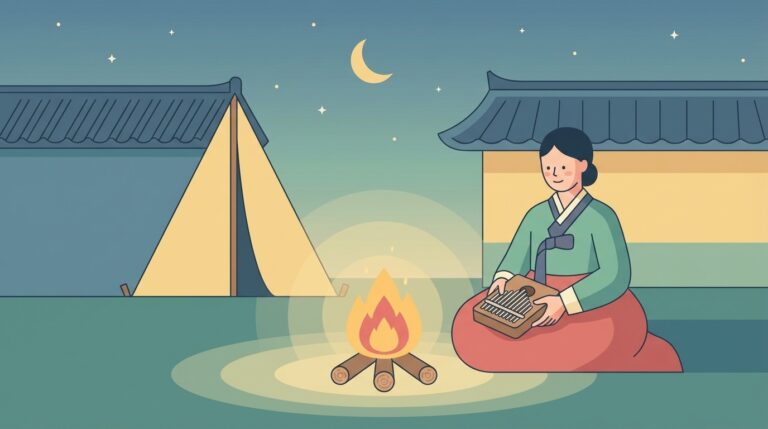
Imagine this: It’s a Friday night, and you’ve driven out of the bustling streets of Seoul to a quiet camping spot in Gapyeong. The campfire is crackling in front of your tent (a trendy weekend getaway known as 차박, car camping). Your Korean friend doesn’t reach for a Bluetooth speaker to blast K-Pop. Instead, they pull out a small wooden block with metal tines—a Kalimba. As they gently pluck a melody that sounds like a vintage music box, they close their eyes, let out a long breath, and say, “아… 진짜 힐링된다.” (Ah… this is truly healing.)
At a C1 level, you already know how to say “my hobby is listening to music.” But the textbook Korean you’ve learned doesn’t capture the deep, almost desperate desire for “힐링” (healing) that permeates modern Korean society. When you master how to talk about hobbies as a form of mental sanctuary—like playing the Kalimba to space out—you instantly upgrade from a ‘foreign learner’ to an ‘insider’ who truly understands the Korean mindset.
Note: The insights in this post come directly from my years of teaching advanced students who wanted to sound less like a news anchor and more like a close friend over a beer at the Han River.
Phase 2: Deep Dive into Key Expressions
Here are the most native ways to talk about using an instrument or a quiet hobby to find peace.
1. 마음이 차분해지다
- Pronunciation: [ma-eumi chabunhaejyeoyo] (ma-eum-ee cha-boon-hae-jyeo-yo)
- Meaning: Literal: My mind becomes calm. / Real nuance: It grounds me / It brings me peace.
- K-Culture Moment: You’ll hear this in slice-of-life K-Dramas when the protagonist escapes the toxic corporate office, sits by the sea, and simply listens to the waves. It’s not just about being quiet; it’s an active transition from chaos to tranquility.
- Editor’s Insight: The suffix
-아/어지다indicates a change in state. You aren’t just calm; the Kalimba makes you calm. It’s a beautiful way to express the emotional effect of a hobby.- Situation Spectrum:
[🚫 Never] ———— [⚠️ Careful] ———— [✅ Freely]
- Casual with friends: ✅
- Coworkers (Semi-formal): ✅
- Boss/Elders (Formal): ✅ (Just use the polite ending: 마음이 차분해집니다.)
- 🤔 Think About It: Why is the transition of emotions (
-지다) so commonly used in Korean? How does your native language express the process of calming down?2. 잡생각을 없애는 데 최고예요
- Pronunciation: [japsaenggageul eopsaeneun de choegoyeyo] (jap-saeng-gak-eul eop-sae-neun de choe-go-ye-yo)
- Meaning: Literal: It is the best at getting rid of mixed thoughts. / Real nuance: It’s the perfect way to clear my head of intrusive/random thoughts.
- K-Culture Moment: Think of variety shows where celebrities try to build giant Lego sets, do coloring books, or play the Kalimba. When asked why, they sigh and use this exact phrase. In a hyper-competitive society, “not thinking” is a luxury.
- Editor’s Insight: 잡생각 (jap-saeng-gak) is a C1-level goldmine. ‘잡’ means mixed or miscellaneous. It perfectly describes the anxiety, work stress, and random worries that keep you up at night.
- Situation Spectrum:
[🚫 Never] ———— [⚠️ Careful] ———— [✅ Freely]
- Casual with friends: ✅
- Coworkers (Semi-formal): ✅
- Boss/Elders (Formal): ⚠️ (A bit too conversational for a formal presentation, but fine for small talk.)
- 🤔 Think About It: Does your culture view “spacing out” or “having an empty mind” as a waste of time, or as a necessary mental detox?
3. 완전 소확행이죠
- Pronunciation: [wanjeon sohwakhaeng-ijyo] (wan-jeon so-hwak-haeng-ee-jyo)
- Meaning: Literal: It’s totally a small but certain happiness. / Real nuance: This is my little slice of heaven.
- K-Culture Moment: This word dominates Korean Instagram hashtags. Whether it’s eating a piece of cake after work, watching a K-Drama with a face mask on, or learning a simple Kalimba tune—these are the small victories that make a tough week bearable.
- Editor’s Insight: 소확행 (So-hwak-haeng) is an acronym (소소하지만 확실한 행복). Koreans love acronyms. Adding “완전” (totally) makes you sound incredibly native.
- Situation Spectrum:
[🚫 Never] ———— [⚠️ Careful] ———— [✅ Freely]
- Casual with friends: ✅
- Coworkers (Semi-formal): ✅
- Boss/Elders (Formal): ⚠️ (Older generations know the word, but it’s fundamentally slang.)
- 🤔 Think About It: Is there an equivalent concept in your culture to “So-hwak-haeng”?
Phase 3: Textbook vs. Real Korean
Let’s see how a C1 speaker levels up their hobby talk.
| Situation | 📖 Textbook Korean | 🗣️ Real Korean | 💡 Why the Difference? |
|---|---|---|---|
| Asking about a hobby | 취미가 무엇입니까? (What is your hobby?) | 쉴 때 주로 뭐 하세요? (What do you usually do when you rest?) | ‘Hobby’ sounds like a formal interview. Asking about ‘resting’ shows genuine interest in their well-being. |
| Describing the activity | 저는 칼림바를 연주합니다. (I play the Kalimba.) | 요즘 칼림바 치면서 멍때려요. (Lately, I space out while playing the Kalimba.) | “멍때리다” (spacing out) is the ultimate goal of modern Korean hobbies. |
| Expressing the feeling | 기분이 좋습니다. (I feel good.) | 완전 힐링돼요. (It’s totally healing.) | English loanwords like ‘힐링’ (Healing) carry a deeply culturally ingrained nuance of psychological recovery. |
Phase 4: Cultural Context — K-Culture Deep Dive
4-1. Non-verbal Cue: The ‘Good’ Sigh
In many Western cultures, a deep sigh means frustration or boredom. In Korea, if you play a soft Kalimba tune, put the instrument down, close your eyes, and let out a long breath (한숨)—it means the exact opposite. It’s the physical release of tension. When demonstrating “힐링된다,” your body language should melt like butter on a hot pan.
4-2. K-Culture Connection: The “Meong” (멍) Phenomenon
If you live in Korea or watch Korean media, you’ve probably seen people staring blankly into space. This isn’t laziness; it’s a national pastime called 멍때리기 (Meong-ttae-ri-gi).
Because the Korean work and school environment is so intense (빨리빨리 / hurry-hurry culture), the brain needs a hard reset. Playing the Kalimba often accompanies:
– 불멍 (Bul-meong): Staring at a campfire.
– 물멍 (Mul-meong): Staring at a river or waves.
Plucking a simple, repetitive Kalimba tune while doing ‘불멍’ is considered the absolute peak of modern Korean relaxation.
Phase 5: Real-life Roleplay Scenario
Setting: Friday night, 8 PM. You are sitting on a picnic mat at Yeouido Hangang Park with two of your Korean coworkers. The Seoul skyline is glowing, and the cool river breeze is blowing. Everyone is exhausted from a brutal week of overtime.
Characters:
– YOU: An expat working in Seoul. You brought your Kalimba to practice.
– Min-su (32): Your coworker. Perpetually stressed, relies heavily on iced americanos.
– Ji-yoon (28): The trendy junior colleague who loves Instagramming aesthetic moments.
Dialogue:
Min-su: 아… 이번 주 진짜 하얗게 불태웠다. 집에 가도 잠이 안 올 것 같아. 😫
(Ah… ibeon ju jinjja hayake bultaewotda. Jibe gado jami an ol geot gata.)
[Ah… I truly burned myself out this week. I don’t think I can sleep even if I go home.]
(🎭 Stage Direction: Min-su rubs his temples, looking drained.)
YOU: 민수 대리님, 이거 한 번 튕겨보실래요? 제가 요즘 배우고 있는 칼림바예요.
(Minsu daerinim, igeo han beon twinggyeobosillaeyo? Jaega yojeum baeugo inneun kallimbayeyo.)
[Min-su, do you want to try plucking this? It’s a Kalimba I’ve been learning lately.]
Ji-yoon: 어! 저 이거 브이로그에서 본 적 있어요! 소리 진짜 예쁘던데.
(Eo! Jeo igeo beuireogeueseo bon jeok isseoyo! Sori jinjja yeppeudeonde.)
[Oh! I’ve seen this in a vlog! The sound is really pretty.]
Min-su: 이런 장난감 같은 게 효과가 있나? (Plucks a few notes awkwardly) 🎶 띙… 띵…
(Ireon jangnangam gateun ge hyogwaga inna?)
[Does a toy-like thing like this actually work?]
YOU: 에이, 무시하지 마세요. 잡생각을 없애는 데 최고예요.
(Ei, musihaji maseyo. Japsaenggageul eopsaeneun de choegoyeyo.)
[Hey, don’t underestimate it. It’s the best for getting rid of random thoughts.]
Min-su: 오… 소리 들으니까 마음이 좀 차분해지긴 하네.
(O… sori deureuneunikka maeumi jom chabunhaejigin hane.)
[Oh… hearing the sound actually does calm my mind a bit.]
Ji-yoon: 대리님, 지금 완전 한강에서 물멍 때리기 딱 좋은 타이밍이에요.
(Daerinim, jigeum wanjeon hangangeseo mulmeong ttaerigi ttak joeun taiming-iyeyo.)
[Min-su, this is the absolute perfect timing to space out looking at the river.]
Min-su: 그러게. 이게 진짜 소확행이구나. 좀만 더 쳐봐도 돼요?
(Geureoge. Ige jinjja sohwakhaeng-iguna. Jomman deo chyeobwado dwaeyo?)
[You’re right. This is true small but certain happiness. Can I play it a little more?]
🔀 Your Turn! Decision Point: How do you respond to Min-su?
– A) “아니요, 제 거니까 돌려주세요.” (No, it’s mine, give it back.)
– B) “그럼요! 그냥 소리만 들어도 완전 힐링돼요.” (Of course! Just listening to the sound is totally healing.)
– C) “대리님은 음악에 소질이 없으시네요.”✅ Best Choice: B — In Korean culture, sharing an experience (especially a healing one) builds profound “정” (Jeong – deep emotional bond).
⚠️ Choice A & C Analysis: Both are too aggressive for a relaxed setting and would instantly shatter the delicate “눈치” (atmosphere/mood) of the group.
Bonus Scenario: The Kalimba Purchase
You’re at Nakwon Instrument Arcade (낙원상가) trying to buy a Kalimba.
YOU: 사장님, 이거 소리 한 번 들어봐도 될까요?
(Sajangnim, igeo sori han beon deureobwado doelkkayo? – Boss, may I hear how this sounds?)
Shop Owner: 그럼요, 직접 튕겨보세요. 요즘 직장인들이 힐링용으로 많이 사가요.
(Geureomyo, jikjeop twinggyeoboseyo. Yojeum jikjangindeuri hillingyong-euro mani sagayo. – Of course, try plucking it yourself. A lot of office workers buy it for healing these days.)
Phase 6: 10-Second Shadowing Drill
Speak out loud! Follow the pacing (/ = short pause) and the emotion tag.
😌 편안하게 (Relaxed):
요즘은 / 잡생각이 많아서, /
(yojeumeun / japsaenggagi manaseo, /)
자기 전에 / 칼림바를 치는데 /
(jagi jeone / kallimbareul chineunde /)
마음이 / 정~말 차분해져요.
(maeumi / jeong~mal chabunhaejyeoyo.)
(Lately, I have a lot on my mind, so I play the Kalimba before bed, and it really calms my mind.)
Phase 7: K-Culture Mini Dictionary
| 한국어 | Romanization | English | Cultural Context |
|---|---|---|---|
| 힐링 | hilling | Healing | Not medical. It refers to emotional relaxation, self-care, and recovering from societal stress. |
| 소확행 | sohwakhaeng | Small but certain happiness | A philosophy of finding joy in cheap, simple, everyday things rather than grand milestones. |
| 멍때리기 | meong-ttae-ri-gi | Spacing out | Purposefully emptying the mind. There is even a national “Spacing Out” competition in Korea! |
| 차박 | chabak | Car camping | A massive hobby trend where people convert their SUVs to sleep in scenic spots. |
| 눈치 | nunchi | Social sense | The ability to read the room. If someone needs “힐링”, having good nunchi means giving them quiet space. |
Phase 8: Traveler Survival Kit 🎒
Even if you’re just visiting Korea, you might want to buy an instrument or find a quiet place to play it.
🆘 Survival Phrases for Nakwon Instrument Arcade
– 🇰🇷 “직접 쳐봐도 될까요?” (jikjeop chyeobwado doelkkayo?)
– 🗣️ Meaning: Can I play/try it myself?
– 🇰🇷 “조금 더 맑은 소리 나는 거 있어요?” (jogeum deo malgeun sori naneun geo isseoyo?)
– 🗣️ Meaning: Do you have one with a clearer sound?
– 📍 Where to use: Nakwon Instrument Arcade (낙원상가), Music shops in Hongdae.
– 💡 Pro Tip: When buying acoustic instruments in Korea, never just pick one up and play. Always ask the owner first to show respect.📌 Editor’s Travel Note
– Finding a quiet spot: Hangang Parks are great, but avoid the main areas of Yeouido on Friday nights if you want peace. Head to Seonyudo Park (선유도공원) or Mangwon Hangang Park (망원한강공원) for true “물멍” (water gazing).
– Tipping in shops: If a shop owner helps you tune your Kalimba for 20 minutes, do not offer a tip! Tipping is not a part of Korean culture and can cause confusion. Just say a warm “정말 감사합니다!” (Thank you so much!).
Phase 9: Critical Thinking — “한 발 더 깊이”
Let’s analyze the Korean culture behind today’s lesson.
🧠 Think Deeper: Language & Global Era — Why is an English Word the Ultimate Korean Goal?
Isn’t it fascinating that Koreans use the English loanword “힐링” (Healing) to describe their deepest psychological needs? In a hyper-competitive society heavily influenced by the 빨리빨리 (hurry up) ethos, traditional Korean words for resting (쉬다, 휴식) began to feel too passive or formal. “힐링” was adopted by the media to represent an active, almost therapeutic escape from societal pressure. Playing a tiny Kalimba isn’t just a hobby; it’s a micro-rebellion against burnout. It shows how the Korean language actively absorbs global vocabulary to fill emotional voids created by modern lifestyles.
💬 Your Turn: Does your language borrow English words to express modern psychological concepts? Share your thoughts in the comments!
Phase 10: FAQ & Common Mistakes
Q: Can I use “잡생각을 없애다” with my boss?
Maybe. If you are having a warm, one-on-one coffee chat, it’s totally fine and makes you sound fluent! But don’t use it in a formal performance review to explain why you were staring out the window.
Q: Is it okay to play instruments in Korean parks?
Yes! Acoustic, quiet instruments like the Kalimba or an unplugged acoustic guitar are widely accepted. Just avoid loud amplifiers unless you have a busking permit.
❌ Common Mistake #1: Confusing 심심하다 (Sim-sim-ha-da) and 여유롭다 (Yeo-yu-rop-da).
Foreign learners often say “공원에서 칼림바를 치니까 심심해요” trying to say they are relaxed. 심심하다 means you are bored out of your mind!
✅ Do this instead: Say “여유로워요” (I feel relaxed/at ease) or “힐링돼요” (It’s healing).
Phase 11: Summary & Action Items
One-Liner Summary: To speak advanced Korean about hobbies, frame them not just as activities, but as “소확행” (small happiness) that brings “힐링” (healing) and clears away “잡생각” (intrusive thoughts).
Action Mission:
– 🥉 Bronze (Solo): Look at your Kalimba or your favorite relaxing item and say out loud, “이건 제 소확행이에요” (This is my small happiness) 3 times.
– 🥈 Silver (Online): Post a photo of your relaxing hobby on social media or a Korean learning forum with the caption: “잡생각을 없애는 데 최고예요! 🎶”
– 🥇 Gold (Real Life): Next time your Korean friend looks stressed, ask them: “쉴 때 주로 뭐 하세요?” and recommend a healing activity.
🎯 K-Culture Mission: Search YouTube for “칼림바 물멍” (Kalimba water gazing) or “칼림바 불멍” (Kalimba fire gazing). Watch a 5-minute video and try to feel the “마음이 차분해지는” vibe!
Phase 12: Quiz — Interactive Challenge
1. Situational Judgment: Your Korean friend says they are totally burned out from work. What is the most culturally empathetic, C1-level response?
A) 병원에 가보세요. (You should go to the hospital.)
B) 오늘 저녁에 한강 가서 물멍 때리면서 힐링할래요? (Do you want to go to the Han River tonight, space out by the water, and heal?)
C) 취미가 무엇입니까? (What is your hobby?)
2. Fill in the Blank:
요즘 스트레스가 많아서 잠들기 전에 칼림바를 쳐요. _________을 없애는 데 최고거든요.
(Lately I have a lot of stress, so I play the Kalimba before falling asleep. It’s the best for getting rid of random/intrusive thoughts.)
3. True or False – K-Culture Edition:
If a Korean person closes their eyes and sighs deeply after listening to your Kalimba playing, it means they are incredibly bored and want you to stop. (T/F)
🚨 Click to reveal answers
- B is the best choice. It shows deep cultural empathy (‘물멍’ and ‘힐링’). A is too literal, and C sounds like a textbook.
- 잡생각 (jap-saeng-gak)
- False! In the context of relaxation, a deep sigh (한숨) is a sign of tension leaving the body. They are truly experiencing “힐링”.
How did you do? Let me know in the comments below, and until next time, keep your Korean learning healing! 🇰🇷✨
Frequently Asked Questions (FAQ)
Q: What does "마음이 차분해지다" mean in Korean and how do you pronounce it?
A: In Korean, "마음이 차분해지다" is pronounced [ma-eumi chabunhaejyeoyo] and means: Literal: My mind becomes calm. / Real nuance: It grounds me / It brings me peace.
Q: What does "잡생각을 없애는 데 최고예요" mean in Korean and how do you pronounce it?
A: In Korean, "잡생각을 없애는 데 최고예요" is pronounced [japsaenggageul eopsaeneun de choegoyeyo] and means: Literal: It is the best at getting rid of mixed thoughts. / Real nuance: It's the perfect way to clear my head of intrusive/random thoughts.
Q: What does "완전 소확행이죠" mean in Korean and how do you pronounce it?
A: In Korean, "완전 소확행이죠" is pronounced [wanjeon sohwakhaeng-ijyo] and means: Literal: It's totally a small but certain happiness. / Real nuance: This is my little slice of heaven.