

Phase 1: The Empathy Driven Cold Open
Hello, C2 learners! I’m the Lead Editor of Daily Hangul.
Picture this: You are watching a highly acclaimed K-Drama, like My Liberation Notes (나의 해방일지). The protagonist, exhausted from the daily grind of commuting and societal pressure, doesn’t seek solace in a grand church or a quiet temple. Instead, she seeks “liberation” through her own inner reflections and raw, late-night conversations.
Or perhaps you’ve walked through the bustling streets of Jongno, Seoul. You see the magnificent Jogyesa Temple right next to towering glass corporate buildings. Older generations are bowing deeply inside, while the youth are outside, merely snapping aesthetic photos for Instagram before heading to a nearby tarot card cafe to ask about their career prospects.
What is going on here? Why are the younger generations in Korea—a country historically shaped by Shamanism, Buddhism, and later, explosive Christian growth—stepping away from organized religion?
Today, we are diving deep into the 탈종교화 (Secularization / De-religionization) phenomenon in South Korea. At a C2 level, you aren’t just learning how to say “I don’t go to church”; you are unpacking the socio-cultural shifts of a hyper-competitive society prioritizing Hyeonsaeng (real life) over the afterlife. Let’s master the advanced vocabulary and cultural nuances to discuss this fascinating topic like a true native.
Phase 2: Core Expressions Deep Dive
To discuss religion and spirituality in modern Korea, you need more than textbook vocabulary. Here are three critical concepts.
1. 탈종교화 (Secularization / Decline of Religious Population)
- Pronunciation: [Tal-jong-gyo-hwa] – The ‘tal’ sounds like the ‘tal’ in ‘talent’, meaning ‘breaking away from’.
- Meaning: (Literal) De-religionization / (Real Nuance) The societal trend where people, especially the youth, are abandoning formal religious institutions.
- K-Culture Moment: You’re watching a sophisticated Korean documentary or reading a column in a major newspaper. The journalist notes that over 60% of South Koreans now identify as having no religion, emphasizing the 탈종교화 현상 (Secularization phenomenon).
- Editor’s Insight: This isn’t just a statistical term; it’s a reflection of exhaustion. Koreans often say life is too busy and competitive to dedicate weekends to religious duties.
- Situation Spectrum:
[🚫 절대 금지] ———— [⚠️ 주의] ———— [✅ 자유롭게]
- Casual with friends: ⚠️ (A bit too academic for casual chats, use “요즘 종교 없는 사람 많지” instead)
- Formal/Debate (Semi-formal/Formal): ✅
- 🤔 Think About It: Why do you think a highly developed, fast-paced society experiences rapid secularization? Does your home country show a similar trend, or is religion still a central pillar of community life?
2. 모태신앙 (Faith from the Mother’s Womb)
- Pronunciation: [Mo-tae-sin-ang] – ‘Mo-tae’ sounds like ‘mo-tie’ (but softer ‘t’).
- Meaning: (Literal) Womb faith / (Real Nuance) Someone who has belonged to a religion (usually Christianity) since birth because of their parents.
- K-Culture Moment: In K-Dramas or reality dating shows, someone might introduce themselves saying, “저는 기독교 모태신앙입니다” (I am a lifelong Christian). Interestingly, youth culture borrowed this exact word to create the famous slang 모태솔로 (Motae-solo), meaning someone who has been single since birth!
- Editor’s Insight: Many young Koreans use this term with a hint of burden. They might say, “I’m a Motaesinang, but honestly, I don’t go to church anymore.”
- Situation Spectrum:
[🚫 절대 금지] ———— [⚠️ 주의] ———— [✅ 자유롭게]
- Casual: ✅
- Professional: ✅ (Appropriate if the topic of religion naturally arises)
- 🤔 Think About It: Does your language have a specific word for someone born into a religion? How does inheriting a religion affect one’s spiritual autonomy?
3. 기복신앙 (Praying for Earthly Blessings)
- Pronunciation: [Gi-bok-sin-ang]
- Meaning: (Literal) Praying for fortune faith / (Real Nuance) A transactional approach to religion where one prays primarily for wealth, health, or success (like passing the university entrance exam).
- K-Culture Moment: Every November, 100 days before the Suneung (College Scholastic Ability Test), news broadcasts show mothers bowing 108 times at temples or praying fervently at churches. This is the ultimate display of Giboksinang.
- Editor’s Insight: Younger generations often criticize Giboksinang. They are shifting towards seeking 마음의 평안 (Peace of mind) and mindfulness rather than asking a deity for a promotion or a lottery win.
- Situation Spectrum:
[🚫 절대 금지] ———— [⚠️ 주의] ———— [✅ 자유롭게]
- Intellectual discussion: ✅
- Talking to deeply religious elders: 🚫 (It can sound dismissive of their earnest prayers)
- 🤔 Think About It: Is prayer in your culture focused more on spiritual growth or tangible, earthly blessings?
Phase 3: Textbook vs. Real Korean
Let’s see how C2 level fluency differs from standard textbook phrases.
| Situation | 📖 Textbook Korean | 🗣️ Real, Nuanced Korean | 💡 Why the Difference? |
|---|---|---|---|
| Stating you have no religion | 저는 종교가 없습니다. (I don’t have a religion.) | 전 무교예요. 근데 명상이나 요가는 좋아해요. (I’m Mugyo/non-religious. But I like meditation and yoga.) | Youth prefer to label themselves as 무교 (Mugyo) but quickly clarify their interest in spiritual self-care. |
| Explaining why you stopped attending | 시간이 없어서 교회에 안 갑니다. (I don’t go to church because I lack time.) | 요즘 현생이 너무 바빠서, 주말엔 그냥 쉬고 싶더라고요. (My Hyeonsaeng (real life) is so hectic lately; I just want to rest on weekends.) | 현생 (Hyeonsaeng) is a crucial Gen-Z term emphasizing that surviving current reality takes priority over the afterlife. |
| Discussing the religious decline | 최근 종교 인구가 감소하고 있습니다. (Recently, the religious population is decreasing.) | 요즘 탈종교화가 심해져서, 청년들 사이에서는 템플스테이 같은 힐링 체험이 더 인기죠. (With secularization accelerating, healing experiences like Temple Stays are more popular among the youth.) | Elevates the vocabulary (탈종교화) while linking it to a modern cultural trend (Temple Stay). |
Phase 4: Cultural Context — K-Culture Deep Dive
4-1. The Irony of K-Spirituality: Temple Stays without Buddhism
If young Koreans are turning away from religion, why are Temple Stays (템플스테이) fully booked months in advance?
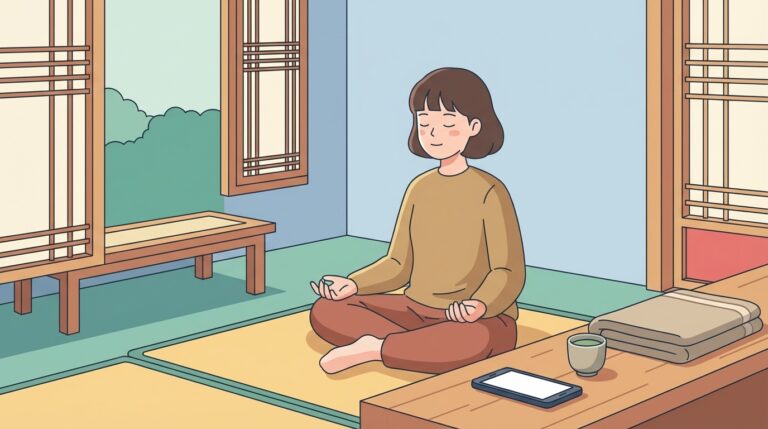
In modern Korea, a Temple Stay is rarely about converting to Buddhism. For the exhausted corporate worker in Seoul, it is the ultimate 디지털 디톡스 (Digital Detox). You hand over your smartphone, wear comfortable temple garments, eat vegan food (바루공양), and do the 108 bows (108배) not to worship Buddha, but to silence the chaotic noise of modern life. It’s spirituality rebranded as self-care.
4-2. Non-Verbal Nuances
When discussing religion with older Koreans, 눈치 (Nunchi) is vital. If an elder asks, “교회 다니니?” (Do you go to church?), and you aggressively debate atheism, it’s considered highly disrespectful. The culturally intelligent response is a soft, polite deflection: “아, 아직 특별히 믿는 종교는 없습니다” (Ah, I don’t have a specific religion I believe in yet), accompanied by a warm smile. The word “아직 (yet)” acts as a social buffer, showing humility rather than ideological hostility.
Phase 5: Real-Life Roleplay Scenario
Setting: A trendy vegan cafe in Anguk-dong, right near Jogyesa Temple. It’s Saturday afternoon. You and your Korean colleague, Minji (30, Marketing Manager, perceptive and trendy), are having oat milk lattes.
Minji: 저 다음 주말에 템플스테이 가려고요. 완전 기대돼요! 🧘♀️
(Jeo da-eum ju-mal-e tem-peul-seu-te-i ga-ryeo-go-yo. Wan-jeon gi-dae-dwae-yo!)
(I’m going on a Temple Stay next weekend. I’m so excited!)
YOU: 어? 민지 씨, 기독교 모태신앙 아니었어요?
(Eo? Min-ji ssi, gi-dok-gyo mo-tae-sin-ang a-ni-eo-sseo-yo?)
(Huh? Minji, weren’t you a lifelong Christian?)
Minji: 맞아요. 근데 요즘은 교회 안 나간 지 꽤 됐어요. 현생이 너무 팍팍해서… 종교보다는 그냥 조용히 제 마음의 평안을 찾고 싶더라고요.
(Ma-ja-yo. Geun-de yo-jeum-eun gyo-hoe an na-gan ji kkwae dwae-sseo-yo. Hyeon-saeng-i neo-mu pak-pak-hae-seo… Jong-gyo-bo-da-neun geu-nyang jo-yong-hi je ma-eum-ui pyeong-an-eul chat-go sip-deo-ra-go-yo.)
(That’s right. But it’s been a while since I went to church. Real life is so tough… Rather than religion, I just want to quietly find my peace of mind.)
Minji: [You’re name] 씨는요? 종교 있으세요?
([Your name] ssi-neun-yo? Jong-gyo isseu-se-yo?)
(How about you? Do you have a religion?)
🔀 Your Turn! How do you answer as a C2 learner?
– A) “저는 무신론자입니다. 신은 없다고 생각해요.” (I am an atheist. I believe God doesn’t exist.)
– B) “저는 무교예요. 민지 씨처럼 명상하면서 멘탈 관리하는 게 더 좋더라고요.”
– C) “저도 기복신앙은 별로 안 좋아해요.”✅ Best Choice: B — Reason: It perfectly captures the modern Korean zeitgeist. You state you are Mugyo (non-religious) but immediately connect with her desire for mental health and meditation, building rapport.
⚠️ Choice A Analysis: While grammatically flawless, declaring yourself a “무신론자” (Atheist) in a strict sense can sound a bit academic and cold for a casual cafe chat.
⚠️ Choice C Analysis: Suddenly bringing up Giboksinang is slightly unnatural here and might sound like you are lecturing her.
Phase 6: 10-Second Shadowing Drill
Speak aloud with the right pauses and intonation to sound like a native intellectual discussing modern trends!
😊 저는 / 종교는 없지만, / 마음의 평안을 위해서 / 명상은 즐겨 해요.
(jeo-neun / jong-gyo-neun eop-ji-man, / ma-eum-ui pyeong-an-eul wi-hae-seo / myeong-sang-eun jeul-gyeo hae-yo.)
(I don’t have a religion, but I enjoy meditation for peace of mind.)
Pro Tip: Elongate the “평~안” slightly to give it a soothing, thoughtful vibe!
Phase 7: K-Culture Mini Dictionary
| Korean | Romanization | English | Contextual Meaning |
|---|---|---|---|
| 무교 | mugyo | Non-religious | Having no formal religious affiliation. The most common response among Gen Z. |
| 현생 | hyeonsaeng | Real / Current Life | Slang for one’s current, exhausting reality. Used when reality gets in the way of hobbies, fandoms, or religion. |
| 멘탈 관리 | mental gwanri | Mental Management | Taking care of one’s mental health. Replaced religious prayer for many youths. |
| 사주팔자 | saju palja | Fortune Telling | The Four Pillars of Destiny. Ironically, while youth are secularizing, they flock to Saju readers to ease anxiety about the future. |
Phase 8: Traveler Survival Kit (Cultural & Religious Sites)
Even if Koreans are secularizing, beautiful temples and historic cathedrals are major travel destinations.
🆘 Survival Expressions for Visiting Religious Sites
– 🇰🇷 “여기서 사진 찍어도 되나요?” (yeo-gi-seo sa-jin jji-geo-do doe-na-yo?)
– 🗣️ Meaning: Is it okay to take pictures here?
– 📍 Where to use: Inside a temple hall or a historic church.
– 💡 Pro Tip: Never point your camera directly at someone who is deep in prayer or bowing.📌 Editor’s Travel Note
– Footwear Rules: If you see a wooden floor inside a temple building, you must take off your shoes.
– Donation Boxes (불전함): You’ll see wooden boxes at temples. You don’t have to donate, but leaving a 1,000 KRW bill is a nice gesture if you make a wish.
– Temple Stays: If you want to book one, use the official Templestay website. They have programs specifically catered to English speakers!
Phase 9: Critical Thinking — “One Step Deeper”
🧠 Think Deeper: The Irony of Secularization and ‘Saju’ (Fortune Telling)
It is deeply fascinating that while the religious population in Korea is drastically decreasing, the market for Saju (traditional fortune-telling) and Tarot cards is booming among people in their 20s and 30s. Why? In a hyper-competitive society, young Koreans are plagued by uncertainty regarding employment, housing, and marriage. Organized religion demands commitment, regular attendance, and obedience to dogma—which feels burdensome.
Conversely, Saju or Tarot offers personalized “consulting.” It provides immediate psychological comfort without the institutional strings attached. This highlights a shift from collective religious worship to individualized spiritual consumerism. They aren’t seeking a god to serve; they are seeking a navigator for their anxiety.
💬 Your Turn: In your culture, when young people feel anxious about the future and step away from traditional religion, where do they turn for psychological comfort? Share in the comments!
Phase 10: FAQ & Avoiding Misunderstandings
Q1: Can I ask a Korean I just met about their religion?
Yes, but with caution. Unlike politics, religion is not entirely taboo, but it’s not the best icebreaker. Wait until you know them better, and ask politely: “혹시 종교 있으세요?” (Do you happen to have a religion?)
Q2: A Korean friend said they are “Mugyo” (non-religious), but they still perform “Jesa” (ancestral rites) during Chuseok. Isn’t that a contradiction?
Great observation! In Korea, Confucian ancestral rites (Jesa) are viewed by most as a cultural tradition and familial duty, not a religious worship of a deity. Being Mugyo simply means they don’t attend church, temple, or mosque.
❌ Common Mistake: Confusing Korean “무교” (Mugyo) with strict Western “Atheism.” Many Koreans who claim to be Mugyo still believe in an afterlife, ghosts, or karma. They just reject institutional religion.
Phase 11: Summary & Action Items
One-Liner Summary: Modern Koreans are experiencing rapid Taljonggyohwa (secularization), shifting away from institutional Giboksinang (praying for blessings) to seek personal mental peace and Hyeonsaeng (real life) survival.
Action Mission 3-Steps:
– 🥉 Bronze: Look in the mirror and practice saying, “저는 종교는 없지만 명상은 좋아해요.”
– 🥈 Silver: Write a short journal entry in Korean about your thoughts on Taljonggyohwa.
– 🥇 Gold: Next time you chat with a Korean language exchange partner, ask them what they think about the popularity of Temple Stays among Gen Z!
K-Culture Mission: Watch an episode of a K-Drama (like The Glory or My Liberation Notes) and observe the characters’ relationship with religion or fate. Do they rely on prayers, or their own willpower?
Phase 12: Quiz — Interactive Challenge
1. Situational Judgment:
You are discussing societal trends in a high-level Korean class. You want to say that fewer people are attending religious institutions these days. Which phrase is the most C2-appropriate?
– A) 한국 사람들은 이제 신을 안 믿어요.
– B) 최근 한국 사회에서 탈종교화 현상이 뚜렷해지고 있습니다.
– C) 교회가 재미없어서 사람들이 안 가요.
2. True or False — K-Culture Edition:
If a Korean says they are “무교” (Mugyo), it means they absolutely despise all forms of spirituality and will never visit a temple or get a Tarot reading. (T/F)
3. Fill in the Blank:
“I used to go to church, but nowadays my _______ is too busy and exhausting, so I just rest on Sundays.”
“예전엔 교회에 갔는데, 요즘은 (________)이/가 너무 바빠서 일요일엔 그냥 쉬어요.”
(Answers: 1. B – It uses advanced vocabulary suitable for C2. / 2. False – Mugyo just means no formal affiliation; many still enjoy spiritual activities like Tarot or Temple Stays. / 3. 현생 (Hyeonsaeng))
Frequently Asked Questions (FAQ)
Q: What does "탈종교화 (Secularization / Decline of Religious Population)" mean in Korean and how do you pronounce it?
A: In Korean, "탈종교화 (Secularization / Decline of Religious Population)" is pronounced [Tal-jong-gyo-hwa] and means: (Literal) De-religionization / (Real Nuance) The societal trend where people, especially the youth, are abandoning formal religious institutions.
Q: What does "모태신앙 (Faith from the Mother's Womb)" mean in Korean and how do you pronounce it?
A: In Korean, "모태신앙 (Faith from the Mother's Womb)" is pronounced [Mo-tae-sin-ang] and means: (Literal) Womb faith / (Real Nuance) Someone who has belonged to a religion (usually Christianity) since birth because of their parents.
Q: What does "기복신앙 (Praying for Earthly Blessings)" mean in Korean and how do you pronounce it?
A: In Korean, "기복신앙 (Praying for Earthly Blessings)" is pronounced [Gi-bok-sin-ang] and means: (Literal) Praying for fortune faith / (Real Nuance) A transactional approach to religion where one prays primarily for wealth, health, or success (like passing the university entrance exam).







