

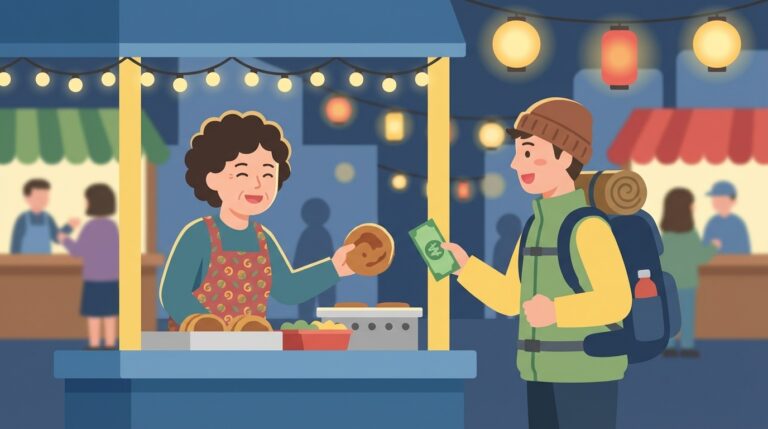
Panic at the Food Stall? 떡볶이 and the Art of Paying in Cash 💸
Phase 1: Welcome to the Street Food Alley!
Hello there! I’m your Daily Hangul Editor, your local Korean friend and veteran tutor. 😊
Picture this: You are walking through the vibrant alleys of Gwangjang Market or Myeongdong. The air smells like sweet Hotteok (호떡) and spicy Tteokbokki (떡볶이). You finally point to a delicious skewer, the vendor hands it to you, and you proudly pull out your shiny credit card.
Suddenly, the smiling vendor crosses their arms in an ‘X’ shape and says, “카드 안 돼요” (No cards). Panic sets in! You see a cardboard sign with bank account numbers, but you don’t have a Korean bank account yet.
In K-Dramas, you always see people tapping their phones or cards to pay for everything. Korea is famously a “cashless society.” But street food stalls? That’s the one place where cash is still king! Today, we are going to learn exactly what to say and do when buying street food in Korea so you can eat like a true insider without any awkward moments.
Phase 2: Core Expressions Deep Dive
Let’s learn the survival phrases you need when holding that delicious skewer!
1. 현금 결제 되나요? (Can I pay with cash?)
- Pronunciation: [hyeon-geum gyeol-je doe-na-yo?]
- Sound-alike: ‘Hyeon’ sounds like “hyun” in Hyundai. ‘Gyeol’ is like “gyul”.
- Meaning: Literal: Is cash payment possible? / Real nuance: Do you accept cash?
- K-Culture Moment: You’ve just ordered a 3,000 won fish cake. Instead of assuming, you politely ask this while reaching for your wallet. It shows you know how things work!
- Editor’s Insight: Even though cash is preferred at street stalls, asking this politely softens the interaction. It’s much better than just shoving a bill at them.
- Situation Spectrum:
[🚫 Never] ———— [⚠️ Be Careful] ———— [✅ Freely]
- Close Friends (Casual): 🚫 (You don’t buy things from friends!)
- Vendors/Store owners (Formal/Polite): ✅
- 🤔 Think About It: Why do Koreans use “되나요?” (Is it becoming/possible?) instead of “Can I?” Korean language focuses on the situation being possible rather than the person doing the action.
2. 계좌이체 할게요. (I will do a bank transfer.)
- Pronunciation: [gye-jwa-i-che hal-ge-yo.]
- Meaning: I will transfer to your bank account.
- K-Culture Moment: Look around any Korean street food stall, and you’ll see a piece of paper with a bank name and number. Young Koreans almost never carry cash, so they quickly transfer the money using their banking apps right in front of the vendor.
- Editor’s Insight: If you live in Korea and have a local bank account, this is your magic phrase. Once you say it, the vendor will nod and let you eat while you tap away on your phone.
- Situation Spectrum:
[🚫 Never] ———— [⚠️ Be Careful] ———— [✅ Freely]
- Store owners/Vendors: ✅
3. 잔돈 있으세요? (Do you have change?)
- Pronunciation: [jan-don i-sseu-se-yo?]
- Meaning: Do you have small change?
- K-Culture Moment: You want a 2,000 won snack, but you only have a yellow 50,000 won bill (Shin Saimdang). Vendors hate breaking large bills for small items early in the day. Asking this first is a huge sign of respect (눈치 – Nunchi)!
- Editor’s Insight: ‘잔돈’ means small change. Using ‘으세요’ makes it highly respectful to the older vendor (Ajumma/Ajeossi).
- Situation Spectrum:
[🚫 Never] ———— [⚠️ Be Careful] ———— [✅ Freely]
- Vendors/Taxi drivers: ✅
Phase 3: Textbook vs. Real Korean
Let’s see how real people talk on the streets compared to textbooks.
| Situation | 📖 Textbook Korean | 🗣️ Real Korean | 💡 Why is it different? |
|---|---|---|---|
| Asking to pay in cash | 현금으로 계산할 수 있습니까? (Can I calculate with cash?) | 현금 돼요? (Cash possible?) | Koreans love efficiency. Dropping the verb and just asking “Noun + possible?” is the ultimate shortcut. |
| Asking the price | 이것은 얼마입니까? (How much is this?) | 사장님, 이거 얼마예요? (Boss, how much is this?) | Adding “사장님” (Boss/Owner) gets their attention politely and builds quick rapport. |
| Giving the money | 여기 현금 있습니다. (Here is the cash.) | 여기요~ / 현금이요~ (Here~ / Cash~) | A friendly, slightly prolonged “~yo” sounds much more natural and sweet than a robotic statement. |
Bottom Note: Stick to “현금 돼요?” (Hyeon-geum doe-yo?)! It’s perfectly polite for A2 learners and sounds incredibly natural.
Phase 4: Cultural Context — K-Culture Deep Dive
4-1. Non-verbal Cue: The Two-Handed Rule
When you hand your cash to the vendor (often an older auntie ‘Ajumma’ or uncle ‘Ajeossi’), try to use both hands, or at least support your right elbow with your left hand. It’s a classic sign of respect in Korea. If you hand over cash with one hand (especially your left hand) while looking at your phone, you might get a grumpy look!
4-2. K-Travel & Food Connection: The 1% Cash Zone
Korea is a futuristic playground. You can ride the subway, buy a coffee, and even pay for a tiny pack of gum at the convenience store with a card or phone. But traditional markets (like Gwangjang Market where you eat Bindaetteok) and late-night Pojangmacha (tented food stalls seen in every K-Drama drinking scene) are the exceptions.
Why? Street stalls often don’t have registered card terminals, and transaction fees eat into their small profits. Carrying a few 1,000 won (blue) and 10,000 won (green) bills is a traveler’s secret weapon!
Phase 5: Real-life Roleplay Scenario
Setting: A chilly Friday night in Myeongdong. The neon lights are bright. You are standing in front of a steaming stall selling Gyeran-ppang (Egg Bread).
Characters:
– YOU: A hungry traveler craving something warm.
– Ajumma (아줌마): The stall owner. She is moving fast, flipping the breads.
Dialogue:
YOU: 사장님, 이거 하나 얼마예요? 🍞
(Sa-jang-nim, i-geo ha-na eol-ma-ye-yo?)
[Boss, how much is one of these?]
Ajumma: 이천 원이에요~ 뜨거우니까 조심해요.
(I-cheon won-i-e-yo~ Tteu-geo-u-ni-kka jo-sim-hae-yo.)
[It’s 2,000 won~ It’s hot, so be careful.]
(🎭 Stage Direction: She puts the bread in a small paper cup and hands it to you.)
YOU: (Reaching for your wallet) 아, 카드 되나요?
(Ah, ka-deu doe-na-yo?)
[Ah, do you take cards?]
Ajumma: 미안해요, 카드는 안 돼요. 현금이나 계좌이체만 돼요.
(Mi-an-hae-yo, ka-deu-neun an doe-yo. Hyeon-geum-i-na gye-jwa-i-che-man doe-yo.)
[Sorry, no cards. Only cash or bank transfer.]
🔀 Your Turn! How do you respond?
– A) “오만 원짜리 있어요. 잔돈 있으세요?” (I have a 50,000 won bill. Do you have change?)
– B) “현금 없어요. 안녕히 계세요.” (I don’t have cash. Goodbye.) – While handing the food back
– C) “아, 그럼 여기 현금 만 원이요!” (Ah, then here is 10,000 won in cash!)✅ Best Choice: C — It’s the smoothest transaction.
⚠️ Choice A Analysis: It’s okay if you absolutely must, but asking an Ajumma to break a 50,000 bill for a 2,000 won item might make her sigh loudly! Always try to carry smaller bills.
Ajumma: 네, 팔천 원 거스름돈 여기 있어요. 맛있게 먹어요!
(Ne, pal-cheon won geo-seu-reum-don yeo-gi i-sseo-yo. Ma-sit-ge meo-geo-yo!)
[Yes, here is 8,000 won in change. Enjoy your food!]
YOU: 감사합니다! 많이 파세요~
(Gam-sa-ham-ni-da! Ma-ni pa-se-yo~)
[Thank you! Sell a lot (Hope you have good business)!]
Phase 6: 10-Second Shadowing Drill
Practice this until it flows naturally! (Follow the pauses /)
😊 사장님, / 카드는 / 안 되나요? / 그럼 / 현금으로 / 할게요!
(Sa-jang-nim, / ka-deu-neun / an doe-na-yo? / geu-reom / hyeon-geum-eu-ro / hal-ge-yo!)
Friendly: Boss, you don’t take cards? Then I’ll pay with cash!
Phase 7: K-Culture Mini Dictionary
| Korean | Romanization | English | Context |
|---|---|---|---|
| 포장마차 | po-jang-ma-cha | Tented street stall | Where K-Drama leads drink Soju and eat udon. Cash is a must here! |
| 현금 | hyeon-geum | Cash | Physical money (bills and coins). |
| 계좌이체 | gye-jwa-i-che | Bank transfer | The lifeline of young Koreans at street stalls. |
| 잔돈 / 거스름돈 | jan-don / geo-seu-reum-don | Change | Money returned to you, or small coins/bills. |
| 길거리 음식 | gil-geo-ri eum-sik | Street food | Tteokbokki, Hotteok, Odeng, etc. |
Phase 8: Traveler’s Survival Kit
🆘 Survival Phrases Top 3
– 🇰🇷 “이거 하나 얼마예요?” (i-geo ha-na eol-ma-ye-yo?) – How much is one of this?
– 🇰🇷 “잔돈 있으세요?” (jan-don i-sseu-se-yo?) – Do you have change?
– 🇰🇷 “많이 파세요~” (ma-ni pa-se-yo) – Literally “Sell a lot.” A polite way to say goodbye to a vendor!📌 Editor’s Travel Note
– The Bill Rule: Keep 1,000 won (blue) and 10,000 won (green) bills in your pocket. Avoid handing over a 50,000 won (yellow) bill for a 1,500 won fish cake.
– Tipping? Korea has NO tipping culture. If you leave your change on the counter, the Ajumma might chase you down the street thinking you forgot your money!
Phase 9: Critical Thinking — “One Step Deeper”
Media vs Reality: The Illusion of the 100% Cashless Society
🧠 Think Deeper:
If you watch K-Dramas, you might think cash doesn’t exist in Korea anymore. Everyone taps their sleek smartphones on subway gates and cafe counters. However, traditional markets represent the heartbeat of the older generation. Using cash here isn’t just about avoiding card fees; it’s a bridge between the high-tech modern lifestyle and the nostalgic ‘Jeong’ (정 – warm connection) of the past. Handing physical money to the vendor creates a brief human connection that a digital beep just can’t replace.💬 Your Turn: Does your country have places where only cash is accepted? How do you feel about moving to a completely cashless society? Tell us in the comments!
Phase 10: FAQ & Avoiding Mistakes
Q: Can I bargain (haggle) at a street food stall?
No! Unlike clothing markets (like Dongdaemun) where you might playfully ask for a discount, food prices are fixed and already very cheap. Haggling for a $2 snack is considered rude.
Q: What if I really don’t have cash and I already ate?
If you have a Korean friend with you, they will do a “계좌이체” (Bank transfer). If you are alone, politely explain “현금이 없어요. ATM 어디 있어요?” (I have no cash. Where is the ATM?) and leave an item behind as collateral while you run to get cash. Most convenience stores have ATMs.
❌ Common Mistake: Throwing the money on the counter.
✅ Do this instead: Hand the money directly to the vendor with a slight nod or two hands. If their hands are messy from cooking, they might point to a money box where you can drop it in and take your own change (honor system!).
Phase 11: Summary & Action Items
One-Liner Summary: When buying Korean street food, remember that “Cash is King,” and asking “현금 되나요?” will make you look like a polite local expert!
Action Mission:
– 🥉 Bronze: Stand in front of a mirror with a dollar bill and practice handing it over while saying “현금으로 할게요” (I’ll pay in cash).
– 🥈 Silver: Write down your favorite Korean street food in your notebook and the phrase “[Food name] 하나 얼마예요?”
– 🥇 Gold: Next time you visit a Korean market or festival, confidently pay in cash using the two-handed rule!
🎬 K-Culture Mission:
Watch a K-Drama episode tonight. Spot a scene where the characters eat at a Pojangmacha (tented stall). Look closely—do they pay with a card or cash? (Hint: It’s almost always cash!)
Phase 12: Quiz — Interactive Challenge
1. Situational Judgment: You want to buy a 3,000 won Tteokbokki, but you only have a 50,000 won bill. What should you ask first?
A) 카드 돼요? (Do you take cards?)
B) 잔돈 있으세요? (Do you have change?)
C) 깎아주세요. (Give me a discount.)
(Answer: B. Asking if they have change first shows great Nunchi!)
2. True or False – K-Culture Edition:
“The street food was amazing! I should leave a 2,000 won tip for the Ajumma to show my appreciation.”
(Answer: FALSE. Tipping is not practiced in Korea. Just tell her “정말 맛있어요! 많이 파세요~” (It’s really delicious! Sell a lot!)—that’s the best tip!)
3. Fill in the Blank:
You want to ask if they accept cash.
“사장님, ____ 결제 되나요?”
(Answer: 현금 – hyeon-geum)
Frequently Asked Questions (FAQ)
Q: What does "현금 결제 되나요? (Can I pay with cash?)" mean in Korean and how do you pronounce it?
A: In Korean, "현금 결제 되나요? (Can I pay with cash?)" is pronounced [hyeon-geum gyeol-je doe-na-yo?] and means: a key conversational Korean expression covered in this lesson.
Q: What does "계좌이체 할게요. (I will do a bank transfer.)" mean in Korean and how do you pronounce it?
A: In Korean, "계좌이체 할게요. (I will do a bank transfer.)" is pronounced [gye-jwa-i-che hal-ge-yo.] and means: I will transfer to your bank account.
Q: What does "잔돈 있으세요? (Do you have change?)" mean in Korean and how do you pronounce it?
A: In Korean, "잔돈 있으세요? (Do you have change?)" is pronounced [jan-don i-sseu-se-yo?] and means: Do you have small change?






