

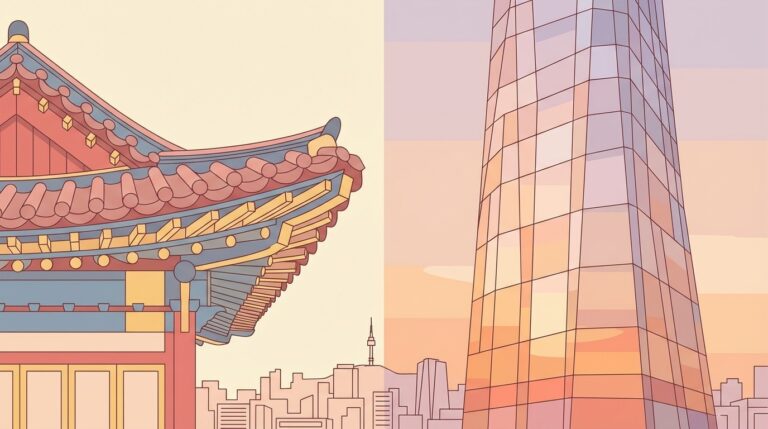
Phase 1: The Immersive Open
Hello there! I’m your Daily Hangul Editor, your veteran tutor, and your personal local navigator here in Seoul.
Picture this: You are watching your favorite K-Drama. The main character, usually a young and incredibly wealthy CEO (a Chaebol), is standing by a massive floor-to-ceiling window in their penthouse or corner office. They are looking down at the glittering sea of lights that is Seoul, holding a glass of whiskey. They turn around and say something profound about the city.
But when you finally visit Seoul, standing on the 118th floor of the Lotte World Tower, or looking out from a trendy rooftop in Seongsu-dong where old shoe factories meet hyper-modern glass skyscrapers, you realize… you only know how to say “이 건물이 아주 커요” (This building is very big).
As a C1-level speaker, you are beyond basic descriptions. You want to sound like an educated local who can discuss the breathtaking skyline, the blend of history and modernity, and the complex reality of urban regeneration. This guide, based on real conversations my advanced students have had with their Korean colleagues, will give you the precise tools to sound like a true insider. Let’s elevate your Korean to the penthouse level!
Phase 2: Deep Dive into Core Expressions
1. 스카이라인이 장관이네요.
- Pronunciation: seukairaini jang-gwani-ne-yo [seukairaini jahng-gwan-ee-neh-yo]
- Meaning: The skyline is spectacular. (Literal: The skyline is a grand sight.)
- K-Culture Moment: You are at a company dinner (Hoesik) at an upscale restaurant with a view of the Han River. Instead of a simple “와, 멋있다” (Wow, cool), you drop this line. Your colleagues will immediately nod in respect.
- Editor’s Insight: “장관이다” is a high-level vocabulary word used to describe an awe-inspiring, magnificent view. It carries a heavy, sophisticated nuance compared to basic adjectives.
- Situation Spectrum:
[🚫 절대 금지] ———— [⚠️ 주의] ———— [✅ 자유롭게]
- Friends (Casual): ✅ (Usually with a slight tone change: “야, 장관이다!”)
- Colleagues (Semi-formal): ✅
- Boss/Elders (Formal): ✅ (Perfectly polite and professional)
- 🤔 Think About It: Korean heavily relies on Sino-Korean words (Hanja) like “장관 (壯觀)” to elevate the formality and poetry of a sentence. Does your native language have a separate set of vocabulary for professional or artistic descriptions?
2. 구도심과 신도심이 절묘하게 어우러지네요.
- Pronunciation: gudosim-gwa sindosim-i jeolmio-hage eo-u-reo-ji-ne-yo [goo-doh-shim-gwa shin-doh-shim-ee jul-myo-ha-geh uh-oo-ruh-jee-neh-yo]
- Meaning: The old and new downtowns blend exquisitely.
- K-Culture Moment: Walking around DDP (Dongdaemun Design Plaza), where Zaha Hadid’s futuristic silver spaceship sits right next to traditional markets and old city gates.
- Editor’s Insight: “절묘하게 어우러지다” is a phrase you will hear constantly from Korean architects, designers, and art critics. It means two contrasting things exist together in perfect harmony.
- Situation Spectrum:
[🚫 절대 금지] ———— [⚠️ 주의] ———— [✅ 자유롭게]
- Friends (Casual): ⚠️ (Might sound a bit too academic/pretentious for a casual beer night)
- Colleagues (Semi-formal): ✅
- Boss/Elders (Formal): ✅
- 🤔 Think About It: Seoul was largely rebuilt after the 1950s. Why do you think Koreans place such a high linguistic value on the “harmony” (조화) of the old and the new?
3. 뷰가 탁 트여서 가슴이 뻥 뚫리는 기분이에요.
- Pronunciation: byu-ga tak teu-yeo-seo gaseum-i ppeong ttul-li-neun gibun-i-e-yo [byoo-gah tahk teu-yuh-suh gah-seum-ee ppuhng ttool-lee-neun gee-boon-ee-eh-yo]
- Meaning: The view is so open, it feels like my chest is cleared out (I feel completely refreshed).
- K-Culture Moment: Reaching the top of N Seoul Tower or an observatory after a stressful week of work in the crowded city below.
- Editor’s Insight: Koreans physically associate emotional frustration with feeling “stuffy in the chest” (답답하다). Therefore, looking at a high, unobstructed view “punches a hole” (뻥 뚫리다) in that frustration. It’s an incredibly native way to express relief.
- Situation Spectrum:
[🚫 절대 금지] ———— [⚠️ 주의] ———— [✅ 자유롭게]
- Friends (Casual): ✅ (가슴이 뻥 뚫린다!)
- Colleagues (Semi-formal): ✅
- Boss/Elders (Formal): ⚠️ (Can be used, but usually kept for personal expression rather than formal reports)
- 🤔 Think About It: Emotional catharsis linked to physical spaces—how do you express “taking a breath of fresh air” in your culture?
Phase 3: Textbook vs. Real Korean
| Situation | 📖 Textbook Korean | 🗣️ Real Korean (C1 Level) | 💡 Why is it different? |
|---|---|---|---|
| Describing building height | 이 건물은 아주 높습니다. (This building is very tall.) | 와, 건물이 하늘을 찌를 듯하네요. (The building seems to pierce the sky.) | Koreans love vivid, exaggerated metaphors to express awe. |
| Enjoying the night view | 야경이 예쁩니다. (The night view is pretty.) | 야경이 예술이네요 / 끝내주네요. (The night view is art / killer.) | “예술이다” is a colloquial way to say something is flawlessly beautiful. |
| Talking about old and new areas | 옛날 건물과 새 건물이 있습니다. (There are old and new buildings.) | 전통과 현대의 조화가 매력적이네요. (The harmony of tradition and modernity is charming.) | Advanced speakers use nominalization (조화, 매력) to sound analytical and polished. |
Bottom Note: At the C1 level, your goal is to transition from stating basic facts to expressing nuanced feelings and cultural observations. Using idiomatic expressions like “끝내주다” in the right context proves you understand the “vibe” of the language.
Phase 4: Cultural Context — K-Culture Deep Dive
4-1. The Non-Verbal Nunchi of High Places
When visiting high-end skyscrapers in Seoul (like the top floors of Parc1 or Lotte World Tower), the atmosphere is often intensely curated. There is an unspoken Nunchi (눈치) rule: the higher the floor, the quieter the voice. If you are expressing amazement at the view, do it with an aspirated, almost whispered tone (“와…”), rather than a loud shout. It shows you belong in that sophisticated space.
4-2. The K-Drama Trope: The Corner Office
Have you noticed in K-Dramas that power is always represented by elevation? The evil chairman or the brilliant young CEO is always filmed standing against a panoramic window, looking down at the traffic below. This isn’t just a cool camera angle; it reflects a deeply ingrained social hierarchy. In a rapidly developed city like Seoul, occupying the sky means you have conquered the intense, hyper-competitive reality of the ground level.
4-3. Urban Regeneration: The Seongsu-dong Phenomenon
Seoul isn’t just about tearing everything down anymore. The hottest trend is “도시 재생” (Urban Regeneration). Areas like Seongsu-dong were once grimy industrial zones full of handmade shoe factories. Now? Those same brick factories house Dior pop-ups, artisanal cafes, and K-Pop entertainment companies. The juxtaposition of a rusted iron gate next to a sleek glass skyscraper is the defining aesthetic of modern Seoul.
Phase 5: Real-Life Roleplay Scenario
Setting: Friday evening, 7:30 PM. You are at a trendy rooftop wine bar in Seongsu-dong with your Korean colleagues. The sun is setting, casting a golden glow over a massive new glass skyscraper right next to an old red-brick factory.
Characters:
– YOU: A foreign professional working in Seoul, trying to impress your team with your cultural and linguistic fluency.
– Min-su (34): Your friendly Korean manager. He appreciates good architecture and loves a good glass of wine.
Dialogue:
Min-su: 여기 분위기 진짜 좋죠? 요즘 성수동이 제일 핫플이에요.
(yeogi bunwigi jinjja chojyo? yojeum seongsudong-i jeil hatpeul-i-e-yo.)
[The atmosphere here is really great, right? Seongsu-dong is the trendiest place these days.]
YOU: 네, 정말 좋네요. 특히 저기 오래된 공장 옆에 새 빌딩이 있는 게 인상적이에요.
(ne, jeongmal jonneyo. teukhi jeogi oraedoen gongjang yeope sae bilding-i inneun ge insangjeok-i-e-yo.)
[Yes, it’s really great. It’s especially impressive how that new building is right next to the old factory.]
Min-su: 맞아요. 예전에는 그냥 다 부수고 아파트를 지었는데, 요즘은 이런 도시 재생 프로젝트가 많아졌어요.
(majayo. yejeon-eneun geunyang da busugo apateu-reul jieon-neunde, yojeum-eun ireon dosi jaesaeng peurojekteu-ga manajyeosseoyo.)
[Exactly. In the past, they just demolished everything and built apartments, but these days there are many urban regeneration projects like this.]
(Min-su points toward the skyline across the river)
Min-su: 저기 강 건너 빌딩들 뷰도 꽤 괜찮지 않아요?
(jeogi gang geonneo bilding-deul byu-do kkwae gwaenchanji anayo?)
[The view of the buildings across the river is pretty nice too, isn’t it?]
🔀 Your Turn! How should you respond?
– A) “네, 건물이 아주 크고 높아요.” (Yes, the buildings are very big and tall.)
– B) “와, 진짜 구도심과 신도심이 절묘하게 어우러지네요. 스카이라인이 장관이에요!” (Wow, the old and new downtowns blend perfectly. The skyline is spectacular!)
– C) “헐, 대박! 뷰가 미쳤네요!” (Omg, epic! The view is crazy!)✅ Best Choice: B — Reason: It matches the sophisticated atmosphere of the rooftop wine bar and demonstrates high-level vocabulary appropriate for discussing architecture with a manager.
⚠️ Choice C Analysis: While native speakers definitely say “뷰가 미쳤다” (the view is crazy), using it with your manager at a semi-formal gathering might make you sound a bit too immature or overly casual. Save choice C for when you are with your closest friends!
Bonus K-Culture Scenario: At the Lotte World Tower Observatory
Staff: 손님, 창가 쪽으로 붙으시면 사진이 더 잘 나옵니다.
(sonnim, chang-ga jjog-euro but-eusimyeon sajin-i deo jal naomnida.)
[Customer, if you stick closer to the window, the photos will come out better.]
YOU: 아, 감사합니다. 혹시 여기서 서울 야경이 제일 잘 보이는 포인트가 어딘가요?
(a, gamsahamnida. hoksi yeogiseo seoul yagyeong-i jeil jal boineun pointeu-ga eodin-gayo?)
[Ah, thank you. By any chance, where is the best point to see the Seoul night view from here?]
Staff: 저쪽 남산타워 방향 뷰가 제일 끝내줍니다!
(jeojjok namsantawo banghyang byu-ga jeil kkeunnae-jumnida!)
[The view toward N Seoul Tower over there is the absolute best!]
Phase 6: 10-Second Shadowing Drill
Speak out loud! Follow the pauses (/) and match the emotion tag.
😌 (In awe, taking a deep breath)
뷰가 / 탁 트여서 / 가슴이 / 뻥 뚫리는 / 기분이에요! ttul-li-neun / gibun-i-e-yo!)
(byu-ga / tak teu-yeo-seo / gaseum-i / ppeong
Phase 7: K-Culture Mini Dictionary
| 한국어 | Romanization | English | Context |
|---|---|---|---|
| 마천루 | macheonnu | Skyscraper | A Sino-Korean word used in news or formal contexts instead of just “고층 빌딩” (high-rise building). |
| 도시 재생 | dosi jaesaeng | Urban regeneration | A huge buzzword in Seoul. Converting old spaces into cultural hubs rather than destroying them. |
| 야경 | yagyeong | Night view | Seoul is famous for its night view, often jokingly attributed to office workers doing overtime! |
| 핫플 | hatpeul | Hot place (Trendy spot) | Slang for a highly popular, Instagrammable location. |
| 젠트리피케이션 | jenteuripikeisyeon | Gentrification | The dark side of urban regeneration; a very common topic in Korean news regarding places like Seongsu or Hongdae. |
Phase 8: Traveler Survival Kit
If you are visiting Seoul’s iconic landmarks, you need these phrases to navigate like a pro.
🆘 Survival Phrases
– 🇰🇷 “전망대 입구가 어디예요?” (jeonmangdae ipgu-ga eodi-ye-yo?)
– 🗣️ Where is the entrance to the observation deck?
– 🇰🇷 “창가 자리로 부탁드려요.” (chang-ga jari-ro butak-deuryeo-yo.)
– 🗣️ A window seat, please. (Crucial for cafes/restaurants in tall buildings!)
– 🇰🇷 “사진 한 장만 찍어주시겠어요?” (sajin han jang-man jjigeo-jusi-gesseo-yo?)
– 🗣️ Could you please take a picture for me?📌 Editor’s Travel Note
– App Tip: For navigating massive complexes like COEX or Lotte World Mall, use KakaoMap’s indoor map feature.
– Pro Tip: Koreans are arguably the best smartphone photographers in the world. If you want a great full-body shot with a skyscraper in the background, ask a Korean in their 20s or 30s. They will instinctively crouch down to give you the best proportions!
– Tickets: Always book tickets for places like N Seoul Tower or Lotte World Tower online via apps like Naver. It’s usually cheaper and lets you skip the massive queues.
Phase 9: Critical Thinking Corner — “A Step Deeper”
🧠 Think Deeper: Media vs. Reality — The Two Faces of Seoul’s Skyline
In K-Dramas, Seoul’s skyline is often depicted as a flawless, glittering utopia of glass and steel, perfectly representing the “Miracle on the Han River.” However, the reality of this hyper-rapid development is much more complex. The “Pali-pali” (Hurry up) culture that built these skyscrapers often came at the cost of erasing historical neighborhoods. Today’s push for “Urban Regeneration” (도시 재생) is an attempt to heal that historical amnesia. When Koreans proudly show you a place like Seoullo 7017 (an old highway turned into a walking park) or Seongsu-dong, they aren’t just showing off a cool spot; they are showing a shift in national identity—from blindly chasing the future to finally respecting the past.
💬 Your Turn: How does your city balance rapid modern development with preserving its historical identity? Have you experienced a neighborhood changing due to gentrification? Share your thoughts in the comments!
Phase 10: FAQ & Avoiding Common Mistakes
Q: Can I use “끝내주네요” (It’s killer/awesome) to my boss?
A: Maybe, but read the room. It’s a slightly colloquial, enthusiastic expression. If your boss is friendly and you are at a casual team dinner, yes! If it’s the CEO you just met, stick to “장관이네요” (spectacular) or “인상적이네요” (impressive).
Q: How do I talk about the height of a building?
❌ Common Mistake: “이 건물이 아주 커요!” (This building is very big!)
✅ Do This Instead: “건물이 진짜 높네요!” (The building is really tall!)
In Korean, size (크다) and height (높다) are strictly separated when talking about buildings. A stadium is 크다 (big), but a skyscraper is 높다 (tall).
Phase 11: Summary & Action Items
- One-Liner Summary: Elevate your Korean to the C1 level by using sophisticated vocabulary like “장관이다” (spectacular) and “어우러지다” (blend perfectly) to discuss Seoul’s architecture and urban regeneration.
-
Action Mission:
- 🥉 Bronze: Stand by a window at home, look outside, and dramatically sigh: “뷰가 탁 트여서 가슴이 뻥 뚫리네요!”
- 🥈 Silver: Leave a comment on a Korean travel vlog on YouTube praising the night view using “야경이 예술이네요.”
- 🥇 Gold: On your next visit to a high-rise cafe or observatory in Korea, use these expressions with your Korean friend or colleague!
- K-Culture Mission: Open Google Street View, drop the pin in “Seongsu-dong 카페거리” (Cafe Street), and virtually walk around. Spot the exact places where the old red-brick factories meet the new modern aesthetic!
Phase 12: Quiz — Interactive Challenge
1. Situational Judgment: You are looking down at the Han River from a high-end restaurant with a client. Which phrase makes you sound the most professional and fluent?
– A) 한강이 아주 커서 좋아요.
– B) 뷰를 보니 가슴이 뻥 뚫리네요.
– C) 스카이라인이 정말 장관이네요.
2. Fill in the Blank: 옛날 공장 건물과 현대적인 카페의 ( _____ )가/이 참 매력적이에요.
– A) 젠트리피케이션 (Gentrification)
– B) 조화 (Harmony)
– C) 마천루 (Skyscraper)
3. True or False – K-Culture Edition: In Korea, if you want a great photo in front of a landmark, you should look for someone carrying a large professional camera to ask for help.
👉 Click here for Answers!
1. C – A is too basic. B is good but a bit personal/emotional. C is the perfect professional compliment for the view.
2. B – 조화 (Harmony). The harmony of old and new is charming.
3. False – Just look for a Korean in their 20s or 30s with a smartphone. They are culturally trained to take the most flattering, Instagram-ready photos!
Frequently Asked Questions (FAQ)
Q: What does "스카이라인이 장관이네요." mean in Korean and how do you pronounce it?
A: In Korean, "스카이라인이 장관이네요." is pronounced [seukairaini jang-gwani-ne-yo [seukairaini jahng-gwan-ee-neh-yo] and means: The skyline is spectacular. (Literal: The skyline is a grand sight.)
Q: What does "구도심과 신도심이 절묘하게 어우러지네요." mean in Korean and how do you pronounce it?
A: In Korean, "구도심과 신도심이 절묘하게 어우러지네요." is pronounced [gudosim-gwa sindosim-i jeolmio-hage eo-u-reo-ji-ne-yo [goo-doh-shim-gwa shin-doh-shim-ee jul-myo-ha-geh uh-oo-ruh-jee-neh-yo] and means: The old and new downtowns blend exquisitely.
Q: What does "뷰가 탁 트여서 가슴이 뻥 뚫리는 기분이에요." mean in Korean and how do you pronounce it?
A: In Korean, "뷰가 탁 트여서 가슴이 뻥 뚫리는 기분이에요." is pronounced [byu-ga tak teu-yeo-seo gaseum-i ppeong ttul-li-neun gibun-i-e-yo [byoo-gah tahk teu-yuh-suh gah-seum-ee ppuhng ttool-lee-neun gee-boon-ee-eh-yo] and means: The view is so open, it feels like my chest is cleared out (I feel completely refreshed).







