

Phase 1: Empathy & K-Culture Cold Open
Hello there! I’m the Lead Editor at Daily Hangul.
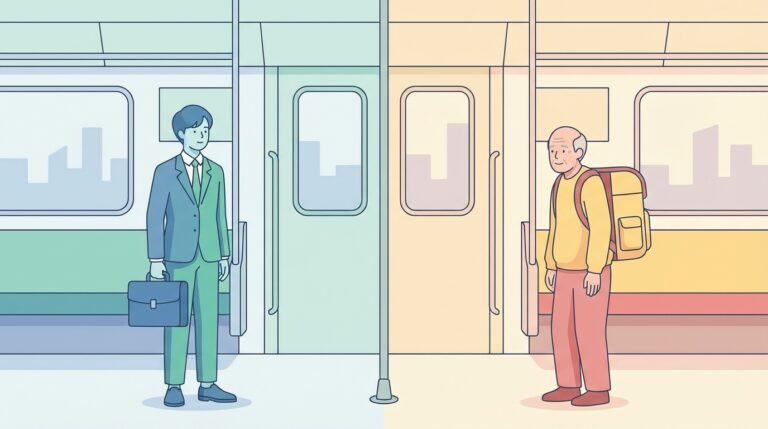
Picture this: It’s 6:00 PM on a Friday. You’re squeezed into Seoul Subway Line 1, notoriously known as the Jiok-cheol (Hell-subway). You look over at the pink ‘Priority Seats’ at the end of the car. A young office worker is sitting there, eyes tightly shut, pretending to be asleep, while an elderly man stands right in front of him, clearing his throat loudly. The tension is palpable.
If you watch slice-of-life K-Dramas like My Mister, you’ve probably seen these scenes. But behind this everyday subway commute lies one of the most heated socioeconomic debates in modern Korea: the deficit of the public transport system and the proposal to raise the eligible age for elderly free rides (지하철 무임승차 연령 상향).
As a C2-level Korean learner, moving beyond ordering coffee to discussing societal issues is what truly makes you an ‘insider.’ If you want to hold your own in a deep conversation with Korean friends over a glass of Soju, you need to understand the cultural and economic nuances behind these headlines. Let’s dive in. This article is based on real debates happening in Korean society right now.
Phase 2: Deep Dive into Core Expressions
1. 무임승차 (Free Riding)
- Pronunciation: mu-im-seung-cha [The ‘으’ in seung sounds like the disgusted sound you make when stepping in gum.]
- Meaning: Literal: Riding without paying a fare. / Real nuance: Free-riding on someone else’s effort (like in a group project or welfare system).
- K-Culture Moment: In university K-Dramas like Cheese in the Trap, the ultimate villain isn’t a monster; it’s the team member who does no work but gets the same grade. Students call this ‘조별과제 무임승차’ (group project free-riding).
- Editor’s Insight: While legally used for the elderly’s free subway passes, younger generations often use this word metaphorically to express frustration about carrying the economic burden for others.
- Situation Spectrum:
[🚫 절대 금지] ———— [⚠️ 주의] ———— [✅ 자유롭게]
- Casual with friends (Discussing news): ✅
- Co-workers (Debating society): ⚠️ (Keep it objective)
- Formal/Elders: 🚫 (Can sound highly accusatory if not used carefully)
- 🤔 Think About It: Why does the concept of ‘free-riding’ evoke such strong emotional reactions in Korea’s highly competitive, meritocratic society?
2. 적자를 보전하다 (To make up for the deficit)
- Pronunciation: jeok-ja-reul bo-jeon-ha-da
- Meaning: To cover or compensate for financial losses.
- K-Culture Moment: You’ll hear this on the 8 O’clock News when anchors discuss why subway fares (gyotong-bi) are increasing again. The government is trying to ‘cover the deficit’ caused by the aging population.
- Editor’s Insight: This is a highly advanced, formal phrase. Using ‘적자를 보전하다’ instead of ‘돈을 메꾸다’ instantly elevates your Korean to a professional, native-like level.
- Situation Spectrum:
[🚫 절대 금지] ———— [⚠️ 주의] ———— [✅ 자유롭게]
- Casual with friends: ⚠️ (A bit too stiff/news-like)
- Co-workers/Business: ✅
- Formal/News debate: ✅
- 🤔 Think About It: Public transport is a public good, yet it operates like a business that fears ‘deficits.’ How does your country handle the financing of public utilities?
3. 세대 갈등 (Generational Conflict)
- Pronunciation: se-dae gal-ddeung [Pronounce ‘ddeung’ strongly, like you’re tapping a tight drum.]
- Meaning: The clash of values and interests between different age groups.
- K-Culture Moment: MZ generation vs. Boomers (Kkondae). It’s the core theme of countless SNL Korea sketches. When discussing the subway free-ride age going from 65 to 70, this is the exact phrase used to describe the tension.
- Editor’s Insight: It’s not just a disagreement; it’s a structural conflict. The youth feel economically squeezed, while the elderly feel abandoned after building the country’s economy.
- Situation Spectrum:
[🚫 절대 금지] ———— [⚠️ 주의] ———— [✅ 자유롭게]
- Casual with friends: ✅
- Co-workers: ✅
- Formal/Elders: ✅ (It’s a recognized sociological term)
- 🤔 Think About It: How does language itself (honorifics vs. casual speech) sometimes fuel this ‘generational conflict’ in Korea?
Phase 3: Textbook vs. Real Korean
| Situation | 📖 Textbook Korean | 🗣️ Real Korean | 💡 Why the difference? |
|---|---|---|---|
| Reacting to fare hikes | 지하철 요금이 올라서 슬픕니다. (I am sad the fare went up.) | 내 월급 빼고 다 오르네. (Everything goes up except my salary.) | Koreans use self-deprecating humor to cope with economic stress. |
| Suggesting a compromise | 무임승차 연령을 상향해야 합니다. (We must raise the free ride age.) | 65세는 요새 청춘이죠, 70세로 올려야 감당이 되죠. (65 is practically youth these days; we gotta raise it to 70 to handle it.) | Reflects the reality of an aging society where ’65’ is no longer considered ‘old.’ |
| Expressing the burden | 적자가 심각합니다. (The deficit is serious.) | 이대로 가면 청년들 등골 휩니다. (At this rate, the youth’s backs will break.) | ‘등골이 휘다’ (spine breaking) vividly visualizes the heavy burden of supporting others. |
Phase 4: Cultural Context — K-Culture Deep Dive
4-1. Non-verbal Element: The Nunchi of the Priority Seats
In Korea, space is deeply tied to hierarchy. The Noyakjaseok (Priority seats for the elderly, disabled, and pregnant) are located at the ends of subway cars. Even when a train is packed to the brim, you will often see these seats empty. Why? Nunchi (눈치). Sitting there as an able-bodied young person invites glares from older passengers. It’s an unspoken social contract, heavily influenced by traditional respect for elders.
4-2. The ‘Subway Delivery Grandpas’ (지하철 택배)
If you observe Seoul subways during the day, you’ll see elderly men with large backpacks or carts. They are part of the ‘Subway Delivery’ service. Because citizens over 65 ride for free, companies hire them to deliver small packages across the city. This touches upon a heartbreaking reality: Korea has one of the highest elderly poverty rates in the OECD. For many seniors, the free subway pass isn’t just a perk; it’s their only means of survival and participation in society. When debating the ‘deficit,’ Koreans are torn between economic logic and compassion for these grandpas.
Phase 5: Real-life Roleplay Scenario
Setting: Tuesday afternoon, inside a bustling cafe near City Hall (시청역). You and your Korean colleague, Min-su, are looking at a news headline on a smartphone about Seoul Metro’s massive deficit.
Characters:
– YOU: An expat professional working in Seoul, fluent enough to discuss current events.
– Min-su (34): Your friendly Korean colleague who is feeling the pinch of inflation.
Dialogue:
Min-su: 하아… 다음 달부터 지하철 요금 또 오른대요. 봤어요?
(Haa… da-eum dal-bu-teo ji-ha-cheol yo-geum tto o-reun-dae-yo. Bwas-seo-yo?)
[Sigh… They say subway fares are going up again next month. Did you see?]
YOU: 네, 기사 봤어요. 적자가 너무 심각하다면서요.
(Ne, gi-sa bwas-seo-yo. Jeok-ja-ga neo-mu sim-gak-ha-da-myeon-seo-yo.)
[Yes, I saw the article. They said the deficit is too severe.]
Min-su: 솔직히 노인 무임승차 때문에 생기는 적자를 왜 우리가 다 떠안아야 하는지 모르겠어요.
(Sol-jik-hi no-in mu-im-seung-cha ttae-mun-e saeng-gi-neun jeok-ja-reul wae u-ri-ga da tteo-an-a-ya ha-neun-ji mo-reu-ges-seo-yo.)
[Honestly, I don’t know why we have to shoulder all the deficit caused by the elderly free rides.]
🔀 Your Turn! How should you respond?
– A) “맞아요! 노인들은 돈을 내야 합니다!” (Too aggressive and culturally insensitive.)
– B) “그래도 어르신들 덕분에 한국이 발전했잖아요. 이해해야죠.” (A bit preachy; might invalidate his frustration.)
– C) “진짜 딜레마네요. 고령화가 너무 빨라서 시스템이 못 따라가는 것 같아요.”✅ Best Choice: C.
Why? It shows immense emotional intelligence. You acknowledge the structural problem (aging society) without directly attacking either generation. This is the pinnacle of C2 conversational skill—balancing empathy with objective analysis.
(Continuing with Choice C)
Min-su: 맞아요. 65세 기준이 80년대에 만들어진 건데, 지금은 현실이랑 너무 안 맞죠.
(Ma-ja-yo. 65-se gi-jun-i 80-nyeon-dae-e man-deul-eo-jin geon-de, ji-geum-eun hyeon-sil-i-rang neo-mu an mat-jyo.)
[Exactly. The 65-year-old standard was made in the 80s, it doesn’t fit reality now.]
YOU: 연령을 70세로 상향하는 논의가 진행 중이라던데, 세대 간의 타협점이 필요해 보이네요.
(Yeon-ryeong-eul 70-se-ro sang-hyang-ha-neun non-ui-ga jin-haeng jung-i-ra-deon-de, se-dae gan-ui ta-hyeop-jeom-i pi-ryo-hae bo-i-ne-yo.)
[I heard discussions to raise the age to 70 are ongoing. Looks like a compromise between generations is needed.]
Phase 6: 10-Second Shadowing Drill
Master this advanced opinion-giving sentence. Pay attention to the pauses!
😤 솔직히 / 고령화 속도를 생각하면, / 무임승차 연령 상향은 / 불가피한 선택이라고 봅니다.
(Sol-jik-hi / go-ryeong-hwa sok-do-reul saeng-gak-ha-myeon, / mu-im-seung-cha yeon-ryeong sang-hyang-eun / bul-ga-pi-han seon-taek-i-ra-go bom-ni-da.)
[Honestly, considering the speed of the aging population, I believe raising the free ride age is an inevitable choice.]
Phase 7: K-Culture Mini Dictionary
| Korean | Romanization | English | Contextual Meaning |
|---|---|---|---|
| 노약자석 | no-yak-ja-seok | Priority Seats | Reserved for the elderly, disabled, and pregnant. A zone of heavy ‘nunchi’. |
| 지옥철 | ji-ok-cheol | Hell-subway | Rush hour subways (Line 1, Line 9) where personal space goes to die. |
| 경로 우대 | gyeong-ro u-dae | Respect/Discount for elders | The traditional and legal system providing benefits to senior citizens. |
| 쩍벌남 | jjeok-beol-nam | Manspreader | A slang for men who sit with their legs spread wide on the subway. |
Phase 8: Traveler Survival Kit (Public Transport Edition)
Even as an advanced speaker, surviving the Seoul subway requires tactical knowledge.
🆘 Survival Expression #1: Excuse me, getting off!
– 🇰🇷 “잠시만요, 내리겠습니다!” (jam-si-man-yo, nae-ri-get-seum-ni-da!)
– 🗣️ Sound guide: jam-shee-man-yo, neh-ree-get-seum-nee-da!
– 📍 Where to use: In a packed Jiok-cheol when the doors open and you’re stuck in the middle.
– 💡 Pro Tip: Don’t just say ‘Excuse me’. Adding ‘I am getting off’ instantly makes the Red Sea of commuters part for you.📌 Editor’s Travel Note
– T-Money vs. Credit Cards: Most foreign credit cards with tap-to-pay DO NOT work on Korean subway turnstiles yet. Buy a T-Money card at a convenience store.
– The Pink Seats: Pregnant women seats (임산부 배려석) are pink. Even if empty, do not sit there. It’s considered highly insensitive.
Phase 9: Critical Thinking Corner — “A Step Deeper”
Welfare vs. Burden: The Crossroads of a Super-Aging Society
Korea is transitioning from a Confucian society built on ‘Respect for Elders’ (경로효친) to a hyper-capitalist ‘Super-Aging Society’ (초고령 사회). In the past, elders were the revered heads of large families, supported by many children. Today, the demographic pyramid is inverted. The debate over subway fares is not just about money; it’s a profound identity crisis for Korea. Should the young sacrifice their economic stability to honor the elders who built the nation from the ashes of war? Or should the welfare system be brutally pragmatic to survive? This tension is embedded in every sigh you hear when fares are raised.
💬 Your Turn: How does your culture handle the balance between respecting the elderly and economic sustainability? Do senior citizens get free public transport? Share your thoughts in the comments!
Phase 10: FAQ & Avoiding Misunderstandings
Q: Can I use the word ‘무임승차’ (free riding) playfully with my boss?
No. While friends might joke, “Are you free-riding on this project?”, saying it to a superior is practically a resignation letter. It implies they are lazy and incompetent.
Q: Is it illegal to sit in the priority seats?
No, it’s not illegal. However, the social pressure (Nunchi) is so intense that most Koreans would rather stand for an hour than sit there. As a foreigner, doing so might attract unwanted scolding from elderly passengers.
❌ Common Mistake #1: Calling an elderly person ‘할아버지’ (Grandpa) or ‘할머니’ (Grandma) just because they look old.
✅ Do this instead: Use ‘어르신’ (Elder). It is a highly respectful, neutral term that avoids the potentially offensive assumption about their age.
Phase 11: Summary & Action Items
- One-Liner Summary: The debate over elderly free subway rides (무임승차) in Korea is a microcosm of the clash between traditional respect and the harsh realities of a super-aging society.
Action Mission 3-Step:
– 🥉 Bronze (Solo): Read a Korean news headline containing the word ‘적자’ (Deficit) and translate it.
– 🥈 Silver (Online): Go to a Korean YouTube video about ‘지하철 무임승차’ and leave a comment using ‘세대 갈등’ (Generational conflict).
– 🥇 Gold (Real-world): Next time you ride the Seoul subway, observe the dynamic around the priority seats and try to spot a ‘Subway Delivery Grandpa’.
Phase 12: Quiz — Interactive Challenge
1. Situational Judgment: You are discussing the subway deficit with a Korean friend. Which sentence sounds the most natural and advanced?
– A) 노인들이 지하철을 무료로 타서 돈이 없어요.
– B) 무임승차로 인한 적자 보전 문제가 심각한 것 같아요.
– C) 지하철 회사가 가난합니다.
Answer: B. A and C are grammatically correct but sound like a beginner’s textbook. B uses advanced vocabulary (적자 보전) perfect for C2 level.
2. True or False – K-Culture Edition:
“If the subway is completely packed and only the priority seat (노약자석) is empty, a 20-year-old Korean university student will usually sit there.”
Answer: False. The power of Nunchi is stronger than the desire to sit. They will almost always remain standing.
Frequently Asked Questions (FAQ)
Q: What does "무임승차 (Free Riding)" mean in Korean and how do you pronounce it?
A: In Korean, "무임승차 (Free Riding)" is pronounced [mu-im-seung-cha [The '으' in seung sounds like the disgusted sound you make when stepping in gum.] and means: Literal: Riding without paying a fare. / Real nuance: Free-riding on someone else's effort (like in a group project or welfare system).
Q: What does "적자를 보전하다 (To make up for the deficit)" mean in Korean and how do you pronounce it?
A: In Korean, "적자를 보전하다 (To make up for the deficit)" is pronounced [jeok-ja-reul bo-jeon-ha-da] and means: To cover or compensate for financial losses.
Q: What does "세대 갈등 (Generational Conflict)" mean in Korean and how do you pronounce it?
A: In Korean, "세대 갈등 (Generational Conflict)" is pronounced [se-dae gal-ddeung [Pronounce 'ddeung' strongly, like you're tapping a tight drum.] and means: The clash of values and interests between different age groups.







