

Phase 1: Welcome to the Chaos! 🎪
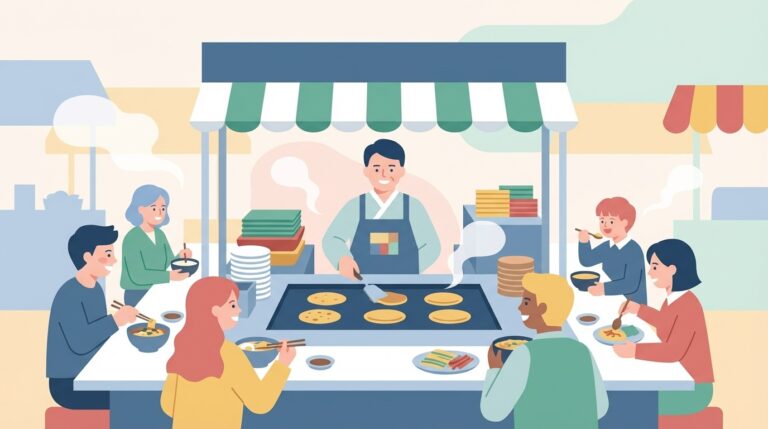
안녕하세요! (Hello!) I am your Daily Hangul Editor. Imagine this: You are standing at the entrance of Gwangjang Market in Seoul on a Friday night. The air is thick with the savory smell of bindaetteok (mung bean pancakes) frying in oil. Neon signs flash, steam rises from giant pots of tteokbokki, and thousands of people are moving shoulder-to-shoulder.
In a K-Drama, this is the exact moment the main characters grab each other’s hands so they don’t get lost in the crowd. But what if you need to actually say something about this overwhelming, vibrant chaos?
If you only know textbook Korean, you might just say “사람이 많습니다” (There are many people). But that doesn’t capture the energy! Today, we are going to learn how to express the bustling, lively vibe of a Korean traditional market like a true local. By the end of this lesson, you won’t just survive the crowd—you’ll thrive in it!
Phase 2: Core Expressions Deep Dive
Let’s learn the top 3 expressions you need when surrounded by a sea of people.
1. 사람이 진짜 많아요! (There are really so many people!)
- Pronunciation: saram-i jinjja manayo! [sa-ram-ee jeen-jja mah-nah-yo!]
- Meaning: Literal: People are really many! / Real nuance: Wow, this place is packed!
- K-Culture Moment: You will hear this phrase constantly in Korean vlogs when YouTubers visit popular restaurants or markets. It’s the standard reaction to a big crowd.
- Editor’s Insight: The word ‘진짜’ (jinjja) means ‘really’, and emphasizing it by dragging out the sound (진~짜) makes you sound 100% native.
- Situation Spectrum:
[🚫 절대 금지] ———— [⚠️ 주의] ———— [✅ 자유롭게]- Casual to close friends: ✅ (사람 진짜 많다! – saram jinjja manta!)
- Store owner/Strangers (A2 level polite): ✅ (사람이 진짜 많아요!)
- Formal Business: ⚠️ (Use ‘매우 많습니다’ instead)
- 🤔 Think About It: Why do Koreans often state the obvious (like “There are so many people” when everyone can see it)? In Korean culture, sharing your immediate feeling with others builds a sense of togetherness (공감대).
2. 여기 좀 복잡해요. (It’s a bit crowded/chaotic here.)
- Pronunciation: yeogi jom bokjaphaeyo. [yuh-gee johm bok-jahp-hae-yo.]
- Meaning: Literal: Here is a bit complicated. / Real nuance: It’s too crowded and chaotic here.
- K-Culture Moment: In a K-Drama, when the rich male lead takes the female lead to a crowded street market for the first time, he looks around nervously and says this line.
- Editor’s Insight: ‘복잡하다’ normally means ‘complicated’ (like math), but in relation to spaces, it means ‘crowded’ or ‘congested’. It usually has a slightly negative or overwhelmed nuance.
- Situation Spectrum:
[🚫 절대 금지] ———— [⚠️ 주의] ———— [✅ 자유롭게]- Friends: ✅
- Colleagues: ✅
- Formal: ✅ (여기 조금 복잡하네요)
- 🤔 Think About It: Koreans often use ‘좀’ (a little/a bit) even when something is VERY crowded. Softening negative statements is a key part of polite Korean speech. Do you have a similar habit in your native language?
3. 완전 북적북적해요! (It’s totally bustling!)
- Pronunciation: wanjeon bukjeok-bukjeok-haeyo! [wahn-juhn book-juhk-book-juhk-hae-yo!]
- Meaning: Literal: Completely bustling! / Real nuance: The vibe is so lively and packed with people!
- K-Culture Moment: K-Pop idols often use this expression on live streams when they visit a festival or a fan meeting venue and hear the loud, energetic crowd.
- Editor’s Insight: ‘북적북적’ is a mimetic word (의태어)—it mimics the feeling of a crowd moving and talking. Koreans love using these doubled words to paint a picture. It has a very positive, energetic vibe!
- Situation Spectrum:
[🚫 절대 금지] ———— [⚠️ 주의] ———— [✅ 자유롭게]- Friends/Social Media: ✅
- Colleagues (casual): ✅
- Formal/Boss: ⚠️ (Too playful for a serious report)
- 🤔 Think About It: Korean has hundreds of words that mimic sounds or feelings. How does using “sound words” change the mood of a conversation compared to standard adjectives?
Phase 3: Textbook vs. Real Korean
| 상황 (Situation) | 📖 교과서 한국어 (Textbook) | 🗣️ 진짜 한국어 (Real Korean) | 💡 왜 다를까? (Why the difference?) |
|---|---|---|---|
| Noting the crowd | 시장에 사람이 많습니다. | 와, 사람 완전 많아요! | In real life, spoken Korean relies heavily on emotional reactions like ‘와’ (Wow) and casual intensifiers like ‘완전’ (totally). |
| Feeling overwhelmed | 이곳은 매우 혼잡합니다. | 아, 여기 너무 복잡해요. | ‘혼잡하다’ is used in news broadcasts; ‘복잡해요’ is what actual humans say on the street. |
| Describing the vibe | 활기가 넘칩니다. | 분위기 북적북적하고 좋네요! | ‘북적북적’ captures the specific feeling of a market—noisy, crowded, but fun. |
Bottom Note: As an A2 learner, using ‘진짜 많아요’ or ‘복잡해요’ will immediately make you sound less like a robot and more like a friend!
Phase 4: K-Culture Deep Dive
4-1. The ‘Nunchi’ of the Crowd 🚶♂️
When navigating a bustling market, Nunchi (눈치)—the ability to read the room—is your best friend. In a crowded Korean market, people will gently brush against your shoulders. Do not expect an “Excuse me” or “I’m sorry” for every tiny bump! In a highly populated country like Korea, minor physical contact in crowded spaces is expected. Just keep moving with the flow of the crowd. If you bump into someone hard, a quick bow of the head and a quiet “죄송합니다 (joesonghamnida)” is perfect.
4-2. The K-Food Market Hustle 🍢
Korean traditional markets aren’t just for shopping; they are food heavens! To eat at a popular stall, you have to be quick. When you see empty stools, you need to point and ask the stall owner quickly. In K-Dramas, you’ll often see characters sitting on tiny plastic stools, surrounded by noise, eating hot soup. The noise isn’t considered annoying; it’s called ‘사람 사는 냄새’ (the smell of people living). It’s the comforting, warm atmosphere of human connection.
Phase 5: Real-world Roleplay Scenario
Setting: Saturday afternoon at Namdaemun Market. The alleys are packed with shoppers, tourists, and stall owners shouting their daily deals. You and your Korean friend, Min-su, are looking for a famous Kalguksu (knife-cut noodle) stall.
Characters:
– YOU: An A2 Korean learner, excited but slightly overwhelmed by the crowd.
– Min-su (30): Your Korean friend who loves street food.
Dialogue:
Min-su: 와, 오늘 주말이라서 시장에 사람 진짜 많다!
(wa, oneul jumal-iraseo sijang-e saram jinjja manta!)
[Wow, it’s the weekend, so there are really so many people at the market!]
(🎭 Stage Direction: Min-su looks around, shielding his eyes from the sun)
YOU: 네, 여기 완전 북적북적해요! 길을 잃어버릴 것 같아요.
(ne, yeogi wanjeon bukjeok-bukjeok-haeyo! gil-eul ireobeoril geot gatayo.)
[Yes, it’s totally bustling here! I feel like I’m going to get lost.]
Min-su: 내 가방 끈 꽉 잡아! 아, 저기 칼국수 가게다. 근데 줄이 너무 기네.
(nae gabang kkeun kkwak jaba! a, jeogi kalguksu gageda. geunde jul-i neomu gine.)
[Hold onto my bag strap tightly! Ah, there’s the noodle shop. But the line is too long.]
YOU: 으… 저기는 너무 복잡해요. 우리 다른 곳에 갈까요?
(eu… jeogi-neun neomu bokjaphaeyo. uri dareun gos-e galkkayo?)
[Ugh… it’s too crowded there. Should we go somewhere else?]
Min-su: 에이, 시장은 원래 복잡한 맛으로 오는 거야! 조금만 기다리자.
(ei, sijang-eun wonrae bokjaphan mas-euro oneun geoya! jogeumman gidarija.)
[Hey, you come to the market for the taste of the crowd! Let’s just wait a bit.]
🔀 Your Turn! How should you reply to Min-su?
– A) “아니요. 저는 복잡한 거 싫어요.” (No. I hate crowded things.)
– B) “그래요! 맛집이니까 북적거리는 거겠죠?” (Sure! It must be bustling because it’s a famous restaurant, right?)
– C) “진짜 복잡해요. 집에 가요.” (It’s really crowded. Let’s go home.)✅ Best Choice: B. It shows you understand the culture of waiting in line for good food (맛집 웨이팅) while using your new vocabulary perfectly!
⚠️ Choice A & C Analysis: While grammatically correct, these might sound a bit too blunt or negative to a friend who is excited to show you around.
Phase 6: 10-Second Shadowing Drill
Let’s practice the most natural way to express your amazement at the crowd! Follow the slashes for pauses and match the emotion.
😲 와! / 여기 / 사람 진~짜 / 많아요! (wa! / yeogi / saram jin~jja / manayo!)
(Translation: Wow! There are really so many people here!)
Tip: Make sure to stretch out the ‘진~짜’ to sound genuinely surprised!
Phase 7: K-Culture Mini Dictionary
Here are some survival words you will see and hear in the market:
| 한국어 (Korean) | Romanization | 영어 (English) | 맥락 설명 (Context) |
|---|---|---|---|
| 이모님 | imonim | Auntie (Polite) | The best way to respectfully call a middle-aged female stall owner. It creates a warm, friendly bond. |
| 단골 | dangol | Regular customer | Stall owners will give you extra food if they know you are a ‘dangol’. |
| 덤 | deom | Extra / Bonus | The beautiful Korean market culture of giving you a little extra food for free out of kindness. |
| 포장마차 | pojangmacha | Street food tent | The iconic orange tents you see in K-Dramas where people eat tteokbokki or drink soju. |
| 북적북적 | bukjeok-bukjeok | Bustling / Crowded | The sound/feeling of a lively crowd. |
Phase 8: Traveler Survival Kit 🆘
If you are visiting a busy Korean market, you need these quick phrases to survive the noise!
🆘 Survival Phrases for the Market
– 🇰🇷 “이거 얼마예요?” (igeo eolmayeyo?) – How much is this?
– 🇰🇷 “여기 앉아도 돼요?” (yeogi anjado dwaeyo?) – Can I sit here? (Crucial for grabbing a seat!)
– 🇰🇷 “포장해 주세요.” (pojanghae juseyo) – Please pack this to go. (Takeout)📌 Editor’s Travel Note
– Cash vs Card: Korea is a cashless society, BUT traditional markets are the exception. Always bring some cash (10,000 KRW bills) for small street food stalls! Some take bank transfers, but as a traveler, cash is king here.
– Tipping: Do NOT tip! Even if the food is amazing and the ‘Imonim’ gave you extra. Tipping doesn’t exist in Korea and will only confuse the stall owner.
Phase 9: Critical Thinking — “One Step Deeper”
Food & Identity: The Warmth of the Crowd
Why do Koreans love crowded, noisy places like traditional markets or busy BBQ restaurants? In many Western cultures, dining is about quiet intimacy and personal space. But in Korea, food is deeply connected to 정 (Jeong)—a unique concept of collective warmth, affection, and community connection. A restaurant that is loud, smoky, and packed with people isn’t “annoying”; it’s seen as “alive” and “popular.” Sharing physical space, hearing the chatter of strangers, and eating shoulder-to-shoulder reinforces the feeling that “we are all in this together.”
💬 Your Turn: Does your culture prefer quiet, private dining, or loud, bustling atmospheres? Let us know in the comments!
Phase 10: FAQ & Avoiding Misunderstandings
Q: Someone bumped into me hard at the market and didn’t apologize. Are they mad at me?
A: No! In super crowded spaces like markets or the Seoul subway during rush hour, minor bumping is just considered a part of the environment. Don’t take it personally!
Q: Can I use “아줌마 (Ajumma)” to call the lady selling food?
A: ⚠️ Try to avoid it. While “Ajumma” means a middle-aged woman, it can sometimes sound a bit rude or dismissive nowadays. Use “이모님 (Imonim – Auntie)” or “사장님 (Sajangnim – Boss/Owner)” instead. They will treat you much better!
❌ Common Mistake: Complaining loudly in English (or your native language) about the crowd.
✅ Do this instead: Embrace the chaos! Smile and say, “완전 북적북적해요!” Locals love it when foreigners appreciate the vibrant energy of their markets.
Phase 11: Summary & Action Items
One-Liner Summary: When the market gets crazy, remember to smile and say: “와, 사람 진짜 많아요! 여기 완전 북적북적해요!”
Your Action Missions:
– 🥉 Bronze (Solo): Stand in front of a mirror and act surprised while saying “와, 여기 사람 진짜 많아요!” 3 times.
– 🥈 Silver (Online): Find a YouTube walking tour of a Korean market. Leave a comment saying “완전 북적북적해요!”
– 🥇 Gold (Real Life): Next time you are in a crowded café, restaurant, or market (anywhere in the world), turn to your friend and use one of today’s phrases!
🎪 Special K-Culture Mission:
Watch an episode of a K-Drama or a K-Pop idol’s vlog where they visit a street food market. Pay attention to how close everyone stands to each other and listen for the word “진짜”!
Phase 12: Interactive Quiz 🧠
1. You are at a famous street food stall. It’s incredibly noisy and full of people. Which phrase best describes this positive, energetic vibe?
A) 사람이 없습니다. (There are no people.)
B) 여기 완전 북적북적해요! (It’s totally bustling here!)
C) 조용해요. (It’s quiet.)
2. True or False: If you bump shoulders with someone slightly in a packed Korean market, you must stop and apologize profusely.
3. Fill in the blank: To politely call the female stall owner to order, you should say “저기요, _______!”
A) 아줌마 (Ajumma)
B) 이모님 (Imonim)
C) 학생 (Haksaeng)
(Answers: 1:B, 2:False – light brushing is normal, 3:B)
Frequently Asked Questions (FAQ)
Q: What does "사람이 진짜 많아요! (There are really so many people!)" mean in Korean and how do you pronounce it?
A: In Korean, "사람이 진짜 많아요! (There are really so many people!)" is pronounced [saram-i jinjja manayo! [sa-ram-ee jeen-jja mah-nah-yo!] and means: Literal: People are really many! / Real nuance: Wow, this place is packed!
Q: What does "여기 좀 복잡해요. (It's a bit crowded/chaotic here.)" mean in Korean and how do you pronounce it?
A: In Korean, "여기 좀 복잡해요. (It's a bit crowded/chaotic here.)" is pronounced [yeogi jom bokjaphaeyo. [yuh-gee johm bok-jahp-hae-yo.] and means: Literal: Here is a bit complicated. / Real nuance: It's too crowded and chaotic here.
Q: What does "완전 북적북적해요! (It's totally bustling!)" mean in Korean and how do you pronounce it?
A: In Korean, "완전 북적북적해요! (It's totally bustling!)" is pronounced [wanjeon bukjeok-bukjeok-haeyo! [wahn-juhn book-juhk-book-juhk-hae-yo!] and means: Literal: Completely bustling! / Real nuance: The vibe is so lively and packed with people!







