

Phase 1: Empathy (The Real K-Drama Moment)
Hello! I’m your Daily Hangul Editor, your local culture navigator and veteran tutor.
Imagine this: You’re living your best K-Drama life. You’ve rented a sleek car, the windows are down, and you’re driving along the beautiful coastal roads of Jeju Island or navigating the neon-lit streets of Seoul. You finally arrive at that viral K-Food restaurant you’ve been dying to try. The GPS cheerfully announces, “You have arrived!”
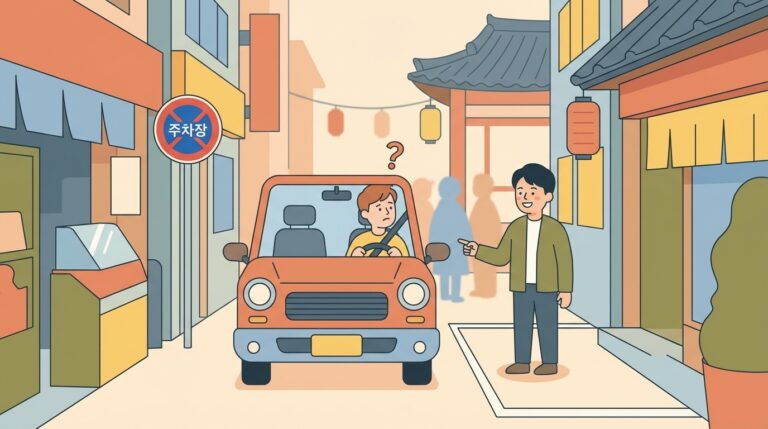
But wait… you look around, and there is absolutely nowhere to park. Just a narrow alleyway filled with people, scooters, and a million restaurant signs. Your palms start to sweat. The cars behind you are honking. Panic mode activated.
If you’re planning on renting a car in Korea, knowing how to drive is only half the battle. The real boss level? Parking (주차 – jucha). If you don’t know the right phrases, you might end up driving in circles for an hour or getting a hefty parking ticket. But don’t worry! I’m here to teach you the survival phrases that will make you look like a seasoned Seoulite.
This guide is based on real SOS calls from my students who were stuck in Hongdae alleyways. Let’s dive in!
Phase 2: Core Expressions – Deep Dive
Here are the top 3 lifesavers you need when parking in Korea.
1. 여기 주차해도 돼요?
- Pronunciation: Yeogi jucha-haedo dwaeyo? [Yo-gee joo-cha heh-do dweh-yo?]
- Meaning: Can I park here? (Literal: Is doing parking here okay?)
- K-Culture Moment: You pull up to a cute, aesthetic K-cafe in Yeonnam-dong. There’s a tiny empty space right in front of the window. Before you turn off the engine, you roll down the window and ask the barista this exact phrase.
- Editor’s Insight: This is the most polite and natural way to ask for permission. The ending “~해도 돼요?” (~haedo dwaeyo?) is your golden ticket for asking “Is it okay if I…?” in Korean.
- Situation Spectrum:
[🚫 Never] ———— [⚠️ Caution] ———— [✅ Freely]
- Close Friends (Casual): ✅ (Drop the ‘yo’: 여기 주차해도 돼?)
- Strangers/Staff (Polite): ✅ (Perfect!)
- Police/Officials (Formal): ⚠️ (Better to use: 여기 주차해도 됩니까?)
- 🤔 Think About It: In Korea, space is very limited. Asking for permission before taking up space shows Nunchi (social awareness). How do people handle street parking in your home country?
2. 주차장 어디에 있어요?
- Pronunciation: Juchajang eodie isseoyo? [Joo-cha-jang uh-dee-eh ees-uh-yo?]
- Meaning: Where is the parking lot?
- K-Culture Moment: You arrive at your hotel or a big shopping mall, but the entrance is confusing. You spot a security guard in a uniform. You slightly bow your head and ask this.
- Editor’s Insight: “주차장” (Juchajang) means parking lot. “어디에 있어요?” is a beginner’s best friend meaning “Where is…?” It sounds much softer and more natural than just shouting “Parking lot?!”
- Situation Spectrum:
[🚫 Never] ———— [⚠️ Caution] ———— [✅ Freely]
- Close Friends (Casual): ✅ (주차장 어디야?)
- Strangers/Staff (Polite): ✅
- Boss/Elders (Formal): ⚠️ (주차장이 어디에 있습니까?)
- 🤔 Think About It: Why do Koreans often use “있어요” (exists) instead of “is” when asking for locations? It reflects a worldview of locating things in space rather than defining what they are.
3. 차 좀 빼주세요.
- Pronunciation: Cha jom ppae-juseyo. [Cha johm ppeh-joo-seh-yo.]
- Meaning: Please move your car. (Literal: Please pull out the car a little.)
- K-Culture Moment: You finish eating your K-BBQ, walk out to your rental car, and gasp! Another car is parked horizontally right in front of yours, blocking you completely. You call the number on their dashboard and say this.
- Editor’s Insight: “좀” (jom) literally means “a little,” but Koreans use it as a linguistic cushion to make a request sound softer and less aggressive. Without “좀”, it sounds like a police order.
- Situation Spectrum:
[🚫 Never] ———— [⚠️ Caution] ———— [✅ Freely]
- Close Friends (Casual): ✅ (차 좀 빼줘.)
- Strangers (Polite): ✅ (On the phone)
- Boss/Elders (Formal): ⚠️ (차량 이동 부탁드립니다 – Please move the vehicle.)
- 🤔 Think About It: Double parking is so common in Korea that people leave their phone numbers on their cars. Would you feel comfortable leaving your personal phone number visible to the public in your country?
Phase 3: Textbook vs. Real Korean
Let’s see how textbooks compare to the real streets of Seoul.
| Situation | 📖 Textbook Korean | 🗣️ Real Street Korean | 💡 Why the difference? |
|---|---|---|---|
| Asking to park | 이곳에 주차를 해도 괜찮습니까? (Is it alright if I do the parking in this place?) | 여기 주차 돼요? (Parking okay here?) | Koreans love efficiency. Dropping particles and shortening sentences is standard for quick, busy situations. |
| Asking where to park | 주차장이 어디에 있습니까? (Where is the parking lot located?) | 주차 어디다 해요? (Where do I do the parking?) | Focuses on the action rather than the place. |
| Asking to move a car | 차를 이동해 주시겠습니까? (Would you please relocate the vehicle?) | 차 좀 빼주세요. (Please pull the car out a bit.) | “이동하다” (relocate) is too formal for everyday conversation. “빼다” (pull out) is the go-to slang/verb! |
Phase 4: Cultural Context — K-Culture Deep Dive
4-1. Non-verbal Nunchi (눈치) in Parking
When asking “여기 주차해도 돼요?” (Can I park here?), don’t just shout it from your car window. The Korean way is to roll down the window, make eye contact, give a slight nod (a mini-bow from the neck), and smile apologetically. If they say no, cross your arms in an “X” shape or give a quick nod of acknowledgment before driving away.
4-2. The “Valet” (발렛) Culture at K-Cafes & Restaurants
If you watch K-Dramas, you’ve probably seen the rich CEO toss his car keys to a man in a suit. But in real-life Korea, Valet Parking (발렛파킹) isn’t just for luxury hotels! Many popular restaurants and cafes in trendy areas like Gangnam, Cheongdam, or even busy BBQ spots offer valet service.
Why? Because parking space is a nightmare!
– How it works: You pull up, a staff member (usually wearing an armband) approaches. You leave the engine running, step out, and they hand you a small paper ticket.
– The Cost: Usually 3,000 to 5,000 KRW.
– Pro Tip: In the past, it was cash only, but nowadays, they often accept bank transfers. Still, keeping a few 1,000 KRW bills in your rental car is a lifesaver for valet fees!
Phase 5: Real-Life Roleplay Scenario
Setting: Friday night, 7 PM. You’ve rented a car to take your Korean friends to a famous spicy Galbi (ribs) restaurant in an alleyway in Mapo-gu. The smell of roasted meat fills the air, but the tiny parking lot in front of the restaurant looks completely full.
Characters:
– YOU: An adventurous foreigner who volunteered to drive.
– Sajang-nim (사장님): The restaurant owner. She’s wearing an apron, holding a pair of BBQ tongs, and looking very busy.
(You roll down the window as the Sajang-nim approaches your car.)
YOU: 저기요! (Excuse me!)
Jeogiyo!
Sajang-nim: 네! 식사하러 오셨어요? 😊
Ne! Siksahareo osyeosseoyo?
(Yes! Did you come to eat?)
YOU: 네. 근데… 주차장 다 찼어요? 😥
Ne. Geunde… juchajang da chasseoyo?
(Yes. But… is the parking lot totally full?)
Sajang-nim: 아휴, 네. 지금 자리가 없네. 저기 앞 건물에 주차하세요.
Ahyu, ne. Jigeum jariga eomne. Jeogi ap geonmure juchahaseyo.
(Oh my, yes. There are no spots right now. Park at the building over there.)
🔀 Your Turn! How do you respond to make sure it’s safe?
– A) “오케이! 땡큐!” (Okay! Thank you!)
– B) “거기 주차해도 돼요? 딱지 안 끊겨요?” (Can I park there? Will I not get a ticket?)
– C) “사장님이 대신 주차해 주세요!” (You park it for me!)✅ Best Choice: B — Reason: In Korea, sometimes restaurant owners tell you to park at a neighbor’s closed shop. It’s smart to double-check “여기 주차해도 돼요?” (Is it okay to park here?) so you don’t get a parking ticket (딱지 – ttakji).
⚠️ Choice C Analysis: Unless there is a big “Valet” sign, demanding the busy owner to park your car is considered very rude (and a bit comical)!
Phase 6: 10-Second Shadowing Drill
Let’s practice our tone! Follow the slashes (/) for pauses, and try to match the emotion.
Situation: Asking politely to park.
🥺 저기요… / 여기 / 주차해도 / 돼요?
(jeogiyo… / yeogi / juchahaedo / dwaeyo?)
(Excuse me… is it okay if I park here?)
Situation: Calling someone to move their double-parked car.
📱 안녕하세요, / 차 좀 / 빼주세요~
(annyeonghaseyo, / cha jom / ppae-juseyo~)
(Hello, could you please move your car?)
Phase 7: K-Culture Mini Dictionary
| Korean | Romanization | English | Context/Meaning |
|---|---|---|---|
| 주차 | jucha | Parking | The root noun. Combine with 하다 (to do) -> 주차하다 (to park). |
| 주차장 | juchajang | Parking lot | The suffix ‘장’ (jang) means a place or location. |
| 발렛 | ballet | Valet | Konglish for Valet parking. Very common at cafes and restaurants. |
| 이중주차 | ijung-jucha | Double parking | Parking parallel to already parked cars. You must leave your car in ‘Neutral’ (N) so others can push it! |
| 딱지 | ttakji | Parking ticket | Slang for a fine. “딱지 끊겼어” means “I got a parking ticket.” |
Phase 8: Traveler Survival Kit (Driving Edition)
If you are renting a car in Korea, memorize these survival items!
🆘 Survival Phrases TOP 3
1. 🇰🇷 “가장 가까운 공영 주차장 어디예요?”
– 🗣️ (Gajang gakkaun gongyeong juchajang eodiyeyo?)
– 🇬🇧 “Where is the nearest public parking lot?”
– 💡 Pro Tip: Look for “공영 주차장” (Public Parking). They are much cheaper than private lots (민영 주차장).
- 🇰🇷 “하루 주차 얼마예요?”
- 🗣️ (Haru jucha eolmayeyo?)
- 🇬🇧 “How much is it for a full day of parking?”
- 🇰🇷 “여기 유료예요, 무료예요?”
- 🗣️ (Yeogi yuryoyeyo, muryoyeyo?)
- 🇬🇧 “Is this paid or free?”
📌 Editor’s Travel Note
– Useful Apps: Google Maps does NOT work well for driving in Korea. You MUST download KakaoMap (카카오맵) or Naver Map (네이버지도) for accurate navigation.
– Parking Apps: Use the Kakao T app. It has a ‘Parking’ tab that shows you nearby lots, prices, and even lets you pay automatically via the app!
– Line Colors on the Road:
– White line: Free to park.
– Yellow line (solid or dashed): NO parking (or only for a very short, specific time).
Phase 9: Critical Thinking — “One Step Deeper”
Let’s analyze a unique aspect of Korean society through our driving theme.
Media vs. Reality (미디어 vs 현실)
🧠 Think Deeper:
In K-Dramas, the wealthy male lead always effortlessly pulls his sports car right up to the entrance of a high-end restaurant, tosses the keys, and walks in. It looks so smooth and spacious! But the reality of driving in Korea—especially Seoul—is a stark contrast. Due to rapid urbanization and mountainous terrain, space is a premium luxury.
This lack of space birthed the unique culture of 이중주차 (Double Parking). People park blocking other cars, but leave their car gear in Neutral and put a plaque with their personal phone number on the dashboard. It requires an immense level of high social trust. You trust strangers to gently push your car out of the way, and you trust them with your phone number. It shatters the spacious K-Drama illusion, but shows a beautiful, chaotic, trust-based reality of Korean city life.💬 Your Turn: Would you feel safe leaving your car in Neutral for a stranger to push, or leaving your phone number visible on your dashboard? Share how parking works in your country in the comments!
Phase 10: FAQ & Avoiding Mistakes
Q: “Can I just park in front of a convenience store for 5 minutes?”
Maybe. If there is a white line, yes. But usually, owners put out physical barriers (like orange cones or water jugs) to reserve spots for their customers. Always ask: “여기 잠깐 주차해도 돼요?” (Can I park here for a moment?)
Q: “Do I need to tip the valet driver?”
No! There is strictly no tipping culture in Korea. The valet fee (usually 3,000 KRW) is a set service charge. Just pay the exact amount, say “감사합니다” (Thank you), and you’re good to go.
❌ Common Mistake #1: Parking in a spot marked with a wheelchair icon (Handicap) or pink lines (Women-only/Pregnant women parking). The fines for parking in handicap spots are huge, and locals will report rental cars immediately via an app!
✅ Do this instead: Look for standard white-lined spots, or just head straight to a “공영 주차장” (Public Parking Lot) to be safe and stress-free.
Phase 11: Summary & Action Items
- One-Liner Summary: When renting a car and finding parking in Korea, always check your Nunchi, ask politely with “여기 주차해도 돼요?”, and embrace the Valet culture!
Action Mission:
– 🥉 Bronze (Solo): Stand in front of a mirror and practice “여기 주차해도 돼요?” 3 times with a polite smile and slight head nod.
– 🥈 Silver (Online): Go to a Korean travel forum or comment below: “I want to rent a car and go to [Your Dream Korean City]. Are there many 주차장 (parking lots)?”
– 🥇 Gold (Real Life): If you are in Korea, use KakaoMap to search for “공영 주차장” around your hotel today!
K-Culture Mission:
Next time you watch a K-Drama, look closely at the cars parked on the streets. Can you spot the glowing neon phone numbers on the dashboard? Spot one and you’ll realize how authentic the set is!
Phase 12: Quiz — Interactive Challenge
Let’s test your Korean driving survival skills!
1. Fill in the Blank (상황 판단 문제)
You want to ask the security guard where the parking lot is.
“주차장 _________ 있어요?”
A) 언제 (when)
B) 누구 (who)
C) 어디에 (where)
2. True or False — K-Culture Edition
“When using Valet Parking at a cafe in Gangnam, you should tip the driver an extra 5,000 KRW for good service.”
– True (T) / False (F)
3. Situation Judgment
You double-parked your rental car because the lot was full. What MUST you do?
A) Lock the car, put the parking brake on, and hide your phone number.
B) Leave the car in Neutral (N), take off the parking brake, and display your phone number on the dashboard.
C) Leave the engine running and walk away.
(Answers: 1. C / 2. F – No tipping in Korea! Just pay the set fee. / 3. B – This is the unwritten law of Korean double parking!)
Enjoy your road trip, drive safely, and let us know your parking adventures below!
Frequently Asked Questions (FAQ)
Q: What does "여기 주차해도 돼요?" mean in Korean and how do you pronounce it?
A: In Korean, "여기 주차해도 돼요?" is pronounced [Yeogi jucha-haedo dwaeyo? [Yo-gee joo-cha heh-do dweh-yo?] and means: Can I park here? (Literal: Is doing parking here okay?)
Q: What does "주차장 어디에 있어요?" mean in Korean and how do you pronounce it?
A: In Korean, "주차장 어디에 있어요?" is pronounced [Juchajang eodie isseoyo? [Joo-cha-jang uh-dee-eh ees-uh-yo?] and means: Where is the parking lot?
Q: What does "차 좀 빼주세요." mean in Korean and how do you pronounce it?
A: In Korean, "차 좀 빼주세요." is pronounced [Cha jom ppae-juseyo. [Cha johm ppeh-joo-seh-yo.] and means: Please move your car. (Literal: Please pull out the car a little.)






