Master Advanced Korean: Surviving the Late-Night Political Debate
Phase 1: The ‘Makgeolli’ Epiphany
Hello! This is the Lead Editor of Daily Hangul.
Picture this: You are watching a K-Drama like Reply 1988 or Snowdrop. The setting is a smoky underground university club, or a dimly lit makgeolli (rice wine) tavern on a rainy night. The characters are whispering intensely. The subtitles just say, ‘We have to fight the system,’ but the actual Korean being spoken is layered with decades of real-world history, division, and a very specific piece of legislation: The National Security Law (국가보안법, Gukgaboanbeop).
As an advanced (C1) Korean learner, you’ve probably mastered ordering iced americanos and talking about your weekend. But what happens when you are invited to a late-night drinking session with Korean university students or intellectuals, and the topic suddenly shifts to North Korea, democracy, and freedom of speech?
If you don’t understand the nuances of this debate, you might miss out on understanding the true heartbeat of modern South Korea. This guide is built from the real experiences of advanced learners who wanted to go beyond K-Pop and truly connect with the socio-political reality of their Korean friends. Let’s dive into the deep end.
Phase 2: Core Expressions Deep Dive
Here are the top three C1-level expressions you need to understand (and respectfully use) when this debate inevitably comes up over the third bottle of soju.
1. 시대착오적인 악법이다 (It’s an anachronistic, evil law)
- Pronunciation: [sidaechagoejeogin akbbeobida] — ‘sidae’ sounds like ‘she-dae’, ‘chago’ means error, think of a ‘system error in time’.
- Meaning: Literal: It is a chronologically erroneous evil law. / Real Nuance: It’s completely outdated and belongs in the Cold War era.
- K-Culture Moment: This is the battle cry of the liberal side (and former student activists, undonggwon). You’ll hear this in historical K-movies like 1987: When the Day Comes or from your socially conscious friend aggressively tapping their soju glass on the table.
- Editor’s Insight: The word ‘시대착오적’ (anachronistic) is a high-level Hanja word. Dropping this in a debate instantly signals that your Korean is C1 level. It holds a strong feeling of frustration against a system that refuses to evolve.
- Situation Spectrum:
[🚫 Boss/Elders] ———— [⚠️ Colleagues] ———— [✅ Close Friends/Debate Club]
- Casual with friends (if debating): ✅
- Semi-formal (Colleagues): ⚠️ (Avoid political debates at work!)
- Formal/Elders: 🚫 (Very sensitive topic for older generations.)
- 🤔 Think About It: Why is time (시대, era) such an important concept in Korean political discourse? How does the rapid modernization of South Korea create friction between different ‘eras’ living simultaneously in one society?
2. 표현의 자유를 위축시키다 (It chills/shrinks freedom of expression)
- Pronunciation: [pyohyeonui jayureul wichuksikida] — ‘wi-chuk’ sounds like a sharp intake of breath when you are startled and shrink back.
- Meaning: Literal: To shrink freedom of expression. / Real Nuance: It creates a chilling effect on free speech.
- K-Culture Moment: Have you ever noticed how Koreans sometimes lower their voices when talking about North Korea in public, or jokingly use the word ‘코렁탕’ (a slang combining ‘nose’ and ‘beef soup’, referring to old torture methods)? This expression perfectly captures that societal anxiety.
- Editor’s Insight: Instead of just saying ‘제한하다’ (to limit), ‘위축시키다’ (to shrink/intimidate) implies a psychological effect. It means people are self-censoring out of fear.
- Situation Spectrum:
[🚫 Formal/Elders] ———— [⚠️ Colleagues] ———— [✅ Close Friends]- 🤔 Think About It: Does true freedom of expression exist anywhere? How does South Korea’s geographical reality complicate the Western ideal of absolute free speech?
3. 휴전 국가라는 특수성을 감안해야 한다 (We must consider the unique situation of being a nation under an armistice)
- Pronunciation: [hyujeon gukgaraneun teuksuseongeul gamanhaeya handa]
- Meaning: Literal: Must take into account the special characteristic of being a ceasefire state. / Real Nuance: ‘Don’t forget we are technically still at war with the North.’
- K-Culture Moment: This is the standard counter-argument. You’ll hear this from older generations, military veterans, or conservative friends. It’s the reality check that bursts the idealistic bubble.
- Editor’s Insight: ‘감안하다’ (to take into consideration) is a fantastic C1 vocabulary word. It sounds much more educated and diplomatic than just saying ‘생각해야 한다’ (must think about).
- Situation Spectrum:
[🚫 Strictly Casual] ———— [⚠️ Colleagues] ———— [✅ Intellectual Debate/Elders]- 🤔 Think About It: How often do you, as a visitor or expat, remember that Seoul is only 50km away from a heavily militarized border? How does this invisible pressure shape the Korean psyche?
Phase 3: Textbook vs. Real Korean
| Situation | 📖 Textbook Korean | 🗣️ Real Korean (C1 Level) | 💡 Why the difference? |
|---|---|---|---|
| Expressing disagreement gently | 저는 그 의견에 반대합니다. (I oppose that opinion.) | 그건 좀 너무 나간 거 아닐까요? (Isn’t that taking it a bit too far?) | Koreans use questions to soften direct confrontation (Nunchi culture). |
| Suggesting it’s time for a change | 법을 폐지해야 합니다. (We must abolish the law.) | 솔직히 이제는 좀 없앨 때도 되지 않았나? (Honestly, isn’t it about time we got rid of it?) | Adding ‘솔직히’ (honestly) and ending in a rhetorical question builds consensus. |
| Pointing out the North Korean threat | 북한은 위험합니다. (North Korea is dangerous.) | 아직 윗동네 상황이 어떤지 뻔히 아는데… (We all clearly know how the ‘neighborhood up north’ is doing…) | Using slang like ‘윗동네’ (the neighborhood up north) is a common way to refer to North Korea casually without sounding too militant. |
Bottom Note: At the C1 level, the goal isn’t just to be grammatically correct, but to master the art of ‘indirect directness’—making a strong point without ruining the mood of the dinner table.
Phase 4: Cultural Context — K-Culture Deep Dive
4-1. Non-Verbal Cues: The Art of Political ‘Nunchi’
When discussing sensitive topics like the National Security Law or North Korea, pay attention to the volume of the conversation. If you are in a crowded BBQ restaurant, you will notice your Korean friends naturally lowering their voices or leaning in. This isn’t necessarily because they are doing something illegal, but because of Nunchi (눈치)—an awareness that older people at the next table might have very traumatic memories of the Korean War or the military dictatorships, and overhearing a loud debate could cause unnecessary friction.
4-2. The ‘Undonggwon’ K-Drama Trope
If you’ve watched K-Dramas set in the 1980s (like Reply 1988 featuring Bo-ra’s character, or Youth of May), you’ve seen the Undonggwon (운동권) — the student activists who fought for democracy. The National Security Law was frequently used during those times to suppress these very students by framing them as North Korean sympathizers. Understanding this trauma is crucial. When a young Korean argues against the law today, they are channeling the ghosts of those 1980s protests. When you watch these dramas now, you won’t just read the subtitles; you’ll feel the historical weight behind their words.
Phase 5: Interactive Roleplay Scenario
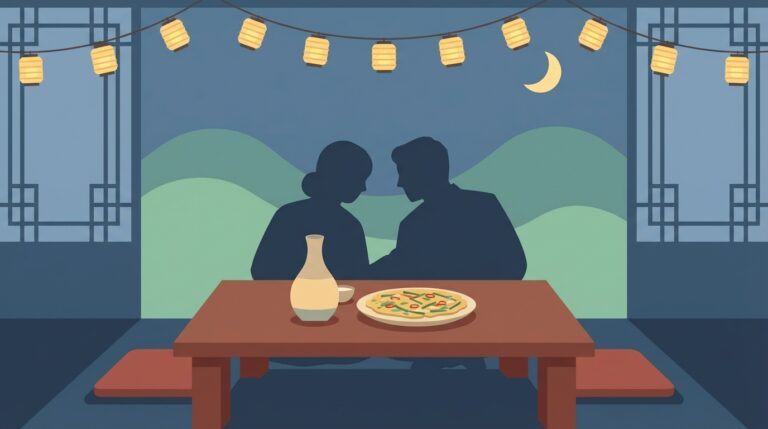
Setting: Friday, 11:30 PM. A traditional Jeon (Korean pancake) and Makgeolli tavern in Sinchon, near Yonsei University. Rain is hitting the tin roof. You are having drinks with two Korean friends from your language exchange group.
Characters:
– YOU: An expat highly interested in Korean modern history.
– Minwoo (32): Your Korean friend. A bit conservative, served in the frontline military.
– Jiwon (30): Liberal, highly vocal, majored in sociology.
Dialogue:
Jiwon: 아, 오늘 뉴스 봤어? 또 국가보안법으로 압수수색 들어갔대. 진짜 시대착오적인 악법이라니까.
(A, oneul nyuseu bwasseo? Tto gukgaboanbeobeuro apsususaek deureogatdae. Jinjja sidaechagoejeogin akbbeobiranikka.)
[English: Ah, did you see the news today? Another search and seizure under the National Security Law. I’m telling you, it’s such an anachronistic, evil law.]
(🎭 Stage Direction: Jiwon aggressively pours a bowl of makgeolli for herself)
Minwoo: 야, 그래도 우리가 아직 휴전 국가라는 특수성을 감안해야지. 윗동네가 자꾸 도발하는데 방어막은 있어야 할 거 아냐.
(Ya, geuraedo uriga ajik hyujeon gukgaraneun teuksuseongeul gamanhaeyaji. Witdongnega jakku dobalhaneunde bangeomageun isseoya hal geo anya.)
[English: Hey, still, we have to consider the unique situation of being under an armistice. The neighborhood up north keeps provoking us; we need a defense shield.]
Jiwon: 방어막 좋아하네. 그거 핑계로 표현의 자유를 위축시키는 게 문제잖아!
(Bangeomak joahane. Geugeo pinggyero pyohyeonui jayureul wichuksikineun ge munjejana!)
[English: Defense shield, my foot. The problem is they use that as an excuse to shrink freedom of expression!]
(🎭 Stage Direction: Jiwon suddenly turns to you)
Jiwon: 넌 어떻게 생각해? 외국인 시선에서는 이거 진짜 이상하지 않아?
(Neon eotteoke saenggakhae? Oegugin siseonesseoneun igeo jinjja isanghaji ana?)
[English: What do you think? From a foreigner’s perspective, isn’t this really weird?]
🔀 Your Turn! How do you respond?
– A) “지원 말이 맞아. 당장 폐지해야 돼!” (Jiwon is right. It should be abolished immediately!)
– B) “음… 외부인 입장에서는 양쪽 다 이해가 가요. 참 어려운 문제네요.” (Hmm… as an outsider, I can understand both sides. It’s a really difficult issue.)
– C) “전 정치에 관심 없어요. 파전이나 먹죠!” (I don’t care about politics. Let’s just eat the pajeon!)✅ Best Choice: B — Why? In Korean drinking culture, jumping aggressively into a sensitive domestic political debate as a foreigner can sometimes kill the mood or come off as arrogant. Choice B acknowledges the complexity of their trauma while showing you’ve been listening. It keeps the conversation deep but respectful.
⚠️ Choice C Analysis: While safe, it abruptly cuts off a deep conversation, which might make you look superficial to friends who are trying to share their deeper culture with you.
Phase 6: 10-Second Shadowing Drill
Let’s practice the natural rhythm of a C1 debate sentence. Pay attention to the pauses!
😤 솔직히 / 표현의 자유를 / 너무 위축시키는 거 아니에요?
(soljikhi / pyohyeonui jayureul / neomu wichuksikineun geo anieyo?)
[Tone: Frustrated but raising a valid question. Drag the ‘너~무’ slightly for emphasis.]
Phase 7: K-Culture Mini Dictionary
| Korean | Romanization | English Meaning | Contextual Explanation |
|---|---|---|---|
| 운동권 | undonggwon | Student Activists | The generation of university students in the 80s who protested against the military dictatorship. Often clashed with the National Security Law. |
| 분단국가 | bundangukga | Divided Nation | A crucial keyword to understand South Korean geopolitics and conservative arguments. |
| 휴전 | hyujeon | Armistice / Ceasefire | Korea is technically not at peace; the war is merely paused. This fact underpins all security laws. |
| 윗동네 | witdongne | The neighborhood up north | A slang term for North Korea, used to casually refer to the regime without sounding too serious or political. |
Phase 8: Traveler’s Survival Kit (DMZ & History Edition)
You might not debate the National Security Law at a convenience store, but this historical divide affects your travel! If you visit the DMZ, the JSA, or the War Memorial of Korea, you need these survival phrases.
🆘 Survival Phrases for Historical/Military Sites
– 🇰🇷 “여기 사진 찍어도 되나요?” (yeogi sajin jjigeodo doenayo?)
– 🗣️ Guide: [yeo-gi sa-jin jji-geo-do dwe-na-yo?]
– 📍 Where to use: DMZ tours, checkpoints, museums.
– 🇰🇷 “출입 통제 구역인가요?” (churip tongje guyeogingayo?)
– 🗣️ Guide: [chu-rip tong-je gu-yeo-gin-ga-yo?]
– 📍 Meaning: Is this a restricted area? (Crucial for hiking near the northern borders!)
– 🇰🇷 “신분증(여권) 보여드려야 하나요?” (sinbunjeung(yeogwon) boyeodeuryeoya hanayo?)
– 🗣️ Guide: [shin-bun-jeung(yeo-gwon) bo-yeo-deu-ryeo-ya ha-na-yo?]
– 📍 Meaning: Do I need to show my ID/Passport?📌 Editor’s Travel Note
– Dress Code: DMZ tours have strict dress codes (no ripped jeans, no sandals, no camouflage). This isn’t just for fashion; it’s because North Korean soldiers used to take photos of ‘scruffy’ tourists for propaganda.
– Behavior: Never point your fingers across the border at the JSA. It can be misinterpreted as a provocation.
Phase 9: Critical Thinking Corner — “One Step Deeper”
Media vs. Reality: The K-Pop Illusion vs. The Divided Reality
Global fans often view South Korea through the colorful, flawless lens of K-Pop and K-Beauty. It looks like a futuristic utopia. Yet, just an hour’s drive from the glitzy streets of Gangnam lies a border loaded with landmines. The existence of the National Security Law is a stark reminder of this paradox. Male K-Pop idols must shave their heads and serve in the military because of the very same geopolitical tension that necessitates this debate.
🧠 Think Deeper:
How does a society balance rapid global cultural export (Soft Power) with the grim reality of military tension (Hard Power)? Does consuming Korean media give you a complete picture of the country?💬 Your Turn: Have you ever visited a place in Korea where you suddenly felt the reality of the division? Share your experience in the comments!
Phase 10: FAQ & Mistake Prevention
- Q: Can I joke about Kim Jong-un with my Korean friends?
- A: Maybe, but tread lightly. Younger Koreans make memes about him, but to older generations, the North Korean regime represents profound trauma, separated families, and the Korean War. Read the room (Nunchi) before making a joke.
- Q: Is it illegal to read North Korean news in South Korea?
- A: South Korean internet blocks official North Korean state media websites due to the National Security Law. You literally cannot access them without a VPN!
❌ Common Mistake #1: Treating the North/South division purely as a Hollywood movie plot in front of Koreans.
✅ Do this instead: Approach the topic with the same respect you would approach any country’s historical trauma. Ask questions to learn, not to judge.
Phase 11: Summary & Action Items
- One-Liner Summary: Mastering C1 Korean means understanding the historical weight behind words like ‘시대착오적’ (anachronistic) and recognizing the lingering shadows of a divided nation.
-
Action Mission 3 Steps:
- 🥉 Bronze (Solo): Read a Korean news article about the ‘국가보안법’ and try to find the word ‘위축’ (shrink/chill).
- 🥈 Silver (Online): Leave a comment in Korean on a YouTube history documentary expressing a balanced view.
- 🥇 Gold (Real World): Next time you are with a close Korean friend, ask them: “한국 사람들은 북한 뉴스 볼 때 어떤 기분이 들어요?” (How do Koreans feel when they watch news about North Korea?)
- K-Culture Mission: Watch the movie 1987: When the Day Comes or The Attorney. Pay close attention to how the authorities use “National Security” as a reason to arrest the protagonists.
Phase 12: Quiz — Interactive Challenge
1. Situational Judgment: You are at a company dinner. Your older manager starts complaining that young people today don’t understand the threat of North Korea. What is the most culturally appropriate (and safe) response for you as a foreigner?
– A) “부장님, 그건 시대착오적인 생각입니다!” (Manager, that is an anachronistic thought!)
– B) “네, 휴전 국가라는 특수성이 참 어려운 것 같습니다.” (Yes, the unique situation of being a ceasefire state seems very difficult.)
– C) “저는 외국인이라서 잘 몰라요. 짠~” (I’m a foreigner so I don’t know. Cheers!)
💡 Click here for the answer
Answer: B. It shows high-level vocabulary (C1) and empathy without explicitly taking a hard political stance. Choice A will likely get you fired or heavily disliked. Choice C is a bit too dismissive for a senior colleague.
2. True or False – K-Culture Edition: South Korea and North Korea signed a peace treaty ending the Korean War in 1953.
💡 Click here for the answer
False. They signed an armistice (휴전, hyujeon), not a peace treaty. Technically, the war is just paused, which is the core reason the National Security Law still exists today.
Frequently Asked Questions (FAQ)
Q: What does "시대착오적인 악법이다 (It's an anachronistic, evil law)" mean in Korean and how do you pronounce it?
A: In Korean, "시대착오적인 악법이다 (It's an anachronistic, evil law)" is pronounced [sidaechagoejeogin akbbeobida] and means: Literal: It is a chronologically erroneous evil law. / Real Nuance: It’s completely outdated and belongs in the Cold War era.
Q: What does "표현의 자유를 위축시키다 (It chills/shrinks freedom of expression)" mean in Korean and how do you pronounce it?
A: In Korean, "표현의 자유를 위축시키다 (It chills/shrinks freedom of expression)" is pronounced [pyohyeonui jayureul wichuksikida] and means: Literal: To shrink freedom of expression. / Real Nuance: It creates a chilling effect on free speech.