

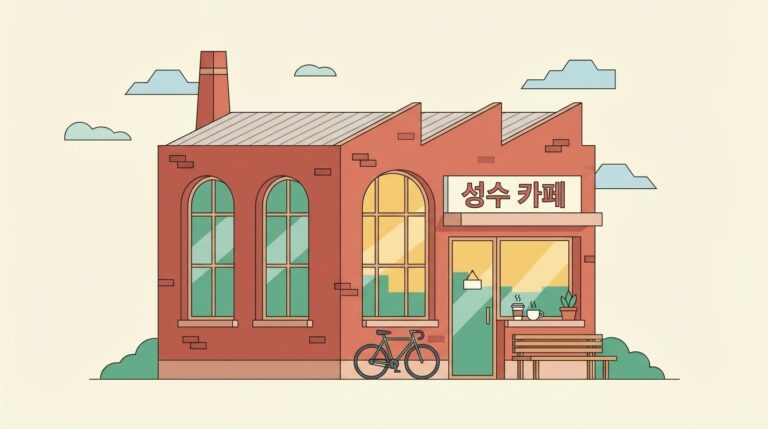
Phase 1: Empathy (The Cold Open)
Hello! Daily Hangul Editor here.
Imagine this: You step out of Exit 3 at Seongsu Station in Seoul. According to your favorite K-Travel vlogger, this is the “Brooklyn of Seoul.” But as you look around, all you see are gritty auto repair shops, old shoe factories, and red-brick warehouses. You start to panic. Did KakaoMap glitch again?
Then, you turn down a narrow alley. Tucked between a noisy printing press and a rusty metal gate, you spot it—a massive, ultra-chic cafe bustling with trendy locals. In K-Dramas, this is exactly where the stylish art director lead would sip her iced Americano. You hear the person next to you exclaim, “와, 여기 완전 힙하다!” (Wa, yeogi wanjeon hip-ha-da!)
Welcome to Seongsu-dong, the heart of Korea’s urban regeneration (도시 재생). If you want to understand Seoul’s architecture right now, you can’t just learn textbook words like “건물 (building).” You need to know the B2-level vocabulary of transformation, history, and aesthetics. Let’s dive into the language of Seoul’s trendiest streets so you can sound like a true insider on your next cafe-hopping adventure!
Phase 2: Deep Dive into Key Expressions
Here are the top three expressions you absolutely need when exploring revitalized architectural spaces in Korea.
1. 공장을 개조했어요
- Pronunciation: gong-jang-eul gae-jo-hae-sseo-yo [gong-jang: like the ‘gong’ you hit + jang / gae-jo: sounds like ‘gay-joe’]
- Meaning: Literal = “They remodeled/renovated a factory.” / Real nuance = “This place has an authentic industrial-chic vibe.”
- K-Culture Moment: You’ll hear this on every Korean dating reality show when couples go on a date in Seongsu. It shows that the place isn’t just new; it has a story.
- Editor’s Insight: The verb 개조하다 (to remodel/convert) is a fantastic B2 word. It elevates your Korean from simple descriptions (“It is a cafe”) to explaining architectural transformation.
- Situation Spectrum:
[🚫 절대 금지] ———— [⚠️ 주의] ———— [✅ 자유롭게]
- Friends (Casual): ✅ (공장 개조했대!)
- Co-workers (Semi-formal): ✅ (공장을 개조했네요.)
- Boss/Elders (Formal): ✅ (공장을 개조한 곳입니다.)
- 🤔 Think About It: Why does modern Korean culture love converting old factories instead of tearing them down? What does this say about the balance between rapid development and nostalgia?
2. 원래는 ~이었대요
- Pronunciation: won-rae-neun ~i-eot-dae-yo [won-rae: sounds like ‘one-ray’ / dae-yo: day-yo]
- Meaning: Literal = “I heard it was originally ~” / Real nuance = “Did you know the backstory of this place?”
- K-Culture Moment: Imagine sitting in a gorgeous bakery, and your Korean friend points to a rustic ceiling beam. They use this phrase to drop some insider knowledge about the building’s past.
- Editor’s Insight: The grammar -대요 (I heard that…) is essential for B2. It shows you aren’t just making a statement, but sharing information you learned from a blog, Instagram, or rumors.
- Situation Spectrum:
[🚫 절대 금지] ———— [⚠️ 주의] ———— [✅ 자유롭게]
- Friends (Casual): ✅ (원래 구두 공장이었대.)
- Co-workers (Semi-formal): ✅ (원래는 인쇄소였대요.)
- Boss/Elders (Formal): ⚠️ (원래는 인쇄소였다고 합니다 is better.)
- 🤔 Think About It: Koreans love sharing “hidden info” found on blogs. Does your culture have a similar grammatical structure just for passing along hearsay?
3. 감성이 미쳤어요
- Pronunciation: gam-seong-i mi-chyeo-sseo-yo [gam-seong: gahm-sung / mi-chyeo-sseo: mee-chuh-sso]
- Meaning: Literal = “The sentiment/sensitivity is crazy.” / Real nuance = “The aesthetic/vibe here is absolutely insane (in a good way)!”
- K-Culture Moment: This is the ultimate Instagram caption for an architectural masterpiece. Whether it’s a brutalist concrete wall or a cozy wooden interior, this phrase fits.
- Editor’s Insight: 감성 (gam-seong) translates to ‘sentiment,’ but in modern Korean, it means ‘aesthetic’ or ‘vibe.’ While “미쳤어요 (crazy)” is technically a bit rough, young people use it purely as a compliment for mind-blowing design.
- Situation Spectrum:
[🚫 절대 금지] ———— [⚠️ 주의] ———— [✅ 자유롭게]
- Friends (Casual): ✅ (감성 미쳤다!)
- Co-workers (Semi-formal): ⚠️ (Use with close colleagues only)
- Boss/Elders (Formal): 🚫 (Use “분위기가 정말 좋네요” instead)
- 🤔 Think About It: Using negative words like “crazy” as ultimate praise is common globally (like “sick” in English). Why do you think youth culture does this?
Phase 3: Textbook vs. Real Korean
| Situation | 📖 Textbook Korean | 🗣️ Real Korean | 💡 Why is it different? |
|---|---|---|---|
| Complimenting a building’s design | 이 건물은 아름답습니다. (This building is beautiful.) | 여기 완전 감성 미쳤다! (The aesthetic here is insane!) | Young Koreans prioritize ‘vibe/aesthetic’ (감성) over traditional beauty. |
| Asking about a place’s history | 이 장소는 예전에 무엇이었습니까? (What was this place before?) | 여기 원래 뭐 하던 곳이야? (What used to happen here?) | The real phrase focuses on the activity (뭐 하던) rather than the object. |
| Describing an old area | 이곳은 오래된 동네입니다. (This is an old neighborhood.) | 요즘 제일 핫한 뉴트로 골목이에요. (It’s the hottest Newtro alley these days.) | Integrating Konglish (핫한, 뉴트로) reflects current media trends. |
Bottom Note for B2 Learners: You don’t need to use deep slang, but mastering words like 감성 (aesthetic) and 원래 (originally) will immediately make you sound less like a textbook and more like a local.
Phase 4: Cultural Context — K-Culture Deep Dive
4-1. Non-Verbal Elements: The “Nunchi” of Seongsu
When exploring urban regeneration areas, you’ll encounter a mix of trendy visitors and older local workers. Good nunchi (social awareness) means knowing where to point your camera. Many active factories have signs saying “사진 촬영 금지” (No photography). Taking photos of heavy machinery while workers are busy is considered rude. Be respectful of the space’s dual identity!
4-2. The “Newtro” K-Culture Connection
Seongsu-dong is the epicenter of Newtro (New + Retro). K-Pop agencies love shooting music videos in these abandoned-looking spaces because the rough, brutalist architecture (exposed concrete, rusted iron) contrasts perfectly with glamorous outfits and sharp choreography.
Similarly, in K-Dramas, whenever a gritty underdog character opens a stylish new business, it’s almost always in a renovated warehouse setting. The architecture itself tells a story of “resilience” and “rebirth.” When you use Korean to talk about these spaces, you are participating in this cultural narrative of making the old cool again.
Phase 5: Real-Life Roleplay Scenario
Setting: Saturday afternoon in Seongsu-dong. You and your Korean friend, Minsu, just walked into “Onion” (a famous cafe converted from an old metal factory). The place is deliberately unpolished—crumbling brick walls, wild grass growing on the roof, but the smell of freshly baked pandoro bread is heavenly.
Characters:
– YOU: A B2 Korean learner, an architecture enthusiast who loves taking aesthetic photos.
– Minsu (29): Your Korean language exchange partner. He knows all the hot spots.
Dialogue:
Minsu: 야, 여기 어때? 분위기 대박이지?
(Ya, yeogi eottae? bunwigi daebagiji?)
[Hey, how’s this place? The vibe is amazing, right?]
YOU: 우와, 진짜 크다. 원래 뭐 하던 곳이야?
(Uwa, jinjja keuda. wonrae mwo hadeon gosiya?)
[Wow, it’s really big. What was this place originally?]
(🎭 Stage Direction: You look around at the exposed concrete ceiling)
Minsu: 여기 옛날에 금속 부품 공장이었대.
(Yeogi yennare geumsok bupum gongjangieotdae.)
[I heard this used to be a metal parts factory a long time ago.]
YOU: 아, 진짜? 공장을 개조한 거야? 완전 힙하다!
(A, jinjja? gongjangeul gaejohan geoya? wanjeon hip-hada!)
[Oh, really? They renovated a factory? It’s totally hip!]
Minsu: 그치? 성수동은 이런 뉴트로 감성이 매력이야. 근데 자리 잡기 진짜 힘들어.
(Geuchi? seongsudongeun ireon nyeuteuro gamseongi maeryeogiya. geunde jari japgi jinjja himdeureo.)
[Right? This Newtro aesthetic is the charm of Seongsu-dong. But grabbing a seat is really hard.]
YOU: 저기 창가 쪽에 빈자리 있다! 내가 먼저 가서 앉을게.
(Jeogi changga jjoge binjari itda! naega meonjeo gaseo anjeulge.)
[There’s an empty seat by the window over there! I’ll go sit down first.]
Minsu: 오, 나이스! 그럼 내가 빵이랑 커피 주문할게. 너 뭐 마실래?
(O, naiseu! geureom naega ppangirang keopi jumunhalge. neo mwo masillae?)
[Oh, nice! Then I’ll order the bread and coffee. What do you want to drink?]
🔀 Your Turn! How should you respond?
– A) “아메리카노 주세요. 감사합니다.” (Americano please. Thank you.)
– B) “난 아이스 아메리카노! 계산은 이따가 내가 반 보낼게.” (Iced Americano for me! I’ll send you my half of the bill later.)
– C) “네가 사? 그럼 제일 비싼 거 먹을래!” (You’re buying? Then I’ll have the most expensive one!)✅ Best Choice: B — Reason: In a casual setting with a friend, A is too robotic and formal. Choice B shows great B2 fluency by naturally offering to split the bill later (using mobile transfer, which is incredibly common among Korean youth).
⚠️ Choice C Analysis: It’s a funny joke among very close friends, but could be seen as slightly impolite if you and Minsu are just language partners.
(Bonus K-Culture Scenario)
You finally sit down, but notice the table is extremely low—almost at your knees (a notorious feature of trendy Korean cafes).
YOU: 민수야… 테이블이 왜 이렇게 낮아? (Minsu… why is the table so low?)
Minsu: 아… 이거 요즘 ‘인스타 감성’ 카페 특징이야. 허리 아파도 참아야 돼! (Ah… this is a characteristic of ‘Insta-aesthetic’ cafes these days. You just have to endure the back pain!)
Phase 6: 10-Second Shadowing Drill
Practice this B2-level compound sentence. Pay attention to the pauses!
😲 우와! / 원래는 / 구두 공장이었는데, / 지금은 / 복합문화공간이네요!
(Uwa! / wonrae-neun / gudu gongjang-ieonneunde, / jigeumeun / bokam-munhwa-gonggan-ineyo!)
[Wow! Originally it was a shoe factory, but now it’s a complex cultural space!]
Phase 7: K-Culture Mini Dictionary
| Korean | Romanization | English | Context |
|---|---|---|---|
| 뉴트로 | nyu-teu-ro | Newtro | New + Retro. Enjoying vintage things in a modern way. The core theme of Seongsu. |
| 복합문화공간 | bo-kam-mun-hwa-gong-gan | Complex Cultural Space | B2 Vocabulary. A space that is a cafe, art gallery, and pop-up store all at once. |
| 인스타 감성 | in-seu-ta gam-seong | Insta-aesthetic | Places specifically designed to look good on Instagram, even if slightly impractical. |
| 핫플 | hat-peul | Hot Place | Slang for a trendy, popular spot. |
Phase 8: Traveler Survival Kit
Navigating the maze-like alleys of Seongsu can be tricky since cool cafes are often hidden behind rusty metal doors.
🆘 Survival Expressions for Seongsu
– 🇰🇷 “혹시 여기 웨이팅 있나요?” (hok-si yeo-gi we-i-ting in-na-yo?)
– 🗣️ Meaning: Is there a waiting list here?
– 📍 Where to use: At the entrance of any popular cafe/restaurant in Seongsu.
– 💡 Pro Tip: Many places use an iPad kiosk (캐치테이블/CatchTable) at the door. You might need a Korean phone number to queue, or ask the staff: “외국인인데 어떻게 웨이팅해요?” (I’m a foreigner, how do I wait?)📌 Editor’s Travel Note
– Navigating: Google Maps barely works in Korea’s narrow alleys. KakaoMap or Naver Map is mandatory for Seongsu-dong.
– Pop-up Stores: Seongsu is famous for weekend “Pop-up stores” (팝업 스토어). They are usually free to enter but require you to follow their Instagram account first!
Phase 9: Critical Thinking — “One Step Deeper”
Media vs Reality: The Gentrification Dilemma
On Instagram, Seongsu-dong is a glamorous playground of high-end fashion pop-ups and aesthetic cafes. However, behind the “Newtro” charm lies a complex social reality. As large brands buy up old factories to renovate them, the soaring rent (젠트리피케이션 – gentrification) is pushing out the original blue-collar mechanics and shoemakers who built the neighborhood. The rough, industrial aesthetic that young people pay $8 for a coffee to enjoy is actually the fading livelihood of the older generation.
🧠 Think Deeper:
When we call a dilapidated factory “aesthetic (감성),” are we appreciating history, or just consuming someone else’s past as a trend?💬 Your Turn: Has your city experienced urban regeneration? How does your culture balance preserving local businesses with modern gentrification? Let us know in the comments!
Phase 10: FAQ & Avoiding Misunderstandings
- Q: How do I actually pronounce “Seongsu”?
A: Many learners say “Seong-soo” with equal stress. In Korean, the first syllable is slightly higher and faster. Think of it like sung-SU. - Q: Can I take photos anywhere in Seongsu?
A: Maybe. While cafes welcome it, do NOT take photos directly inside the working auto shops or shoe factories. It makes the workers uncomfortable. Always look for “CCTV 촬영중” (CCTV recording) or “사진 금지” (No photos) signs.
❌ Common Mistake #1: Saying “공장을 부셨어요” (They destroyed the factory) instead of “개조했어요” (remodeled/renovated). If the structure is still there, always use 개조하다!
Phase 11: Summary & Action Items
- One-Liner Summary: Seongsu-dong’s architecture is best described using the B2 grammar of transformation: 원래 ~이었는데, 개조했어요 (It originally was ~, but they remodeled it).
-
Action Mission 3 Steps:
- 🥉 Bronze (Solo): Look around your room and say “원래는 [past item]이었는데…” to practice the grammar.
- 🥈 Silver (Online): Find a photo of a cool Korean cafe on Instagram and comment “분위기 완전 힙해요!”
- 🥇 Gold (Real-Life): Visit a renovated cafe or building in your city and explain its history to a friend in Korean.
- K-Culture Mission: Open Google Maps or Naver Map Street View, drop the little person into ‘Seongsu-dong Cafe Street’ (성수동 카페거리), and see if you can spot the contrast between the old factories and new cafes!
Phase 12: Quiz — Interactive Challenge
1. Situational Judgment: You are walking with your Korean boss in Seongsu. You want to compliment the beautiful interior of a renovated warehouse cafe. What should you say?
A) 부장님, 여기 감성 미쳤네요!
B) 부장님, 분위기가 정말 좋네요.
C) 부장님, 여기 원래 공장이었대.
(Answer: B. A is too slangy for a boss, and C uses 반말 (informal speech).)
2. Fill in the Blank:
“이 멋진 카페는 ______ 구두 공장이었대요.”
(This cool cafe was ______ a shoe factory.)
(Answer: 원래 – originally)
3. True or False – K-Culture Edition:
“If you see an old, rusty metal door in Seongsu-dong, it’s definitely an abandoned building you shouldn’t enter.”
(Answer: False! It might just be the entrance to the most famous, hipster cafe in the city. Always check for a small sign or CatchTable iPad!)
4. Roleplay Consequence: In Phase 5, if you had chosen Option C (“You’re buying? Then I’ll have the most expensive one!”) with an older colleague instead of a close friend, what would happen?
(Answer: You would commit a “Nunchi” fail. In Korean work culture, usually, the senior pays, but the junior politely orders something mid-range or similar to the senior’s drink as a sign of respect.)
Frequently Asked Questions (FAQ)
Q: What does "공장을 개조했어요" mean in Korean and how do you pronounce it?
A: In Korean, "공장을 개조했어요" is pronounced [gong-jang-eul gae-jo-hae-sseo-yo [gong-jang: like the 'gong' you hit + jang / gae-jo: sounds like 'gay-joe'] and means: Literal = "They remodeled/renovated a factory." / Real nuance = "This place has an authentic industrial-chic vibe."
Q: What does "원래는 ~이었대요" mean in Korean and how do you pronounce it?
A: In Korean, "원래는 ~이었대요" is pronounced [won-rae-neun ~i-eot-dae-yo [won-rae: sounds like 'one-ray' / dae-yo: day-yo] and means: Literal = "I heard it was originally ~" / Real nuance = "Did you know the backstory of this place?"
Q: What does "감성이 미쳤어요" mean in Korean and how do you pronounce it?
A: In Korean, "감성이 미쳤어요" is pronounced [gam-seong-i mi-chyeo-sseo-yo [gam-seong: gahm-sung / mi-chyeo-sseo: mee-chuh-sso] and means: Literal = "The sentiment/sensitivity is crazy." / Real nuance = "The aesthetic/vibe here is absolutely insane (in a good way)!"







