

Phase 1: Empathy (Immersive Open)
Hello there! It’s your Daily Hangul Editor. Grab a seat, roll your D20, and let’s get into it.
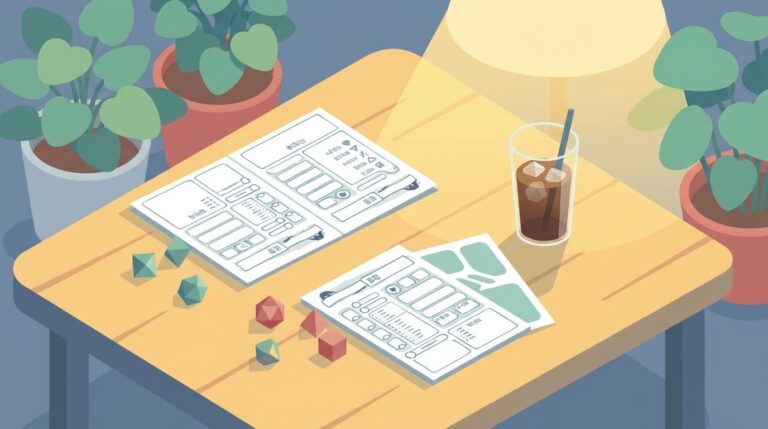
Picture this: It’s Friday night in a dimly lit, bustling board game café in Hongdae. Half-empty iced Americanos sweat on the table, character sheets are scattered everywhere, and the Game Master (GM) looks at you expectantly. “So, what do you do?” they ask. You know exactly what your Elf Rogue would do, but the Korean phrase you learned in your textbook—”저는 문을 엽니다” (I open the door)—feels painfully stiff. Where’s the flavor? Where’s the drama?
If you’ve ever tried to join a Tabletop Role-Playing Game (TRPG) or a heavy strategy board game with Korean friends, you’ve probably hit this wall. Textbook Korean is great for ordering coffee, but surviving a dungeon or betraying your friends in a game of Avalon requires a completely different vocabulary.
Today, we are diving deep into the C1-level jargon of Korean tabletop gaming. By the end of this module, you won’t just be playing the game; you’ll be the 인싸 (Insider) carrying the team. These insights are straight from the gaming tables of Seoul, so get ready to level up your Korean!
Phase 2: Core Expressions – The Gamer’s Arsenal
1. 과몰입 좀 할게요 (I’m going to over-immerse now)
- Pronunciation: Gwamolip jom halgeyo [Gwa-mo-reep jom hal-ge-yo]
- Meaning: Literal: “I will over-immerse a little.” / Real nuance: “I’m going to get super into character now (don’t judge me).”
- K-Culture Moment: You’ll hear this a lot not just in TRPGs, but on K-Variety shows like Crime Scene or The Great Escape. Before delivering a dramatic, tear-jerking line as a tragic hero, a player might say this to warn the table that they are about to act their heart out.
- Editor’s Insight: This is arguably the trendiest slang in modern Korean culture. Koreans use 과몰입 for everything—from obsessing over a K-Drama character to hyper-fixating on MBTI personality types. In a TRPG, it’s a fun, self-aware way to excuse your upcoming theatrical performance.
- Situation Spectrum:
[🚫 Absolutely Not] ———— [⚠️ Caution] ———— [✅ Go for it]- Close Friends (Casual): ✅ “야, 나 과몰입한다?” (Hey, I’m going in deep!)
- Co-workers (Semi-formal): ⚠️ (Only if playing a game together)
- Boss/Elders (Formal): 🚫
- 🤔 Think About It: Why do Koreans feel the need to announce that they are about to act out of character? How does this relate to the Korean cultural emphasis on maintaining societal norms and avoiding ‘standing out’ unnecessarily?
2. 판정해 볼게요 / 다이스 굴릴게요 (I’ll make a check / I’ll roll the dice)
- Pronunciation: Panjeonghae bolgeyo [Pan-jung-hae bol-ge-yo] / Daiseu gullilgeyo [Da-ee-seu gool-lil-ge-yo]
- Meaning: Literal: “I will try a judgment” / Real nuance: “I’m rolling for a skill check.”
- K-Culture Moment: The tension is high. The GM asks for a Dexterity check. Instead of the basic “주사위를 던지겠습니다” (I will throw the dice), saying “회피 판정할게요” (I’ll roll for evasion) instantly marks you as a seasoned player.
- Editor’s Insight: English loan words are massive in Korean gaming. We use “다이스” (dice) instead of “주사위” just as often. The word 판정 (Judgment/Verdict) adds a technical, official weight to your action, making you sound like a true veteran.
- Situation Spectrum:
- Close Friends (Casual): ✅
- Co-workers (Semi-formal): ✅
- Boss/Elders (Formal): ⚠️ (Unlikely to play TRPGs with your traditional boss!)
- 🤔 Think About It: Notice how English terms (Dice, Master, Check) dominate Korean gaming culture. Does your native language also borrow heavily from English for gaming terminology, or do you have localized terms?
3. 이거 완전 억까 아니에요? (Isn’t the game screwing me over?)
- Pronunciation: Igeo wanjeon eokka anieyo? [Ee-geo wan-jeon uk-kka ah-nee-eh-yo?]
- Meaning: Literal: “Isn’t this complete forced-criticism?” / Real nuance: “This is so unfair! The game/GM is totally out to get me!”
- K-Culture Moment: You roll a natural 1 (a critical failure, or 펌블 in Korean), and your sword breaks, hitting your ally. You throw your hands up and yell, “억까야!”
- Editor’s Insight: 억까 is an abbreviation of “억지로 까다” (criticizing or putting someone down forcefully/illogically). In gaming, it means the RNG (Random Number Generator) or the GM has designed an inescapable, unfair situation. It’s a hilarious, slightly whiny way to bond with your party over bad luck.
- Situation Spectrum:
- Close Friends (Casual): ✅
- Co-workers (Semi-formal): ⚠️ (Might sound a bit too slangy/whiny)
- Boss/Elders (Formal): 🚫
- 🤔 Think About It: Blaming the system rather than oneself is a common coping mechanism in competitive gaming. How does having a specific word like “억까” change the dynamic of complaining at the table?
Phase 3: Textbook vs Real Korean
| Situation | 📖 Textbook Korean | 🗣️ Real Korean (Tabletop Edition) | 💡 Why the difference? |
|---|---|---|---|
| Starting a game | “게임을 시작하겠습니다.” (I will start the game.) | “자, 판 깔아봅시다!” (Let’s lay out the board!) | “판을 깔다” implies setting the stage for something grand or dramatic. |
| Rolling a Critical Success | “대성공입니다!” (It is a great success!) | “와, 크리 떴다!” (Wow, crit popped off!) | Gamers love efficiency; “크리” is short for Critical, “뜨다” means to appear. |
| Leading the team to victory | “제가 팀을 승리로 이끌겠습니다.” (I will lead the team to victory.) | “이번 판은 제가 캐리할게요.” (I’ll carry this round.) | E-sports culture heavily influences tabletop terminology in Korea. |
| Making a character | “캐릭터를 만들겠습니다.” (I will make a character.) | “캐메(캐릭터 메이킹) 시작하죠.” (Let’s start character making.) | Koreans love 4-syllable abbreviations (줄임말) for speed. |
Bottom Note for C1 Learners: You don’t need to use slang in every sentence. The sweet spot is mixing polite grammar (요/습니다) with gamer vocabulary. “마스터, 저 이거 억까 같은데요?” (Master, I think this is a bit unfair?) is a perfect, witty blend.
Phase 4: Cultural Context — K-Culture Deep Dive
4-1. Non-verbal Elements: The Art of “리액션” (Reaction)
In Western TRPGs, quiet contemplation of your next move is normal. In Korea, silence is deadly. The concept of 눈치 (Nunchi) means you should be actively reading the room and providing 리액션 (Reactions). If someone makes a great move or rolls a high number, you are expected to clap, gasp, or audibly cheer. If you are playing a mafia-style game and someone lies, leaning back, crossing your arms, and making a loud “에이~ (Eyyyy~)” sound is practically required.
4-2. The K-Variety Show Connection
Korean tabletop gaming heavily mirrors the editing style of Korean variety shows (예능). Shows like Crime Scene or The Great Escape have popularized the idea of amateur actors throwing themselves into ridiculous scenarios. When you say “저 과몰입 할게요” (I’m going to over-immerse), you are essentially signaling to the table: “Pretend we are on a TV show right now. I am the main character for the next 30 seconds.”
Critical Perspective: While shows make it look like everyone is a master improviser, real-life gamers can be quite shy initially. It often takes a few drinks or an hour of warm-up before the true 과몰입 begins. Don’t feel pressured to be a K-Drama star from minute one!
Phase 5: Real-Life Roleplay Scenario
Setting: Saturday afternoon. A private room in a Gangnam board game café. The AC is blasting, and there’s a towering plate of honey butter toast in the center of the table. You are playing a fantasy TRPG with your Korean friends.
Characters:
– YOU (The Player): An Elf Ranger who just found a suspicious treasure chest.
– Min-su (32, The GM): Your Korean buddy who takes his Game Master role very seriously.
– Ji-yoon (28, The Fighter): Quick to act, impatient, and loves combat.
Dialogue:
Min-su (GM): 방 한가운데에 금빛으로 빛나는 상자가 있습니다. 어떻게 할까요?
(Bang hangaundaee geumbicheuro binnaneun sangjaga itseumnida. Eotteoke halkkayo?)
[There is a golden glowing chest in the middle of the room. What will you do?]
(🎭 Stage Direction: Min-su tents his fingers like an evil mastermind)
Ji-yoon: 야, 무조건 열어야지! 제가 가서 확 엽니다!
(Ya, mujogeon yeoyeoji! Jega gaseo hwak yeomnida!)
[Hey, we gotta open it! I go and rip it open!]
YOU: 잠깐만요! 지윤 씨, 그거 함정일 수도 있어요.
(Jamkkanmanyo! Ji-yoon ssi, geugeo hamjeongil sudo isseoyo.)
[Wait a minute! Ji-yoon, that could be a trap.]
Min-su (GM): 지윤은 이미 손잡이를 잡았습니다. 멈추시겠습니까?
(Jiyuneun imi sonjabireul jabatsseumnida. Meomchusigetseumnikka?)
[Ji-yoon has already grabbed the handle. Will you stop her?]
🔀 Your Turn! How do you respond?
– A) “네, 멈추겠습니다.” (Yes, I will stop her. – Too textbook!)
– B) “저 과몰입 좀 할게요. 몸을 날려서 지윤을 밀쳐냅니다!” (I’m going to over-immerse. I throw my body and push Ji-yoon away!)
– C) “마스터, 이거 완전 억까 아니에요? 왜 갑자기 상자가 나와요!” (Master, isn’t this totally unfair? Why is there a chest suddenly!)✅ Best Choice: B — This perfectly utilizes the C1 slang we learned and shows you are ready to engage in dramatic roleplay.
⚠️ Choice C Analysis: While funny, complaining about a basic treasure chest might stall the game. Save “억까” for when you actually roll a terrible trap!
Min-su (GM): 좋아요! 민첩 판정해 볼게요. 다이스 굴려주세요.
(Joayo! Mincheop panjeonghae bolgeyo. Daiseu gullyeojuseyo.)
[Good! Let’s do an agility check. Please roll the dice.]
YOU: (Rolls a 20) 헐, 대박. 마스터, 저 크리 떴어요!
(Heol, daebak. Maseuteo, jeo keuri tteosseoyo!)
[Omg, jackpot. Master, I rolled a crit!]
Ji-yoon: 와, 오늘 당신이 우리 팀 캐리하네요!
(Wa, oneul dangsini uri tim kaerihaneyo!)
[Wow, you’re carrying our team today!]
Bonus Roleplay: The Café Survival
Before the game starts, you need to navigate the café.
Staff: 주문하시겠어요? (Are you ready to order?)
YOU: 아이스 아메리카노 세 잔 주시고요, 혹시 이 게임 룰 설명해 주실 수 있나요?
(Aiseu amerukano se jan jusigoyo, hoksi i geim rul seolmyeonghae jusil su innayo?)
[Three iced Americanos please, and by any chance, could you explain the rules for this game?]
Staff: 네, 5분 뒤에 테이블로 가서 설명해 드릴게요!
(Ne, obun dwie teibeullo gaseo seolmyeonghae deurilgeyo!)
[Yes, I’ll come to your table in 5 minutes to explain!]
Phase 6: 10-Second Shadowing Drill
Channel your inner dramatic actor. Pay attention to the pauses (/) and the prolonged vowels (~).
😤 Determined: 마스터! / 저 지금부터 / 과몰입 좀 / 하겠~습니다!
(Maseuteo! / jeo jigeumbuteo / gwamolip jom / haget~seumnida!)🥺 Whining playfully: 아 진짜! / 이거 / 완전 억까 / 아니에요?
(Ah jinjja! / igeo / wanjeon eokka / anieyo?)
Phase 7: K-Culture Mini Dictionary
| Korean | Romanization | English | Contextual Explanation |
|---|---|---|---|
| 과몰입 | gwamolip | Over-immersion | Hyper-focusing on a role, narrative, or personality type (like MBTI). |
| 억까 | eokka | Unfair disadvantage | Abbreviation for ‘억지로 까다’. Used when the game feels rigged. |
| 판을 깔다 | paneul kkalda | Setting the stage | Creating an atmosphere where someone can show off or act. |
| 크리 / 펌블 | keuri / peombeul | Crit / Fumble | Loan words used universally in Korean RPGs for 20s and 1s. |
| 캐리하다 | kaerihada | To carry | Taking the lead and ensuring the team’s success, borrowed from e-sports. |
Phase 8: Traveler’s Survival Kit
Board game cafés (보드게임카페) are massive in Korea—they are hybrid spaces with full food menus, private rooms, and thousands of games. If you’re visiting Seoul, you must check one out!
🆘 Survival Expression #1: Asking for Rules
– 🇰🇷 “이거 룰 설명해 주실 수 있나요?” (igeo rul seolmyeonghae jusil su innayo?)
– 🗣️ Sound-alike: [ee-geo rool sul-myung-hae joo-shil soo in-na-yo?]
– 📍 Where to use: Any board game cafe.
– 💡 Pro Tip: Korean board game cafe staff are literally trained to teach games. Don’t struggle with the manual—just ask!📌 Editor’s Travel Note
– Finding a Cafe: Search “보드게임카페” on KakaoMap or Naver Map.
– Payment: You usually pay for the drinks upfront, and the hourly room fee (around 3,000 KRW/hour) is calculated when you leave.
– Snacks: Do not miss the snacks. Ordering “짜파게티” (Jjapagetti) while gaming is a deeply cherished Korean tradition.
Phase 9: Critical Thinking Corner — “A Step Deeper”
🧠 Think Deeper: Media vs Reality & The Escapism of Play
Why has 과몰입 (over-immersion) become such a massive cultural keyword in Korea? Modern Korean society is famously fast-paced, highly competitive, and strictly hierarchical. Young Koreans face immense pressure in education and the job market. TRPGs, board games, and the national obsession with MBTI personality types provide a safe, structured space to adopt an alternate identity. When a Korean friend says “I’m over-immersing,” they are temporarily casting off the heavy expectations of society and granting themselves permission to be messy, dramatic, or entirely different. Language like this shows how deeply gaming acts as a psychological release valve.
💬 Your Turn: Does your culture have a concept similar to “과몰입”? How do adults in your country temporarily escape societal pressures? Share your thoughts in the comments!
Phase 10: FAQ & Avoiding Misunderstandings
Q: Can I use informal language (반말, Banmal) while roleplaying my character?
Yes and No! This is crucial. In character, you can use whatever language fits your role (even talking down to a king if you’re playing a rogue). However, Out of Character (OOC) when addressing the GM or other players, you must revert to the appropriate polite form (존댓말) unless you are all close friends. Mixing this up is a major faux pas!
Q: Is it rude to scream or yell when rolling the dice?
In a private room at a board game cafe? It’s encouraged! High energy (텐션) is appreciated. In an open-hall cafe, keep the volume respectful, but reactions (리액션) are always welcome.
❌ Common Mistake #1: Arguing with the GM using formal, aggressive business Korean. (e.g., “이 규칙은 부당합니다.” – This rule is unjust.)
✅ Do This Instead: Use gaming slang to keep it light. “아 마스터~ 완전 억까잖아요!” (Ah Master~ This is totally unfair!)
Phase 11: Summary & Action Items
One-Liner Summary: To survive a Korean tabletop game, embrace the drama with “과몰입”, call out the unfairness with “억까”, and always remember to react loudly!
Action Mission:
– 🥉 Bronze (Solo): Stand in front of a mirror, roll an imaginary die, and declare “판정해 볼게요!” with absolute confidence.
– 🥈 Silver (Online): Join a Korean TRPG or board game Discord/Reddit and introduce your favorite character using today’s vocabulary.
– 🥇 Gold (Real Life): Visit a board game cafe in Korea, ask the staff for a rule explanation, and use “과몰입” during your session!
🎮 K-Culture Mission:
Search for “대탈출” (The Great Escape) or “크라임씬” (Crime Scene) on YouTube. Watch a 5-minute clip and spot how the celebrities physically react and “over-immerse” into their roles. Notice the body language!
Phase 12: Quiz — Interactive Challenge
1. Situational Judgment: You are playing a game of Catan. The dice rolls ‘7’ for the fourth time in a row, and the robber steals your resources again. What is the most culturally appropriate (and witty) thing to say?
– A) 저는 화가 납니다. (I am angry.)
– B) 아, 주사위 억까 진짜 심하네! (Ah, this dice is screwing me over so badly!)
– C) 게임을 그만두겠습니다. (I will quit the game.)
(Answer: B. It acknowledges the bad luck using native gamer slang without genuinely ruining the mood.)
2. Fill in the Blank:
“저 지금 요정 캐릭터에 _______ 할 거니까 웃지 마세요!”
(I’m going to _______ into my fairy character now, so don’t laugh!)
(Answer: 과몰입)
3. True or False – K-Culture Edition:
“When playing a character in a TRPG, you must always use formal polite Korean (존댓말) to other characters if the players controlling them are older than you in real life.”
(Answer: False! In-character, age dynamics depend entirely on the fictional narrative. However, out-of-character discussions must respect real-life age/status!)
Frequently Asked Questions (FAQ)
Q: What does "과몰입 좀 할게요 (I'm going to over-immerse now)" mean in Korean and how do you pronounce it?
A: In Korean, "과몰입 좀 할게요 (I'm going to over-immerse now)" is pronounced [Gwamolip jom halgeyo [Gwa-mo-reep jom hal-ge-yo] and means: Literal: "I will over-immerse a little." / Real nuance: "I'm going to get super into character now (don't judge me)."
Q: What does "판정해 볼게요 / 다이스 굴릴게요 (I'll make a check / I'll roll the dice)" mean in Korean and how do you pronounce it?
A: In Korean, "판정해 볼게요 / 다이스 굴릴게요 (I'll make a check / I'll roll the dice)" is pronounced [Panjeonghae bolgeyo [Pan-jung-hae bol-ge-yo] and means: Literal: "I will try a judgment" / Real nuance: "I'm rolling for a skill check."
Q: What does "이거 완전 억까 아니에요? (Isn't the game screwing me over?)" mean in Korean and how do you pronounce it?
A: In Korean, "이거 완전 억까 아니에요? (Isn't the game screwing me over?)" is pronounced [Igeo wanjeon eokka anieyo? [Ee-geo wan-jeon uk-kka ah-nee-eh-yo?] and means: Literal: "Isn't this complete forced-criticism?" / Real nuance: "This is so unfair! The game/GM is totally out to get me!"







