

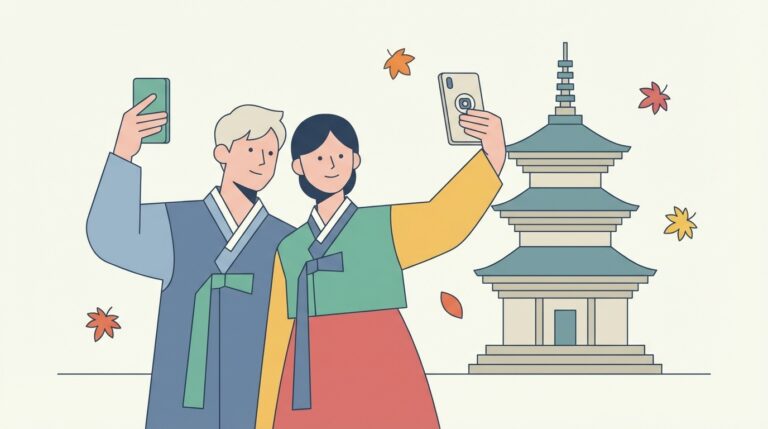
Phase 1: Empathy (Welcome to the “Museum Without Walls”!)
Hello! This is your Daily Hangul Editor. 😊
Imagine this: You’re watching a historical K-Drama like Alchemy of Souls or Hwarang. The screen shows breathtaking temples, ancient stone pagodas, and lush mountains. You think to yourself, “I have to go there!”
So, you book a KTX ticket to Gyeongju, the ancient capital of the Silla Dynasty. You step out of the station, ready to explore Bulguksa Temple (불국사) and the breathtaking Seokguram Grotto (석굴암). But suddenly, reality hits. The signs are confusing, the bus schedules look like a math test, and you need to buy tickets. How do you ask a local for help without sounding like a robotic textbook?
Don’t worry! As a tutor who has guided hundreds of students (and gotten lost in Gyeongju myself!), I know exactly what you need. Today, we’re going to learn the real, practical Korean phrases you need to navigate Korea’s most famous historical sites like a true insider. Let’s dive in!
Phase 2: Core Expressions Deep Dive
1. [불국사 가는 버스 어디서 타요?]
- Pronunciation: bulguksa ganeun beoseu eodiseo tayo? [bool-gook-sah gah-neun buh-suh uh-dee-suh tah-yo?]
- Meaning: Where do I catch the bus going to Bulguksa? (Literal: Bulguksa-going bus, where do I ride?)
- K-Culture Moment: Gyeongju is huge, and taking the bus is the most common way to get to Bulguksa. You’ll often see groups of Korean university students or backpackers asking local grandmas this exact question at the terminal!
- Editor’s Insight: Notice how there is no “I” or “Excuse me, sir” in this sentence. Korean is a high-context language. If you’re looking around at a bus stop, locals already know you are the one who wants to ride the bus. Keeping it short and sweet sounds much more natural!
- Situation Spectrum:
[🚫 절대 금지] ———— [⚠️ 주의] ———— [✅ 자유롭게]- Friends (Casual): ✅ (Drop the ‘요’: 타?)
- Strangers on the street (Semi-formal): ✅ (Perfect!)
- Formal announcements (Formal): ⚠️ (Use ‘탑니까?’ instead)
- 🤔 Think About It: Why does Korean put the destination before the bus? (e.g., “Bulguksa-going bus”). How does this reflect the Korean thought process of setting the “big picture” or “goal” before the subject?
2. [어른 두 명이요.]
- Pronunciation: eoreun du myeong-iyo. [uh-reun doo myuhng-ee-yo]
- Meaning: Two adults, please. (Literal: Adult two people.)
- K-Culture Moment: When you finally reach the Bulguksa ticket booth, the line moves fast. Koreans love “Bbali-bbali” (hurry-hurry) culture. You don’t have time to say a long, textbook sentence. Just flash a smile, show your fingers, and say this phrase!
- Editor’s Insight: The textbook will teach you “표를 두 장 주십시오” (Please give me two tickets). But in real life, ticket agents just need to know who and how many. Adding “요 (yo)” at the end of a noun phrase makes it instantly polite.
- Situation Spectrum:
[🚫 절대 금지] ———— [⚠️ 주의] ———— [✅ 자유롭게]- Casual/Friends: 🚫 (Not used with friends)
- Service staff (Semi-formal): ✅ (The ultimate survival phrase!)
- Formal: ⚠️
- 🤔 Think About It: Counters are a big part of Korean! We use ‘명’ for people, ‘장’ for paper tickets, and ‘개’ for items. Does your native language have counter words, or do you just use numbers?
3. [여기서 사진 찍어도 돼요?]
- Pronunciation: yeogiseo sajin jjigeodo dwaeyo? [yuh-gee-suh sah-jeen jjee-guh-doh dweh-yo?]
- Meaning: Is it okay to take pictures here?
- K-Culture Moment: You’re inside the Seokguram Grotto. The Buddha statue is magnificent. But wait… is photography allowed? In many Korean historical indoor sites, it is strictly forbidden to protect the artifacts. Always ask this before snapping a pic!
- Editor’s Insight: The grammar
-아/어도 돼요?(Is it okay if I…?) is a B1 level goldmine. You can use it anywhere! “앉아도 돼요?” (Can I sit?), “먹어도 돼요?” (Can I eat?). It shows respect for the rules. - Situation Spectrum:
[🚫 절대 금지] ———— [⚠️ 주의] ———— [✅ 자유롭게]- Friends: ✅ (Drop ‘요’)
- Staff/Guards: ✅
- Superiors: ⚠️ (Better to use “찍어도 될까요?”)
- 🤔 Think About It: Koreans value “Nunchi” (reading the room). Asking for permission before acting is a key part of showing good Nunchi.
Phase 3: Textbook vs. Real Korean
| Situation | 📖 Textbook Korean | 🗣️ Real Korean | 💡 Why is it different? |
|---|---|---|---|
| Asking for directions | 불국사에 가려면 어떻게 해야 합니까? | 불국사 가려면 어떻게 가요? | Koreans drop location particles (에) in speech to speak faster. |
| Buying tickets | 표를 두 장 사고 싶습니다. | 어른 두 명이요. | Efficiency! Service workers just need the core info (Adult/Child, Quantity). |
| Asking to take a photo | 사진을 찍어 주시겠습니까? | 저기요, 사진 좀 부탁드릴게요. | “부탁드릴게요” (I make a request) sounds much softer and more natural than a direct question. |
Bottom Note: Don’t stress about perfectly formal grammar when traveling. Politeness in Korea is more about your tone, adding ‘요’, and a slight bow!
Phase 4: Cultural Context — K-Culture Deep Dive
4-1. Non-Verbal “Nunchi” at Temples
When visiting Buddhist temples like Bulguksa, language is only half the battle.
* The Bow: If you make eye contact with a monk, a slight nod of the head is polite.
* Two Hands: When handing your credit card to the ticket agent, use both hands, or support your right elbow with your left hand. It’s a classic sign of respect in Korea!
4-2. The “School Trip” Nostalgia (수학여행)
For Koreans, Gyeongju isn’t just a historical site; it’s a childhood memory! Almost every middle or high school in Korea goes on a Suhak-yeohaeng (수학여행 – school trip) to Gyeongju.
If you tell a Korean friend you went to Bulguksa, they will likely smile and say, “Ah! I took a group photo in front of Dabotap (the stone pagoda) when I was 15!”
Recently, Gyeongju’s Hwangridan-gil (황리단길) has become a massive K-Travel hotspot. Young Koreans rent modern Hanboks or retro 1970s school uniforms to take aesthetic photos (인생샷) and eat the famous 10-Won Bread (십원빵), which is shaped like the coin that features Bulguksa’s pagoda!
Phase 5: Real-Life Roleplay Scenario
Setting: A sunny Friday morning at the Gyeongju Intercity Bus Terminal. You and your Korean friend, Minji, are ready to explore Silla history. The buses are loud, and tourists are everywhere.
Characters:
* YOU: An exchange student who loves K-Dramas and wants to see the real historical sites.
* Minji (22): Your cheerful Korean friend who is acting as your local guide (but she hasn’t been here since high school!).
Dialogue:
YOU: 민지 씨, 우리 이제 불국사로 가요? 🚌
(Minji ssi, uri ije bulguksaro gayo?)
(Minji, are we going to Bulguksa now?)
Minji: 네! 저기 정류장에서 10번이나 11번 버스 타면 돼요.
(Ne! jeogi jeongnyujang-eseo sip-beon-ina sib-il-beon beoseu tamyeon dwaeyo.)
(Yes! We can take bus 10 or 11 at the stop over there.)
YOU: 시간은 얼마나 걸려요?
(Siganeun eolmana geollyeoyo?)
(How long does it take?)
Minji: 음… 한 40분 정도? 아, 버스 온다! 뛰어요!
(Eum… han sasip-bun jeongdo? A, beoseu onda! Ttwieoyo!)
(Hmm… about 40 minutes? Oh, the bus is coming! Run!)
(🎭 Stage Direction: You both run to the bus. You get on first and tap your transportation card.)
Bus Driver: 어서 오세요.
(Eoseo oseyo.)
(Welcome.)
YOU: 안녕하세요!
(Annyeonghaseyo!)
(Hello!)
(🎭 Stage Direction: Minji tries to tap her card, but her card reader says “잔액이 부족합니다” – Insufficient balance!)
Minji: 헐, 나 교통카드 돈 다 썼나 봐. 어떡하지?
(Heol, na gyotongkadeu don da sseonna bwa. Eotteokhaji?)
(OMG, I think my transit card is out of money. What do I do?)
🔀 YOUR TURN! How do you save the day?
* A) “기사님, 제 카드로 두 명 결제해 주세요!” (Driver, please charge two people on my card!)
* B) “민지 씨, 내려요!” (Minji, let’s get off!)
* C) “제 카드를 빌려줄게요.” (I will lend you my card.)✅ Best Choice: A — In Korea, one person can pay for multiple people on a single T-money card! Just tell the driver “두 명이요” (Two people) before you tap. Choice B is too dramatic, and Choice C takes too much time while the bus is waiting.
YOU: 기사님, 제 카드로 두 명 결제해 주세요!
(Gisanim, je kadeuro du myeong gyeoljehae juseyo!)
(Driver, please charge two people on my card!)
Bus Driver: 네, 다시 찍어주세요.
(Ne, dasi jjigeojuseyo.)
(Okay, please tap it again.)
Minji: 와, 진짜 고마워요! 이따가 내가 십원빵 살게요!
(Wa, jinjja gomawoyo! Ittaga naega sib-won-bbang salgeyo!)
(Wow, thank you so much! I’ll buy the 10-won bread later!)
🎬 Bonus Roleplay: The Photo Op
Setting: You are standing in front of the stunning Dabotap Pagoda. You want a picture with Minji.
YOU: 저기요, 죄송하지만 사진 좀 찍어주시겠어요?
(Jeogiyo, joesonghajiman sajin jom jjigeojusigesseoyo?)
(Excuse me, sorry to bother you, but could you take a picture for us?)
Passerby (Korean tourist): 아, 네! 찍어드릴게요. 하나, 둘, 셋!
(A, ne! Jjigeodeurilgeyo. Hana, dul, set!)
(Ah, yes! I’ll take it. One, two, three!)
YOU: 감사합니다! 예쁘게 잘 나왔네요.
(Gamsahamnida! Yeppeuge jal nawatneyo.)
(Thank you! It came out beautifully.)
Phase 6: 10-Second Shadowing Drill
Practice your speaking rhythm! Pause at the / marks and express the emotion in the tags.
- 🗣️ Asking the bus:
😊 불국사 가는 버스 / 어디서 타요?(bulguksa ganeun beoseu / eodiseo tayo?) - 🎫 At the ticket booth:
😊 어른 두 명 / 학생 한 명이요.(eoreun du myeong / haksaeng han myeong-iyo.) - 📸 Inside Seokguram:
🥺 저기... / 여기서 / 사진 찍어도 돼요?(jeogi… / yeogiseo / sajin jjigeodo dwaeyo?)
Phase 7: K-Culture Mini Dictionary
| Korean | Romanization | English | Cultural Context |
|---|---|---|---|
| 수학여행 | suhak-yeohaeng | School Trip | A rite of passage for Korean students. Gyeongju is the #1 classic destination. |
| 신라 | Silla | Silla Dynasty | The ancient kingdom (57 BC – 935 AD) whose capital was Gyeongju. |
| 인생샷 | insaeng-syat | Shot of a lifetime | The perfect photo for Instagram. Finding an “insaeng-syat” spot is crucial for young Koreans traveling! |
| 황리단길 | Hwangridan-gil | Hwangridan Street | The trendiest street in Gyeongju, mixing traditional Hanok architecture with modern cafes. |
| 십원빵 | sib-won-bbang | 10-Won Bread | A popular street food filled with cheese, shaped like the Korean 10-won coin (which features the Bulguksa pagoda). |
Phase 8: Traveler’s Survival Kit
If you are visiting a historical site in Korea, keep these survival phrases in your back pocket!
🆘 Survival Phrases for Historical Sites
1. 🇰🇷 “한국어 오디오 가이드 있어요?” (hangugeo odio gaideu isseoyo?)
🗣️ Do you have an audio guide?
2. 🇰🇷 “몇 시에 문 닫아요?” (myeot sie mun dadayo?)
🗣️ What time do you close?
3. 🇰🇷 “화장실은 어디에 있어요?” (hwajangsireun eodie isseoyo?)
🗣️ Where is the restroom?
📌 Editor’s Travel Note:
* Transportation: When going to Gyeongju, remember that the KTX station (Singyeongju) is quite far from the downtown historical sites! You will need to take a bus or taxi into the city.
* Shoes: Bulguksa and Seokguram require a lot of walking up mountain paths. Leave the aesthetic shoes at the hotel and wear comfortable sneakers!
* KakaoMap/Naver Map: Google Maps does not provide walking directions in Korea. Download Naver Map or KakaoMap before your trip!
Phase 9: Critical Thinking Corner — “A Step Deeper”
🧠 Think Deeper: Media vs. Reality in Korean Tourism
When you watch K-Dramas set in the past, historical sites look incredibly peaceful, silent, and isolated. But the reality of visiting a place like Bulguksa is beautifully chaotic. It represents the “Global Era of Korean Culture.” You will see Buddhist monks chanting next to teenagers filming TikToks in rented Hanboks, and ancient royal tombs sitting directly behind modern Starbucks cafes. This blend shows that Korean history isn’t just locked away in a museum; it is actively lived in, consumed, and adapted by the modern generation.
💬 Your Turn: In your country, are historical sites kept strictly separate from modern life, or are they blended together like in Gyeongju? Let us know in the comments!
Phase 10: FAQ & Avoiding Mistakes
Q: Do I need to wear modest clothes to visit Bulguksa?
Yes and no. While it is a tourist attraction, it is also an active place of worship. You don’t need to cover up completely, but avoiding very revealing clothing (like beachwear) is a sign of good Nunchi and respect.
Q: Can I touch the stone pagodas?
No! Many artifacts in Gyeongju are UNESCO World Heritage sites and are over a thousand years old. Please respect the “눈으로만 보세요” (Please look with your eyes only) signs.
❌ Common Mistake #1: Calling every temple “Jeol (절)” in a taxi.
✅ How to fix it: If you tell a Gyeongju taxi driver “절에 가주세요” (Please go to the temple), they will be very confused because Gyeongju has dozens of temples! Always use the specific name: “불국사 가주세요” (Please go to Bulguksa).❌ Common Mistake #2: Assuming Seokguram is right next to Bulguksa.
✅ How to fix it: They are in the same general area, but Seokguram is much higher up the mountain. You need to take another bus (Bus #12) or a taxi from Bulguksa to get there. Plan your time accordingly!
Phase 11: Summary & Action Items
✨ One-Liner Summary: To master Gyeongju, drop the heavy textbook grammar, use “어디서 타요?” (Where do I ride?), and embrace the polite, concise flow of real Korean!
🎯 Action Mission:
* 🥉 Bronze (Solo): Stand in front of a mirror and practice asking for two tickets holding up two fingers: “어른 두 명이요!”
* 🥈 Silver (Online): Go to Google Maps (or Naver Map), search for ‘Hwangridan-gil’, drop the street view, and imagine ordering a 10-Won bread!
* 🥇 Gold (Real Life): Next time you travel in Korea or visit a Korean cultural event, ask a local: “여기서 사진 찍어도 돼요?” (Can I take a picture here?)
👑 K-Culture Mission:
Watch a travel vlog on YouTube of K-Pop idols visiting Gyeongju (e.g., BTS’s RM visited the Gyeongju museum, or SEVENTEEN on a school trip concept). Listen carefully to see if you can hear the word “수학여행” (School trip)!
Did you enjoy today’s trip to Gyeongju? What historical site in Korea is on your bucket list? Drop a comment below! 👇
Phase 12: Quiz — Interactive Challenge
1. Situational Judgment: You are at the Seokguram ticket booth. You are traveling with one other adult friend. What is the most natural thing to say?
* A) 우리 두 사람에게 표를 주십시오.
* B) 어른 두 명이요.
* C) 저는 표를 사고 싶어요.
2. Fill in the Blank: You want to ask a kind-looking student to take a photo of you.
“저기요, ( ) 좀 찍어주시겠어요?”
* A) 수학여행
* B) 사진
* C) 버스
3. True or False – K-Culture Edition:
“Gyeongju is known as a popular destination for Korean middle and high school field trips (수학여행).”
* True / False
4. Roleplay Outcome: You are on the bus and tap your card. The driver asks, “한 명 더 찍어드릴까요?” (Shall I charge for one more person?). If you are alone, what should you say?
* A) 네, 두 명이요!
* B) 아니요, 한 명이에요. (No, just one person.)
* C) 사진 찍어도 돼요?
👉 Click to see the answers!
- B (It’s fast, natural, and polite!)
- B (사진 = Picture)
- True (It is the ultimate nostalgic school trip destination!)
- B (You only want to pay for yourself!)
Frequently Asked Questions (FAQ)
Q: What does "[불국사 가는 버스 어디서 타요?]" mean in Korean and how do you pronounce it?
A: In Korean, "[불국사 가는 버스 어디서 타요?]" is pronounced [bulguksa ganeun beoseu eodiseo tayo? [bool-gook-sah gah-neun buh-suh uh-dee-suh tah-yo?] and means: Where do I catch the bus going to Bulguksa? (Literal: Bulguksa-going bus, where do I ride?)
Q: What does "[어른 두 명이요.]" mean in Korean and how do you pronounce it?
A: In Korean, "[어른 두 명이요.]" is pronounced [eoreun du myeong-iyo. [uh-reun doo myuhng-ee-yo] and means: Two adults, please. (Literal: Adult two people.)
Q: What does "[여기서 사진 찍어도 돼요?]" mean in Korean and how do you pronounce it?
A: In Korean, "[여기서 사진 찍어도 돼요?]" is pronounced [yeogiseo sajin jjigeodo dwaeyo? [yuh-gee-suh sah-jeen jjee-guh-doh dweh-yo?] and means: Is it okay to take pictures here?







