

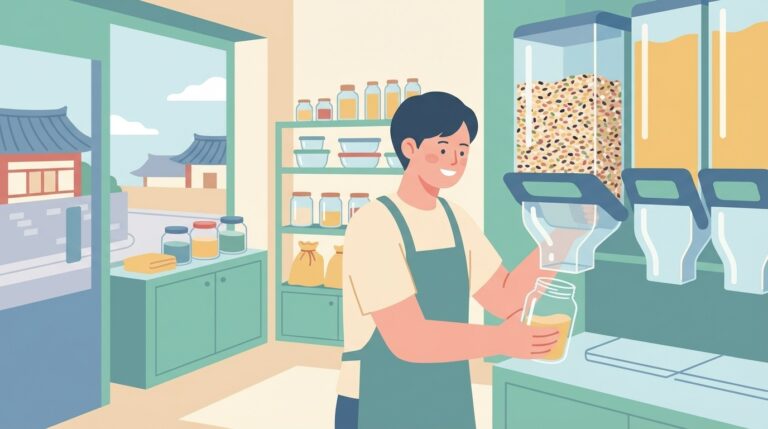
Save the Earth, Korean Style: How to Survive a Zero Waste Shop in Seoul
Phase 1: Empathy & The “Why”
Hello! I’m your Daily Hangul Editor, your veteran tutor and local cultural navigator in Seoul.
You know those classic K-Drama scenes where the chaebol CEO points at a clothing rack and says, “I’ll take everything from here to there,” leaving with dozens of shopping bags? Well, if you walk down the trendy streets of Seongsu-dong or Yeonnam-dong today, you’ll see a very different vibe. The young MZ generation (Millennials and Gen Z) of Seoul are strolling around with canvas eco-bags, clinking glass jars, and stylish tumblers.
Welcome to the era of the Korean Zero Waste Shop! As Korea’s massive delivery and café cultures produced mountains of plastic, a powerful eco-friendly counter-movement was born. But here’s the catch: the vocabulary you need for a zero-waste shop isn’t usually in standard textbooks. How do you tell the staff you brought your own jar? How do you ask to buy just a tiny amount of organic dish soap?
If you use clunky textbook phrases, you might get a confused look. But if you know the natural, local expressions, you’ll not only save the planet but also get the ultimate “Insider (인싸)” treatment from the staff. Let’s dive into the real Korean phrases you need!
Phase 2: Core Expressions Deep Dive
1. 용기 챙겨 왔어요 (I brought my own container)
- Pronunciation: yong-gi chaeng-gyeo wass-eo-yo [sounds like: yong-ghee chang-gyo was-so-yo]
- Meaning: I brought a container.
- K-Culture Moment: There is a famous social media movement in Korea called “용기내 챌린지” (Yong-gi-nae Challenge). “용기” means both “Container” and “Courage.” So it’s a clever pun: “Have courage and bring your own container!” If you say this at a shop, the staff will instantly smile.
- Editor’s Insight: The verb 챙기다 (to pack/bring) sounds much more natural and proactive than the textbook word 가져오다 (to bring). It implies you prepared it thoughtfully in advance.
- Situation Spectrum:
[🚫 절대 금지] ———— [⚠️ 주의] ———— [✅ 자유롭게]
- Friends/Casual: ✅ (용기 챙겨 왔어)
- Shop Staff (Polite): ✅ (용기 챙겨 왔어요)
- Formal/Boss: ⚠️ (A bit too casual for business, use 가져왔습니다)
- 🤔 Think About It: Why does Korean have a specific verb (챙기다) just for “taking care to pack something”? It reflects a culture that highly values preparation and being mindful of details!
2. 조금씩 소분해서 살 수 있나요? (Can I buy this in small portions?)
- Pronunciation: jo-geum-ssik so-bun-hae-seo sal su in-na-yo? [sounds like: jo-geum-shik so-boon-hay-so sal soo in-na-yo?]
- Meaning: Literally “Can I divide it into small parts and buy it?” -> Can I buy in bulk/small quantities?
- K-Culture Moment: You’ll see the word “소분 (So-bun)” everywhere on Korean delivery apps or meal-prep YouTube channels. Because many young Koreans live alone (1-person households), buying large quantities leads to waste. “소분” is a vital B2-level survival word!
- Editor’s Insight: You can just say “조금만 살게요” (I’ll buy a little), but using the word “소분” instantly elevates your Korean to an advanced, native-like level.
- Situation Spectrum:
[🚫 절대 금지] ———— [⚠️ 주의] ———— [✅ 자유롭게]
- Friends/Casual: ✅ (소분해서 살래)
- Shop Staff/Semi-formal: ✅ (소분해서 살 수 있나요?)
- 🤔 Think About It: How does the concept of “소분” contrast with the traditional Korean dining culture of a massive table full of shared side dishes (반찬)?
3. 영수증은 버려주세요 / 괜찮아요 (Please throw away the receipt / I don’t need the receipt)
- Pronunciation: yeong-su-jeung-eun beo-ryeo-ju-se-yo / gwaen-chan-a-yo [sounds like: young-soo-joong-eun bo-ryo-joo-say-yo]
- Meaning: Please throw away the receipt / The receipt is fine (meaning ‘no thank you’).
- K-Culture Moment: Whenever you buy something in Korea, from a convenience store to a luxury boutique, the cashier will ask: “영수증 드릴까요?” (Shall I give you the receipt?). In an eco-friendly shop, saying “버려주세요” (throw it away) or “모바일 영수증으로 받을게요” (I’ll get a mobile receipt) is the ultimate green move.
- Editor’s Insight: In Korean, “괜찮아요 (It’s okay)” often means “No, thank you.” It is the polite way to refuse things without sounding harsh.
- Situation Spectrum:
[🚫 절대 금지] ———— [⚠️ 주의] ———— [✅ 자유롭게]
- To Cashiers (Polite): ✅
- Formal: ✅ (영수증은 괜찮습니다)
Phase 3: Textbook vs. Real Korean
| Situation | 📖 Textbook Korean | 🗣️ Real Korean | 💡 Why is it different? |
|---|---|---|---|
| Refusing a plastic bag | 비닐봉투는 필요하지 않습니다. (I do not need a plastic bag.) | 봉투는 괜찮아요. 가방에 넣을게요. (Bags are okay. I’ll put it in my bag.) | “괜찮아요” softens the refusal, sounding much friendlier than a blunt “I don’t need it.” |
| Asking to use a tumbler | 환경 보호를 위해 제 텀블러를 사용하겠습니다. (I will use my tumbler for environmental protection.) | 여기에 담아주세요. (Handing over the tumbler) (Please put it in here.) | Koreans prefer efficient, direct action. Pointing to the cup and saying “here” is fast and natural. |
| Asking for eco-friendly packaging | 일회용품을 주지 마세요. (Do not give me disposable items.) | 일회용 수저는 빼주세요. (Please leave out the disposable spoons/chopsticks.) | “빼주세요 (please leave it out)” is the standard phrase you’ll see on Korean delivery apps (Baemin, Yogiyo). |
Phase 4: Cultural Context — K-Culture Deep Dive
4-1. Non-verbal Cue: The “Two-Handed” Eco Move
When you hand your personal container or tumbler to the café staff, always use both hands, or at least support your right arm with your left hand. This shows respect. Also, read the room (눈치 – Nunchi)! If the shop is incredibly busy with a long line, make sure your container is clean, open, and ready to hand over to avoid holding up the “Ppalli-ppalli (hurry hurry)” flow of Seoul.
4-2. The K-Pop & K-Food Connection
- K-Pop Eco-Warriors: If you are a K-Pop fan, you know about the “POCA (Photocard) Albums” or digital albums. Fans started protesting against buying heavy physical albums just for photocards, leading agencies to create minimal, eco-friendly packaging. You’ll often see idols carrying large tumblers on their V-Live/Weverse streams!
- K-Food Delivery Checkbox: Korea’s delivery culture is world-class, but the plastic waste was getting out of hand. Now, by law, apps like Baedal Minjok have a default checked box that says:
[v] 일회용 수저, 포크 안 주셔도 돼요(You don’t need to give me disposable spoons/forks). Unchecking it actually requires extra effort!
Phase 5: Interactive Roleplay Scenario
Setting: A warm, minimalist zero-waste shop in Seongsu-dong. Sunlight hits the large glass jars filled with organic grains, coffee beans, and colorful liquid detergents.
Characters:
– YOU: An international resident or traveler trying to buy some laundry detergent sustainably.
– Jiwon (20s): The friendly shop assistant wearing a linen apron.
Dialogue:
Jiwon: 안녕하세요! 혹시 저희 매장 이용해 보신 적 있으신가요? 🌱
(an-nyeong-ha-se-yo! hok-si jeo-hui mae-jang i-yong-hae bo-sin jeok i-sseu-sin-ga-yo?)
[Hello! Have you ever used our store before?]
YOU: 아니요, 오늘 처음이에요.
(a-ni-yo, o-neul cheo-eum-i-e-yo.)
[No, today is my first time.]
Jiwon: 아, 환영합니다! 액체 세제는 원하시는 만큼 통에 담으시고 무게를 재시면 돼요.
(a, hwan-yeong-ham-ni-da! aek-che se-je-neun won-ha-si-neun man-keum tong-e da-meu-si-go mu-ge-reul jae-si-myeon dwae-yo.)
[Ah, welcome! For liquid detergent, you can fill the container as much as you want and weigh it.]
YOU: 네, 알겠습니다. 용기 챙겨 왔어요!
(ne, al-get-seum-ni-da. yong-gi chaeng-gyeo wass-eo-yo!)
[Yes, understood. I brought my own container!]
(🎭 Stage Direction: You proudly show your clean glass jar.)
Jiwon: 우와, 멋지시네요! 저울에서 빈 용기 무게부터 먼저 빼주세요.
(u-wa, meot-ji-si-ne-yo! jeo-ul-e-seo bin yong-gi mu-ge-bu-teo meon-jeo ppae-ju-se-yo.)
[Wow, that’s awesome! Please subtract the weight of the empty container on the scale first. (Tare it)]
YOU: (After filling the jar) 다 담았어요. 계산해 주세요.
(da da-ma-sseo-yo. gye-san-hae ju-se-yo.)
[I filled it all. Please check me out.]
Jiwon: 네, 4,500원입니다. 카드를 앞에 꽂아주세요.
(ne, sa-cheon-o-baek-won-im-ni-da. ka-deu-reul a-pe kko-ja-ju-se-yo.)
[Yes, it’s 4,500 won. Please insert your card in the front.]
🔀 Your Turn! The transaction is done. Jiwon asks: “영수증 드릴까요?” (Would you like the receipt?) How do you respond?
- A) “아니요. 싫어요.” (No. I hate it.)
- B) “영수증은 괜찮아요. 버려주세요.” (The receipt is fine. Please throw it away.)
- C) “제가 왜 영수증을 받죠?” (Why would I receive a receipt?)
✅ Best Choice: B — Reason: It uses the polite “괜찮아요” to refuse and gives clear instructions to discard it.
⚠️ Choice A & C Analysis: Choice A sounds like you are angry or disgusted by the receipt. Choice C sounds highly defensive and argumentative. Always stick to “괜찮아요”!
Phase 6: 10-Second Shadowing Drill
Let’s practice a confident, eco-friendly declaration!
😊 저는 / 비닐봉투 대신 / 에코백을 / 쓸게요!
(jeo-neun / bi-nil-bong-tu dae-sin / e-ko-bae-geul / sseul-gge-yo!)
[I will use an eco-bag instead of a plastic bag!]
Pro Tip: Pause slightly at the slash marks (/). Put a strong emphasis on “에코백을” to sound energetic and proud of your choice!
Phase 7: K-Culture Mini Dictionary
| Korean | Romanization | English | Context/Meaning |
|---|---|---|---|
| 텀블러 | teom-beul-reo | Tumbler/Thermos | Reusable cup. Getting a “텀블러 할인” (Tumbler discount) is a common cafe perk! |
| 다회용기 | da-hoe-yong-gi | Reusable container | Literally “Multi-use container.” Opposites are 일회용품 (disposables). |
| 소분 | so-bun | Portioning / Sub-dividing | Buying or dividing things into small quantities to avoid waste. |
| 친환경 | chin-hwan-gyeong | Eco-friendly | “친” (pro/friendly) + “환경” (environment). Seen on many products. |
| 눈치 | nunchi | Social sense/Tact | Using Nunchi to know when it’s your turn at the bulk dispensers without holding up the line. |
Phase 8: Traveler Survival Kit 🆘
Are you visiting Seoul soon? Even if you don’t go to a specific Zero Waste shop, these phrases will save you in cafes and bakeries across the city!
🆘 Survival Phrase #1: Eating in or Takeout?
– 🇰🇷 “드시고 가시나요?” (Are you eating here?)
– 🗣️ Your Answer: “먹고 갈게요” (I’ll eat and go) OR “포장해 주세요” (Please pack it / Takeout).
– 📍 Where to use: Every single cafe and restaurant. By law in Korea, if you say “먹고 갈게요” (Dine-in), they MUST give you a reusable mug, not a plastic cup!🆘 Survival Phrase #2: Tumbler Discount
– 🇰🇷 “텀블러 할인 되나요?” (Do you offer a tumbler discount?)
– 🗣️ Pronunciation: [teom-beul-reo ha-rin dway-na-yo?]
– 💡 Pro Tip: Starbucks and many local franchises in Korea give you a 300~400 won discount if you bring your own cup!
📌 Editor’s Travel Note:
Searching for these shops? Open KakaoMap or Naver Map and type “제로웨이스트 샵” (Zero Waste Shop) or “비건” (Vegan). Mangwon-dong and Seongsu-dong are the absolute best neighborhoods for eco-friendly hopping!
Phase 9: Critical Thinking Corner — “One Step Deeper”
Global Era: The Clash of “Ppalli-Ppalli” and “Slow Living”
🧠 Think Deeper:
Korea is famous for its extreme convenience. “Ppalli-ppalli” (hurry hurry) culture birthed a world-class delivery system where you can get a hot meal or an iced Americano delivered to your door in 15 minutes, heavily wrapped in plastic to prevent spilling. However, this peak convenience created an immense environmental burden. The recent boom of Zero Waste shops isn’t just a trend; it’s a deliberate, mindful rebellion by young Koreans against their own hyper-fast, convenience-obsessed society. Choosing to wash a jar, carry it, and slowly weigh out detergent is a profound statement in a country where speed is traditionally king.💬 Your Turn: Does your country struggle with balancing extreme convenience (like food delivery) and environmental protection? How is your generation dealing with it? Share in the comments!
Phase 10: FAQ & Avoiding Common Mistakes
Q: Do I have to buy a special container to visit these shops?
A: Not at all! In fact, the most “pro” move is bringing a thoroughly washed old pasta sauce jar or a plastic takeout container. Reusing what you have is the true zero-waste spirit!
Q: What if I didn’t bring a container but I want to buy something?
A: Most shops operate a “공유 용기” (Shared container) section where you can take a sterilized, donated jar for free, or buy a cheap reusable cloth bag.
❌ Common Mistake #1: Forgetting to Tare (Zero out) the container.
✅ How to fix it: Before filling your jar, put it on the scale and print the barcode for the empty weight. If you forget, you’ll end up paying for the weight of your heavy glass jar!
Phase 11: Summary & Action Items
One-Liner Summary: To shop sustainably in Korea like a local, remember “용기 챙겨 왔어요 (I brought my container)” and politely refuse waste with “괜찮아요 (It’s okay/No thanks).”
Action Mission:
– 🥉 Bronze (Solo): Stand in front of a mirror and say, “영수증은 버려주세요!” 3 times with a polite smile.
– 🥈 Silver (Online): Look up your favorite K-Pop idol. Have they ever participated in a green campaign or used a tumbler? Share it with your study group!
– 🥇 Gold (Real-Life): Next time you go to a Korean café (or any café), bring your tumbler and say “여기에 담아주세요!” (Please put it in here!).
K-Culture Mission: Open a Korean food delivery app (like Baemin/Yogiyo) if you are in Korea, and find the checkbox that says “일회용 수저 빼주세요”!
Phase 12: Interactive Quiz
1. Situational Judgment:
You are at a café in Seoul. You brought your own tumbler and want a discount. What is the most natural way to ask?
– A) 환경을 위해 깎아주세요. (Discount me for the environment.)
– B) 텀블러 할인 되나요? (Is a tumbler discount available?)
– C) 내 컵이니까 싸게 해. (It’s my cup, so make it cheap.)
2. Fill in the Blank:
Because you live alone, you don’t want to buy a 5kg bag of rice. You want to buy just 500g from the bulk bin.
“조금씩 [________]해서 살 수 있나요?”
3. True or False – K-Culture Edition:
In Korea, if you eat inside a café, the staff will automatically serve your iced coffee in a disposable plastic cup if you don’t say anything. (T/F)
(Answers: 1. B / 2. 소분 / 3. False. It is actually illegal for Korean cafes to serve drinks in disposable plastic cups if the customer is dining in!)
Did you enjoy today’s eco-friendly lesson? Drop a comment below with your favorite reusable item you carry around!
Frequently Asked Questions (FAQ)
Q: What does "용기 챙겨 왔어요 (I brought my own container)" mean in Korean and how do you pronounce it?
A: In Korean, "용기 챙겨 왔어요 (I brought my own container)" is pronounced [yong-gi chaeng-gyeo wass-eo-yo [sounds like: yong-ghee chang-gyo was-so-yo] and means: I brought a container.
Q: What does "조금씩 소분해서 살 수 있나요? (Can I buy this in small portions?)" mean in Korean and how do you pronounce it?
A: In Korean, "조금씩 소분해서 살 수 있나요? (Can I buy this in small portions?)" is pronounced [jo-geum-ssik so-bun-hae-seo sal su in-na-yo? [sounds like: jo-geum-shik so-boon-hay-so sal soo in-na-yo?] and means: Literally "Can I divide it into small parts and buy it?" -> Can I buy in bulk/small quantities?
Q: What does "영수증은 버려주세요 / 괜찮아요 (Please throw away the receipt / I don't need the receipt)" mean in Korean and how do you pronounce it?
A: In Korean, "영수증은 버려주세요 / 괜찮아요 (Please throw away the receipt / I don't need the receipt)" is pronounced [yeong-su-jeung-eun beo-ryeo-ju-se-yo / gwaen-chan-a-yo [sounds like: young-soo-joong-eun bo-ryo-joo-say-yo] and means: Please throw away the receipt / The receipt is fine (meaning 'no thank you').







