

Phase 1: Welcome to the Korean Family Circle!
Hello! I’m your Daily Hangul Editor, your veteran tutor and local cultural navigator.
Picture this: You are watching a heartwarming K-Drama. The main character visits a small rural village. An elderly woman, who they’ve just met, piles a massive mountain of rice into their bowl and says, “Eat up, my baby!” The protagonist smiles and says, “Thank you, Halmeoni (Grandma)!”
Wait… they just met! Why did they call her grandma?
In Korean culture, family terms aren’t just for your blood relatives. They are the ultimate key to showing respect, building affection, and navigating Korean society. Whether you are introducing your own grandparents or trying to buy some delicious street food at a traditional market in Seoul, knowing how to use ‘Grandfather’ and ‘Grandmother’ will instantly upgrade you from a ‘tourist’ to an ‘insider.’
This guide is based on real questions from beginners just like you. Let’s dive into the warm, fuzzy world of Korean grandparents!
Phase 2: Core Expressions Deep Dive
1. 할머니 (Grandmother)
- Pronunciation: [hal-meo-ni]
- Sound-alike guide: ‘hal’ (like Halloween) + ‘meo’ (sounds like the ‘mu’ in mutt) + ‘ni’ (like knee).
- Meaning: Grandmother (Literal) vs. Elderly lady / Affectionate term for an older woman (Real nuance)
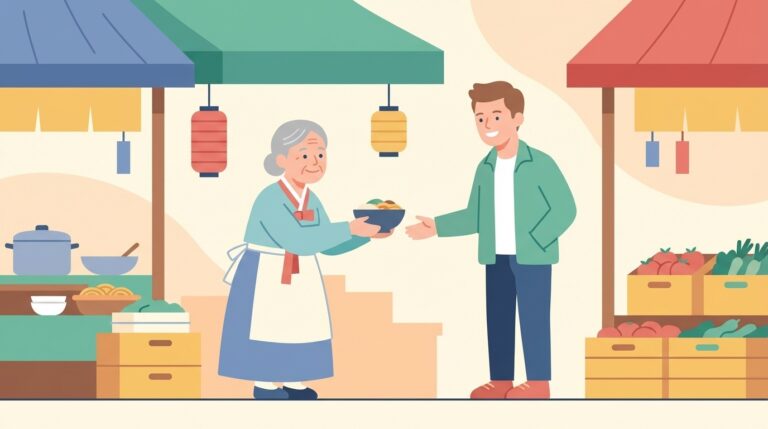
- K-Culture Moment: If you go to a traditional Korean market (like Gwangjang Market) and call the elderly food stall owner “Halmeoni” with a bright smile, there’s a 99% chance she’ll give you extra food.
- Editor’s Insight: This word feels incredibly warm. When you use it for a stranger, you are basically saying, “I respect you and feel close to you, just like my own family.”
- Situation Spectrum:
[🚫 Never] ———— [⚠️ Caution] ———— [✅ Freely]
- To your actual grandmother: ✅
- To an elderly lady (70+ years old) at a market: ✅
- To a middle-aged lady (40s-50s): 🚫 (She will be very offended!)
- 🤔 Think About It: Why do Koreans use family terms for strangers? What does it say about the concept of ‘community’ in Korea?
2. 할아버지 (Grandfather)
- Pronunciation: [hal-a-beo-ji]
- Sound-alike guide: ‘hal’ + ‘a’ (ah) + ‘beo’ (like bow in bowling) + ‘ji’ (like jeep).
- Meaning: Grandfather (Literal) vs. Elderly man (Real nuance)
- K-Culture Moment: You’ll often see “Halabeojis” gathering at parks in Seoul (like Tapgol Park), playing the traditional board game Baduk (Go) or drinking Makgeolli.
- Editor’s Insight: Just like Halmeoni, this is a respectful term for any elderly man. However, it’s slightly less common to use it to get someone’s attention in a store compared to Halmeoni.
- Situation Spectrum:
[🚫 Never] ———— [⚠️ Caution] ———— [✅ Freely]
- To your actual grandfather: ✅
- To a friendly elderly man helping you with directions: ✅
- To your 50-year-old boss: 🚫
3. 우리 (Our – The Magic Word)
- Pronunciation: [u-ri]
- Sound-alike guide: ‘u’ (oo) + ‘ri’ (ree, with a soft ‘r’ like a Spanish ‘r’).
- Meaning: We/Our (Literal) vs. My (Real nuance when talking about family)
- K-Culture Moment: In K-Pop fandoms, fans often call their favorite idol “Uri [Idol’s Name]” to show deep affection and protectiveness.
- Editor’s Insight: In English, you say “My grandma.” In Korean, if you say “나의 할머니 (My grandma),” it sounds like you are the only one who owns her! We almost always use “우리 할머니 (Our grandma).”
- 🤔 Think About It: How does saying “our” instead of “my” change the way you feel about the people around you?
Phase 3: Textbook vs. Real Korean
| Situation | 📖 Textbook Korean | 🗣️ Real Korean | 💡 Why is it different? |
|---|---|---|---|
| Introducing your grandma | 제 할머니입니다. (This is my grandmother.) | 우리 할머니예요. (This is our grandma.) | Korean culture is collectivist; family is shared, not individually owned. |
| Calling an elderly stall owner | 아주머니 (Ma’am) | 할머니~ (Grandma~) | Calling an elder ‘family’ creates Jeong (emotional bond) and removes social distance. |
Bottom Note for A1: Don’t worry about complex honorifics yet! Just remembering to say “Uri (우리)” instead of “My” will make you sound amazingly natural.
Phase 4: Cultural Context — K-Culture Deep Dive
4-1. Non-Verbal Magic: The Polite Bow
When you talk to a Halmeoni or Halabeoji, your body language is just as important as your words.
– The Bow: A slight nod of the head isn’t enough. Do a gentle 15-to-30-degree bow when greeting them.
– Two Hands: If you are handing something to an elder (like cash at a market) or receiving something (like a bowl of soup), ALWAYS use two hands. It’s the golden rule of Korean respect!
4-2. K-Food Connection: The Power of ‘Jeong’ (정)
Have you noticed how Korean food is rarely served in individual portions? Stews are shared, side dishes (banchan) are placed in the middle for everyone, and Korean BBQ is grilled together. This shared eating culture is rooted in the same mindset as calling strangers “Grandma.”
At a traditional market, a Halmeoni might see you struggling to order in Korean. Because you are a “guest” in her country, her grandmotherly instincts kick in. She might give you Service (서비스 – free extra food). This isn’t just a marketing tactic; it’s Jeong (정), the deep, warm feeling of human connection.
Phase 5: Real-Life Roleplay Scenario
Setting: It’s 2 PM on a sunny Saturday at Gwangjang Market in Seoul. The smell of sizzling mung bean pancakes (Bindaetteok) fills the air. You sit on a small plastic stool at a stall run by a sweet, 75-year-old lady.
Characters:
– YOU: A traveler on their 3rd day in Korea, very hungry.
– Vendor: An elderly Korean woman (Halmeoni), smiling but speaking only Korean.
Dialogue:
Vendor: 어서 와요! 많이 배고파요?
(eoseo wayo! mani baegopayo?)
[Welcome! Are you very hungry?]
(🎭 Stage Direction: She hands you a massive plate of pancakes, way more than you ordered.)
YOU: 우와, 진짜 많아요!
(uwa, jinjja manayo!)
[Wow, that’s really a lot!]
Vendor: 많이 먹어요, 학생~
(mani meogeoyo, haksaeng~)
[Eat a lot, student~]
🔀 Your Turn! How should you respond to thank her?
– A) “사장님, 감사합니다.” (Sajangnim, gamsahamnida – Thank you, boss.)
– B) “할머니, 잘 먹겠습니다!” (Halmeoni, jal meokgetseumnida – Grandma, I will eat well!)
– C) “고마워!” (Gomawo! – Thanks!)✅ Best Choice: B — Calling her ‘Halmeoni’ in this casual, warm market setting is perfect. Saying “I will eat well” (잘 먹겠습니다) is the polite Korean way to say grace before a meal!
⚠️ Choice A Analysis: “Sajangnim” is polite and safe, but a bit formal for a cozy market stall.
🚫 Choice C Analysis: NEVER use casual language (Banmal) with elders! It is highly disrespectful.
Phase 6: 10-Second Shadowing Drill
Listen to the rhythm and practice out loud. Pay attention to the pauses (/)!
😊 우와 / 우리 할머니예요!
(uwa / u-ri hal-meo-ni-ye-yo!)
Wow, this is our grandma!
🥺 할머니 / 이거 / 얼마예요?
(hal-meo-ni / i-geo / eol-ma-ye-yo?)
Grandma, how much is this? (Said with a sweet, polite tone at a market)
Phase 7: K-Culture Mini Dictionary
| Korean | Romanization | English | Cultural Context |
|---|---|---|---|
| 우리 | uri | Our / We | Used instead of ‘my’ for family, friends, and country. |
| 정 | jeong | Affection / Bond | The invisible emotional connection between people in Korea. |
| 효도 | hyodo | Filial piety | The duty of respecting and caring for one’s parents and grandparents. |
| 반말 | banmal | Casual speech | Informal language. Never use this with a Halmeoni or Halabeoji! |
Phase 8: Traveler Survival Kit
If you are traveling in Korea, you will definitely interact with elderly folks, especially outside the trendy cafes of Gangnam. Here are your lifesavers:
🆘 Survival Phrases at the Market
– 🇰🇷 “할머니, 이거 얼마예요?” (Halmeoni, igeo eolmayeyo?)
– 🗣️ Meaning: Grandma, how much is this?
– 📍 Where to use: Traditional markets, small neighborhood shops.
- 🇰🇷 “너무 맛있어요!” (neomu masisseoyo!)
- 🗣️ Meaning: It’s so delicious!
- 💡 Pro Tip: Say this to a Halmeoni after eating her food, and watch her face light up. She might even give you free snacks!
📌 Editor’s Travel Note
– Cash is King: While Korea is a “card-only” paradise in the cities, elderly vendors at traditional markets usually prefer cash.
– No Tipping: Never tip a Halmeoni at a restaurant or market! Tipping is not a part of Korean culture and might confuse them. Just say a loud “Thank you” (감사합니다).
Phase 9: Critical Thinking Corner — “One Step Deeper”
Language & Power: The Age Hierarchy
In English, you can say “Hi, John!” to your 70-year-old neighbor. In Korea, addressing an elder by their first name is unthinkable. The Korean language has different levels of politeness deeply tied to age and social status. By calling a stranger “Halmeoni” or “Halabeoji,” you are instantly acknowledging their seniority and showing your respect. But at the same time, by using a family term, you are softening the hierarchy with warmth and affection.
💬 Your Turn:
In your culture, how do you address an elderly person you’ve just met on the street? Do you have terms that show both respect and closeness? Let me know in the comments!
Phase 10: FAQ & Common Mistakes
Q: Can I call the young-looking 50-year-old lady at the restaurant ‘Halmeoni’?
No, no, no! Please don’t. Calling a middle-aged woman a grandmother will make her feel old and offended.
Q: So what should I call a 50-year-old lady or man?
Use 사장님 (Sajangnim – Boss/Owner) if they work there, or 아주머니 / 아저씨 (Ajummoni / Ajeossi – Ma’am / Sir).
Q: My K-Pop idol’s mom is older. Should I call her Halmeoni?
No, call her 어머니 (Eomeoni – Mother). Halmeoni is strictly for the grandparent generation (usually 70+ years old).
❌ Common Mistake #1: Saying “나의 할머니” (My grandma).
✅ Do this instead: Always say “우리 할머니” (Uri halmeoni – Our grandma).
Phase 11: Summary & Action Items
One-Liner Summary: Remember to use “우리 (Uri)” instead of “My,” and treat elderly strangers with respect by calling them Halmeoni or Halabeoji!
Action Mission:
– 🥉 Bronze (Solo): Stand in front of a mirror, bow slightly, and practice saying “할머니, 감사합니다!” (Halmeoni, gamsahamnida!).
– 🥈 Silver (Online): Find a K-Drama clip on YouTube with a grandparent character and leave a comment using the word “Halmeoni” or “Halabeoji.”
– 🥇 Gold (Real Life): Visit a Korean market (or a local Korean grocery store in your area) and politely use the phrase “할머니, 이거 얼마예요?”
🎬 Special K-Culture Mission:
Watch the first episode of a classic K-Drama like Reply 1988 or Hometown Cha-Cha-Cha. Count how many times you hear the characters say “할머니” or “할아버지.”
Phase 12: Quiz — Interactive Challenge
1. Situational Judgment: You are at a trendy cafe in Seoul. The female owner looks about 45 years old. You want to ask her a question. What should you call her?
– A) 할머니 (Halmeoni)
– B) 사장님 (Sajangnim)
– C) 야! (Ya! – Hey!)
2. True or False – K-Culture Edition:
If you talk about your own grandmother to a Korean friend, you should say “나의 할머니 (My grandma)” to be grammatically correct.
3. Fill in the Blank:
To show respect to an elder when handing them something, you should always use ______ hand(s).
(Answers below!)
Click to see the answers!
1. Answer: B (사장님 – Sajangnim). She is too young to be called a grandmother! Calling her Halmeoni will definitely upset her. Never use ‘Ya!’ as it is extremely rude.
2. Answer: False. Koreans almost exclusively use “우리 할머니” (Our grandma) to show collective affection and cultural warmth.
3. Answer: Two. Always use two hands when giving or receiving items from an elder!
Frequently Asked Questions (FAQ)
Q: What does "할머니 (Grandmother)" mean in Korean and how do you pronounce it?
A: In Korean, "할머니 (Grandmother)" is pronounced [hal-meo-ni] and means: a key conversational Korean expression covered in this lesson.
Q: What does "할아버지 (Grandfather)" mean in Korean and how do you pronounce it?
A: In Korean, "할아버지 (Grandfather)" is pronounced [hal-a-beo-ji] and means: a key conversational Korean expression covered in this lesson.
Q: What does "우리 (Our - The Magic Word)" mean in Korean and how do you pronounce it?
A: In Korean, "우리 (Our - The Magic Word)" is pronounced [u-ri] and means: a key conversational Korean expression covered in this lesson.







