

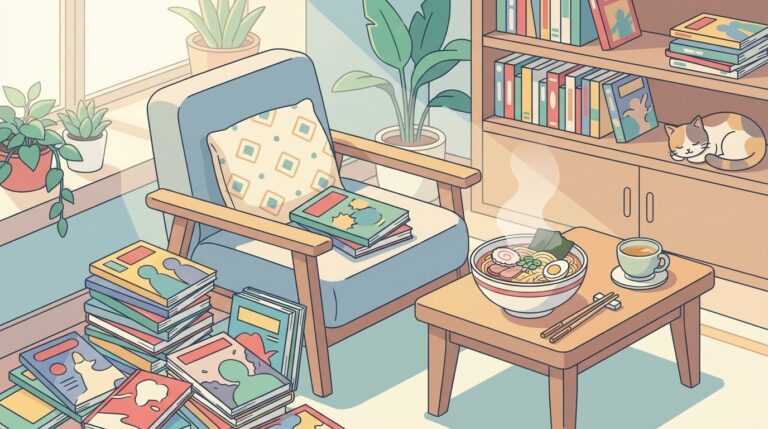
Level Up Your K-Bookstore Visit: Finding and Reading Korean Comics Like a Pro!
Hello! I am the Lead Editor at Daily Hangul.
Imagine this: You are in Seoul, inspired by a K-Drama like True Beauty (여신강림) or Business Proposal (사내맞선). You want to experience that cozy, aesthetic vibe of reading a Korean comic book. You step into a massive Kyobo Bookstore, surrounded by thousands of books. You finally find the physical copy of your favorite Webtoon!
But wait… it is wrapped tightly in plastic! Can you open it? Where is the reading area? And how do you even ask for a recommendation?
If you simply translate “I want to read a comic book” from your textbook, you might sound like a robot. Today, we are going to learn the real survival Korean you need to navigate a Korean bookstore and enjoy the ultimate K-Comic experience. Don’t worry, this guide is perfectly tailored for beginner (A2) learners. Let’s dive in!
Phase 2: Core Expressions Deep Dive
Here are the top three phrases you need when hunting for comics in Korea.
1. 만화책 코너가 어디예요? (Where is the comic book section?)
- Pronunciation: manhwachaek koneo-ga eodiyeyo? [mahn-hwa-check ko-nuh-gah uh-dee-yay-yo?]
- Meaning: Where is the comic book (manhwa) section?
- K-Culture Moment: Korean bookstores are gigantic. Instead of wandering around for 20 minutes, use this phrase to ask the staff. You will often see a huge dedicated section just for Webtoons and Manga!
- Editor’s Insight: The word “코너” comes from the English word “corner,” but in Korean, it means “section” or “department” in a store.
- Situation Spectrum:
[🚫 Never] ———— [⚠️ Be Careful] ———— [✅ Freely]
- Close Friends (Casual): 🚫 (Use 반말: 만화책 코너 어디야?)
- Store Staff (Formal): ✅ (Perfect!)
- 🤔 Think About It: Why does Korean use so many English loanwords (Konglish) like “코너” for modern store layouts? How does your native language handle new retail concepts?
2. 이 웹툰 단행본 있어요? (Do you have the physical book of this webtoon?)
- Pronunciation: i weptun danhaengbon isseoyo? [ee web-toon dahn-heng-bon eess-uh-yo?]
- Meaning: Do you have the physical volume (danhaengbon) of this webtoon?
- K-Culture Moment: Webtoons are originally digital, but when they get super popular (like Solo Leveling), they are printed as danhaengbon (physical books). Fans rush to bookstores to buy them because they often include exclusive photo cards!
- Editor’s Insight: Just say the title of the webtoon, point to your phone screen, and ask “이거 있어요?” (Do you have this?). It works every time!
- Situation Spectrum:
[🚫 Never] ———— [⚠️ Be Careful] ———— [✅ Freely]
- Store Staff (Formal/Polite): ✅
- 🤔 Think About It: In a digital world, why do Korean K-Pop and Webtoon fans still obsess over buying physical copies?
3. 이거 비닐 뜯어도 돼요? (Can I open this plastic wrap?)
- Pronunciation: igeo binil tteudeodo dwaeyo? [ee-guh bee-neel tteu-duh-doh dway-yo?]
- Meaning: Can I tear the plastic wrap on this?
- K-Culture Moment: Almost all comic books in Korean bookstores are securely wrapped in plastic. If you open it without paying, the staff will be very unhappy! Always ask if there is an open sample first.
- Editor’s Insight: “뜯다” means to tear or open a package. “~아/어도 돼요?” is the magic A2 grammar point meaning “Is it okay if I… / May I…?”
- Situation Spectrum:
[🚫 Never] ———— [⚠️ Be Careful] ———— [✅ Freely]
- Store Staff: ⚠️ (They will likely say “No,” but it’s the polite way to ask!)
- 🤔 Think About It: Why do you think Korean bookstores wrap their comics so tightly? (Hint: It has to do with an old culture of reading for free!)
Phase 3: Textbook vs. Real Korean
Let’s see how textbooks differ from the streets of Seoul.
| Situation | 📖 Textbook Korean | 🗣️ Real Korean | 💡 Why is it different? |
|---|---|---|---|
| Looking for a book | 만화책을 찾고 있습니다. (I am looking for a comic book.) | [웹툰 제목] 있어요? (Do you have [Webtoon Title]?) | Koreans value speed. Directly asking “Do you have [Title]?” is faster and perfectly polite! |
| Asking to read | 포장을 뜯어도 됩니까? (May I tear the packaging?) | 이거 샘플(견본) 없어요? (Is there a sample for this?) | Instead of asking to break the rules, locals ask if there is an already-opened display copy. |
| Asking for recommendations | 좋은 만화방을 추천해 주시겠습니까? (Would you please recommend a good comic room?) | 근처에 괜찮은 만화카페 있어요? (Is there a decent Manhwa Cafe nearby?) | The word “만화방” is outdated. Today’s trendy spots are called “만화카페” (Comic Cafes). |
Phase 4: Cultural Context — K-Culture Deep Dive
4-1. Non-verbal Nuance (Nunchi at the Bookstore)
In Korea, reading the room (Nunchi) is everything. If you see a book wrapped in plastic, your nunchi should tell you: “Do not open this.” Also, when handing a book to the cashier, try to use two hands, or lightly support your right elbow with your left hand. It is a small gesture that shows immense respect!
4-2. K-Drama Connection: The Evolution of Manhwa Cafes
Have you seen the cozy comic book rooms in K-Dramas where characters eat ramen and fall in love? Those are 만화카페 (Manhwa Cafes).
Unlike traditional bookstores, Manhwa Cafes charge you by the hour. You get a little card, find a cozy cave-like booth, and grab as many comics as you want. The best part? You can order Kimchi Fried Rice, Ramyeon, and Iced Americanos right to your seat. It is the ultimate rainy-day date spot in Korea!
Critical View: Dramas make these cafes look like empty, romantic, quiet places. In reality, on a weekend in Hongdae, they are packed with students, and you might have to wait in line just to get a seat!
Phase 5: Real-World Roleplay Scenario
Setting: A massive Kyobo Bookstore in Gangnam. It’s Friday afternoon. You are looking for the physical copy of a famous Webtoon to take home as a souvenir.
Characters:
– YOU: A foreign traveler on a mission to find the Webtoon True Beauty.
– Staff (지훈): A 20-something bookstore employee organizing shelves.
Dialogue:
YOU: 저기요, 질문 하나 해도 돼요?
(jeogiyo, jilmun hana haedo dwaeyo?)
[Excuse me, can I ask a question?]
지훈: 네, 고객님. 어떤 책 찾으세요?
(ne, gogaengnim. eotteon chaek chajeuseyo?)
[Yes, customer. What book are you looking for?]
YOU: 만화책 코너가 어디예요?
(manhwachaek koneo-ga eodiyeyo?)
[Where is the comic book section?]
지훈: 아, 웹툰 단행본은 저기 A구역에 있습니다.
(a, weptun danhaengboneun jeogi A-guyeoge itseumnida.)
[Ah, Webtoon physical books are over there in Section A.]
(🎭 Stage Direction: Ji-hoon points toward a brightly lit section with giant Webtoon posters.)
YOU: 감사합니다!
(gamsahamnida!)
[Thank you!]
(🎭 Stage Direction: You walk to Section A and find the book. But wait… it is wrapped in thick plastic! You take it back to Ji-hoon.)
YOU: 저기요, 이거 그림체만 보고 싶은데…
(jeogiyo, igeo geurimche-man bogo sipeunde…)
[Excuse me, I just want to see the art style…]
🔀 Your Turn! How should you ask?
– A) 이거 비닐 뜯어도 돼요? (Can I tear this plastic wrap?)
– B) 이거 샘플(견본) 없어요? (Do you have a sample for this?)
– C) 제가 그냥 뜯을게요! (I will just tear it!)✅ Best Choice: B — Asking for a sample (샘플) is the most natural and polite way.
⚠️ Choice A Analysis: While grammatically correct, the staff will definitely say “No.” Books are sealed to protect the photocard inside!
🚫 Choice C Analysis: Absolutely never do this! You will have to buy the book if you break the seal.
지훈: 아, 잠시만요. 여기 샘플 책 있습니다. 이걸로 보세요! 😊
(a, jamsimanyo. yeogi saempeul chaek itseumnida. igeollo boseyo!)
[Ah, wait a moment. Here is a sample book. Please look at this one!]
Phase 6: 10-Second Shadowing Drill
Let’s practice the rhythm! Read out loud, paying attention to the pauses (/).
🥺 저기요 / 이 웹툰 / 찾아주세요!
(jeogiyo / i weptun / chajajuseyo!)
Excuse me, please find this webtoon for me!😊 근처에 / 만화카페 / 있어요?
(geuncheo-e / manhwakape / isseoyo?)
Is there a comic cafe nearby?
Phase 7: K-Culture Mini Dictionary
| Korean | Romanization | English | Cultural Context |
|---|---|---|---|
| 만화방 | manhwabang | Old-school comic room | The 90s version of a comic cafe. Usually smoky, filled with older men reading martial arts comics. |
| 만화카페 | manhwakape | Comic Cafe | The modern, aesthetic evolution. Couches, blankets, ramen, and perfect for Gen Z dates. |
| 단행본 | danhaengbon | Physical Volume | A published physical book of a series that was originally released serially (like a Webtoon). |
| 서서 읽기 | seoseo ilgi | Reading while standing | Standing in a bookstore reading a whole book without buying it. Koreans did this so much that bookstores started wrapping comics in plastic! |
| 견본/샘플 | gyeonbon / saempeul | Sample copy | The one unsealed book on the shelf meant for browsing. |
Phase 8: Traveler Survival Kit 🆘
If you are navigating a massive bookstore like Kyobo or YP Books, keep these survival phrases in your back pocket!
🆘 Survival Phrase #1: Kiosk Magic
– 🇰🇷 “도서 검색대 어디 있어요?” (doseo geomsaekdae eodi isseoyo?)
– 🗣️ Pronunciation: doh-suh gum-sek-dae uh-dee eess-uh-yo?
– 📍 Where to use: Large bookstores.
– 💡 Pro Tip: Do not rely only on the staff! Korean bookstores have amazing touch-screen kiosks (도서 검색대). You type the book name, and it prints a tiny physical receipt with a map showing the exact shelf number (e.g., A-15-2). It is a lifesaver!📌 Editor’s Travel Note
– App Tip: Use Papago to translate book titles. You can take a photo of the Korean cover, and it translates the title instantly.
– Payment: Bookstores are 100% card-friendly. You rarely need cash.
– Cafe etiquette: If you go to a Manhwa Cafe, you usually pay for a “time block” (e.g., 2 hours + a drink). Don’t overstay your time, or you will pay extra fees at checkout!
Phase 9: Critical Thinking Corner — “A Step Deeper”
🧠 Media vs. Reality: The Romanticization of the Manhwa Cafe
If you watch K-Dramas, Manhwa Cafes are often portrayed as magical, quiet spaces where the male and female leads accidentally touch hands while reaching for the same book.
However, the reality is a fascinating reflection of modern Korean society. Korea is highly urbanized, and personal living spaces (like small apartments or dorms) can feel cramped. Therefore, businesses like Manhwa Cafes, PC Bangs (gaming cafes), and study cafes serve as affordable “third spaces” for young people to relax, eat, and hang out away from their parents. It is less about the comic books themselves, and more about renting a cozy slice of personal space for $3 an hour.
💬 Your Turn: Does your culture have a popular “third space” where young people go to just hang out cheaply? Let us know in the comments!
Phase 10: FAQ & Avoiding Misunderstandings
Q: Can I take photos inside the bookstore?
Yes, taking aesthetic photos is generally fine, but DO NOT take close-up photos of the inside pages of books or comics. That is considered copyright infringement, and staff will stop you.
Q: If I open the plastic wrap by mistake, what happens?
You bought it! In Korea, breaking the seal means you are legally obligated to purchase the item.
❌ Common Mistake #1: Treating a Manhwa Cafe like a library.
✅ Do this instead: A Manhwa Cafe is a business. You must check in at the counter first, get a timer card, and usually order a drink. Do not just walk in and sit down!
Phase 11: Summary & Action Items
One-Liner Summary: Look for the “만화책 코너” (Comic section), ask for the “단행본” (physical copy), and never rip the plastic wrap without asking for a “샘플” (sample) first!
Action Mission 3 Steps:
– 🥉 Bronze (Solo): Stand in front of a mirror and ask, “이거 샘플 없어요?” with a polite, curious face.
– 🥈 Silver (Online): Go to Webtoon or an online comic site, and look for the word “단행본” in the comments or descriptions.
– 🥇 Gold (Real Life): Visit a Korean bookstore in your country (or Korea!) and successfully use the kiosk to find a comic book using Korean.
🔥 K-Culture Mission: Search for a “Manhwa Cafe Tour” vlog on YouTube. Notice what food they order. (Hint: It is almost always Ramyeon!).
Phase 12: Quiz — Interactive Challenge
1. You find a Webtoon you love at the bookstore, but it is wrapped in plastic. You want to see the drawing style. What should you say to the staff?
A) 만화책 코너가 어디예요?
B) 이거 비닐 뜯어도 돼요?
C) 이거 샘플 없어요?
2. True or False: In a modern Korean Manhwa Cafe, you can order a full meal like Kimchi Fried Rice while reading.
A) True
B) False
3. Fill in the blank:
To find the physical printed book of a digital Webtoon, you should ask for the (________).
A) 웹툰 (Webtoon)
B) 단행본 (Danhaengbon)
C) 만화방 (Manhwabang)
(Answers: 1. C – Ask for a sample! 2. True – The food is amazing! 3. B)
Frequently Asked Questions (FAQ)
Q: What does "만화책 코너가 어디예요? (Where is the comic book section?)" mean in Korean and how do you pronounce it?
A: In Korean, "만화책 코너가 어디예요? (Where is the comic book section?)" is pronounced [manhwachaek koneo-ga eodiyeyo? [mahn-hwa-check ko-nuh-gah uh-dee-yay-yo?] and means: Where is the comic book (manhwa) section?
Q: What does "이 웹툰 단행본 있어요? (Do you have the physical book of this webtoon?)" mean in Korean and how do you pronounce it?
A: In Korean, "이 웹툰 단행본 있어요? (Do you have the physical book of this webtoon?)" is pronounced [i weptun danhaengbon isseoyo? [ee web-toon dahn-heng-bon eess-uh-yo?] and means: Do you have the physical volume (danhaengbon) of this webtoon?
Q: What does "이거 비닐 뜯어도 돼요? (Can I open this plastic wrap?)" mean in Korean and how do you pronounce it?
A: In Korean, "이거 비닐 뜯어도 돼요? (Can I open this plastic wrap?)" is pronounced [igeo binil tteudeodo dwaeyo? [ee-guh bee-neel tteu-duh-doh dway-yo?] and means: Can I tear the plastic wrap on this?







