

Phase 1: Empathy (The Immersive Opening)
Hello, fellow plant lovers! It’s your Daily Hangul Editor.
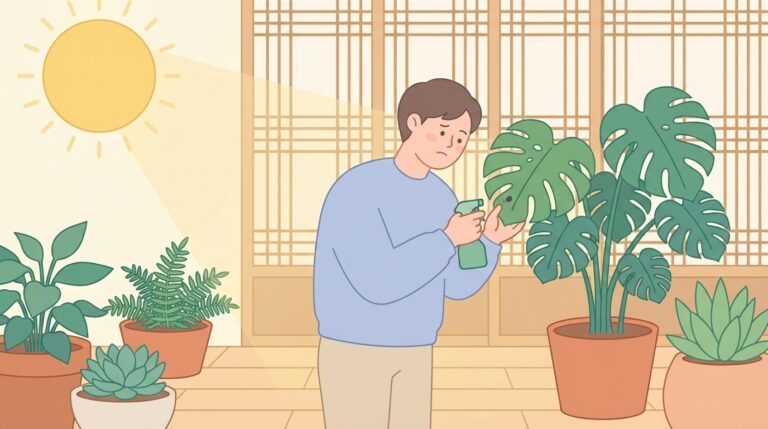
Imagine this: You’ve just spent the weekend curating your perfect “Planterior” (플랜테리어) on your Korean apartment veranda. Sunlight is streaming through the windows, you’re sipping an iced Americano, and your Monstera looks like it belongs in a K-pop idol’s aesthetic vlog. You lean in to admire a new leaf, and suddenly… bzzzt. A tiny black fly buzzes right into your nose.
Then you see them. The dreaded fungus gnats.
Panic sets in. You need to rush to the local neighborhood flower shop (꽃집) or plant clinic. But how do you explain the situation? If you just say “벌레가 있어요” (I have bugs), the florist might think you’re dealing with a cockroach infestation! At the C1 level, we need to move beyond simple textbook complaints and use the exact, nuanced horticultural terminology that Korean “plant butlers” (식집사) use.
This guide is based on real frantic messages from our expat students who just wanted to save their beloved green friends. Let’s dive in!
Phase 2: Deep Dive into Core Expressions
When dealing with pests, Korean vocabulary becomes wonderfully specific and surprisingly passive.
1. 뿌리파리가 생겼어요 (Fungus gnats appeared)
- Pronunciation: [ppu-ri-pa-ri-ga saeng-gyeo-sseo-yo] / ‘뿌’ sounds like a sharp, tense ‘bbu’, and ‘생’ sounds like ‘sang’ in ‘sang a song’.
- Meaning: Literal: Fungus gnats arose/formed. / Real Nuance: My plant has a fungus gnat infestation.
- K-Culture Moment: You walk into a lush plant shop in Mangwon-dong, holding up a blurry photo on your phone, looking distressed. Saying this immediately tells the florist exactly what soil-dwelling pest you’re battling.
- Editor’s Insight: Notice we use 생기다 (to arise/appear) instead of “I got bugs” or “The plant has bugs.” In Korean, negative natural occurrences are often phrased passively. It removes the blame from you (the plant parent) and treats the bugs as a natural phenomenon that just happened.
- Situation Spectrum:
[🚫 Do Not Use] ———— [⚠️ Caution] ———— [✅ Freely]
- Casual with friends: ✅ (뿌리파리 생겼어ㅠㅠ)
- To a florist/expert: ✅ (Formal: 생겼어요)
- 🤔 Think About It: Why does Korean frequently use “생기다” for sickness, pests, or even problems? How does displacing the “blame” affect the psychological weight of the conversation?
2. 과습이 온 것 같아요 (I think overwatering has set in)
- Pronunciation: [gwa-seu-bi on geot ga-ta-yo] / ‘과’ is a quick ‘gwa’, ‘습’ is a short ‘seup’ (like ‘soup’ but shorter and tighter).
- Meaning: Literal: It seems over-humidity has come. / Real Nuance: I think I overwatered it, and the roots are suffocating.
- K-Culture Moment: Pests like gnats thrive in damp soil. When you ask a Korean plant expert why bugs appeared, they will almost always diagnose it as “과습” (overwatering/excessive moisture), which is the #1 killer of apartment plants in Korea.
- Editor’s Insight: “과습이 오다” (Overwatering came) is a highly native, C1-level phrase. Instead of saying “I gave it too much water” (물을 너무 많이 줬어요), which sounds like a beginner’s confession of guilt, saying “과습이 왔다” frames it as a botanical condition that has afflicted the plant.
- Situation Spectrum:
[🚫 Do Not Use] ———— [⚠️ Caution] ———— [✅ Freely]
- Florist/Plant Clinic: ✅
- Chatting with other plant lovers: ✅
3. 친환경 살충제 좀 추천해 주세요 (Please recommend an eco-friendly pesticide)
- Pronunciation: [chin-hwan-gyeong sal-chung-je jom chu-cheon-hae ju-se-yo] / ‘친환경’ flows smoothly, ‘살충제’ sounds like ‘sal-choong-jeh’.
- Meaning: Literal/Real Nuance: Please recommend an eco-friendly bug spray/pesticide.
- K-Culture Moment: Koreans are highly conscious of chemicals used indoors, especially in enclosed verandas where pets, children, or “companion plants” live. Asking for “친환경” (eco-friendly) or “천연” (natural) is standard practice.
- Editor’s Insight: Never use the word “에프킬라” (F-Killer – a famous mosquito/roach spray brand) for plants! It will freeze the plant to death. Using “살충제” shows you know the specific term for agricultural/plant pest control.
- Situation Spectrum:
[🚫 Do Not Use] ———— [⚠️ Caution] ———— [✅ Freely]
- Shopping at a hardware store/plant shop: ✅
Phase 3: Textbook vs. Real Korean
Let’s upgrade your vocabulary from B1 to a solid C1.
| Situation | 📖 Textbook Korean | 🗣️ Real Korean | 💡 Why the difference? |
|---|---|---|---|
| Bugs are swarming | 벌레가 많이 있습니다. (There are many bugs.) | 벌레가 자꾸 꼬여요. (Bugs keep twisting/swarming.) | “꼬이다” vividly describes the annoying, repetitive swarming motion of gnats. |
| Overwatered | 제가 물을 너무 많이 주었습니다. (I gave too much water.) | 과습이 왔어요. (Overwatering arrived.) | Treating the issue as a condition (과습) sounds much more professional than admitting fault. |
| Need to apply pesticide | 약을 식물에 뿌리세요. (Spray medicine on the plant.) | 약 좀 쳐야겠어요. (I should hit/strike the medicine.) | “약을 치다” is a deeply rooted agricultural idiom meaning to apply pesticides or fertilizer. |
Bottom Note: At the C1 level, mastering these slight idiom shifts (“약을 치다” instead of “약을 뿌리다”) instantly makes you sound like a local who has lived in Korea for years.
Phase 4: Cultural Context — K-Culture Deep Dive
4-1. The Non-verbal “Nunchi” of Plant Clinics
When showing your infested plant to a florist, do not bring the bug-infested plant directly into the shop without warning! Pests spread easily. The Korean nunchi (눈치 – social tact) move is to take highly zoomed-in, clear photos of the leaves and the soil, walk into the shop empty-handed, and show the photos while explaining the symptoms.
4-2. The “Companion Plant” (반려식물) Phenomenon
If you watch K-dramas or idol reality shows (like BTS’s In the Soop or RM’s vlogs), you’ll notice a massive trend: 반려식물 (Companion Plants).
With a huge portion of young Koreans living in single-person households (1인 가구) in high-rise apartments, keeping a pet (like a dog or cat) is often prohibited by landlords or too difficult for busy office workers. Therefore, plants have been elevated from mere decorations to “companions.” People call themselves 식집사 (Plant Butlers)—a play on the term “고양이 집사” (Cat Butler). Treating a pest problem isn’t just gardening; it’s considered taking your “companion” to the doctor. This is why the language around plants (과습이 오다, 아프다) mirrors the language used for human or pet illnesses.
Phase 5: Real-Life Roleplay Scenario
Setting: Saturday afternoon, 2 PM. A chic, sun-drenched flower shop in Yeonnam-dong. The air smells like eucalyptus and damp earth. You are standing at the counter with your phone out, showing photos of your tragic Monstera to the florist.
Characters:
– YOU: An expat who proudly identifies as a ‘식집사’ (Plant Butler), currently devastated by pests.
– Min-ji (30s): The local florist. Friendly, knowledgeable, and very serious about plant health.
The Dialogue:
You: 사장님, 저희 집 몬스테라에 문제가 생겼어요. 🌿
(sajangnim, jeo-hui jip monseutera-e munje-ga saeng-gyeo-sseo-yo.)
[Boss, a problem has arisen with my Monstera at home.]
Min-ji: 어머, 잎이 왜 이렇게 노랗게 변했죠?
(eomeo, ip-i wae i-reo-ke no-ra-ke byeon-haet-jjo?)
[Oh my, why have the leaves turned so yellow?]
You: (Showing the photo) 흙 주변에 자꾸 쪼그만 벌레가 꼬여서요. 혹시 뿌리파리인가요?
(heuk ju-byeon-e ja-kku jjo-geu-man beol-le-ga kko-yeo-seo-yo. hok-si ppu-ri-pa-ri-in-ga-yo?)
[Tiny bugs keep swarming around the soil. By any chance, are they fungus gnats?]
Min-ji: 아… 사진 보니까 맞네요. 요즘 장마철이라 과습이 와서 생겼을 확률이 높아요.
(a… sa-jin bo-ni-kka man-ne-yo. yo-jeum jang-ma-cheo-ri-ra gwa-seu-bi wa-seo saeng-gyeo-sseul hwang-nyu-ri no-pa-yo.)
[Ah… looking at the photo, you’re right. Since it’s the monsoon season lately, there’s a high chance they appeared because overwatering set in.]
You: 앗, 어떡하죠? 물을 너무 자주 줬나 봐요.
(at, eo-tteo-ka-jo? mu-reul neo-mu ja-ju jwon-na bwa-yo.)
[Oops, what should I do? I guess I watered it too frequently.]
Min-ji: 일단 흙을 좀 말리시고요, 바람 잘 통하는 베란다 쪽에 두세요. 약도 좀 쳐야 할 것 같은데…
(il-dan heu-geul jom mal-li-si-go-yo, ba-ram jal tong-ha-neun be-ran-da jjo-ge du-se-yo. yak-do jom cheo-ya hal geot ga-teun-de…)
[First, dry out the soil a bit, and place it near the veranda where the wind flows well. I think you’ll need to apply some medicine too…]
🔀 Your Turn! How do you respond to ask for the right product?
– A) “벌레 죽이는 거 주세요!” (Give me something that kills bugs!)
– B) “집에 강아지가 있어서요. 혹시 친환경 살충제도 있나요?” (I have a dog at home. By any chance, do you have eco-friendly pesticide?)
– C) “에프킬라 뿌려도 되나요?” (Can I just spray F-Killer?)✅ Best Choice: B — Not only do you use the advanced term “친환경 살충제” (eco-friendly pesticide), but you also provide a valid reason (having a pet), which allows the florist to recommend a specific, safe product.
⚠️ Choice C Analysis: Absolutely 🚫! “에프킬라” (standard bug spray) will instantly kill your plant. The florist might actually gasp in horror.
Min-ji: 네, 반려동물한테 무해한 천연 기피제 있어요. 이거 잎 앞뒤로 꼼꼼하게 뿌려주세요!
(ne, ban-lyeo-dong-mul-han-te mu-hae-han cheon-yeon gi-pi-je i-sseo-yo. i-geo ip ap-dwi-ro kkom-kkom-ha-ge ppu-ryeo-ju-se-yo!)
[Yes, I have a natural repellent that is harmless to pets. Please spray this thoroughly on the front and back of the leaves!]
Phase 6: 10-Second Shadowing Drill
Let’s practice the rhythm and emotional nuance of diagnosing your plant like a true C1 speaker.
- Sentence: “바람이 / 안 통해서 / 과습이 온 것 같아요.”
- Pronunciation: ba-ra-mi / an tong-hae-seo / gwa-seu-bi on geot ga-ta-yo.
- Emotion Tag: 😢 Sadly, with a hint of guilt for your poor plant.
- Guide: Pause briefly at the slashes (
/). Drop your intonation at the end of “같아요” to sound naturally concerned.
Phase 7: K-Culture Mini Dictionary
| 한국어 (Korean) | Romanization | English | Contextual Meaning |
|---|---|---|---|
| 반려식물 | ban-lyeo-sik-mul | Companion Plant | Elevating a houseplant to the status of a pet or family member. |
| 식집사 | sik-jip-sa | Plant Butler | A proud plant parent. A combination of ‘식물’ (plant) and ‘집사’ (butler). |
| 과습 | gwa-seup | Over-humidity / Overwatering | The state of soil being too wet, causing roots to rot. The #1 enemy of Korean apartment gardeners. |
| 플랜테리어 | peul-laen-te-ri-eo | Planterior | Plant + Interior. Decorating one’s living space with various plants, highly popular in Korean apartment culture. |
| 통풍 | tong-pung | Ventilation | Crucial for veranda gardens. Often the solution florists give for any pest problem. |
Phase 8: Traveler Survival Kit (Plant Cafe Edition)
You might not be maintaining a veranda garden if you’re just visiting Korea, but you will almost certainly visit one of Korea’s famous 식물 카페 (Plant/Botanical Cafes)!
🆘 Survival Phrases for Plant Cafes & Souvenir Shops
– 🇰🇷 “이거 키우기 쉬워요?” (i-geo ki-u-gi swi-wo-yo?)
– 🗣️ Meaning: Is this easy to raise/grow?
– 📍 Where to use: Buying a small succulent or cactus to keep in your long-term Airbnb.
- 🇰🇷 “눈으로만 봐주세요.” (nu-neu-ro-man bwa-ju-se-yo.)
- 🗣️ Meaning: Please look with your eyes only. (Do not touch!)
- 📍 Where to see: Written on signs in aesthetic plant cafes. Touching the delicate plants is a huge faux pas!
📌 Editor’s Travel Note
– Customs Warning: Do NOT try to bring potted plants with soil in your suitcase back to your home country! Agricultural customs will confiscate them immediately. Stick to buying them to brighten up your temporary stay in Korea, or just enjoy the cafe vibes.
– Where to go: Yangjae Flower Market (양재꽃시장) is a massive, incredibly cheap wholesale market where you can see Korea’s diverse horticulture scene firsthand.
Phase 9: Critical Thinking — “One Step Deeper”
🧠 Think Deeper: Language & Changing Lifestyles (The Rise of ‘식집사’)
In the past, Korean agricultural vocabulary was strictly for farmers. Words like ‘약을 치다’ (applying pesticide) or ‘수확하다’ (harvesting) belonged to rural life. However, as Korea rapidly modernized and over 60% of the population moved into high-density apartments, nature became something you had to intentionally bring inside.By creating the word 식집사 (Plant Butler) and 반려식물 (Companion Plant), young Koreans are using language to redefine their relationship with nature. In a hyper-competitive society where raising a child or even a dog feels financially or temporally overwhelming for a single person, caring for a Monstera offers a sense of responsibility and ‘힐링’ (healing) without the heavy burden. The language reflects a shift from seeing plants as mere “decor” to seeing them as living beings that share our lonely urban spaces.
💬 Your Turn: Does your culture have a specific term for “plant lovers”? Do people treat their houseplants like pets in your home country? Share your thoughts in the comments!
Phase 10: FAQ & Mistake Prevention
- Q: Can I use “과습” for humans? Like when it’s really humid outside in Korean summer?
- A: No! “과습” is almost exclusively used for soil and plants. If the weather is humid, you say “습하다” (It is humid) or “습도가 높다” (Humidity is high).
- Q: Can I negotiate prices at a Korean flower shop?
- A: Generally, no. In large wholesale markets like Yangjae or Namdaemun, you might get a small discount if you buy in bulk, but in trendy neighborhood boutique shops (like in Seongsu or Yeonnam), prices are fixed.
❌ Common Mistake #1: Saying “저는 벌레가 있어요” (I have bugs) to a florist.
✅ Do This Instead: Say “식물에 벌레가 생겼어요” (Bugs have appeared on my plant). If you say the first sentence, it literally sounds like your physical body has a parasite!
Phase 11: Summary & Action Items
- One-Liner Summary: To handle veranda garden pests like a local, upgrade your vocabulary from blaming yourself to diagnosing the condition: use “생기다” (arise) for bugs and “과습이 오다” (overwatering has come) for root issues.
-
Action Mission 3 Steps:
- 🥉 Bronze (Solo): Look at a houseplant in your home and confidently diagnose it out loud: “과습이 온 것 같아요.”
- 🥈 Silver (Online): Go to a Korean plant Instagram account (search #식집사) and leave a supportive comment: “식물이 너무 예뻐요!” (Your plant is so pretty!)
- 🥇 Gold (Real-world): Next time you visit a flower shop in Korea, ask the owner about a plant: “이거 키우기 쉬워요?”
- K-Culture Mission: Search for “RM 반려식물” on YouTube. Watch how carefully he talks about his bonsai trees. Try to catch words like ‘흙’ (soil), ‘물’ (water), or ‘잎’ (leaf)!
Phase 12: Quiz — Interactive Challenge
1. Situational Judgment: Your Korean friend is crying because her expensive Alocasia plant died. You want to ask if she gave it too much water. Which is the most natural, C1-level way to ask?
– A) 물을 너무 많이 줬어? (Did you give it too much water?)
– B) 혹시 과습이 온 거야? (By any chance, did overwatering set in?)
– C) 식물에 물이 많았어? (Was there a lot of water in the plant?)
2. True or False – K-Culture Edition:
– Korean apartment landlords usually encourage tenants to keep large dogs, which is why “Companion Plants” are rarely seen in cities. (T/F)
3. Fill in the Blank:
“바람이 안 통하면 뿌리파리가 자꾸 ( _______ ).”
(Hint: The word for bugs ‘swarming’ or ‘twisting’ around)
🚨 Click here for the Answers!
- Answer: B. While A is grammatically correct, B uses the advanced, natural idiom “과습이 오다” which sounds much more empathetic and knowledgeable.
- Answer: False. Landlords often restrict large pets, and the busy, high-density apartment lifestyle is exactly why “Companion Plants” (반려식물) have become so incredibly popular!
- Answer: 꼬여요 (from 꼬이다).
How many did you get right? Don’t let the bugs get you down, fellow Sik-jip-sas! Until next time! 🌿💚
Frequently Asked Questions (FAQ)
Q: What does "뿌리파리가 생겼어요 (Fungus gnats appeared)" mean in Korean and how do you pronounce it?
A: In Korean, "뿌리파리가 생겼어요 (Fungus gnats appeared)" is pronounced [ppu-ri-pa-ri-ga saeng-gyeo-sseo-yo] and means: Literal: Fungus gnats arose/formed. / Real Nuance: My plant has a fungus gnat infestation.
Q: What does "과습이 온 것 같아요 (I think overwatering has set in)" mean in Korean and how do you pronounce it?
A: In Korean, "과습이 온 것 같아요 (I think overwatering has set in)" is pronounced [gwa-seu-bi on geot ga-ta-yo] and means: Literal: It seems over-humidity has come. / Real Nuance: I think I overwatered it, and the roots are suffocating.
Q: What does "친환경 살충제 좀 추천해 주세요 (Please recommend an eco-friendly pesticide)" mean in Korean and how do you pronounce it?
A: In Korean, "친환경 살충제 좀 추천해 주세요 (Please recommend an eco-friendly pesticide)" is pronounced [chin-hwan-gyeong sal-chung-je jom chu-cheon-hae ju-se-yo] and means: Literal/Real Nuance: Please recommend an eco-friendly bug spray/pesticide.







