

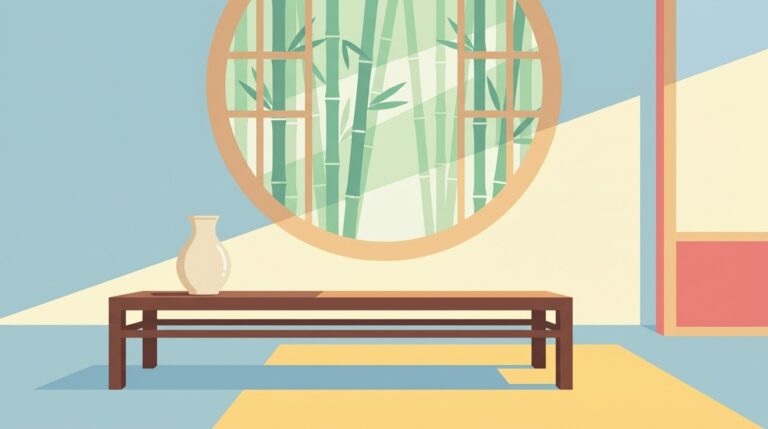
Phase 1: Empathy (The Immersive Opening)
Hello! I’m your Lead Editor at Daily Hangul.
Picture this: You are watching a high-end K-Drama. The camera pans through the chaebol CEO’s penthouse or a brilliant artist’s studio. You notice something striking—there is almost nothing there. Just one sleek sofa, a single minimalist painting, and a lot of empty floor. Or perhaps you’re actually in Seoul, escaping the neon signs of Gangnam, and you step into a hidden Hanok cafe in Bukchon. The interior is stark, quiet, and seemingly unfinished.
Your Korean friend takes a sip of their hand-drip coffee, sighs contentedly, and says, “아, 여백의 미가 참 좋네요.” (Ah, the yeobaegui mi is so nice.)
You look at the empty corner. You think, “What beauty? It’s just… empty space!”
Welcome to C2-level Korean, where we move beyond describing things as just “예뻐요” (pretty) or “넓어요” (spacious). At this advanced stage, you are not just learning vocabulary; you are decoding the philosophical aesthetics that shape Korean art, architecture, and modern lifestyle. If you’ve ever wanted to speak about space and art like an elegant Seoulite or an art curator, you’re in exactly the right place.
Let’s dive into the profound world of Korean minimalism!
Phase 2: Core Expressions Deep Dive
To master Korean spatial aesthetics, you need these high-level expressions in your arsenal.
1. 여백의 미 (Beauty of Empty Space)
- Pronunciation: [yeobaegui mi] (Sounds like: yuh-baek-eui mee. The ‘으’ sounds like the disgusted sound you make when stepping in gum, smoothly transitioning into an ‘ee’.)
- Meaning: (Literal) The beauty of the margin/blank space. (Real nuance) The intentional, aesthetic appreciation of emptiness; letting the unsaid or unfilled speak for itself.
- K-Culture Moment: You will hear this constantly in art galleries (like the Leeum Museum) or when discussing minimalist interior design. It’s the ultimate compliment for a space that doesn’t try too hard.
- Editor’s Insight: This isn’t just about “having no furniture.” It’s an active appreciation. In traditional Korean painting (한국화), the unpainted paper is just as important as the ink brushstrokes. When you use this term, Koreans will immediately perceive you as highly cultured.
- Situation Spectrum:
[🚫 절대 금지] ———— [⚠️ 주의] ———— [✅ 자유롭게]
- Close Friends (Casual): ✅ (Great for cafe-hopping with friends)
- Colleagues (Semi-formal): ✅
- Boss/Elders (Formal): ✅ (Highly appropriate and sophisticated)
- 🤔 Think About It: Western minimalism often focuses on “decluttering” to maximize efficiency. Korean yeobaegui mi is historically rooted in Taoism and Buddhism—emptying space to allow the mind to breathe. Does your culture view “empty space” as a void to be filled, or a presence to be appreciated?
2. 군더더기 없다 (To be free of anything superfluous)
- Pronunciation: [gundeodeogi eopda] (Sounds like: goon-duh-duh-gi up-da)
- Meaning: (Literal) To have no unnecessary additions. (Real nuance) Flawless, sleek, stripped down to its essential beauty.
- K-Culture Moment: Think of an Apple store, or the clean lines of a modern Hanok. You’ll also hear music critics use this for a K-Pop track that is perfectly produced without messy background noise: “편곡에 군더더기가 없네요.”
- Editor’s Insight: “군더더기” refers to an unnecessary lump or addition. Saying a design or space has “no gundeodeogi” is the highest praise for minimalist execution. It implies perfection through subtraction.
- Situation Spectrum:
[🚫 절대 금지] ———— [⚠️ 주의] ———— [✅ 자유롭게]
- Close Friends (Casual): ✅
- Colleagues (Semi-formal): ✅
- Boss/Elders (Formal): ✅
- 🤔 Think About It: Why do we often equate “adding more” with “improving”? This phrase challenges that notion, suggesting that true refinement lies in knowing what to take away.
3. 정갈하다 (To be neat, pristine, and refined)
- Pronunciation: [jeonggalhada] (Sounds like: jung-gal-ha-da)
- Meaning: (Literal/Real) Immaculately neat, clean, and elegant in an understated way.
- K-Culture Moment: When you are served a traditional Korean royal court meal (Hanjeongsik) in a high-end restaurant, and the side dishes are placed with geometric precision. Or when walking into a Zen-like tea house.
- Editor’s Insight: This word is a massive step up from “깨끗하다” (clean). “깨끗하다” just means there’s no dirt. “정갈하다” means it is spiritually, aesthetically, and physically organized to a point of quiet elegance.
- Situation Spectrum:
[🚫 절대 금지] ———— [⚠️ 주의] ———— [✅ 자유롭게]
- Close Friends (Casual): ✅
- Colleagues (Semi-formal): ✅
- Boss/Elders (Formal): ✅
Phase 3: Textbook vs Real Korean
Let’s see how a C2 speaker transforms basic textbook sentences into sophisticated aesthetic critiques.
| Situation | 📖 Textbook Korean | 🗣️ Real Korean (C2 Level) | 💡 Why the Difference? |
|---|---|---|---|
| Describing an empty cafe | 가구가 별로 없어서 넓어 보여요. (It looks spacious because there’s little furniture.) | 여백의 미가 돋보이는 공간이네요. (It’s a space where the beauty of emptiness stands out.) | C2 elevates physical description to artistic appreciation. |
| Praising a simple design | 디자인이 아주 심플하고 깨끗해요. (The design is very simple and clean.) | 군더더기 없이 깔끔하게 떨어지네요. (It falls cleanly without any superfluous elements.) | “떨어지다” (to fall) is native slang for how a design “finishes” or looks structurally. |
| Complimenting a table setting | 반찬이 예쁘게 나왔어요. (The side dishes came out pretty.) | 상차림이 아주 정갈하네요. (The table setting is incredibly refined and pristine.) | Respects the effort and traditional aesthetics behind the presentation. |
Phase 4: Cultural Context — K-Culture Deep Dive
4-1. The Non-Verbal Language of Minimalism
When navigating high-end minimalist spaces in Korea (like galleries in Hannam-dong or tea houses in Bukchon), your body language matters. The Korean concept of 눈치 (Nunchi) here translates to matching the volume of the room. Minimalist spaces in Korea are designed for introspective silence. Speaking loudly or taking excessive, noisy selfies (without muting your camera) breaks the yeobaegui mi of the atmosphere.
4-2. The “Namjooning” Phenomenon & Dansaekhwa
If you follow K-Pop, particularly BTS, you know RM’s love for art museums—a hobby fans affectionately call “Namjooning.” RM frequently highlights 단색화 (Dansaekhwa), Korean monochrome painting. This art movement is the epitome of Korean minimalism. It’s not just painting one color; it’s a meditative process of repeatedly applying and scraping away paint.
When Gen Z Koreans visit minimalist cafes today, they aren’t just drinking coffee; they are seeking a micro-escape from the hyper-competitive, visually overwhelming streets of Seoul. The empty space is a psychological detox.
Phase 5: Real-Life Roleplay Scenario
Setting: A Friday afternoon. You and your Korean architect friend, Min-soo, are visiting a newly opened, highly anticipated minimalist gallery-cafe in Seongsu-dong. The walls are exposed concrete, there is a single bonsai tree in the center, and the seating consists of simple wooden benches.
Characters:
– YOU: An advanced Korean learner, culturally savvy.
– Min-soo (32): An architect. He has a keen eye for design and hates anything overly flashy.
Dialogue:
Min-soo: 와, 여기 진짜 미쳤다. 요즘 성수동에 이런 공간이 생기다니.
(Wa, yeogi jinjja micheotda. Yojeum seongsudonge ireon gonggani saenggidani.)
[English] Wow, this place is crazy. I can’t believe a space like this opened in Seongsu-dong recently.
(🎭 Stage Direction: Min-soo touches the rough texture of the concrete wall appreciatively.)
YOU: 그러게요. 밖은 엄청 복잡한데, 여기 들어오니까 완전 다른 세상 같아요.
(Geureogeyo. Bakkeun eomcheong bokjaphande, yeogi deureoonikka wanjeon dareun sesang gatayo.)
[English] I know, right? It’s so chaotic outside, but stepping in here feels like a completely different world.
Min-soo: 맞아. 인테리어 어떻게 생각해? 너무 아무것도 없어서 좀 차갑지 않아?
(Maja. Interieo eotteoke saenggakhae? Neomu amugeotdo eopseoseo jom chagapji ana?)
[English] Right. What do you think of the interior? Isn’t it a bit cold because there’s absolutely nothing?
🔀 Your Turn! How should you respond?
– A) “네, 너무 허전해요. 의자도 불편하고요.” (Yes, it’s too empty. The chairs are uncomfortable too.)
– B) “아니요, 오히려 군더더기 없어서 정갈한 느낌이에요. 여백의 미가 있잖아요.”
– C) “진짜 텅텅 비었네요. 사장님이 돈이 없었나 봐요!”✅ Best Choice: B — “No, rather, it feels refined without any superfluous elements. It has the beauty of empty space, you know.” This is a brilliant C2 response. It counters his thought with advanced aesthetic vocabulary, proving your deep cultural understanding.
⚠️ Choice A & C Analysis: ‘허전하다’ (Choice A) implies a negative, lonely emptiness. Choice C is a joke, but ruins the sophisticated vibe Min-soo is enjoying.
Min-soo: (Eyes widening) 오~ ‘여백의 미’? ‘정갈하다’? 너 진짜 한국인 다 됐구나. 표현력 대박인데?
(O~ ‘yeobaegui mi’? ‘jeonggalhada’? Neo jinjja hangugin da dwaetguna. Pyohyeollyeok daebaginde?)
[English] Oh~ ‘Beauty of empty space’? ‘Refined’? You’ve practically become Korean. Your expressive skills are amazing!
Phase 6: 10-Second Shadowing Drill
Master the C2 aesthetic vibe. Speak slowly, with a calm, appreciative tone.
😌 이 공간은 / 화려하진 않지만, / 군더더기 없이 / 정~~~갈하네요.
(i gongganeun / hwaryeohajin anjiman, / gundeodeogi eopsi / jeong~~~galhaneyo.)
“This space / isn’t flashy, but / without any superfluous elements / it is so~~~ refined.”
🤫 꽉 채우는 것보다 / 이렇게 여백의 미를 / 살리는 게 / 더 어려운 법이죠.
(kkwak chaeuneun geotpoda / ireoke yeobaegui mireul / sallineun ge / deo eoryeoun beobijyo.)
“Rather than filling it completely / bringing out the beauty of empty space like this / is naturally harder.”
Phase 7: K-Culture Mini Dictionary
Here are a few more high-level aesthetic terms to add to your vocabulary:
| Korean | Romanization | English | Contextual Nuance |
|---|---|---|---|
| 차경 | chagyeong | Borrowing scenery | A traditional architectural concept where windows act as picture frames to ‘borrow’ the outside nature (trees, mountains) into the room. |
| 단아하다 | dan-ahada | Graceful, elegant | Often used for traditional things (Hanbok, Hanok, or someone’s posture). It means elegant in a neat, unpretentious way. |
| 비워내다 | biwonaeda | To empty out / purge | Used in minimalist lifestyles (미니멀 라이프). Not just throwing things away, but intentionally emptying one’s space or mind. |
| 미니멀하다 | minimeolhada | To be minimalist | The Konglish version widely used among younger Koreans to describe simple, chic designs. |
Phase 8: Traveler’s Survival Kit (Aesthetics Edition)
When exploring Seoul’s trendiest aesthetic spaces (like Hannam-dong, Seongsu, or Bukchon), keep these in mind:
🆘 Survival Phrases for Galleries & Cafes
– 🇰🇷 “사진 찍어도 되나요?” (sajin jjigeodo doenayo?) – Can I take pictures?
– 🇰🇷 “조금만 조용히 해 주실 수 있나요?” (jogeumman joyonghi hae jusil su innayo?) – Could you please keep it down a little? (Use with extreme caution, only when necessary).
– 🇰🇷 “관람 동선이 어떻게 되나요?” (gwallam dongseoni eotteoke doenayo?) – What is the viewing route/flow? (Excellent for exhibitions).📌 Editor’s Travel Note
– No Kids Zones (노키즈존): Many high-end minimalist cafes in Korea are “No Kids Zones” to maintain a quiet, zen-like atmosphere. Always check mapping apps before bringing children.
– Silent Shutter apps: Koreans highly value consideration in quiet spaces. If you’re in a gallery or a quiet cafe, using a silent camera app (or covering your speaker) is a great sign of cultural respect.
Phase 9: Critical Thinking — “One Step Deeper”
Media vs Reality: The Luxury of Empty Space in Seoul
🧠 Think Deeper:
If you watch Korean minimalist lifestyle vlogs, you might think everyone lives in serene, white-toned, empty apartments. However, the reality of Seoul’s real estate market tells a different story. Seoul is incredibly densely populated, and square footage is exorbitantly expensive. Therefore, in modern Korea, having “empty space” (여백) in your home isn’t just an aesthetic choice—it is a symbol of extreme wealth. To have a living room with nothing but a single designer chair means you have enough money to buy space just to leave it empty. The traditional yeobaegui mi, which was once about spiritual humility, has ironically transformed into the ultimate modern luxury.💬 Your Turn: Does minimalism in your country carry a similar association with wealth, or is it more associated with frugality? Share your thoughts in the comments!
Phase 10: FAQ & Avoiding Mistakes
❌ Common Mistake #1: Confusing 허전하다 and 여백의 미
Foreign learners often say “방이 허전하네요” (The room feels empty) when trying to compliment a minimalist space. Never do this! 허전하다 implies something is missing, creating a feeling of lack or loneliness. Always use 여백의 미가 있다 or 깔끔하다 for intentional, beautiful emptiness.
Q: Can I use 정갈하다 (jeonggalhada) to describe a person?
A: Yes, but carefully. You wouldn’t use it for a trendy K-Pop idol. You would use it for someone with an incredibly neat, dignified, and elegant aura (like an elegant older actress or a traditional tea master). “옷차림이 참 정갈하시네요” (Your attire is very exceptionally neat and refined.)
Q: When should I say ‘미니멀하다’ vs ‘여백의 미’?
A: Use ‘미니멀하다’ for modern, western-style minimalism (like an all-white modern office or sleek laptop design). Use ‘여백의 미’ when there is an artistic, slightly traditional, or philosophical depth to the space.
Phase 11: Summary & Action Items
One-Liner Summary: Elevate your Korean from basic descriptions to high art critique by mastering terms like yeobaegui mi (beauty of emptiness) and gundeodeogi eopda (flawlessly stripped down).
Your Action Missions:
– 🥉 Bronze: Look around your room right now. Find one area that is completely empty and say out loud: “음, 여백의 미가 있네요.”
– 🥈 Silver: Go to Instagram, find a Korean architecture or cafe account, and leave a comment: “공간이 군더더기 없이 정갈하네요!”
– 🥇 Gold: Next time you visit an art museum or a modern cafe, use one of today’s expressions with a Korean friend or staff member.
🎬 K-Culture Mission: Watch an episode of a drama featuring wealthy families (like Queen of Tears or Penthouse). Observe their living spaces. Are they cluttered, or do they use yeobaegui mi to show power?
Phase 12: Interactive Quiz
Test your C2 aesthetics intuition!
1. Situational Judgment: You are at a Michelin-starred Korean restaurant. The waiter brings out a beautifully minimalist plate with a small, perfectly shaped piece of fish. What is the most sophisticated compliment?
– A) 와, 양이 너무 적어요. (Wow, the portion is too small.)
– B) 접시가 허전하네요. (The plate feels empty/lacking.)
– C) 플레이팅이 정말 정갈하네요. (The plating is truly refined/pristine.)
2. True or False (K-Culture Edition): In modern Seoul, keeping a strictly minimalist, spacious apartment is generally considered an affordable lifestyle choice for university students.
3. Fill in the Blank:
“이 그림은 꽉 채워지지 않아서 더 멋져요. 한국화 특유의 ( ____ )가 느껴지네요.”
(This painting is cooler because it’s not fully filled. I can feel the unique _______ of Korean paintings.)
👀 Click here for Answers
- C (A is rude, B means it looks sad and empty. C acknowledges the pristine aesthetic effort.)
- False (Space is at a massive premium in Seoul; extreme minimalism is often a luxury!)
- 여백의 미 (Beauty of empty space)
Did you feel the beauty of empty space in today’s lesson? Drop a comment below with your favorite aesthetic term!
Frequently Asked Questions (FAQ)
Q: What does "여백의 미 (Beauty of Empty Space)" mean in Korean and how do you pronounce it?
A: In Korean, "여백의 미 (Beauty of Empty Space)" is pronounced [yeobaegui mi] and means: (Literal) The beauty of the margin/blank space. (Real nuance) The intentional, aesthetic appreciation of emptiness; letting the unsaid or unfilled speak for itself.
Q: What does "군더더기 없다 (To be free of anything superfluous)" mean in Korean and how do you pronounce it?
A: In Korean, "군더더기 없다 (To be free of anything superfluous)" is pronounced [gundeodeogi eopda] and means: (Literal) To have no unnecessary additions. (Real nuance) Flawless, sleek, stripped down to its essential beauty.
Q: What does "정갈하다 (To be neat, pristine, and refined)" mean in Korean and how do you pronounce it?
A: In Korean, "정갈하다 (To be neat, pristine, and refined)" is pronounced [jeonggalhada] and means: (Literal/Real) Immaculately neat, clean, and elegant in an understated way.







