

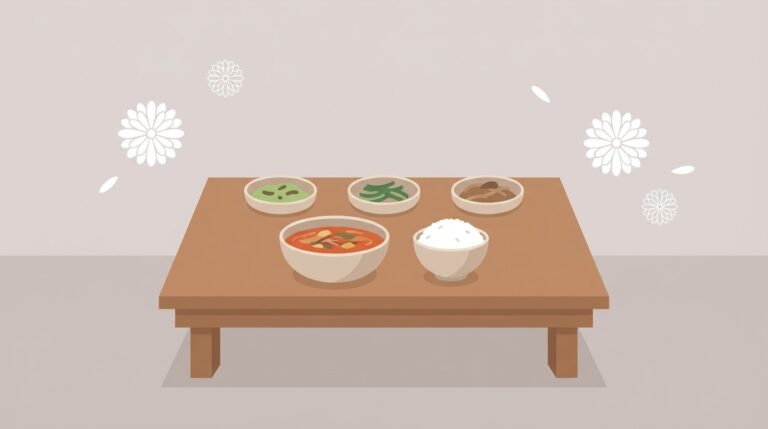
Phase 1: Empathy (The K-Culture Cold Open)
Hello! I’m your Daily Hangul Editor, your friendly local guide to the real Korea.
Imagine this: You’re watching an intense K-Drama. A main character has just lost a loved one. The scene shifts to a hospital basement at 2 AM. Instead of quiet, solemn weeping in a dark room, people are sitting on the floor, wearing black suits, playing cards (Go-Stop), and… eating a bright red, spicy beef soup.
You might be thinking: “Wait, why are they eating spicy food at a funeral? And why is it so noisy?”
If you ever find yourself working in Korea or having Korean friends, you might one day be invited to a funeral hall (장례식장, jangnyesikjang). It can be a terrifying experience for a foreigner. What do you wear? What do you say? And what on earth do you do with that red soup?
Don’t worry. This guide is built from the real panics of my past A1-level students. Today, we are going to navigate the unique, warm, and deeply communal culture of a Korean funeral, centering around the iconic soul food: 육개장 (Yukgaejang).
Phase 2: Core Expressions Deep-Dive
Let’s look at the three most important cultural words and phrases you need to survive this situation.
1. 육개장
- Pronunciation: [Yuk-gae-jang] (Yook-gae-jahng)
- Meaning: (Literal) Spicy beef and vegetable soup / (Real nuance) The soul food of Korean funerals.
- K-Culture Moment: In K-Dramas, when someone pays their respects, the grieving family immediately guides them to a dining area and serves this red soup. It’s an absolute staple.
- Editor’s Insight: This isn’t just a menu item; it’s a symbol of hospitality. Historically, the red chili powder was believed to ward off evil spirits (귀신, gwisin). Also, because funeral hosts stay awake for 3 days straight, this spicy, hearty soup gives them and the guests the stamina to endure the long nights.
- Situation Spectrum:
[🚫 Do Not Use] ———— [⚠️ Caution] ———— [✅ Freely Use]
- Casual / Friends: ✅
- Formal / Funerals: ✅ (It’s perfectly fine to eat it and ask for more!)
- 🤔 Think About It: Why do you think Koreans serve full, warm meals at a place of mourning? Does your culture share food at funerals, or is it more of a quiet, brief gathering?
2. 삼가 고인의 명복을 빕니다
- Pronunciation: [Sam-ga go-in-ui myeong-bog-eul bim-ni-da] (Sahm-gah go-een-ooee myung-bog-eul bim-nee-dah)
- Meaning: (Literal) I respectfully pray for the bliss of the deceased / (Real nuance) May they rest in peace.
- K-Culture Moment: You’ll see this written on the white envelopes holding condolence money, or on large flower wreaths lined up outside the funeral hall.
- Editor’s Insight: Yes, this is a very long and difficult sentence for an A1 beginner! But it is the standard phrase. If it’s too hard to say, you can simply bow deeply in silence. Silence is deeply respected in Korean mourning.
- Situation Spectrum:
[🚫 Do Not Use] ———— [⚠️ Caution] ———— [✅ Freely Use]
- Funerals only: ✅ (Do not use this anywhere else!)
- 🤔 Think About It: In Korean culture, formal situations require highly structured, traditional vocabulary. How does your native language change its tone when dealing with grief?
3. 건배 (🚫 Absolute Warning!)
- Pronunciation: [Geon-bae] (Gun-bae)
- Meaning: (Literal) Empty glass / (Real nuance) Cheers!
- K-Culture Moment: At a Korean BBQ, yelling “Geonbae!” is essential. But at a funeral… it is the ultimate taboo.
- Editor’s Insight: Alcohol (usually Soju) is served alongside Yukgaejang at funerals. You can drink. You can pour drinks for others. But you must NEVER clink glasses or say “Cheers.” You simply pour the drink, hold your glass silently, and drink.
- Situation Spectrum:
[🚫 Do Not Use] ———— [⚠️ Caution] ———— [✅ Freely Use]
- At a funeral: 🚫🚫🚫 (Never!)
- 🤔 Think About It: Clinking glasses represents celebration and joy. By removing the sound of the clink, Koreans maintain the community aspect of drinking together while respecting the sorrow of the moment.
Phase 3: Textbook vs. Real Korean
| Situation | 📖 Textbook Korean | 🗣️ Real Korean | 💡 Why is it different? |
|---|---|---|---|
| Greeting the grieving family | “안녕하세요.” (Hello) | (Silent nod or deep bow) | “안녕하세요” literally means “Are you at peace?”, which is inappropriate for someone grieving. |
| Drinking alcohol | “건배!” (Cheers!) | (Pouring and drinking in silence) | Joyful sounds and celebrations are strictly avoided at funerals. |
| Receiving food | “맛있게 드세요.” (Enjoy your meal) | “잘 먹겠습니다.” (I will eat well) | You are thanking them for feeding you during their hard time. |
Bottom Note for A1: If you panic and forget all Korean, just remember two things: A quiet voice and a respectful bow. Your presence matters more than perfect grammar.
Phase 4: Cultural Context — K-Culture Deep Dive
4-1. Non-Verbal Language: The Power of Black Socks
When entering a Korean funeral hall, you must take off your shoes. This means your feet will be visible. Wearing brightly colored socks, or worse, having bare feet, is considered highly disrespectful. Always keep a pair of plain black socks handy if you live in Korea! Also, when pouring Soju for someone at a funeral, always use two hands to show respect.
4-2. Food & K-Drama Connection: The 3-Day Vigil
Have you noticed in K-Dramas that funerals happen in hospitals and last for days? In Korea, a funeral typically lasts for three days (삼일장, samiljang). The family stays awake in the funeral hall day and night to “protect” the deceased. Guests come at all hours—even at 2 AM! That’s why large pots of Yukgaejang are constantly boiling. The spicy soup keeps people awake, and feeding guests is the ultimate Korean way of showing gratitude for their visit. The late-night card games you see in dramas? They are a practical way to keep the mourners awake and fill the quiet void with a bit of comforting human noise.
Phase 5: Real-Life Roleplay Scenario
Setting: Friday, 10 PM. A hospital funeral hall in Seoul. You are visiting your Korean coworker, Minsu, whose grandfather has passed away. You are wearing a dark suit. You’ve just finished bowing at the altar, and Minsu guides you to a dining table.
Characters:
– YOU: A beginner in Korean, a bit nervous but wanting to be respectful.
– Minsu (32): Your coworker. He looks tired, wearing a black suit with an armband.
Dialogue:
Minsu: 와 주셔서 정말 감사합니다. 이쪽에 앉으세요.
(Wa jusyeoseo jeongmal gamsahamnida. Ijjoge anjeuseyo.)
[Translation] Thank you so much for coming. Please sit here.
(🎭 Stage Direction: Minsu points to a floor-seating table.)
YOU: 네, 감사합니다.
(Ne, gamsahamnida.)
[Translation] Yes, thank you.
Minsu: 식사 안 하셨죠? 육개장 좀 드릴까요?
(Siksa an hasyeotjyo? Yukgaejang jom deurilkkayo?)
[Translation] You haven’t eaten dinner, right? Shall I give you some Yukgaejang?
YOU: 네, 조금만 주세요.
(Ne, jogeumman juseyo.)
[Translation] Yes, just a little bit, please.
(🎭 Stage Direction: An auntie brings a tray with red soup, rice, and pork slices.)
Minsu: 차린 건 없지만, 많이 드세요.
(Charin geon eopjiman, mani deuseyo.)
[Translation] It’s not much, but please eat a lot.
YOU: 잘 먹겠습니다.
(Jal meokgetseumnida.)
[Translation] I will eat well.
Minsu: 제가 소주 한 잔 드릴게요.
(Jega soju han jan deurilgeyo.)
[Translation] Let me pour you a glass of Soju.
(🎭 Stage Direction: Minsu picks up the green Soju bottle to pour into your glass.)
🔀 Your Turn! How should you react?
– A) Raise your glass, clink it against Minsu’s glass, and say, “건배! (Geonbae!)”
– B) Hold your glass with two hands to receive it, nod silently, and drink without clinking.
– C) Say “맛있어요! (It’s delicious!)” loudly and laugh.✅ Best Choice: B — Reason: Never clink glasses at a funeral. Holding the glass with two hands shows respect, and drinking quietly matches the mourning atmosphere.
⚠️ Choice A & C Analysis: Both involve loud, celebratory actions which are strictly prohibited in this setting.
Phase 6: 10-Second Shadowing Drill
Let’s practice the ultimate respect phrase. Speak slowly, with a calm, low tone.
😔 삼가 / 고인의 / 명복을 / 빕니다. (sam-ga / go-in-ui / myeong-bog-eul / bim-ni-da)
Tip: Don’t rush it. The pauses (/) are important for sounding sincere.
🙏 잘 / 먹겠습니다. (jal / meok-get-seum-ni-da)
Tip: Say this quietly before you take your first bite of the Yukgaejang.
Phase 7: K-Culture Mini Dictionary
| Korean | Romanization | English | Contextual Meaning |
|---|---|---|---|
| 눈치 | nunchi | Social sense | “Reading the room.” Crucial at a funeral to know when to be quiet and when to leave. |
| 조의금 | joeuigeum | Condolence money | Given in a white envelope to the family. Usually 50k or 100k won. |
| 절 | jeol | Traditional bow | At a funeral, you bow twice to the deceased, then once to the family. |
| 상복 | sangbok | Mourning clothes | The black suits and hanboks worn by the grieving family. |
Phase 8: Traveler’s Survival Kit (Etiquette Edition)
Even if you’re just visiting Korea, life happens. If a Korean friend invites you to a funeral hall, keep these survival tips handy!
🆘 Survival Action #1: The Envelope
– Write your name vertically on the bottom left of the back of the white envelope.
– The amount should ideally be an odd number (30k, 50k, 70k, 100k KRW—though 100k is considered acceptable as it’s a round number).
– 📍 Where to do this: There is usually a desk with envelopes and pens right outside the entrance of the funeral hall.📌 Editor’s Etiquette Note
– What to wear: Black suit or dark navy/gray. Avoid shiny jewelry and bright colors.
– Makeup: Keep K-Beauty looks minimal. No bright red lipstick.
– Leaving: You don’t need to say a long goodbye. Simply bowing to the family again before you slip out is the most polite way to leave.
Phase 9: Critical Thinking Corner — “One Step Deeper”
Food & Identity: The Warmth in the Red Soup
In many Western cultures, a funeral is a solemn, quiet event that lasts an hour or two, followed by a brief reception. In Korea, mourning is a physical and communal marathon. By serving Yukgaejang, the family is saying, “Even in our deepest grief, we will take care of the community that came to support us.” And by eating the food—even at 3 AM—the guests are saying, “We accept your hospitality and share the weight of your sorrow.” In Korea, eating together (식구, sikgu – meaning ‘those who share meals’) is the ultimate form of solidarity.
💬 Your Turn: How does your culture use food during times of grief? Is it meant for comfort, or is food generally avoided? Share in the comments!
Phase 10: FAQ & Avoiding Mistakes
Q: Do I have to eat the Yukgaejang? I don’t like spicy food.
A: You don’t have to finish it! It’s perfectly fine to just eat a few bites of the side dishes or simply drink water. Just sitting at the table for 10-15 minutes shows your support.
Q: I don’t know how to do the traditional Korean bow (Jeol) on the floor. What do I do?
A: For foreigners, a deep standing bow (bending your waist 45 to 90 degrees) in front of the altar is completely acceptable and respected.
❌ Common Mistake #1: Saying “안녕하세요” (Annyeonghaseyo – Hello/Are you in peace?) to the grieving family.
✅ Do this instead: Silence is golden. A deep bow is enough. If you must speak, quietly say, “얼마나 상심이 크십니까” (How great your grief must be), or just stick to the bow!❌ Common Mistake #2: Writing the deceased’s name in RED ink.
✅ Do this instead: NEVER write a living or deceased person’s name in red ink in Korea. Always use the black pens provided at the funeral hall.
Phase 11: Summary & Action Items
One-Liner Summary: At a Korean funeral, silence and a warm bowl of Yukgaejang speak louder than a thousand perfect Korean sentences.
Action Mission 3 Steps:
– 🥉 Bronze (Solo): Practice saying 잘 먹겠습니다 (Jal meokgetseumnida) quietly and respectfully.
– 🥈 Silver (Online): Look up “Korean funeral Yukgaejang” on YouTube to see what the traditional dining setup looks like.
– 🥇 Gold (Real Life): Ensure you have one pair of plain black socks in your closet right now—just in case you ever need to attend a formal Korean event.
K-Culture Mission:
The next time you watch a K-Drama and a funeral scene appears, look closely at the tables. Can you spot the red soup? Notice how no one is clinking their green Soju glasses!
Phase 12: Quiz — Interactive Challenge
1. You are at a funeral dining table. Your Korean friend pours you a glass of Soju. What should you do?
A) Say “Geonbae!” and drink.
B) Accept it with two hands, clink glasses softly, and drink.
C) Accept it with two hands and drink quietly without clinking.
2. True or False: It is considered rude to eat a lot of food at a Korean funeral because you are taking the family’s resources.
True / False
3. Fill in the Blank:
Before eating the Yukgaejang at a funeral, you can politely say, “잘 _________.” (I will eat well).
(Scroll down for answers!)
Click to reveal answers
1. C (Never clink glasses at a funeral!)
2. False (Eating heartily is a sign of respect and appreciation for the family’s hospitality.)
3. 먹겠습니다 (meokgetseumnida)
Did you find this guide helpful? Korean culture is deeply rooted in “Jeong” (affection/connection), even in the saddest times. Let us know in the comments what K-Culture moment you want us to break down next!
Frequently Asked Questions (FAQ)
Q: What does "육개장" mean in Korean and how do you pronounce it?
A: In Korean, "육개장" is pronounced [Yuk-gae-jang] and means: (Literal) Spicy beef and vegetable soup / (Real nuance) The soul food of Korean funerals.
Q: What does "삼가 고인의 명복을 빕니다" mean in Korean and how do you pronounce it?
A: In Korean, "삼가 고인의 명복을 빕니다" is pronounced [Sam-ga go-in-ui myeong-bog-eul bim-ni-da] and means: (Literal) I respectfully pray for the bliss of the deceased / (Real nuance) May they rest in peace.
Q: What does "건배 (🚫 Absolute Warning!)" mean in Korean and how do you pronounce it?
A: In Korean, "건배 (🚫 Absolute Warning!)" is pronounced [Geon-bae] and means: (Literal) Empty glass / (Real nuance) Cheers!







