

Phase 1: Empathy (Immersive Open)
Hello! I’m your Daily Hangul Editor.
Picture this: It’s mid-October. You step off the bus at Seoraksan National Park, and immediately, your eyes are blinded—not by the sun, but by a sea of fluorescent pink, neon green, and bright yellow hiking jackets. You might think you’ve accidentally walked into a K-Pop concert for an older demographic. And then, as you are struggling up the steep, rocky path, sweating and out of breath, a smiling Korean hiker passes by and cheerfully says, “다 왔어요! (We are almost there!)”
Spoiler alert: You are not almost there.
If you’ve watched K-Dramas or K-Variety shows like I Live Alone (나 혼자 산다), you’ve probably seen celebrities conquer high mountains, only to reward themselves with a massive feast at the bottom. Hiking in Korea isn’t just a sport; it’s a massive subculture full of unspoken rules, intense fashion, and a whole lot of sharing.
If you don’t know the unique language of the Korean mountain, you might end up offended, exhausted, or missing out on the best part of the hike. Today, based on the actual experiences of our B1 learners who survived the autumn peak season, we are going to dive into the vibrant, spicy, and deeply communal world of Korean hiking culture!
Phase 2: Core Expressions Deep Dive
Here are the essential phrases you need to survive and thrive on a Korean mountain.
1. 다 왔어요 (We’re almost there)
- Pronunciation: [da wasseo-yo] + [Sounds like: ‘dah wa-so-yo’]
- Meaning: Literal = We have completely arrived. / Real nuance = Keep going, don’t give up (even if the peak is an hour away).
- K-Culture Moment: You’ll hear this from cheerful Ahjussis (middle-aged men) walking down the mountain as you are struggling up. In K-Variety shows, this is the classic phrase the PD (producer) uses to trick exhausted celebrities.
- Editor’s Insight: Think of this not as a statement of geographical fact, but as a verbal energy drink. They are just trying to cheer you up!
- Situation Spectrum:
[🚫 절대 금지] ———— [⚠️ 주의] ———— [✅ 자유롭게]
- Strangers on a mountain (Casual cheer): ✅
- Close friends (Joking): ✅
- Boss at work waiting for a project: 🚫 (Do not use this unless the project is literally 99% done!)
- 🤔 Think About It: Why do Koreans encourage strangers on the mountain, even if it means telling a ‘white lie’? Does your culture have a similar way of motivating exhausted travelers?
2. 단풍 구경 가요 (Let’s go see the autumn leaves)
- Pronunciation: [danpung gugyeong gayo] + [Sounds like: ‘dahn-poong goo-gyong ga-yo’]
- Meaning: Literal = Let’s go sightseeing autumn leaves. / Real nuance = Let’s go on a fun autumn trip together.
- K-Culture Moment: In K-Dramas, when a character says “Let’s go see the autumn leaves,” it’s often a subtle, romantic date proposal, or a warm family bonding plan.
- Editor’s Insight: Danpung (단풍) refers to the changing colors of autumn leaves. In Korea, this is a huge seasonal event. It’s not just hiking; it’s an aesthetic experience!
- Situation Spectrum:
[🚫 절대 금지] ———— [⚠️ 주의] ———— [✅ 자유롭게]
- Friends/Significant Other: ✅
- Friendly Coworkers: ✅
- People you just met: ⚠️ (Might sound like you’re asking them out!)
- 🤔 Think About It: Korea has distinct names for seasonal outings (e.g., Danpung gugyeong for autumn, Kkot gugyeong for spring flowers). How does language reflect a culture’s relationship with seasons?
3. 하나 드실래요? (Would you like one?)
- Pronunciation: [hana deusillaeyo?] + [Sounds like: ‘ha-nah deu-shil-lae-yo?’]
- Meaning: Literal = Would you like to eat one? / Real nuance = Please share my food, we are all friends on this mountain.
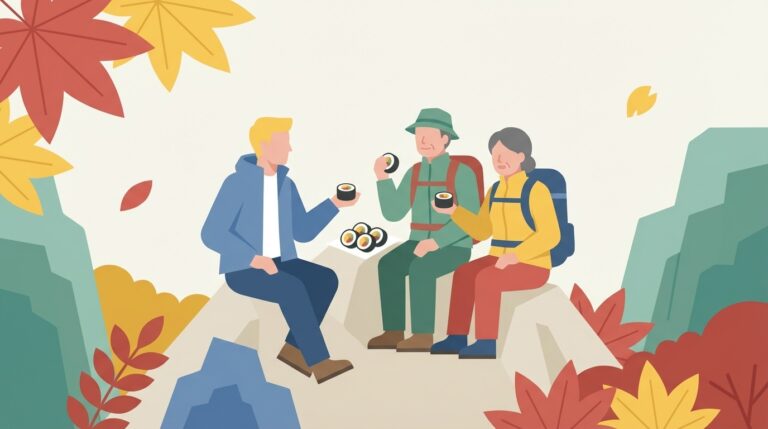
- K-Culture Moment: You sit on a rock to rest. The group next to you opens a massive Tupperware of kimbap, cherry tomatoes, and cucumbers. Suddenly, an Ahjumma extends a cucumber toward you with this phrase.
- Editor’s Insight: This is pure Jeong (정) in action. It’s the warm, communal affection that Koreans express through food.
- Situation Spectrum:
[🚫 절대 금지] ———— [⚠️ 주의] ———— [✅ 자유롭게]
- Sharing with strangers on a hike: ✅
- Offering food to colleagues: ✅
- Offering your half-eaten sandwich: 🚫 (Koreans share, but hygiene still matters!)
- 🤔 Think About It: Sharing food with strangers is common on Korean mountains, but rare on the Seoul subway. Why does the setting change the social rules?
Phase 3: Textbook vs. Real Korean
| Situation | 📖 Textbook Korean | 🗣️ Real Korean | 💡 Why differ? |
|---|---|---|---|
| Suggesting a hike | 산에 올라갑시다. (Let’s climb the mountain.) | 이번 주말에 등산 갈래? (Wanna go hiking this weekend?) | ‘올라갑시다’ sounds like a military order. ‘등산(hiking)’ is the everyday noun. |
| Reacting to the view | 경치가 매우 아름답습니다. (The scenery is very beautiful.) | 와, 뷰 장난 아니다! (Wow, the view is no joke!) | ‘장난 아니다’ is a highly native slang for ‘amazing’ or ‘extreme’. |
| Suggesting a break | 조금 쉬었다가 가겠습니다. (I will rest a little and then go.) | 우리 여기서 좀 쉬었다 가요. (Let’s take a break here before going.) | Real conversational Korean softens suggestions with ‘우리 (we)’ and ‘좀 (a little)’. |
Phase 4: Cultural Context — K-Culture Deep Dive
4-1. Non-Verbal Cues: The Art of the ‘Mountain Nod’
When passing strangers on a narrow mountain trail, you don’t need to bow 90 degrees. A simple, polite nod and a soft “안녕하세요 (Hello)” or “수고하십니다 (Keep up the good work)” is perfect. But remember the Nunchi (눈치): if the path is narrow, the person going up usually has the right of way. Step aside slightly and give them a supportive nod!
4-2. K-Food Connection: The Holy Trinity of Mountain Food
Why do Koreans obsess over hiking? Half the reason is what comes after. Hiking is basically an excuse to eat guilt-free.
– On the mountain: Cucumbers (for hydration), cherry tomatoes, and kimbap.
– At the bottom (하산 – descending): The absolute must-eat combination is Pajeon (Green onion pancake) and Makgeolli (Rice wine). If you ever watch a Korean variety show featuring a hike, it always ends at a rustic restaurant at the base of the mountain, clinking bowls of makgeolli.
Critical View: While Makgeolli at the peak used to be a romanticized tradition, drinking at mountain peaks is now legally restricted in national parks like Seoraksan due to safety. Save the drinks for the bottom!
Phase 5: Real-World Roleplay Scenario
Setting: Saturday morning, halfway up the Ulsanbawi trail in Seoraksan. The autumn leaves are a fiery red. You stop on a rock, out of breath. Next to you is an Ahjumma (middle-aged woman) in a dazzling neon pink windbreaker.
Characters:
– YOU: A foreign traveler who severely underestimated how steep Seoraksan is.
– Ahjumma (아줌마): A seasoned hiker, probably in her 50s, carrying a backpack that looks like Mary Poppins’ bag of food.
Dialogue:
Ahjumma: 학생, 혼자 왔어? 이거 오이 좀 먹어. 🥒
(Haksaeng, honja wasseo? Igeo oi jom meogeo.)
[Student (Young person), did you come alone? Have some of this cucumber.]
(🎭 Stage Direction: She thrusts a perfectly peeled half-cucumber towards you.)
YOU: 헉… 헉… 감사합니다. 대청봉까지 아직 멀었나요?
(Heok… heok… Gamsahamnida. Daecheongbongkkaji ajik meoreonnayo?)
[Pant… pant… Thank you. Is it still far to Daecheongbong peak?]
Ahjumma: 에이~ 다 왔어! 10분만 더 가면 돼.
(Ei~ da wasseo! Sip-bunman deo gamyeon dwae.)
[Oh~ you’re almost there! Just 10 more minutes.]
YOU: 정말요? 밑에서부터 계속 다 왔다고 들은 것 같은데…
(Jeongmallyo? Miteseobuteo gyesok da watdago deureun geot gateunde…)
[Really? I feel like I’ve been hearing ‘almost there’ from the bottom…]
Ahjumma: 하하하! 원래 등산이 그런 거지. 자, 이거 방울토마토도 하나 드실래요?
(Hahaha! Wollae deungsani geureon geoji. Ja, igeo bangultomatodo hana deusillaeyo?)
[Hahaha! That’s just how hiking is. Here, would you like a cherry tomato too?]
🔀 Your Turn! How do you reply?
– A) “아니요, 괜찮습니다.” (No, I’m fine.)
– B) “우와, 감사합니다! 잘 먹겠습니다!” (Wow, thank you! I will enjoy it!)
– C) “저 토마토 알레르기 있어요.” (I have a tomato allergy.)✅ Best Choice: B — If you don’t have allergies, graciously accepting the food (and eating it happily) is the fastest way to make a Korean friend. It’s a mutual exchange of Jeong.
⚠️ Choice A Analysis: It’s polite, but in Korean hiking culture, rejecting an Ahjumma’s food might make her slightly disappointed. If you must decline, add a warm reason: “아니요 괜찮습니다, 방금 많이 먹어서요!” (No thank you, I just ate a lot!)
Phase 6: 10-Second Shadowing Drill
Let’s practice how to express your awe when you finally reach the peak and see the autumn leaves!
😲 우와~ / 단풍이 / 진짜 / 장/난/ 아/니/에/요!
(Uwa~ / danpungi / jinjja / jang/nan/ a/ni/e/yo!)
Emotion Tag: Utterly amazed, emphasizing each syllable at the end.
Phase 7: K-Culture Mini Dictionary
| Korean | Romanization | English | Context |
|---|---|---|---|
| 단풍 | danpung | Autumn foliage | The primary reason Seoraksan gets packed in October. |
| 등산복 | deungsanbok | Hiking clothes | Usually high-tech, brightly colored. A fashion statement for middle-aged Koreans. |
| 인증샷 | injeung-syat | Proof shot / Photo | Taking a photo with the stone marker at the peak to ‘prove’ you made it. |
| 막걸리 | makgeolli | Traditional rice wine | The official post-hike recovery drink. |
| 산장 | sanjang | Mountain cabin/shelter | Where hikers rest or buy expensive cup noodles on major trails. |
Phase 8: Traveler Survival Kit
Going to Seoraksan? Keep these survival phrases in your back pocket!
🆘 Survival Phrase #1: Finding the easy way up
– 🇰🇷 “케이블카 타는 곳이 어디예요?” (Keibeulka taneun gosi eodiyeyo?)
– 🗣️ English Sound: Ke-ee-ble-ka ta-neun go-shi uh-di-ye-yo?
– 📍 Where to use: Seoraksan entrance. The cable car is super popular in autumn!🆘 Survival Phrase #2: Checking your route
– 🇰🇷 “이쪽으로 가면 대청봉 맞나요?” (Ijjogeuro gamyeon daecheongbong mannayo?)
– 🗣️ English Sound: Ee-jjog-eu-ro ga-myun Dae-chung-bong mat-na-yo?
– 📍 Where to use: When the trail splits and you have no idea where to go.📌 Editor’s Travel Note
– Useful App: Naver Map (네이버 지도). It actually shows hiking trails with topographical lines and estimated times!
– Dress Code Warning: Do not hike Seoraksan in jeans. Ahjummas and Ahjussis will look at you with deep concern and might lecture you on safety. Wear proper athletic gear.
– Cable Car Tip: During autumn peak season, cable car tickets sell out by early morning. Go at 7 AM!
Phase 9: Critical Thinking Corner — “One Step Deeper”
Food & Identity: Why We Eat Together on the Mountain
In modern Seoul, individualism is growing. People stare at their phones on the subway and eat alone in cafes. Yet, the moment Koreans step onto a mountain trail, the social rules revert to a traditional, communal past. Offering a stranger a piece of fruit on a steep hike is a survival instinct turned into a cultural love language (Jeong). Food in Korea is rarely just fuel; it is the ultimate tool for breaking down social barriers and declaring, “We are in this struggle together.”
💬 Your Turn: Does the environment change how people interact with strangers in your country? Do you have a place where people suddenly become friendlier? Share in the comments!
Phase 10: FAQ & Avoiding Misunderstandings
Q: “Can I drink alcohol at the peak of Seoraksan?”
No! While it used to be a huge K-culture trope, drinking alcohol in designated peak areas or shelters in national parks is now strictly prohibited and carries a hefty fine. Save the Makgeolli for the restaurants at the bottom.
Q: “An older hiker called me ‘학생 (Student)’. I’m 30. Should I be offended?”
Definitely not! Older Koreans often use ‘학생 (student)’ or ‘총각/처녀 (bachelor/maiden)’ to affectionately address anyone who looks younger than them. Take it as a compliment for your youthful K-Beauty skin!
❌ Common Mistake: Taking “다 왔어요 (We’re almost there)” literally.
✅ Do this instead: Smile, say “감사합니다 (Thank you),” and mentally prepare yourself for another 30 minutes of stairs.
Phase 11: Summary & Action Items
One-Liner Summary: Hiking in Korea is an extreme sport of neon fashion, communal food sharing, and bonding over the shared struggle of reaching the autumn peak.
Action Mission:
– 🥉 Bronze (Solo): Look in the mirror, pretend you are exhausted, and say “와, 뷰 장난 아니다!”
– 🥈 Silver (Online): Find a YouTube vlog of someone hiking Seoraksan and leave a comment: “단풍이 진짜 장난 아니에요!”
– 🥇 Gold (Real World): Next time you go on a walk or a hike with a Korean friend, bring some cherry tomatoes and say, “하나 드실래요?”
K-Culture Mission: Search for ‘Seoraksan Danpung (설악산 단풍)’ on Instagram. Notice the hiking fashion and how people pose for their Injeung-syat (Proof shots)!
Phase 12: Quiz — Interactive Challenge
1. Situational Judgment: You are sweating profusely halfway up the mountain. An older Korean man walking down smiles at you and says, “다 왔어요! 힘내세요!” What is the hidden meaning?
– A) The peak is exactly 1 minute away.
– B) He wants to practice his English with you.
– C) You still have a long way to go, but he is giving you moral support.
2. True or False – K-Culture Edition:
“It is perfectly normal and expected to share food like cucumbers with strangers you meet while resting on a Korean mountain.” (T/F)
3. Fill in the Blank:
You reach the top and want to say the view is unbelievably amazing using native slang.
“와, 뷰 _____ 아니다!”
🚨 Click here for the answers!
1. C (It’s the ultimate ‘white lie’ of encouragement!)
2. True (It’s the culture of ‘Jeong’!)
3. 장난 (Jangnan) – “장난 아니다” literally means “it’s not a joke,” used to describe something awesome or extreme.
Frequently Asked Questions (FAQ)
Q: What does "다 왔어요 (We're almost there)" mean in Korean and how do you pronounce it?
A: In Korean, "다 왔어요 (We're almost there)" is pronounced [da wasseo-yo] and means: Literal = We have completely arrived. / Real nuance = Keep going, don't give up (even if the peak is an hour away).
Q: What does "단풍 구경 가요 (Let's go see the autumn leaves)" mean in Korean and how do you pronounce it?
A: In Korean, "단풍 구경 가요 (Let's go see the autumn leaves)" is pronounced [danpung gugyeong gayo] and means: Literal = Let's go sightseeing autumn leaves. / Real nuance = Let's go on a fun autumn trip together.
Q: What does "하나 드실래요? (Would you like one?)" mean in Korean and how do you pronounce it?
A: In Korean, "하나 드실래요? (Would you like one?)" is pronounced [hana deusillaeyo?] and means: Literal = Would you like to eat one? / Real nuance = Please share my food, we are all friends on this mountain.







