

Hello! I’m your Daily Hangul Editor.
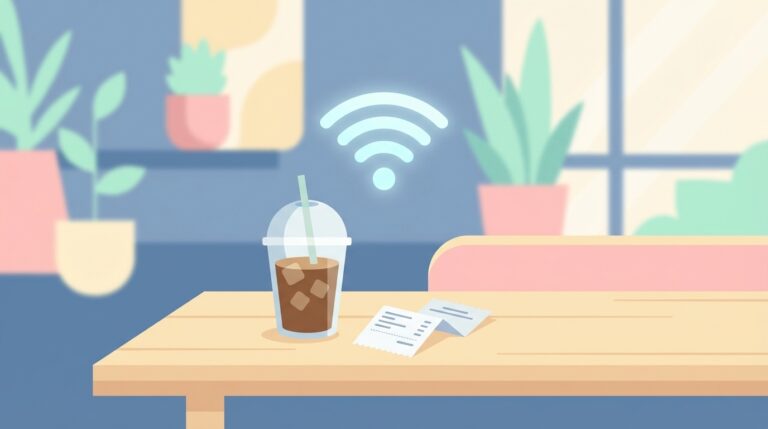
Imagine this: You are at a trendy, beautifully designed cafe in Seongsu-dong, sipping a perfectly aesthetic Iced Americano. You just took a great photo for your Instagram story, but your mobile data is roaming and painfully slow. You look around, hoping to spot a Wi-Fi sign on the wall, but see nothing. The barista looks incredibly busy making lattes. In a K-Drama, this is the exact moment the handsome male lead smoothly connects your phone for you. But in reality? You need to ask.
Not knowing how to ask for the Wi-Fi in Korea is like having a superpower you can’t use. South Korea is globally famous for its lightning-fast, highly accessible free public Wi-Fi—from subway cars to tiny street food stalls. If you know just a couple of natural phrases, you will never be disconnected again. Today, we are moving past textbook Korean to learn the real, street-smart ways to get online in Korea!
Phase 2: Core Expressions
1. 와이파이 비번이 뭐예요? (What is the Wi-Fi password?)
- Pronunciation: wa-i-pa-i bi-beon-i mwo-ye-yo? [wa-ee-pie bee-bun-ee mo-ye-yo?]
- Meaning: Literal: What is the Wi-Fi secret number? / Real nuance: What’s the Wi-Fi password?
- K-Culture Moment: You will hear this exact phrase in almost every cafe. In Korea, asking for the Wi-Fi password is as natural as asking for a napkin.
- Editor’s Insight: The official word for password is ‘비밀번호’ (bi-mil-beon-ho). But that’s too long! Locals almost always shorten it to ‘비번’ (bi-beon). If you say ‘비번 뭐예요?’, you instantly sound like someone who has lived in Seoul for years.
- Situation Spectrum:
[🚫 100% Forbidden] ———— [⚠️ Use with Caution] ———— [✅ Go Ahead]
- Casual with friends: ✅ (와이파이 비번 뭐야?)
- Semi-formal (To cafe staff): ✅ (저기요, 와이파이 비번 뭐예요?)
- Formal (To a strict boss or elder): ⚠️ (Better to use the full word ‘비밀번호’)
- 🤔 Think About It: Koreans love shortening words (비밀번호 -> 비번, 아이스 아메리카노 -> 아아). Do you think this reflects Korea’s famous ‘Pali-pali’ (hurry up) culture?
2. 영수증 밑에 있어요. (It’s at the bottom of the receipt.)
- Pronunciation: yeong-su-jeung mi-te i-sseo-yo. [young-soo-jeung mee-teh ee-suh-yo]
- Meaning: Literal: It is under the receipt. / Real nuance: You can find it at the bottom of the receipt.
- K-Culture Moment: You ask the busy barista for the password, and without missing a beat while steaming milk, they politely point to the piece of paper they just handed you.
- Editor’s Insight: This is the #1 response you will get. To save time, 90% of Korean cafes print the Wi-Fi password and restroom code at the very bottom of the receipt. Never throw it away immediately!
- Situation Spectrum:
[🚫 100% Forbidden] ———— [⚠️ Use with Caution] ———— [✅ Go Ahead]
- This is mostly something you hear rather than say, but understanding it saves you from an awkward “Huh?” moment.
- 🤔 Think About It: Why do you think cafes put the password on the receipt instead of a huge wall sign? (Hint: It subtly encourages people to actually buy a drink first!)
3. 와이파이가 안 터져요. (The Wi-Fi isn’t working/connecting.)
- Pronunciation: wa-i-pa-i-ga an teo-jyeo-yo. [wa-ee-pie-gah ahn tuh-juh-yo]
- Meaning: Literal: The Wi-Fi isn’t exploding. / Real nuance: The Wi-Fi signal is weak or not connecting.
- K-Culture Moment: You are trying to book KTX train tickets on your phone, but the loading wheel keeps spinning. You look at your Korean friend and sigh, saying this phrase.
- Editor’s Insight: The verb ‘터지다’ literally means ‘to explode’ or ‘to burst’. Koreans use this dynamic verb for network signals! If the internet is blazing fast, we excitedly say “와이파이 빵빵 터져요” (The Wi-Fi is exploding with a ‘bang bang’ sound).
- Situation Spectrum:
[🚫 100% Forbidden] ———— [⚠️ Use with Caution] ———— [✅ Go Ahead]
- Casual/Friends: ✅ (와이파이 안 터져)
- To staff: ✅ (죄송한데, 와이파이가 잘 안 터져요)
Phase 3: Textbook vs Real Korean
| Situation | 📖 Textbook Korean | 🗣️ Real Korean | 💡 Why the Difference? |
|---|---|---|---|
| Asking for password | 와이파이 비밀번호를 알려주시겠습니까? (Could you please inform me of the Wi-Fi password?) | 저기요, 와이파이 비번이 뭐예요? (Excuse me, what’s the Wi-Fi p-word?) | Efficiency! Overly formal requests sound stiff in casual cafes. ‘비번’ is the ultimate local hack. |
| Signal is bad | 인터넷 연결 상태가 좋지 않습니다. (The internet connection condition is not good.) | 와이파이가 잘 안 터져요. (The Wi-Fi isn’t exploding well.) | ‘터지다’ (explode/burst) captures the dynamic feeling of a signal better than the clinical word ‘연결’ (connection). |
| Where is it? | 와이파이 비밀번호가 어디에 적혀 있습니까? (Where is the Wi-Fi password written?) | 비번 영수증에 있어요? (Is the p-word on the receipt?) | Assuming it’s on the receipt shows high ‘Nunchi’ (social awareness). |
Phase 4: Cultural Context — K-Culture Deep Dive
4-1. Non-verbal Nunchi (눈치) at the Cafe
Before you confidently march up to the staff to ask for the Wi-Fi, exercise your Nunchi (the Korean art of reading the room). Look at your receipt first. If you don’t have it, look around the POS (Point of Sale) register system. Usually, there’s a tiny, cute handwritten sign saying “Wi-Fi” right next to the card reader. Finding it yourself proves you’re a true local!
4-2. The K-Cafe Culture & “1 Person 1 Drink” Rule
In Korea, cafes are not just places to grab a quick coffee; they act as secondary offices, study rooms, and social hubs. This is why free Wi-Fi and power outlets are everywhere. However, there is an unspoken (and often written) golden rule: 1인 1음료 (1 Person, 1 Drink). It’s considered basic etiquette to order at least one drink per person if you are going to sit down and use their Wi-Fi and electricity. K-Dramas often show characters having deep, dramatic conversations in empty cafes without drinks, but in reality, you gotta buy that Americano first!
Phase 5: Real-Life Roleplay Scenario
Scenario A: The Seongsu-dong Cafe Mission
Setting: Saturday afternoon, 2 PM. A hip, industrial-style cafe in Seongsu-dong. The espresso machine is hissing. You just received your iced latte and a slice of cake.
Characters:
– YOU: An expat wanting to study Korean online.
– Barista Ji-won (20s): Friendly, fast-paced, wearing a stylish apron.
Dialogue:
Barista Ji-won: 주문하신 아이스 라떼와 케이크 나왔습니다. ☕ 영수증 필요하세요?
(jumu-hasin a-i-seu ra-tte-wa ke-i-keu na-wat-seum-ni-da. yeong-su-jeung pi-ryo-ha-se-yo?)
(English) Your iced latte and cake are ready. Do you need the receipt?
YOU: 아, 네! 주세요.
(a, ne! ju-se-yo.)
(English) Ah, yes! Please give it to me.
(🎭 Stage Direction: You take the tray, but you realize you need the internet for your laptop.)
YOU: 저기요, 혹시 와이파이…
(jeo-gi-yo, hok-si wa-i-pa-i…)
(English) Excuse me, by any chance, the Wi-Fi…
🔀 Your Turn! How should you finish this sentence?
– A) “비밀번호를 저에게 주실 수 있습니까?” (Can you give me the password?)
– B) “비번이 뭐예요?” (What’s the password?)
– C) “어떻게 연결해요?” (How do I connect?)✅ Best Choice: B — It is natural, polite, and uses the local abbreviation.
⚠️ Choice A Analysis: This sounds like a robot or a police officer making an official request! Way too formal and awkward for a cafe setting.
Barista Ji-won: 아, 와이파이 비번은 영수증 하단에 적혀 있어요!
(a, wa-i-pa-i bi-beon-eun yeong-su-jeung ha-dan-e jeo-kyeo i-sseo-yo!)
(English) Ah, the Wi-Fi password is written at the bottom of the receipt!
YOU: 아, 여기 있네요! 감사합니다.
(a, yeo-gi in-ne-yo! gam-sa-ham-ni-da.)
(English) Ah, here it is! Thank you.
Scenario B: The Subway Panic (Bonus)
Setting: Inside the bustling Seoul subway Line 2.
YOU: (To a friendly-looking Korean student next to you) 저기요, 지하철 와이파이 무료예요?
(Excuse me, is the subway Wi-Fi free?)
Student: 네, 근데 통신사 연결해야 돼요.
(Yes, but you have to connect through a mobile carrier.)
YOU: 아… 안 터지네요.
(Ah… it’s not connecting/working.)
Student: 외국인이시면 서울 공공 와이파이(Public WiFi Free) 써보세요!
(If you’re a foreigner, try using the Seoul Public Wi-Fi!)
Phase 6: 10-Second Shadowing Drill
Follow the rhythm and pauses! Speak out loud:
😊 저기요, / 와이파이 비번이 / 뭐예요?
(jeo-gi-yo, / wa-i-pa-i bi-beon-i / mwo-ye-yo?)
(Emotion: Brightly and politely asking for help)
😢 아... / 와이파이가 / 안 터져요.
(a... / wa-i-pa-i-ga / an teo-jyeo-yo.)
(Emotion: Frustrated because your K-Drama episode paused buffering)
Phase 7: K-Culture Mini Dictionary
| Korean | Romanization | English | Context |
|---|---|---|---|
| 비번 | bi-beon | Password (Abbr.) | Short for 비밀번호. Used for Wi-Fi, door locks, and logins. |
| 영수증 | yeong-su-jeung | Receipt | The sacred paper holding the Wi-Fi password and restroom code. |
| 데이터 | de-i-teo | Mobile Data | If Wi-Fi fails, you ask your friend: “나 데이터 없어” (I have no data). |
| 터지다 | teo-ji-da | To explode / connect | Used to describe how strong a network connection is. |
| 빵빵하다 | ppang-ppang-ha-da | Full / Strong | Used to say the Wi-Fi signal is perfectly strong (와이파이 빵빵해요). |
Phase 8: Traveler’s Survival Kit
🆘 Survival Expression #1
– 🇰🇷 “콘센트 자리 있어요?”
– 🗣️ Pronunciation guide: [kon-sen-teu ja-ri i-sseo-yo?]
– 📍 Where to use: Cafes, fast-food chains, libraries.
– 💡 Pro Tip: ‘콘센트’ (Consent) is Konglish for an electrical outlet. Since you have the Wi-Fi, you need the power for your laptop!📌 Editor’s Travel Note
– Free Public Wi-Fi: Look for networks named “SEOUL_Secure” or “Public WiFi Free” on buses and subway stations.
– Security: Korean public Wi-Fi is generally very safe, but avoid doing heavy banking on an open network.
– Cafe Bathrooms: Many cafes have a keypad lock on the bathroom door. The code is usually right next to the Wi-Fi password on your receipt! (화장실 비밀번호)
Phase 9: Critical Thinking — “Going One Step Deeper”
Global Era & The ‘Pali-Pali’ Infrastructure
🧠 Think Deeper:
Have you noticed how unbelievably fast the internet is in Korea? This isn’t just about good technology; it reflects Korea’s famous ‘빨리빨리’ (Pali-pali / Hurry up) culture. In a society where efficiency and speed are top priorities, a slow internet connection is almost considered a societal failure. The language evolved too—using words like ‘터지다’ (explode) shows how dynamic and urgent the expectation for connectivity is. Providing free Wi-Fi is seen as basic customer service, seamlessly blending hospitality with tech.💬 Your Turn: How is public Wi-Fi in your country? Do cafes freely give out passwords, or is it heavily restricted? Share your experience in the comments!
Phase 10: FAQ & Preventing Misunderstandings
- Q: Can I just ask for the Wi-Fi password without buying anything?
- A: No. It is considered rude (and a lack of Nunchi). Always order first! Most passwords are on the receipt anyway.
- Q: My friend’s Wi-Fi is strong, but mine is weak. Can I complain to the staff?
- A: Maybe, but softly. You can politely say “와이파이가 잘 안 터져요” (The Wi-Fi isn’t connecting well), but often they might just ask you to move closer to the router.
- Q: Do I need a Korean phone number to use free public Wi-Fi?
- A: Usually, no. Most cafe and Seoul city Wi-Fi networks just require you to click an “Agree” button on a popup page.
❌ Common Mistake #1: Asking “패스워드 뭐예요?” (What is the password?)
✅ Do This Instead: While ‘패스워드’ is understood (as a Konglish word), using ‘비밀번호’ or the local favorite ‘비번’ sounds much more natural and native.
Phase 11: Summary & Action Items
- One-Liner Summary: Check your receipt first, use the magic word “비번” (bi-beon), and enjoy Korea’s explosive (빵빵 터지는) internet speed!
-
Action Mission 3 Steps:
- 🥉 Bronze (Solo): Say “와이파이 비번이 뭐예요?” out loud 3 times fast without getting tongue-tied.
- 🥈 Silver (Online): Change your phone’s hotspot name to “와이파이 빵빵” for a day!
- 🥇 Gold (Real Life): Next time you visit a Korean cafe or restaurant, successfully ask for the Wi-Fi password in Korean instead of just pointing at your phone.
- K-Culture Mission: Watch an episode of a K-Drama set in an office or cafe. Spot the moment someone looks at their phone with a frustrated face—they are probably dealing with data issues!
Phase 12: Quiz — Interactive Challenge
1. Situational Judgment: You ordered a coffee and want to connect to the Wi-Fi. You look at the receipt, but it’s blank at the bottom. What is the most natural thing to say to the barista?
– A) “와이파이 연결 상태가 나쁩니다.”
– B) “저기요, 와이파이 비번이 뭐예요?”
– C) “데이터가 없어요.”
2. Fill in the Blank: The internet is so slow today! “와이파이가 안 ( ____ ).”
3. True or False – K-Culture Edition: In Korea, it is perfectly fine to sit in an empty cafe for 4 hours using their Wi-Fi without buying a drink.
💡 Click here for the answers!
- B (A is too formal and means the connection is bad, C is just stating you have no data).
- 터져요 (teo-jyeo-yo).
- False! The ‘1인 1음료’ (1 person 1 drink) rule is essential K-Cafe etiquette.
Frequently Asked Questions (FAQ)
Q: What does "와이파이 비번이 뭐예요? (What is the Wi-Fi password?)" mean in Korean and how do you pronounce it?
A: In Korean, "와이파이 비번이 뭐예요? (What is the Wi-Fi password?)" is pronounced [wa-i-pa-i bi-beon-i mwo-ye-yo? [wa-ee-pie bee-bun-ee mo-ye-yo?] and means: Literal: What is the Wi-Fi secret number? / Real nuance: What's the Wi-Fi password?
Q: What does "영수증 밑에 있어요. (It's at the bottom of the receipt.)" mean in Korean and how do you pronounce it?
A: In Korean, "영수증 밑에 있어요. (It's at the bottom of the receipt.)" is pronounced [yeong-su-jeung mi-te i-sseo-yo. [young-soo-jeung mee-teh ee-suh-yo] and means: Literal: It is under the receipt. / Real nuance: You can find it at the bottom of the receipt.
Q: What does "와이파이가 안 터져요. (The Wi-Fi isn't working/connecting.)" mean in Korean and how do you pronounce it?
A: In Korean, "와이파이가 안 터져요. (The Wi-Fi isn't working/connecting.)" is pronounced [wa-i-pa-i-ga an teo-jyeo-yo. [wa-ee-pie-gah ahn tuh-juh-yo] and means: Literal: The Wi-Fi isn't exploding. / Real nuance: The Wi-Fi signal is weak or not connecting.







