
 TOPIK 3
· 10 min read
The Romance of Roasted Chestnuts: Essential Korean Street Food Phrases You Need This Winter!
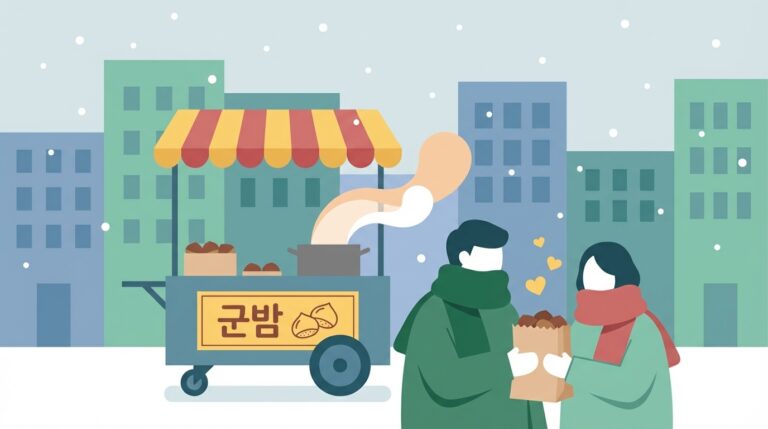 TOPIK 3
· 10 min read
[🚫 Formal] ———— [⚠️ Semi-formal] ———— [✅ Casual]\n> – Street vendor (Ahjussi): ✅\n> – High-end restaurant: 🚫 (Use ‘Jeogiyo’ instead)\n> – 🤔 Think About It: Why are things sold by the ‘bongji’ (bag) instead of exact weights in traditional Korean street food? Does this reflect a culture of generosity?\n\n> ### 2. 앗, 뜨거! 조심해.\n> \n> – Pronunciation: at, tteugeo! josimhae. [aht, tteu-geo! jo-shim-hae]\n> – Meaning: Literal: ‘Ah, hot! Be careful.’ / Real nuance: ‘Ouch, that’s hot! Watch out.’\n> – K-Culture Moment: You grab a chestnut right out of the roaster. It burns! You instinctively yell ‘Atteu!’ and warn your friend. This is the exact sound Koreans make when touching a hot pot of Ramyeon.\n> – Editor’s Insight: Textbooks teach ‘뜨겁습니다 (tteugeopseumnida)’. But when you’re burning your fingers, nobody has time for polite suffixes! ‘Atteu’ is the ultimate reflex sound.\n> – Situation Spectrum: [🚫 Formal] ———— [⚠️ Semi-formal] ———— [✅ Casual]\n> – Close friends: ✅\n> – Boss/Elders: ⚠️ (You’d say ‘앗, 뜨거워요! 조심하세요’)\n> – 🤔 Think About It: Does your language have specific reflex sounds for heat? How does ‘Ouch’ differ from ‘Atteu’?\n\n> ### 3. 줘 봐, 내가 까줄게.\n> \n> – Pronunciation: jwo bwa, naega kkajulge. [jwo bwa, nae-ga kka-jool-ge]\n> – Meaning: Literal: ‘Give it to me, I will peel it for you.’ / Real nuance: ‘Here, let me peel that for you.’\n> – K-Culture Moment: The famous ‘peeling’ love language. In Korea, peeling shrimp, perilla leaves, or hot chestnuts for someone is a huge sign of affection and care.\n> – Editor’s Insight: The verb ‘까다 (kkada)’ means to peel a shell. Adding ‘-줄게 (-julge)’ means doing it as a favor for the other person. It’s incredibly endearing.\n> – Situation Spectrum: [🚫 Formal] ———— [⚠️ Semi-formal] ———— [✅ Casual]\n> – Friends/Dates: ✅\n> – Co-workers: ⚠️ (Might seem too flirtatious or overly caring!)\n\n—\n\n### Phase 3: Textbook vs Real Korean\n\n| Situation | 📖 Textbook Korean | 🗣️ Real Korean | 💡 Why is it different? |\n|—|—|—|—|\n| Reacting to a hot chestnut | 밤이 매우 뜨겁습니다. | 아뜨뜨! / 아, 뜨거! | Reflex reactions in Korea prioritize short, sharp vowel sounds. |\n| Offering to peel a chestnut | 제가 밤 껍질을 벗기겠습니다. | 줘 봐, 내가 까줄게. | ‘껍질을 벗기다’ sounds very scientific. ‘까다’ is the everyday slang for peeling shells. |\n| Asking for the price | 이 밤은 얼마입니까? | 아저씨, 이거 한 봉지에 얼마예요? | Adding ‘Ahjussi’ and ‘Bongji’ contextualizes the phrase for a street market setting. |\n\nBottom Note for B1 Learners: Don’t be afraid to drop the formal ‘yo’ (요) when reacting to pain or heat (like ‘Atteu!’). It shows you’re feeling the language natively!\n\n—\n\n### Phase 4: Cultural Context — K-Culture Deep Dive\n\n#### 4-1. Non-verbal Nunchi (눈치)\nWhen eating street food in the cold, body language is everything. If you see your friend blowing on their fingertips and struggling to open a chestnut, use your Nunchi. Don’t wait for them to ask for help! Reaching out your hand and saying ‘줘 봐 (jwo bwa – give it to me)’ before they even ask is peak Korean social intelligence.\n\n#### 4-2. The ‘Acts of Service’ Romance in K-Dramas\nIf you watch romantic K-Dramas set in winter, you will inevitably see the ‘Gunbam’ or ‘Gun-goguma’ (roasted sweet potato) scene. Why? Because Korean romance heavily emphasizes acts of service over verbal declarations of love. \n\nSaying ‘I love you’ is nice, but burning your own fingers to give your partner the sweetest, perfectly peeled chestnut? That’s true devotion. It mirrors the famous ‘Perilla Leaf Debate’ (깻잎 논쟁) in K-Pop fandoms, where idols debate whether it’s okay for your significant other to peel a perilla leaf for your friend. In Korea, handling someone else’s food requires a deep level of intimacy. \n\n—\n\n### Phase 5: Real-life Roleplay Scenario\n\nSetting: 8:00 PM on a Friday. You and your Korean friend, Min-su, just finished dinner and are walking near Gangnam Station. The air is freezing, but you spot a street vendor roasting chestnuts.\n\nCharacters:\n- YOU: An expat surviving their first Korean winter.\n- Min-su (30): Your friendly Korean co-worker who loves acting as your local guide.\n\nDialogue:\nMin-su: 와, 날씨 진짜 춥다. 어? 저기 군밤 판다! 먹을래?\n(wa, nalssi jinjja chupda. eo? jeogi gunbam panda! meogeullae?)\n[Wow, the weather is so cold. Oh? They’re selling roasted chestnuts over there! Wanna eat?]\n\nYOU: 좋아요! 냄새 진짜 좋네요.\n(joayo! naemsae jinjja jonneyo.)\n[Sounds good! The smell is amazing.]\n\nMin-su: (To the vendor) 아저씨, 이거 한 봉지에 얼마예요?\n(ajeossi, igeo han bongjie eolmayeyo?)\n[Ahjussi, how much is this for one bag?]\n\nVendor: 오천 원이에요. 방금 구워서 아주 맛있어~\n(ocheon wonieyo. banggeum guwoseo aju masisseo~)\n[It’s 5,000 won. I just roasted them, so they’re very delicious~]\n\nMin-su: 한 봉지 주세요! 계좌이체 할게요.\n(han bongji juseyo! gyejwaiche halgeyo.)\n[One bag, please! I’ll do a bank transfer.]\n(🎭 Stage Direction: Min-su takes the hot paper bag and hands you a chestnut.)\n\nMin-su: 자, 먹어봐. 앗, 뜨거! 껍질 조심해.\n(ja, meogeobwa. at, tteugeo! kkeopjil josimhae.)\n[Here, try it. Ah, hot! Careful with the shell.]\n\nYOU: 앗! 진짜 뜨겁네요. 까기 너무 힘들어요.\n(at! jinjja tteugeomneyo. kkagi neomu himdeureoyo.)\n[Ouch! It really is hot. It’s so hard to peel.]\n\nMin-su: 아, 그래? 나도 손가락 데일 것 같아.\n(a, geurae? nado songarak deil geot gata.)\n[Ah, really? I think I’m going to burn my fingers too.]\n\n> 🔀 Your Turn! How should you respond?\n> – A) “그럼 껍질째 먹을게요!” (Then I’ll just eat it with the shell!)\n> – B) “이리 줘 봐요, 제가 까줄게요!” (Hand it here, I’ll peel it for you!)\n> – C) “아저씨한테 까달라고 할까요?” (Should we ask the Ahjussi to peel it?)\n> \n> ✅ Best Choice: B — Reason: It shows empathy and warmth (Jeong)! Taking the initiative to help when both are struggling is a great way to bond.\n> ⚠️ Choice A & C Analysis: You cannot eat the hard shell of a chestnut! And asking the busy vendor to peel it for you is considered very rude and lacking Nunchi.\n\n—\n\n### Phase 6: 10-Second Shadowing Drill\n\nLet’s practice your natural intonation. Follow the slashes (/) for pauses.\n\n😊 아저씨! / 군밤 한 봉지 / 주세요!\n(a-jeo-ssi! / gun-bam han bong-ji / ju-se-yo!)\nTone: Bright, energetic, shivering a bit from the cold!\n\n😤 줘 봐, / 내가 / 까줄게!\n(jwo bwa, / nae-ga / kka-jul-ge!)\nTone: Confident, caring, like a reliable K-Drama lead.\n\n😣 앗, / 뜨거! / 조심해서 먹어.\n(at, / tteu-geo! / jo-sim-hae-seo meo-geo.)\nTone: Startled, quickly pulling your hand away.\n\n—\n\n### Phase 7: K-Culture Mini Dictionary\n\n| Korean | Romanization | English | Cultural Context |\n|—|—|—|—|\n| 길거리 음식 | gilgeori eumshik | Street food | A massive part of Korean nightlife and winter culture. |\n| 가슴속 삼천 원 | gaseumsok samcheon won | 3,000 won in the heart | A famous meme/phrase meaning you should always carry 3,000 KRW cash in winter just in case you encounter a street food cart. |\n| 정 | jeong | Deep affection/bond | The unspoken cultural concept of warmth, sharing, and collective connection. Sharing a bag of hot chestnuts is pure Jeong. |\n| 계좌이체 | gyejwa-iche | Bank transfer | The lifeline of modern Korean street food. If you don’t have cash, vendors have their account numbers taped to the cart! |\n\n—\n\n### Phase 8: Traveler Survival Kit\n\nNavigating street food stalls as a traveler can be intimidating. Here are your lifesavers!\n\n> 🆘 Survival Expression #1: Bank Transfers\n> – 🇰🇷 “계좌이체 되나요?” (gyejwa-iche doenayo?)\n> – 🗣️ English Guide: [gye-jwa-ee-che dwe-na-yo?]\n> – 📍 Where to use: Any street cart, small market stall, or food truck.\n> – 💡 Pro Tip: Look for a piece of paper taped to the cart with a bank name (e.g., 카카오뱅크, 국민은행) and an account number. \n\n> 🆘 Survival Expression #2: Asking the Price\n> – 🇰🇷 “이거 한 봉지에 얼마예요?” (igeo han bongjie eolmayeyo?)\n> – 🗣️ English Guide: [ee-geo han bong-jee-e eol-ma-ye-yo?]\n> – 📍 Where to use: Buying chestnuts, sweet potatoes, or mini fish-shaped pastries (Bungeoppang).\n\n📌 Editor’s Travel Note\n- Cash vs Card: While Korea is a ‘card-only’ heaven, street stalls are the exception. Always carry a few 1,000 won bills during winter!\n- Haggling: Haggling (깎아주세요) is common in clothing markets, but not for street food. The price is fixed.\n- Trash: Finding a trash can on Korean streets is notoriously difficult. Keep the empty brown bag to store the peeled chestnut shells until you find a bin in a subway station!\n\n—\n\n### Phase 9: Critical Thinking — “One Step Deeper”\n\nFood & Identity: Why Do Koreans Always Share?\nIn Western cultures, ordering your own individual meal is standard. But in Korea, food is inherently collective. When someone buys a bag of roasted chestnuts, they don’t buy it for themselves; they buy it for the group. The act of peeling a chestnut and handing it to someone else is a physical manifestation of Jeong (정). It shows that the boundary between ‘you’ and ‘me’ is blurred. \n\n> 🧠 Think Deeper:\n> Does your culture have a specific food that is meant to be shared and prepared for others by hand? How does the way we eat reflect the way we view community?\n> \n> 💬 Your Turn: Have you ever experienced someone peeling or preparing food for you at a table? Share your story in the comments!\n\n—\n\n### Phase 10: FAQ & Avoiding Misunderstandings\n\n- Q: Can I use “내가 까줄게” (I’ll peel it for you) with my boss?\n – A: 🚫 No! Using casual speech (banmal) with a boss is a big taboo. Even if you use the polite form (제가 까드릴게요), peeling food for a superior can sometimes feel too intimate or presumptuous unless you are very close.\n\n- Q: Do I eat the furry inner skin of the chestnut?\n – A: 🚫 No! The inner skin (율피 – yulpi) is very bitter. Make sure you peel both the hard outer shell and the thin inner layer!\n\n> ❌ Common Mistake #1: Asking for a specific number of chestnuts. \n> ✅ Do this instead: Don’t say “밤 다섯 개 주세요” (Give me 5 chestnuts). Always order by the bag: “한 봉지 주세요” (Give me one bag). Vendors measure by volume, not by counting!\n\n—\n\n### Phase 11: Summary & Action Items\n\n- One-Liner Summary: Buying and peeling roasted chestnuts is the ultimate way to experience Korean winter romance, street culture, and Jeong!\n\n- Action Mission:\n – 🥉 Bronze: Stand in front of a mirror, pretend you touched something hot, and naturally yell “앗, 뜨거!” (Atteu!)\n – 🥈 Silver: Leave a comment on this post telling us your favorite winter street food in your country using Korean.\n – 🥇 Gold: Next time you are in Korea or at a Korean market, buy a snack and ask, “이거 한 봉지에 얼마예요?”\n\n- K-Culture Mission: Watch an episode of a classic winter K-Drama (like Goblin or Crash Landing on You) and spot the scene where characters share street food. Pay attention to who peels or serves the food!\n\n—\n\n### Phase 12: Quiz — Interactive Challenge\n\n1. Fill in the Blank:\nYou touch a freshly roasted chestnut and burn your finger. What is the most natural Korean reaction?\n”______, 진짜 조심해!” (______, jinjja josimhae!)\n\n2. True or False – K-Culture Edition:\nIf you buy street food in Korea, you must always leave a 10% tip for the vendor. (T/F)\n\n3. Situational Judgment:\nYou want to buy roasted chestnuts, but you only have your credit card. What should you ask the Ahjussi?\n- A) 카드 되나요? (kadeu doenayo? – Do you take cards?)\n- B) 계좌이체 되나요? (gyejwa-iche doenayo? – Can I do a bank transfer?)\n- C) 공짜로 주세요. (gongjjaro juseyo. – Give it to me for free.)\n\n(Answers: 1. 앗 뜨거! (Atteu!) | 2. False! There is zero tipping culture in Korea. | 3. B is the safest and most common bet for street vendors today!)
 TOPIK 3
Phase 1: Winter Train Blues and Station Survival 안녕하세요! 매일한글 에디터입니다. (Annyeonghaseyo! Yo…

 TOPIK 5
Phase 1: Why One Tiny Paragraph Feels Harder Than the Whole Thesis 안녕하세요! 매일한글 에디터입니다. (…
 TOPIK 2
Phase 1: Why Modern Korean Weddings Surprise Everyone 안녕하세요! 매일한글 에디터입니다. (Annyeonghasey…
 TOPIK 1
#1
Phase 1: Introduction Hello! It’s your editor from Daily Hangul. Picture this: You are w…
 TOPIK 5
#2
Hello! It's Daily Hangul! (DailyHangul.com) 👋 Annyeonghaseyo! Welcome back to Daily Hang…
 TOPIK 1
#3
Introduction Annyeonghaseyo! Hello everyone! This is Daily Hangul, here to upgrade your …