

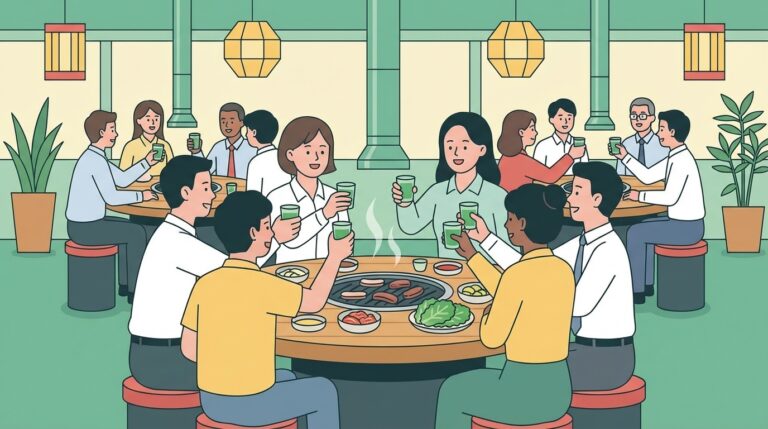
Phase 1: Empathy (Immersive Open)
Hello! I’m the Lead Editor of Daily Hangul.
Picture this: It’s 5:00 PM on a Friday. The office is finally quieting down, and you’re ready to pack your bags. Suddenly, your Korean manager claps his hands and announces, “오늘 회식 메뉴 뭐로 할까?” (What should we have for the hoesik menu today?)
Silence falls over the room. Your coworkers start looking at each other, communicating through their eyes. In K-Dramas, this is the exact moment the camera zooms in on the youngest employee sweating nervously.
Why the tension? Because choosing a menu for a Korean company dinner (회식, Hoesik) isn’t just about food—it’s a delicate game of 눈치 (Nunchi), reading the room, and understanding team dynamics. If you don’t know the right expressions, you might accidentally force your entire team to eat something they silently hate, or worse, seem uncooperative. But if you master this moment, you’ll instantly be treated like a true “Insider” (인싸).
This guide is based on real SOS messages from my intermediate B1 students who survived their first Korean corporate jobs. Let’s dive in!
Phase 2: Core Expressions Deep Dive
1. 아무거나 다 좋아요 (Anything is fine)
- Pronunciation: amugeona da joayo [ah-moo-guh-nah dah jo-ah-yo]
- Meaning: Literal: Anything is all good. / Real nuance: I am flexible, please decide for me (or “I don’t want to take responsibility for a bad choice”).
- K-Culture Moment: This is the most common default answer in Korea. When the boss asks what to eat, 90% of employees will say this to avoid being the one who chose a restaurant that everyone ends up disliking.
- Editor’s Insight: While it sounds polite, if everyone says “아무거나,” it creates a frustrating loop. If you are the youngest or the guest of honor, they might actually want you to choose. Use this, but have a backup dish in mind!
- Situation Spectrum:
[🚫 Never] ———— [⚠️ Caution] ———— [✅ Freely]
- Close Friends (Casual): ✅ (아무거나 좋아)
- Coworkers (Semi-formal): ✅ (아무거나 다 좋아요)
- When specifically asked to pick by the boss: ⚠️
- 🤔 Think About It: Why do Koreans default to “anything is fine”? How does this reflect the collectivist culture prioritizing group harmony over individual preference?
2. 저는 삼겹살이 당겨요 (I’m craving Samgyeopsal)
- Pronunciation: jeoneun samgyeopsari danggyeoyo [juh-neun sam-gyup-sal-ee dang-gyuh-yo]
- Meaning: Literal: Samgyeopsal is pulling me. / Real nuance: I’m really in the mood for Korean BBQ.
- K-Culture Moment: “당기다” is a fantastic native-like B1 expression! You’ll hear this constantly among Korean friends deciding on late-night snacks or drinks. It sounds much more natural than the textbook “먹고 싶어요” (I want to eat).
- Editor’s Insight: Use this when the group is stuck in the “anything is fine” loop. Suggesting a universally loved Hoesik menu like Samgyeopsal with this phrase makes you look decisive and culturally fluent.
- Situation Spectrum:
[🚫 Never] ———— [⚠️ Caution] ———— [✅ Freely]
- Close Friends (Casual): ✅ (나 삼겹살 당겨)
- Coworkers (Semi-formal): ✅ (삼겹살 당기네요)
- Formal/Strict Boss: ⚠️ (Better to ask: 삼겹살 어떠세요?)
- 🤔 Think About It: Does your native language have a specific verb for “craving” or “being pulled by food”?
3. 다수결로 정하시죠 (Let’s decide by majority)
- Pronunciation: dasugyeollo jeonghasijyo [dah-soo-gyul-lo jung-ha-she-jo]
- Meaning: Literal: Let’s decide by the rule of the majority. / Real nuance: Let’s take a vote so no one gets blamed.
- K-Culture Moment: When Team A wants Pizza and Team B wants BBQ, someone will step in as the peacemaker and say this. It’s the ultimate democratic problem-solver in the Korean workplace.
- Editor’s Insight: The suffix “-하시죠” implies a polite suggestion to a group of equals or slightly senior members. It shows leadership and maturity.
- Situation Spectrum:
[🚫 Never] ———— [⚠️ Caution] ———— [✅ Freely]
- Close Friends (Casual): ✅ (다수결로 하자)
- Coworkers (Semi-formal): ✅ (다수결로 정하시죠)
- Very senior executives: 🚫 (They usually decide for the group)
- 🤔 Think About It: Why is “saving face” (not wanting to be the one who made a bad choice) so important in Asian business cultures?
Phase 3: Textbook vs. Real Korean
| Situation | 📖 Textbook Korean | 🗣️ Real Korean | 💡 Why is it different? |
|---|---|---|---|
| Asking the group | 무엇을 먹고 싶습니까? | 오늘 회식 메뉴 뭐로 할까요? | “뭐로 할까요?” focuses on collective decision-making rather than individual desires. |
| Expressing preference | 저는 돼지고기를 좋아합니다. | 전 삼겹살 콜이요! (Call!) | “콜” (Call) is English slang adopted from poker, meaning “I agree/I’m in!” |
| Agreeing with the boss | 저도 그것을 먹겠습니다. | 부장님 드시고 싶은 걸로 가시죠. | Deferring the choice to the elder/boss is a sign of respect and good Nunchi. |
Bottom Note: At a B1 level, mixing a polite form (요/죠) with casual slang like “콜” (Call) shows that you are culturally adaptable. Just don’t use “콜” with the CEO!
Phase 4: Cultural Context — K-Culture Deep Dive
4-1. Non-Verbal Cues: The Nunchi Game
Language is only 20% of the battle. In a Korean company, 눈치 (Nunchi) is everything. If the boss says, “I’m fine with anything… but it’s a bit chilly today, isn’t it?” — that is not a weather observation. That is a direct hint that they want a hot soup dish like 김치찌개 (Kimchi Stew) or 전골 (Hot Pot). If you suggest cold noodles (Naengmyeon) at that moment, you have “no Nunchi” (눈치 없다).
4-2. K-Drama Connection: The Hoesik Trope
Have you ever noticed in K-Dramas like Misaeng or What’s Wrong with Secretary Kim that the youngest employee (막내, Maknae) is always frantically calling restaurants while hiding in the stairwell?
In reality, if you are the Maknae, choosing the menu is often a “test.” You must consider:
1) The team budget.
2) Who has allergies or dietary restrictions.
3) The distance from the office.
4) Is it a place where people can comfortably drink Soju?
While dramas often exaggerate the stress, taking the initiative to say “제가 예약할까요?” (Shall I make the reservation?) will earn you immense respect.
Phase 5: Real-Life Roleplay Scenario
Setting: Friday 5:30 PM. The office is buzzing. Your team of four is wrapping up.
Characters:
– YOU: A foreign employee who transferred to the Seoul office 3 months ago. You love Korean food but are still learning the workplace dynamics.
– Min-su (32): Your friendly Korean coworker who often helps you out.
– Boss (Bujang-nim, 50s): The team leader. Generous but old-school.
Dialogue:
Boss: 자, 오늘 회식 어디로 갈까? 다들 먹고 싶은 거 있어?
(Ja, oneul hoesik eodiro galkka? dadeul meokgo sipeun geo isseo?)
[Well, where should we go for hoesik today? Is there anything you guys want to eat?]
(🎭 Stage Direction: The Boss stretches his arms, looking around the room.)
Min-su: 저는 아무거나 다 좋습니다! 부장님 드시고 싶은 걸로 가시죠.
(Jeoneun amugeona da josseumnida! Bujangnim deusigo sipeun geollo gasijyo.)
[Anything is fine with me! Let’s go with whatever you want to eat, Boss.]
Boss: 에이, 매번 내가 고르잖아. 오늘은 특별히 외국에서 온 우리 알렉스(YOU)가 골라봐!
(Ei, maebeon naega goreujana. Oneureun teukbyeolhi oegugeseo on uri allekseuga gollaba!)
[Hey, I always pick. Today, our friend from abroad, Alex(YOU), should pick!]
YOU: 저요? 음…
(Jeoyo? Eum…)
[Me? Um…]
Min-su: (whispering) 고기… 고기…
(Gogi… gogi…)
[(Meat… meat…)]
🔀 Your Turn! How should you respond?
– A) “저는 피자 먹고 싶어요!” (I want to eat Pizza!)
– B) “다들 삼겹살 어떠세요? 저는 삼겹살이 당겨요!” (How about Samgyeopsal everyone? I’m craving Samgyeopsal!)
– C) “아무거나 다 좋습니다.” (Anything is fine.)✅ Best Choice: B — Why? Min-su gave you a hint. Samgyeopsal is the undisputed king of Hoesik. By phrasing it as a suggestion (“어떠세요?”) combined with your craving (“당겨요”), you balance politeness and decisiveness.
⚠️ Choice A Analysis: While younger Koreans love pizza, traditional Hoesik culture revolves around food that pairs well with Soju. Pizza might be seen as too individualistic for a team dinner.
⚠️ Choice C Analysis: The Boss specifically asked you to choose. If you say “anything,” you throw the burden right back at him, killing the mood!
(Assuming you chose B)
YOU: 다들 삼겹살 어떠세요? 저는 삼겹살이 당겨요!
(Dadeul samgyeopsal eotteoseyo? Jeoneun samgyeopsari danggyeoyo!)
[How about Samgyeopsal, everyone? I’m craving Samgyeopsal!]
Boss: 오, 삼겹살? 좋지! 소주 한잔 딱이네.
(O, samgyeopsal? Jochi! Soju hanjan ttagine.)
[Oh, Samgyeopsal? Sounds good! Perfect for a glass of Soju.]
Min-su: 역시 센스 최고! 제가 바로 강남역 근처로 예약하겠습니다.
(Yeoksi senseu choego! Jega baro gangnamyeok geuncheoro yeyakhagetseumnida.)
[Great sense as expected! I’ll make a reservation near Gangnam Station right away.]
Boss: 그래, 오늘 고기는 내가 쏜다! 가자!
(Geurae, oneul gogineun naega ssonda! Gaja!)
[Alright, meat is on me today! Let’s go!]
(🎭 Stage Direction: Min-su gives you a subtle thumbs-up behind the Boss’s back.)
Phase 6: 10-Second Shadowing Drill
Speak out loud like you’re an actor in a K-Drama! Pay attention to the pauses / and emotions.
- 😊 Brightly: 다들 / 삼겹살 / 어떠세요? (dadeul / samgyeopsal / eotteoseyo?)
- 🤤 Excitedly: 저는 / 삼겹살이 / 당
겨요! (jeoneun / samgyeopsari / danggyeoyo!) - 👔 Politely: 부장님 / 드시고 싶은 걸로 / 가시죠! (bujangnim / deusigo sipeun geollo / gasijyo!)
Phase 7: K-Culture Mini Dictionary
| Korean | Romanization | English | Context |
|---|---|---|---|
| 눈치 | nunchi | Social intelligence / tact | The crucial skill of “reading the room” to understand others’ feelings or the atmosphere without words. |
| 회식 | hoesik | Company dinner | A team bonding event usually involving food and alcohol. Essential for Korean networking. |
| 막내 | maknae | The youngest member | Often tasked with setting the table, grilling meat, and making reservations during Hoesik. |
| 1차 / 2차 | il-cha / i-cha | Round 1 / Round 2 | Hoesik rarely ends at one place. 1차 is dinner (BBQ), 2차 is usually a pub or Noraebang (karaoke). |
| 쏘다 | ssoda | To treat (pay for) | Slang meaning “to shoot.” When someone says “내가 쏠게!” it means “It’s on me!” |
Phase 8: Traveler Survival Kit (Post-Hoesik Navigation)
Even if you aren’t an office worker, you’ll end up in Korean restaurants where these dynamics play out. Here are your survival phrases when dining out:
🆘 Survival Phrases #1: Dietary Needs & Ordering
– 🇰🇷 “이거 맵나요? 덜 맵게 해 주실 수 있나요?” (igeo maemnayo? deol maepge hae jusil su innayo?)
– 🗣️ Meaning: Is this spicy? Can you make it less spicy?
– 📍 Where to use: Any Korean restaurant.
– 💡 Pro Tip: Koreans have a high tolerance for spice. If they say “It’s just slightly spicy (신라면 정도예요),” prepare yourself!🆘 Survival Phrases #2: Leaving the Hoesik
– 🇰🇷 “제가 술을 잘 못 마셔서요.” (jega sureul jal mot masyeoseoyo.)
– 🗣️ Meaning: I can’t drink alcohol very well.
– 📍 Where to use: When offered endless shots of Soju.
– 💡 Pro Tip: It’s perfectly fine to politely decline alcohol nowadays. Just raise a glass of water or cider and clink glasses with the group!
📌 Editor’s Travel Note:
After the Hoesik, getting home safely is key. Download the Kakao T (카카오T) app to hail taxis easily, as catching a cab on the street at 11 PM on a Friday in Gangnam is nearly impossible. And remember: No tipping! Tipping the driver or the restaurant staff will only confuse them.
Phase 9: Critical Thinking Corner — “One Step Deeper”
Food & Identity: Why do Koreans share one big pot?
🧠 Think Deeper:
If you attend a Hoesik, you’ll notice everyone dipping their spoons into the same boiling pot of stew (찌개) or sharing meat from a single grill. For some Western cultures, this might seem unhygienic or overly intimate.
However, in Korea, sharing food from the same source is the ultimate expression of 정 (Jeong – affection/bonding). Historically, eating together from the same pot meant you were “식구” (Sik-gu), which literally translates to “mouths that eat together”—the Korean word for family. By sharing a meal this way at Hoesik, the company is symbolically breaking down professional barriers and treating you as family.💬 Your Turn: How is corporate bonding done in your country? Do people share food, or does everyone order their own individual plate? Let us know in the comments!
Phase 10: FAQ & Avoiding Misunderstandings
Q: “Is it rude to say I don’t eat certain foods (like pork or seafood) to my boss?”
No, it is entirely okay! However, how you say it matters. Instead of a blunt “저는 돼지고기 안 먹어요” (I don’t eat pork), use a softer approach: “제가 종교적인 이유로/알레르기가 있어서 돼지고기를 못 먹습니다.” (I cannot eat pork due to religious reasons/allergies). Koreans are increasingly accommodating to global dietary restrictions.
❌ Common Mistake #1: Saying “저는 이거 싫어요” (I hate this).
✅ Do this instead: Say “저는 매운 걸 잘 못 먹어요” (I am not good at eating spicy food). Framing it as a personal inability rather than a dislike of the food is much more polite in Korea.❌ Common Mistake #2: Refusing the first glass of drinks completely.
✅ Do this instead: Even if you don’t drink alcohol, it’s good Nunchi to receive the first glass of Soju/Beer, let them pour it, toast together, and then just discreetly put it down without drinking. You can then switch to soda.
Phase 11: Summary & Action Items
- One-Liner Summary: Survive your Korean company dinner by using Nunchi and polite suggestions like “저는 삼겹살이 당겨요!” (I’m craving Samgyeopsal!).
Action Mission:
– 🥉 Bronze (Solo): Stand in front of a mirror and practice saying “아무거나 다 좋아요” with a polite, flexible smile.
– 🥈 Silver (Online): Comment below with your favorite Korean food using the phrase: “저는 [Your Food] 당겨요!”
– 🥇 Gold (Real-Life): Next time you decide what to eat with your friends, use “다수결로 정하시죠!” (Let’s decide by majority!).
🎬 K-Culture Mission:
Watch any modern K-Drama (like Business Proposal or Misaeng). Find a Hoesik scene. Observe who is grilling the meat, who pours the drinks, and how the youngest person behaves. You’ll see today’s lesson come to life!
Phase 12: Quiz — Interactive Challenge
1. Situational Judgment:
Your boss asks what you want for the Hoesik. You really want Fried Chicken, but you know the boss loves Sushi. What is the most ‘Nunchi’-appropriate response?
A) “저는 치킨이 먹고 싶습니다! 치킨 사주세요!”
B) “부장님은 회 드시고 싶지 않으세요? 부장님 드시고 싶은 걸로 가시죠.”
C) “아무거나 싫어요. 치킨 콜!”
2. Fill in the Blank:
Colleague: 오늘 점심 뭐 먹을까요?
You: 저는 오늘 김치찌개가 _________ (I’m craving Kimchi Stew today).
3. True or False — K-Culture Edition:
In a Korean restaurant, you should leave a 15% tip if the service was excellent during your Hoesik. (T / F)
👀 Click here for Answers!
1. B – Showing you remembered the boss’s preference is peak Nunchi! ‘A’ is too demanding, and ‘C’ is overly casual/rude.
2. 당겨요 – The perfect natural phrase for “craving.”
3. False – There is absolutely no tipping culture in Korea. The price on the menu is the final price!
Frequently Asked Questions (FAQ)
Q: What does "아무거나 다 좋아요 (Anything is fine)" mean in Korean and how do you pronounce it?
A: In Korean, "아무거나 다 좋아요 (Anything is fine)" is pronounced [amugeona da joayo [ah-moo-guh-nah dah jo-ah-yo] and means: Literal: Anything is all good. / Real nuance: I am flexible, please decide for me (or "I don't want to take responsibility for a bad choice").
Q: What does "저는 삼겹살이 당겨요 (I'm craving Samgyeopsal)" mean in Korean and how do you pronounce it?
A: In Korean, "저는 삼겹살이 당겨요 (I'm craving Samgyeopsal)" is pronounced [jeoneun samgyeopsari danggyeoyo [juh-neun sam-gyup-sal-ee dang-gyuh-yo] and means: Literal: Samgyeopsal is pulling me. / Real nuance: I'm really in the mood for Korean BBQ.
Q: What does "다수결로 정하시죠 (Let's decide by majority)" mean in Korean and how do you pronounce it?
A: In Korean, "다수결로 정하시죠 (Let's decide by majority)" is pronounced [dasugyeollo jeonghasijyo [dah-soo-gyul-lo jung-ha-she-jo] and means: Literal: Let's decide by the rule of the majority. / Real nuance: Let's take a vote so no one gets blamed.







