

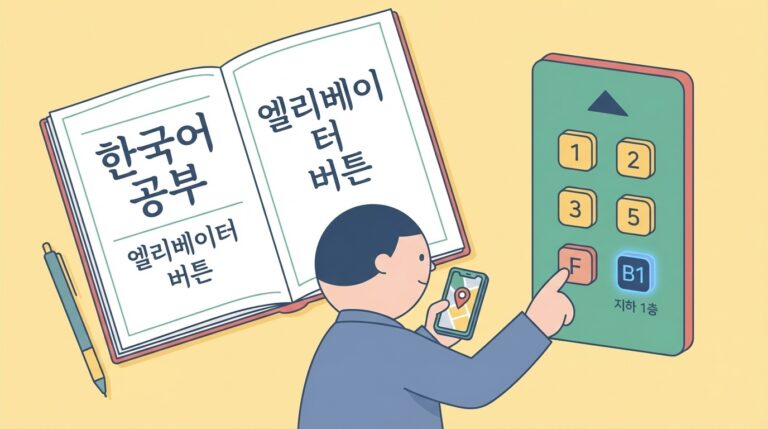
Phase 1: Empathy (The “Wait, where is the cafe?” Moment)
Hello! I’m your Daily Hangul Editor, your local friend and Korean tutor here in Seoul.
Imagine this: You are standing in the middle of Myeongdong. Your map app clearly says you have “Arrived” at that trendy cafe you saw on Instagram. But when you look around, all you see is a cosmetics shop, a convenience store, and a noodle restaurant. Where is the cafe?
You look up, and there it is—on the 4th floor!
In Korea, space is precious. The best cafes, hidden gem restaurants, and PC bangs are often located on the 2nd, 3rd, or even 7th floors of buildings. When you finally find the building and step into the elevator, a friendly local holding the buttons asks you, “Which floor?”
Suddenly, your mind goes blank. “One, two, three…? Il, ee, sam…? Hana, dul, set…?”
Don’t panic! Knowing how to say floor numbers is an absolute survival skill in Korea. Today, we are going to learn exactly how to master the Korean elevator, find those hidden food courts, and sound like a true local while doing it.
Phase 2: Core Expressions Deep Dive
When counting floors, Korea uses Sino-Korean numbers (the numbers based on Chinese characters: 일, 이, 삼…). You never use native Korean numbers (하나, 둘, 셋) for floors!
1. [Number] + 층 (Floor)
- Pronunciation: [Number] + cheung [Sounds like the ‘ch’ in ‘cheese’ + ‘ung’ in ‘lung’]
- Meaning: Floor (e.g., 1층 = il-cheung = 1st floor)
- K-Culture Moment: You will hear this everywhere in Korean department stores. “여성복은 3층입니다” (Women’s clothing is on the 3rd floor).
- Editor’s Insight: Just stick the Sino-Korean number right in front of ‘층’. It’s that easy! 1층 (il-cheung), 2층 (i-cheung), 3층 (sam-cheung).
- Situation Spectrum:
[🚫 Never] ———— [⚠️ Be Careful] ———— [✅ Freely]
- Casual with friends: ✅
- Coworkers: ✅
- Boss/Strangers: ✅ (It’s a neutral noun!)
- 🤔 Think About It: Why do you think Korea uses Sino-Korean numbers for building floors, dates, and money, but Native Korean numbers for counting physical objects like apples or people?
2. 지하 (Basement/Underground)
- Pronunciation: Ji-ha [Jee-hah]
- Meaning: Basement / Underground
- K-Culture Moment: In K-Dramas, the wealthy CEO always goes to the top floor, but the real treasure of a Korean department store is in 지하 1층 (B1)—the legendary Food Court!
- Editor’s Insight: Think of ‘지’ as Earth and ‘하’ as Under. When you combine 지하 with a number and 층, you get basement floors. 지하 1층 (jiha il-cheung) = B1.
- Situation Spectrum:
[🚫 Never] ———— [⚠️ Be Careful] ———— [✅ Freely]
- Casual with friends: ✅
- Coworkers: ✅
- Boss/Strangers: ✅
- 🤔 Think About It: Seoul is famous for its massive underground shopping malls connected to subway stations. How does weather (very hot summers, freezing winters) affect this “underground” culture?
3. 몇 층 가세요?
- Pronunciation: Myeot cheung gaseyo?
- Meaning: Literal: What floor are you going? / Real nuance: Which floor should I press for you?
- K-Culture Moment: You get into a crowded elevator. The person standing next to the buttons is unofficially the “Elevator Captain.” They will ask this to be polite and efficient.
- Editor’s Insight: If someone asks you this, you don’t need a full sentence. Just say the number, add “층”, and attach “요” (yo) to be polite!
- Situation Spectrum:
[🚫 Never] ———— [⚠️ Be Careful] ———— [✅ Freely]
- Asking a friend: 🚫 (Too formal. Use “몇 층 가?” instead)
- Asking a stranger in an elevator: ✅
Phase 3: Textbook vs. Real Korean
| Situation | 📖 Textbook Korean | 🗣️ Real Korean | 💡 Why is it different? |
|---|---|---|---|
| Answering “Which floor?” | 저는 3층에 갑니다. (I am going to the 3rd floor.) | 3층이요. (3rd floor, please.) | The “빨리빨리” (Hurry up) culture values efficiency. Adding ‘요’ to a noun makes it polite but fast! |
| Pressing a button | 3층 버튼을 눌러주시겠어요? (Could you please press the 3rd floor button?) | 3층 좀 눌러주세요. (Please press 3.) | “좀” (a little) softens the request naturally without needing overly complex grammar. |
Phase 4: Cultural Context — K-Culture Deep Dive
4-1. Non-Verbal Cues: The “Elevator Nunchi” (눈치)
When you get into a Korean elevator, you will witness the magic of Nunchi (the ability to read the room). If you are standing near the button panel, it is an unspoken rule that you press the “Open” button (열림) for people rushing in, and rapidly tap the “Close” button (닫힘) the millisecond the last person enters. Koreans rarely wait for the doors to close on their own!
4-2. The Missing “4th Floor” (K-Travel & Daily Life)
If you look at an elevator panel in an older building or a hospital, you might notice something strange: 1, 2, 3, F, 5… Where is the 4?
In Korea (and many East Asian countries), the Sino-Korean word for the number four is 사 (sa). Unfortunately, this sounds exactly like the Chinese character for “Death” (사/死). Because of this superstition, many elevators replace the 4 with an “F” (for Four), or skip it entirely. So if you are going to the 4th floor, confidently press “F”!
Phase 5: Real-Life Roleplay Scenario
Setting: Friday at 12:30 PM. You are inside a packed elevator at “The Hyundai Seoul,” a massive, trendy department store in Yeouido. Your stomach is growling. You want to go to the famous food court in the basement. You are standing in the back, and someone else is holding the door open for you.
Characters:
– YOU: A hungry traveler craving some K-Street food.
– Jimin (25, Friendly Local): Standing right next to the elevator buttons.
Jimin: (Pressing the open button) 타세요!
Taseyo!
[Please get in!]
YOU: 감사합니다.
Gamsahamnida.
[Thank you.]
Jimin: 몇 층 가세요?
Myeot cheung gaseyo?
[Which floor are you going to?]
🔀 Your Turn! How should you answer to go to Basement Level 1?
– A) 지하 1층이요! (Jiha il-cheung-iyo!)
– B) 저는 지하 1층에 갑니다. (Jeoneun jiha il-cheung-e gamnida.)
– C) 하나 층 지하요! (Hana cheung jiha-yo!)✅ Best Choice: A — Perfect, natural, and polite! “이요 (iyo)” is the magic ending for nouns.
⚠️ Choice B Analysis: This is grammatically correct, but sounds like a robot or a textbook.
❌ Choice C Analysis: Never use native Korean numbers (하나) for floors!
(If you chose A)
YOU: 지하 1층이요!
Jiha il-cheung-iyo!
[B1, please!]
Jimin: 네~
Ne~
[Okay~]
(🎭 Stage Direction: Jimin aggressively taps the ‘Close’ button 3 times in one second)
Phase 6: 10-Second Shadowing Drill
Practice speaking like a local! Pay attention to the pauses (/) and emotions.
- 😊 Politely answering:
3층/이요.
(sam-cheung / iyo.)
3rd floor, please. -
🥺 Asking for help in a crowded elevator:
저기요, / 지하 1층 / 눌러 주세요!
(jeogiyo, / jiha il-cheung / nulleo juseyo!)
Excuse me, please press B1!
Phase 7: K-Culture Mini Dictionary
| Korean | Romanization | English | Context |
|---|---|---|---|
| 층 | cheung | Floor | Always paired with Sino-Korean numbers. |
| 지하 | jiha | Basement / Underground | B1 is 지하 1층, B2 is 지하 2층. |
| 푸드코트 | pudeu-koteu | Food Court | Usually located on B1 in department stores. A must-visit! |
| 눈치 | nunchi | Social awareness | Knowing when to press the “Open” button for someone running to the elevator. |
| 닫힘 버튼 | dachim beoteun | “Close” button | The most worn-out button in any Korean elevator! |
Phase 8: Traveler’s Survival Kit
🆘 Top 3 Elevator & Floor Phrases
– 🇰🇷 “여기 몇 층이에요?” (yeogi myeot cheung-ieyo?)
– 🗣️ English: What floor is this?
– 📍 Where to use: When you get lost in a massive K-Pop merch mall.
– 🇰🇷 “화장실은 몇 층에 있어요?” (hwajangsil-eun myeot cheung-e isseoyo?)
– 🗣️ English: Which floor is the restroom on?
– 📍 Where to use: Cafes, restaurants, subway stations.
– 🇰🇷 “올라가요? / 내려가요?” (ollagayo? / naeryeogayo?)
– 🗣️ English: Going up? / Going down?
– 📍 Where to use: Standing outside an elevator to check its direction.📌 Editor’s Travel Note
– Finding Addresses: In Korea, if an address ends in “3F” or “3층”, do not look for a storefront on the street! Enter the building lobby and look for the directory board or the elevator.
– Stair Culture: If it’s just the 2nd floor (2층), many Koreans prefer taking the stairs rather than waiting for the elevator, due to the fast-paced culture!
Phase 9: Critical Thinking Corner — “One Step Deeper”
🧠 Think Deeper: Space & The Fast-Paced Culture (빨리빨리)
Have you ever wondered why Korean elevator doors close so quickly, and why the “Close” button is always faded from being pressed so much? This reflects Korea’s “빨리빨리 (Ppalli-ppalli / Hurry up)” culture. Rapid economic growth and high population density created a society that values speed and efficiency above all else. Waiting 3 extra seconds for an automatic door to close feels like a waste of time. However, this same culture is what brings you blazing-fast 24/7 food delivery and high-speed internet everywhere!💬 Your Turn: In your home country, do people press the “Close” button in elevators, or do they just patiently wait? Share in the comments!
Phase 10: FAQ & Avoiding Misunderstandings
Q: If I’m talking to an older person, can I just say “3층이요”?
A: Yes! Adding “이요 (iyo)” makes it polite enough for strangers, elders, or coworkers in brief daily interactions like elevator rides.
Q: What if I accidentally use Native Korean numbers (하나, 둘, 셋) for floors?
A: People will be very confused! If you say “세 층 (se-cheung)” instead of “삼 층 (sam-cheung)”, it means “Three floors (in total amount)”, not “The 3rd floor.”
❌ Common Mistake: Mixing up 1층 (First floor) and 2층 (Second floor) because in some European countries, the ground floor is “0” or “G”.
✅ Do this instead: In Korea, the ground floor is ALWAYS 1층 (1st floor). There is no “Ground” floor concept. As soon as you enter a building from the street, you are on 1층.
Phase 11: Summary & Action Items
- One-Liner Summary: Always use Sino-Korean numbers (일, 이, 삼…) with “층” for floors, and just say “[Number]층이요!” when someone asks where you’re going.
-
Action Mission 3 Steps:
- 🥉 Bronze (Solo): Look at your hand and count from 1층 to 5층 out loud.
- 🥈 Silver (Online): Comment on this post: “My bedroom/apartment is on [Number]층!”
- 🥇 Gold (Real Life): Next time you are in a Korean building, offer to press the button for someone by asking, “몇 층 가세요?” (Myeot cheung gaseyo?)
- K-Culture Mission: Watch an episode of a K-Drama set in a hospital or office building. Look closely at the elevator button panel. Can you spot the ‘F’ instead of the 4?
Phase 12: Quiz — Interactive Challenge
1. You want to go to the Basement 2 level to take the subway. What do you say?
A) 이 층 지하요.
B) 지하 2층이요.
C) 지하 둘 층이요.
(Answer: B. Jiha (Basement) + Sino-Korean 2 + 층 + 이요)
2. True or False: If you are entering a cafe directly from the street level in Seoul, you are on the Ground Floor (G), and the floor above it is the 1st floor.
(Answer: False. The street-level floor in Korea is always 1층!)
3. Fill in the blank:
A: _________ 가세요? (Which floor are you going to?)
B: 5층이요.
(Answer: 몇 층 – Myeot cheung)
Frequently Asked Questions (FAQ)
Q: What does "[Number] + 층 (Floor)" mean in Korean and how do you pronounce it?
A: In Korean, "[Number] + 층 (Floor)" is pronounced [Number] and means: Floor (e.g., 1층 = il-cheung = 1st floor)
Q: What does "지하 (Basement/Underground)" mean in Korean and how do you pronounce it?
A: In Korean, "지하 (Basement/Underground)" is pronounced [Ji-ha [Jee-hah] and means: Basement / Underground
Q: What does "몇 층 가세요?" mean in Korean and how do you pronounce it?
A: In Korean, "몇 층 가세요?" is pronounced [Myeot cheung gaseyo?] and means: Literal: What floor are you going? / Real nuance: Which floor should I press for you?






