

Phase 1: Empathy (Welcome to the Solo Life in Korea)
Hello! I’m the lead editor of Daily Hangul.
Picture this K-Drama scene: The main character has just had a terrible day at work. They walk into a smoky pojangmacha (tent bar) on the street, sit alone, and pour themselves a shot of soju. It looks poetic, dramatic, and maybe a little lonely. But what happens when you try to live out that main character energy in real life?
You confidently walk into a delicious-smelling K-BBQ restaurant in Seoul. The auntie looks at you, holds up two fingers, and crosses her arms: “2인분부터 돼요!” (Starting from 2 portions!). Suddenly, the romantic K-Drama bubble bursts, and you’re standing there wondering if you have to eat convenience store ramyeon again.
Living or traveling alone in Korea walks a very fine line between loneliness (외로움) and absolute freedom (자유). Today, we are going to dive into the Honjok (1인 가구, single-person household) culture. Knowing these expressions won’t just save you from going hungry—it will give you the ultimate insider confidence to navigate Korea solo!
Phase 2: Core Expressions Deep Dive
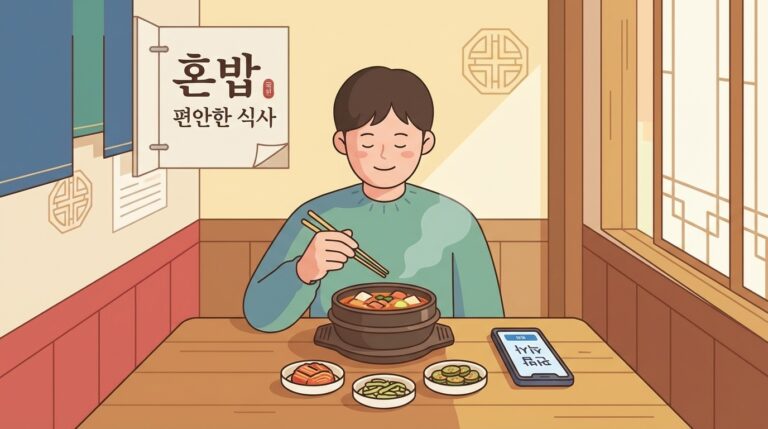
1. 혼밥 / 혼술 (Eating alone / Drinking alone)
- Pronunciation: [hon-bap] / [hon-sul] (Sounds like ‘hone’ + ‘bop’ like popping a bubble)
- Meaning: Eating/Drinking alone (Literal: Alone rice / Alone alcohol)
- K-Culture Moment: You open a food delivery app in Korea, and there’s an entire category dedicated to “1인분 혼밥” (Solo meals for 1). Or your Korean friend texts you on a Friday night: “What are you doing?” and you reply with a photo of your beer and Netflix, saying “저 오늘 혼술해요.” (I’m drinking alone today.)
- Editor’s Insight: This isn’t just a word; it’s a cultural revolution. Ten years ago, eating alone in Korea meant people felt sorry for you. Now? It’s a badge of independence and a cherished “me time.”
- Situation Spectrum:
[🚫 Formal] ———— [⚠️ Semi-formal] ———— [✅ Casual]
- Close friends (Casual): ✅ Perfectly natural.
- Co-workers (Semi-formal): ✅ Good for small talk.
- Boss/Elders (Formal): 🚫 It’s a newly coined slang word. Use “혼자 식사했습니다” (I ate alone) instead.
- 🤔 Think About It: Why did Koreans need to invent a specific, trendy slang word just for “eating alone”? What does this tell you about Korea’s traditional dining culture?
2. 1인분 되나요? (Can I order for one?)
- Pronunciation: [il-in-bun dwe-na-yo?]
- Meaning: Can I order for one person? (Literal: Is 1-person portion possible?)
- K-Culture Moment: You are craving Kimchi Jjigae (Kimchi stew), but the menu says “2인 이상 주문 가능” (Orders available from 2 or more people). You gently approach the staff and use this magic phrase.
- Editor’s Insight: This is your survival shield. In Korea, food portions are often communal. Memorize this phrase to check if solo dining is accepted before you sit down.
- Situation Spectrum:
[🚫 Casual] ———— [⚠️ Semi-formal] ———— [✅ Formal]
- Friends (Casual): 🚫 You wouldn’t say this to a friend.
- Restaurant Staff (Polite): ✅ The absolute standard way to ask.
- 🤔 Think About It: In your home country, do you order by “portions” (인분) or by “dishes”? Why does Korean language emphasize the number of people eating?
3. 혼자가 편해요 (I’m comfortable being alone)
- Pronunciation: [hon-ja-ga pyon-hae-yo]
- Meaning: I like being alone / It’s comfortable being alone.
- K-Culture Moment: A well-meaning but nosy taxi driver asks why you are traveling all by yourself, or a coworker asks why you aren’t dating anyone. This phrase is the ultimate polite shutdown.
- Editor’s Insight: This phrase emphasizes freedom over loneliness. You aren’t lonely (외롭다); you are actively choosing the peace and quiet of being solo.
- Situation Spectrum:
[🚫 Prohibited] ———— [⚠️ Careful] ———— [✅ Free]
- Friends (Casual): ✅ (Drop the ‘yo’: 혼자가 편해)
- Acquaintances/Elders (Semi-formal): ✅ Polite and clear.
- 🤔 Think About It: How does the Korean concept of Jeong (정, collective affection and attachment) conflict with the modern youth’s desire for personal space?
Phase 3: Textbook vs. Real Korean
| Situation | 📖 Textbook Korean | 🗣️ Real Korean | 💡 Why the difference? |
|---|---|---|---|
| Telling a friend you are eating alone | 저는 혼자 밥을 먹습니다. (I eat rice alone.) | 나 오늘 혼밥해. (I’m doing honbap today.) | Slang blends words for efficiency; adds a trendy, independent vibe. |
| Asking a waiter for a table for one | 한 명입니다. 식사할 수 있습니까? (I am one person. Can I eat?) | 사장님, 1인분 되나요? (Boss, is a 1-person portion possible?) | Focuses on the portion rather than your existence, fitting the restaurant system. |
| Explaining why you travel solo | 저는 고독을 즐깁니다. (I enjoy solitude.) | 그냥 혼자가 편해요. (It’s just comfortable being alone.) | Minimizes melodrama. Koreans prefer stating practical comfort over deep philosophical solitude in daily chat. |
(Bottom Note for B1 Learners): While Honbap is technically slang, it is used on the national news now! Just avoid using it in highly formal business presentations.
Phase 4: Cultural Context — K-Culture Deep Dive
4-1. The Non-Verbal Game: Nunchi (눈치) at Restaurants
When you ask “1인분 되나요?”, your body language matters. Hold up one index finger confidently, but don’t look angry if they say no. Solo dining is a game of Nunchi (reading the room). If you try to eat alone at a famous K-BBQ place right at 12:00 PM during the peak office lunch rush, you might get rejected because a table of 4 makes more money. Pro Tip: Go at 1:00 PM or 5:30 PM, and they will welcome you with open arms!
4-2. Food, Fire, and the 2-Portion Rule
Have you noticed in K-Dramas that Koreans rarely have their own separate plates for main dishes? Soups boil in the middle of the table, and everyone dips their spoons in. K-BBQ is grilled on one central fire. Because setting up the charcoal fire and washing 10 different banchan (side dish) plates costs the restaurant a lot of time and money, “1인분” (1 portion) is sometimes not economically viable for them. It’s not that they don’t like you; it’s just math!
Phase 5: Real-Life Roleplay Scenario
Setting: It’s 6:30 PM on a Friday in Sinchon. The K-BBQ restaurant is filled with the sound of sizzling meat and clinking soju glasses. You are starving and decided you must have Samgyeopsal today, even if you are alone.
Characters:
– YOU: A brave solo traveler who knows a little Korean.
– 이모 (Imo / Auntie): The busy, loud, but warm-hearted restaurant owner (in her 50s).
Dialogue:
이모: 어서 오세요~ 몇 분이세요?
(eoseo oseyo~ myeot buniseyo?)
[Welcome~ How many people?]
(🎭 Stage Direction: Auntie is wiping down a table very fast)
YOU: 저 혼자예요. 혹시 1인분 되나요?
(jeo honjayeyo. hoksi il-inbun doenayo?)
[It’s just me. By any chance, is one portion possible?]
이모: 아휴, 학생. 우리 집은 고기 2인분부터 되는데 어쩌지?
(ahyu, haksaeng. uri jibeun gogi i-inbun-buteo doeneunde eojjeoji?)
[Oh my, student. Our place starts from 2 portions of meat, what should we do?]
🔀 Your Turn! How should you reply?
– A) 아… 네, 안녕히 계세요. (Ah… yes, goodbye.)
– B) 왜 안 돼요? 1인분만 주세요. (Why not? Just give me 1 portion.)
– C) 그럼 2인분 주세요! 다 먹을 수 있어요.✅ Best Choice: C! “Then please give me 2 portions! I can eat it all.”
If you really want K-BBQ alone, ordering 2 portions is the ultimate power move. It solves the restaurant’s money issue, and honestly… 2 portions of Korean pork belly is just right for a hungry person! Option B is considered quite rude.
(Continuing with Choice C)
YOU: 그럼 2인분 주세요! 다 먹을 수 있어요. 😊
(geureom i-inbun juseyo! da meogeul su isseoyo.)
[Then please give me 2 portions! I can eat it all.]
이모: 오, 진짜? 알았어! 저기 구석 자리에 앉아요.
(o, jinjja? arasseo! jeogi guseok jarie anjayo.)
[Oh, really? Got it! Sit in that corner seat over there.]
YOU: 네, 감사합니다. 혼자가 편해서요.
(ne, gamsahamnida. honjaga pyeonhaeseoyo.)
[Yes, thank you. Because it’s comfortable being alone.]
이모: 그래그래. 불 바로 넣어줄게!
(geurae-geurae. bul baro neoeojulge!)
[Right, right. I’ll put the fire in right away!]
Phase 6: 10-Second Shadowing Drill
Let’s practice your tone! Follow the pause marks (/) and the emotion tags.
🥺 애절하게 (Desperately but politely):
사장님, / 여기 / 혹시 / 1인분 / 되나요?
(sajangnim, / yeogi / hoksi / il-inbun / dwe-na-yo?)
😌 여유롭게 (Relaxed and confident):
저는 / 요즘 / 그냥 / 혼자가 / 편해요.
(jeo-neun / yo-jeum / geu-nyang / hon-ja-ga / pyon-hae-yo.)
Phase 7: K-Culture Mini Dictionary
| 한국어 (Korean) | Romanization | English | Context / Meaning |
|---|---|---|---|
| 1인 가구 | il-in gagu | 1-person household | The demographic shift changing Korea’s economy and housing market. |
| 혼밥 / 혼술 | hon-bap / hon-sul | Solo eating/drinking | A modern lifestyle choice of dining alone, free from social pressure. |
| 프로혼밥러 | pro-hon-bap-ler | Pro solo-diner | A funny slang term for someone who is a “professional” at eating alone, even at difficult places like BBQ joints. |
| 눈치 | nun-chi | Reading the room | The essential Korean social sense of grasping the atmosphere or others’ feelings. |
Phase 8: Traveler Survival Kit
Since traveling alone is the ultimate test of the Honjok lifestyle, here are your must-know phrases!
🆘 Survival Phrases for the Solo Traveler
– 🇰🇷 “한 명이에요.” (han myeong-ieyo) – “It’s one person.”
– 🇰🇷 “이거 포장되나요?” (igeo pojang-doenayo?) – “Can I get this to go?” (Great if the restaurant is too crowded for solo diners).
– 🇰🇷 “2 플러스 1 행사 상품 맞나요?” (i-peulleoseu-il haengsa sangpum mannayo?) – “Is this the 2+1 promotion item?” (For convenience stores!).📌 Editor’s Travel Note
– Useful Apps: Download Naver Map or KakaoMap. They are much better than Google Maps in Korea. Search “1인 식당” (1-person restaurant) to find solo-friendly spots!
– Convenience Stores: The ultimate haven for single households. Look for “1+1” or “2+1” tags on drinks and snacks. Just remember to bring all items to the counter to get the discount!
– Tipping: Korea has ZERO tipping culture. Do not leave cash on your table; the staff will run down the street to return it to you!
Phase 9: Critical Thinking Corner — “One Step Deeper”
🧠 Think Deeper: Food & Identity (음식과 정체성)
Traditionally, the Korean identity is deeply rooted in the concept of Woori (우리 – We/Us). This is vividly reflected in the food culture: dipping spoons into the same boiling jjigae (stew), sharing a multitude of banchan (side dishes), and constantly pouring drinks for one another. Eating alone used to imply you were socially isolated.
However, the massive rise of the Honjok (solo tribe) over the last decade represents a fundamental shift toward individualism. Modern Koreans are actively choosing the “freedom” of solo living over the heavy social obligations of traditional collective culture. It’s a fascinating tension between the warmth of communal Jeong (정) and the modern craving for personal peace.
💬 Your Turn: How is eating alone viewed in your culture? Is it completely normal, or do people still give you sympathetic looks? Share in the comments!
Phase 10: FAQ & Avoiding Misunderstandings
Q: Can I use “혼밥해요” to my older boss?
No! It’s slang. While everyone understands it, it’s too casual for formal business. Say “혼자 밥 먹었어요” (I ate alone) instead.
Q: If a restaurant refuses me because I’m alone, are they discriminating against foreigners?
99% of the time, no. They refuse Korean solo diners too during peak hours. It’s strictly about table turnover economics and the cost of side dishes.
❌ Common Mistake #1: Saying “외로워요” (I’m lonely) when you just mean “혼자 있어요” (I am alone).
✅ How to fix it: If someone asks “Are you alone?”, just say “네, 혼자 왔어요” (Yes, I came alone). If you say “네, 외로워요”, they will think you are deeply depressed and crying out for help!
Phase 11: Summary & Action Items
- One-Liner Summary: Embrace the freedom of solo life in Korea by mastering the art of Honbap and confidently asking for your 1인분 (1 portion)!
-
Action Mission 3 Steps:
- 🥉 Bronze (Solo): Stand in front of a mirror and practice holding up one finger while saying “사장님, 1인분 되나요?” three times.
- 🥈 Silver (Online): Post a picture of your next meal on your social media or Korean study group with the caption: “오늘은 혼밥! 혼자가 편해요.”
- 🥇 Gold (Real Life): Go to a Korean restaurant (or a local eatery) alone and successfully order a meal using today’s phrases!
- K-Culture Mission: Open YouTube and search for “혼술 브이로그” (Solo drinking vlog) or “혼밥 브이로그”. Notice how aesthetically pleasing and peaceful they make the solo experience look!
Phase 12: Interactive Challenge — Quiz!
1. Situational Judgment:
You are eating alone at a cafe. A friendly Korean grandma sits nearby and asks, “어머, 왜 혼자 먹어요? 안 외로워요?” (Oh my, why are you eating alone? Aren’t you lonely?). What is the best natural response to show you are enjoying your independence?
* A) 네, 너무 외로워요. ㅠㅠ
* B) 아니요, 저는 혼자가 편해요.
* C) 1인분 되나요?
2. True or False – K-Culture Edition:
“It is a great idea to try a famous K-BBQ restaurant completely alone on a Friday at 7 PM.”
3. Fill in the Blank:
You want to take your food back to your hotel room.
“사장님, 이거 _______ 되나요?” (Boss, can I get this to go?)
(Answers below!)
Click to reveal answers
1. B (No, I’m comfortable being alone. – Shuts down the pity politely!)
2. False (Friday at 7 PM is peak corporate dinner (회식) time. Solo diners will likely be turned away due to Nunchi and economics. Go at 5 PM!)
3. 포장 (po-jang – packing/to-go)
Frequently Asked Questions (FAQ)
Q: What does "혼밥 / 혼술 (Eating alone / Drinking alone)" mean in Korean and how do you pronounce it?
A: In Korean, "혼밥 / 혼술 (Eating alone / Drinking alone)" is pronounced [hon-bap] and means: Eating/Drinking alone (Literal: Alone rice / Alone alcohol)
Q: What does "1인분 되나요? (Can I order for one?)" mean in Korean and how do you pronounce it?
A: In Korean, "1인분 되나요? (Can I order for one?)" is pronounced [il-in-bun dwe-na-yo?] and means: Can I order for one person? (Literal: Is 1-person portion possible?)
Q: What does "혼자가 편해요 (I'm comfortable being alone)" mean in Korean and how do you pronounce it?
A: In Korean, "혼자가 편해요 (I'm comfortable being alone)" is pronounced [hon-ja-ga pyon-hae-yo] and means: I like being alone / It's comfortable being alone.







