

Phase 1: Empathy
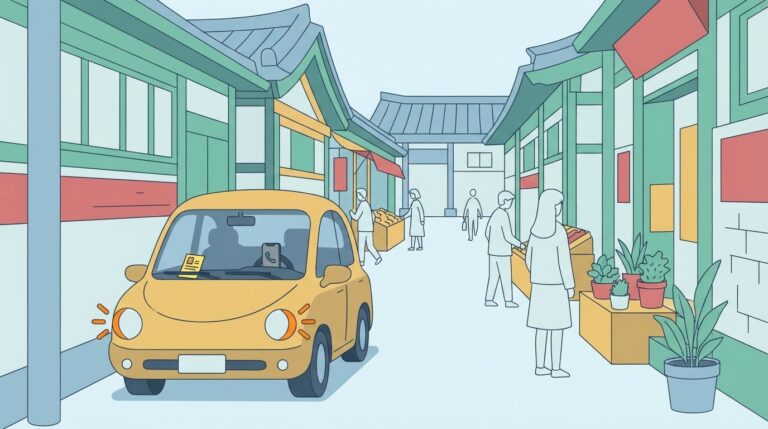
Hello! I’m your Daily Hangul editor. Imagine this scene: You’re watching a K-Drama, and the wealthy CEO protagonist angrily slams his car door in a fancy Gangnam alley, rushing into a building. When he comes out, there’s a bright yellow piece of paper stuck to his windshield. He sighs, pulling it off with annoyance.
Or perhaps you’ve rented a car in Jeju Island for that perfect coastal road trip. You stop at a cute seaside cafe, grab your iced Americano, and return to find that same yellow paper. Your heart drops.
“What is this? Did I do something wrong? I only parked for 5 minutes!”
Welcome to the reality of driving in Korea! Parking space is incredibly scarce, especially in Seoul. While textbooks teach you how to ask “Where is the subway station?”, they rarely teach you how to handle the sudden panic of getting a parking ticket or the cultural nuances of double parking. If you don’t know these specific phrases, a quick coffee run could cost you a hefty fine.
This guide is based on the actual panicky texts I’ve received from my B2-level expat students. Let’s dive into the real Korean phrases you need to survive the urban parking jungle!
Phase 2: Core Expressions Deep Dive
1. 딱지(를) 뗐어요 / 끊겼어요
- Pronunciation: ttak-ji(reul) ttet-sseo-yo / kkeun-kyeot-sseo-yo
- Sound-alike guide: ‘ttak’ (sounds like a sharp ‘tack’), ‘ji’ (like ‘jee’ in ‘jeep’), ‘ttet’ (like ‘tet’ in ‘Tetris’).
- Meaning: Literal: “A sticker was detached/issued.” Real nuance: “I got a parking ticket.”
- K-Culture Moment: You’ll often hear this in office spaces when a coworker rushes in late, looking frustrated. “Ah, I parked in front of the convenience store for two seconds and ttakji ttesseoyo!”
- Editor’s Insight: In Korean, we don’t usually say “I received a fine.” We refer to the physical yellow sticker itself—the ‘딱지’ (ttakji). The verb ‘떼다’ (to detach/issue) or ‘끊기다’ (to be cut/issued) is used. It carries a heavy sigh of regret.
- Situation Spectrum:
[🚫 Never] ———— [⚠️ Be Careful] ———— [✅ Freely]- Friends (Casual): ✅
- Co-workers (Semi-formal): ✅
- Boss/Elders (Formal): ⚠️ (Use the formal version: 과태료를 내게 되었습니다)
- 🤔 Think About It: Why do Koreans focus on the physical sticker (‘ttakji’) rather than the legal concept of a fine (‘fine/penalty’) in daily conversation? How does your native language describe getting a ticket?
2. 차 좀 빼주시겠어요?
- Pronunciation: cha jom ppae-ju-si-get-sseo-yo?
- Sound-alike guide: ‘ppae’ (like ‘peh’ but with a strong, tense ‘p’), ‘ju-si-get-seo-yo’ (smoothly flowing).
- Meaning: Literal: “Would you please extract the car a little?” Real nuance: “Could you please move your car?”
- K-Culture Moment: You’re trying to leave your apartment parking lot, but another car is blocking yours. You call the number on their dashboard. When they pick up, this is the exact phrase you use.
- Editor’s Insight: Notice the word ‘빼다’ (to pull out/extract). We don’t say ‘move’ (움직이다). We ask them to ‘pull it out’ of the space. Adding ‘좀’ (a little/please) and ‘주시겠어요’ (would you give me the favor of) makes it polite but firm. You’re annoyed, but you must keep the peace.
- Situation Spectrum:
[🚫 Never] ———— [⚠️ Be Careful] ———— [✅ Freely]- Friends (Casual): 🚫 (Too formal, just say “차 좀 빼!”)
- Strangers (Polite): ✅
- Security Guards/Elders (Formal): ✅
- 🤔 Think About It: Even when frustrated by someone blocking your car, Korean culture dictates using high honorifics (‘~시겠어요’). What would happen if you used direct, blunt language in this high-stress situation?
3. 잠시만 대도 될까요?
- Pronunciation: jam-si-man dae-do doel-kka-yo?
- Sound-alike guide: ‘dae’ (sounds like ‘day’).
- Meaning: Literal: “Is it okay if I put it for just a moment?” Real nuance: “Can I park here just for a second?”
- K-Culture Moment: You pull up to a busy local restaurant (식당) to pick up your takeout. You roll down the window and shout this to the restaurant owner who is guarding the empty spot out front.
- Editor’s Insight: The textbook verb for parking is ‘주차하다’ (juchahada). But in real life, Koreans use ‘대다’ (daeda – to place/put) for quick, temporary parking. It sounds much more natural and less permanent than ‘주차하다’.
- Situation Spectrum:
[🚫 Never] ———— [⚠️ Be Careful] ———— [✅ Freely]- Shop owners/Strangers: ✅
- Traffic Police: ⚠️ (They will likely just tell you to leave!)
Phase 3: Textbook vs. Real Korean
| Situation | 📖 Textbook Korean | 🗣️ Real Korean | 💡 Why the difference? |
|---|---|---|---|
| Telling a friend you got a ticket | 저는 불법 주차로 벌금을 냈습니다. (I paid a fine for illegal parking.) | 아, 나 주차 딱지 끊겼어. (Ah, my parking sticker got issued.) | Focuses on the physical annoyance (the sticker) and uses casual shorthand. |
| Asking a stranger to move their car | 자동차를 이동해 주시겠습니까? (Would you move the automobile?) | 차 좀 빼주시겠어요? (Could you pull the car out?) | ‘이동하다’ is for news reports; ‘빼다’ is the visual reality of squeezing out of tight Korean lots. |
| Asking to park briefly | 여기에 주차해도 됩니까? (May I park here?) | 깜빡이 켜고 잠깐 댈게요. (I’ll turn on my blinkers and park for a sec.) | Action-oriented. Turning on blinkers (깜빡이) is the universal Korean sign for “I’ll be quick!” |
Phase 4: Cultural Context — K-Culture Deep Dive
4-1. The Non-Verbal Apology: ‘깜빡이’ (Hazard Lights)
In Korea, your car’s hazard lights (비상등 / 깜빡이) are your voice. If you suddenly cut someone off in traffic, you flash them three times to say “I’m sorry!” If you need to stop on the side of a narrow road to drop someone off, you leave them on to say, “I know I’m blocking the road, I’m so sorry, I’ll be fast!” If you park illegally without your blinkers on, people will be angry. With blinkers on? They might give you a 2-minute grace period. It’s the ultimate display of Nunchi (눈치 – situational awareness) on the road.
4-2. The “Phone Number on the Dashboard” Phenomenon
If you walk past parked cars in Korea, you will notice something shocking to many foreigners: almost every car has the owner’s personal cell phone number displayed on the dashboard. Why? Because of 이중주차 (Double Parking).
In older apartment complexes and crowded alleys, there aren’t enough spaces. People park horizontally, blocking parked cars. The unwritten rule? You leave your car in ‘Neutral’ (N gear) and don’t use the parking brake. If someone needs to leave, they literally push your car out of the way with their bare hands! If pushing isn’t an option, they call the number on your dash. It’s a system built on extreme social trust and necessity.
Phase 5: Real-Life Roleplay Scenario
Setting: A narrow, bustling alleyway in Yeonnam-dong on a Saturday afternoon. You rented a SoCar to pick up a custom cake for a friend’s birthday. You spot a tiny space in front of a closed real estate office and pull in. Just as you step out, the owner of the adjacent cafe comes out, looking annoyed.
Characters:
– YOU: The expat, slightly stressed, just needs 2 minutes.
– Cafe Owner (사장님): A busy local in her 50s who needs the space for her delivery riders.
Dialogue:
Cafe Owner: 저기요, 여기 차 대시면 안 돼요. 🙅♀️
(Jeogiyo, yeogi cha daesimyeon an dwaeyo.)
[Excuse me, you can’t park here.]
(🎭 Stage Direction: She waves her hand in an ‘X’ motion.)
YOU: 아, 정말 죄송합니다. 제가 케이크만 빨리 픽업할 건데요.
(A, jeongmal joesonghamnida. Jega keikeuman ppalli pigeopal geondeyo.)
[Ah, I’m so sorry. I’m just quickly picking up a cake.]
Cafe Owner: 그래도 안 돼요. 이따 배달 오토바이 와야 해요.
(Geuraedo an dwaeyo. Itta baedal otobai waya haeyo.)
[Even so, you can’t. The delivery motorcycle is coming later.]
YOU: 딱 3분이면 됩니다. 깜빡이 켜둘게요!
(Ttak sambunimyeon doemnida. Kkamppagi kyeodulgeyo!)
[It will take exactly 3 minutes. I’ll leave my blinkers on!]
Cafe Owner: 하아… 그럼 차단기 앞에 바짝 붙여서 대세요.
(Haa… Geureom chadangi ape bajjak butyeoseo daeseyo.)
[Sigh… Then park it right up close against the barrier.]
🔀 Your Turn! How do you respond?
– A) “싫어요. 제 차는 소중해요.” (I don’t want to. My car is precious.)
– B) “네, 알겠습니다! 바로 빼겠습니다!” (Yes, understood! I’ll move it right away!)
– C) “아싸! 감사합니다!” (Yay! Thank you!)✅ Best Choice: B — Acknowledge her compromise quickly and assure her you will pull the car out (‘빼다’) soon.
⚠️ Choice C Analysis: “아싸” (Assa – Yay) is way too casual and playful for a stressed stranger doing you a favor.
(🎭 Stage Direction: You rush into the cake shop. 5 minutes later, your phone rings. It’s an unknown number.)
YOU: 여보세요?
(Yeoboseyo?)
[Hello?]
Caller: 저기요, 차 좀 빼주시겠어요? 차가 못 나가고 있거든요.
(Jeogiyo, cha jom ppaejusigesseoyo? Chaga mot nagago itgeodeunyo.)
[Excuse me, could you move your car? My car can’t get out.]
YOU: 헉, 죄송합니다! 지금 당장 뛰어나가겠습니다!
(Heok, joesonghamnida! Jigeum dangjang ttwieonagagetseumnida!)
[Gasp, I’m sorry! I’m running out right this second!]
Phase 6: 10-Second Shadowing Drill
Repeat after me to master the rhythm and emotion!
🥺 저기요 / 차 좀 / 빼주시겠어요?
(Jeo-gi-yo / cha jom / ppae-ju-si-get-sseo-yo?)
Tip: Start slightly hesitant (Excuse me…), then politely but firmly ask the question.
😅 아저씨, / 여기 잠깐만 / 차 대도 될까요?
(A-jeo-ssi, / yeo-gi jam-kkan-man / cha dae-do doel-kka-yo?)
Tip: Raise the pitch at the end to sound pleading and friendly!
Phase 7: K-Culture Mini Dictionary
| Korean | Romanization | English | Context |
|---|---|---|---|
| 딱지 | ttakji | Parking ticket | Originally means a small sticker, scab, or a folded paper toy. In adult life, it’s a dreaded fine. |
| 과태료 | gwataeryo | Fine / Penalty | The formal legal term you will see on the notice sent to your mailbox. |
| 비상등 | bisangdeung | Hazard lights | Used constantly in Korea to say “Thank you,” “Sorry,” or “I’ll be right back.” |
| 이중주차 | ijung jucha | Double parking | Parking parallel to parked cars. A standard practice in crowded residential areas. |
| 단속 카메라 | dansok kamera | Enforcement camera | Cameras everywhere that automatically issue tickets if you stop for more than 5 minutes. |
Phase 8: Traveler’s Survival Kit
🆘 Survival Phrases for the Road
– 🇰🇷 “여기 주차장 있어요?” (yeogi juchajang isseoyo?)
– 🗣️ Meaning: “Is there a parking lot here?”
– 📍 Where to use: Calling a restaurant or hotel before you arrive.
- 🇰🇷 “공영 주차장이 어디예요?” (gongyeong juchajangi eodiyeyo?)
- 🗣️ Meaning: “Where is the public parking lot?”
- 📍 Where to use: Asking a local when you can’t find street parking.
📌 Editor’s Travel Note:
– Apps are life: Do NOT use Google Maps for driving in Korea. Download Naver Map or Kakao T. Kakao T has a brilliant “Parking” feature that shows you nearby paid lots and lets you pay automatically.
– The Yellow Lines: A solid yellow line on the side of the road means parking is generally prohibited (but allowed at certain times). A double yellow line means absolutely no stopping or parking, ever. The dansok kamera is always watching!
Phase 9: Critical Thinking — “One Step Deeper”
🧠 Think Deeper: Space, Trust, and Community
When my expat students realize they have to leave their personal phone number on their dashboard, they often panic about privacy. “Won’t I get scammed? Isn’t it dangerous?”
However, this cultural norm reflects the high-density reality of Korean geography (70% mountains, highly concentrated urban areas) and a deeply embedded social trust. Koreans accept a slight loss of privacy for the collective efficiency of the community. Double parking and calling each other to move cars is a daily negotiation of shared space. It’s a striking example of how environmental constraints create unique social contracts.
💬 Your Turn: Would people in your home country be comfortable leaving their phone numbers on their cars? How do people in your city handle severe parking shortages? Share in the comments!
Phase 10: FAQ & Avoiding Misunderstandings
Q: Can I just ignore a parking ticket if I’m driving a rental car (like SoCar)?
No! The rental company will receive the fine, charge the credit card you have on file, and usually add an administrative penalty fee on top.
Q: I saw a space in front of a closed shop. Is it free real estate?
Maybe, but usually no. Often, the shop owner considers the space in front of their store ‘theirs’ (even if legally it’s a public alley). It’s always best to ask: “여기 대도 될까요?” (Can I park here?).
Q: If I’m pushing a double-parked car in an apartment lot and it hits another car, whose fault is it?
Legally, it’s often the person who pushed the car! That’s why many Koreans now prefer to just call the owner to come down and move it themselves to avoid liability.
❌ Common Mistake: Saying “주차를 멈춰주세요” (Please stop parking) when you want someone to move their car.
✅ Do this instead: Use “차 좀 빼주세요” (Please pull your car out). It sounds 100x more natural.
Phase 11: Summary & Action Items
- One-Liner Summary: Forget textbook “parking,” use “차를 대다” (putting the car) and “차를 빼다” (pulling the car out) to navigate Korea’s intense parking culture like a true local.
-
Action Mission 3 Steps:
- 🥉 Bronze: Say “차 좀 빼주시겠어요?” out loud 3 times with a polite but firm voice.
- 🥈 Silver: Write a short comment in your Korean learning group about whether you’d feel comfortable double parking.
- 🥇 Gold: Next time you are in Korea (or an H-Mart parking lot!), try asking “여기 잠깐 대도 돼요?”
- K-Culture Mission: Open Google Maps or Kakao Maps Street View, drop the pegman in a random alley in Seoul (like Gangnam or Hongdae), and zoom in on the parked cars. Can you spot the little phone number plates on the dashboards?
Phase 12: Quiz — Interactive Challenge
1. Situational Judgment: You parked briefly to grab coffee. You return to find a yellow sticker on your windshield. You sigh and text your Korean friend. Which is the most natural message to send?
– A) 나는 과태료를 사랑해.
– B) 아, 카페 앞에 잠깐 댔는데 딱지 뗐어 ㅠㅠ
– C) 내 차가 불법으로 주차했습니다.
2. True or False – K-Culture Edition:
In Korea, leaving your car in ‘Neutral’ (N) gear when double-parked is considered extremely rude. (T/F)
3. Fill in the Blank:
Someone is blocking your driveway. You call them and say: “죄송하지만, 차 좀 _______ 주시겠어요?”
– A) 빼
– B) 넣어
– C) 달려
(Answers: 1. B – Uses natural verbs and casual tone. 2. False – It is actually required so others can push your car! 3. A – 빼다 means to pull out.)
Frequently Asked Questions (FAQ)
Q: What does "딱지(를) 뗐어요 / 끊겼어요" mean in Korean and how do you pronounce it?
A: In Korean, "딱지(를) 뗐어요 / 끊겼어요" is pronounced [ttak-ji(reul] and means: Literal: "A sticker was detached/issued." Real nuance: "I got a parking ticket."
Q: What does "차 좀 빼주시겠어요?" mean in Korean and how do you pronounce it?
A: In Korean, "차 좀 빼주시겠어요?" is pronounced [cha jom ppae-ju-si-get-sseo-yo?] and means: Literal: "Would you please extract the car a little?" Real nuance: "Could you please move your car?"
Q: What does "잠시만 대도 될까요?" mean in Korean and how do you pronounce it?
A: In Korean, "잠시만 대도 될까요?" is pronounced [jam-si-man dae-do doel-kka-yo?] and means: Literal: "Is it okay if I put it for just a moment?" Real nuance: "Can I park here just for a second?"







