

Phase 1: Empathy (Welcome to the K-DIY Scene!)
Hello! I am the Lead Editor of Daily Hangul.
Let’s picture a classic K-Drama scene: The fiercely independent protagonist has just moved into a tiny Oktapbang (rooftop room). They’re broke but full of hope. While walking up the steep hill to their new home, they spot an old, discarded wooden table in the alley. Cue the upbeat indie music! A quick montage of them sanding, painting, and wiping sweat off their brow later… boom! That trash is now a gorgeous vintage centerpiece.
But wait—if you try this exact move in real-life Seoul, you might accidentally end up stealing someone’s belongings, or completely failing because you don’t know what to ask for at the local hardware store (철물점)!
As a C1-level Korean learner, saying simple phrases like “이거 고쳤어요” (I fixed this) doesn’t capture the creative, trendy vibe of modern DIY. Today, we are diving deep into the vocabulary of ‘헌 가구 리폼’ (Old furniture upcycling). You’ll learn the advanced slang, the Hanja idioms for a ‘glow-up’, and the unwritten rules of picking up street furniture in Korea. Let’s get our hands dirty!
Phase 2: Core Expressions Deep Dive
1. 환골탈태하다 (To undergo a massive glow-up)
- Pronunciation: hwangoltaltaehada [hwan-gol-tal-tae-ha-da]
- Meaning: (Literal) To change one’s bones and shed one’s body. (Real nuance) A complete, unbelievable transformation; a massive glow-up.
- K-Culture Moment: You show your Korean coworkers a before-and-after photo of an ugly, chipped cabinet you sanded and painted white. Someone gasps and says, “와, 가구가 완전 환골탈태했네요!” (Wow, the furniture completely transformed!)
- Editor’s Insight: This is a high-level Hanja idiom. While you can use “완전히 달라졌어요” (It changed completely), dropping a perfectly timed ‘환골탈태’ will make Koreans’ jaws drop. It shows you understand sophisticated vocabulary.
- Situation Spectrum:
[🚫 0] ———— [⚠️ 0] ———— [✅ Freely]- Friends (Casual): ✅
- Coworkers (Semi-formal): ✅
- Boss/Elders (Formal): ✅ (It’s a recognized idiom, perfectly fine in formal contexts!)
- 🤔 Think About It: Korean heavily relies on four-character Hanja idioms (사자성어) to convey dramatic situations concisely. Does your native language have ancient idioms that are still widely used in modern, trendy contexts like DIY?
2. 줍줍하다 (To scavenge / To score a find)
- Pronunciation: jubjuphada [joop-joop-ha-da – sounds like the little ‘boop’ sounds you make when picking things up one by one]
- Meaning: (Literal) Pick up, pick up. (Real nuance) To lucky-find or scavenge a great item that someone else discarded or overlooked.
- K-Culture Moment: You spot a beautiful wooden chair near the recycling area of your apartment complex. You take it home, clean it up, and post it on Instagram: “동네에서 예쁜 의자 줍줍!” (Scored a pretty chair in my neighborhood!)
- Editor’s Insight: This comes from the verb 줍다 (to pick up). The repetition makes it cute and trendy. It’s heavily used by the MZ generation when talking about finding hidden gems, whether it’s vintage furniture on the street or a canceled ticket for a K-Pop concert.
- Situation Spectrum:
[🚫 Formal] ———— [⚠️ Semi-formal] ———— [✅ Casual]- Friends (Casual): ✅
- Coworkers (Semi-formal): ⚠️ (Fine with close colleagues, but it’s internet slang)
- Boss/Elders (Formal): 🚫
- 🤔 Think About It: Why do Koreans love repeating syllables to make things sound cute or less serious (e.g., 줍줍, 쓰담쓰담)? How does this soften the action of “taking trash from the street”?
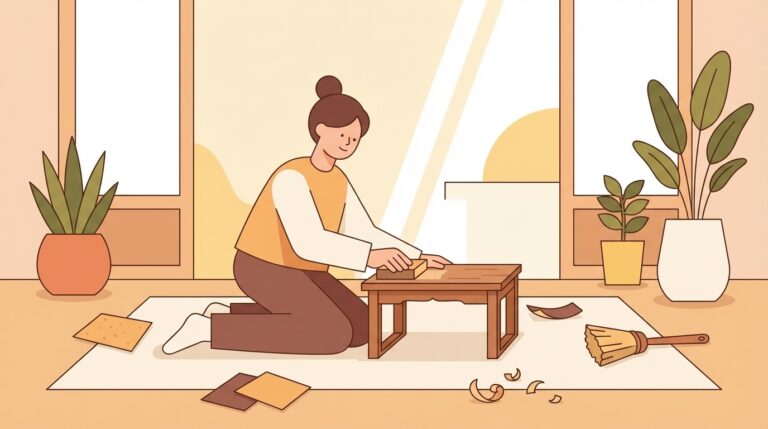
3. 사포질하다 & 바니시 칠하다 (To sand and varnish)
- Pronunciation: sapojilhada [sa-po-jil-ha-da] & banisi chilhada [ba-ni-shi chil-ha-da]
- Meaning: (Literal/Real) To use sandpaper / To apply varnish.
- K-Culture Moment: You’re at a local woodworking workshop (목공방), a popular weekend hobby for Seoulites. The instructor tells you, “사포질을 꼼꼼히 해야 바니시가 잘 먹어요.” (You need to sand it meticulously for the varnish to take well.)
- Editor’s Insight: The suffix ‘-질’ (-jil) usually means an action using a tool (like 가위질 – scissoring). While ‘-질’ can sometimes have a negative nuance in other contexts, here it purely denotes the physical labor of sanding. Notice the phrase ‘잘 먹다’ (to eat well) – Koreans use the verb ‘to eat’ to describe paint or makeup absorbing well into a surface!
- Situation Spectrum:
[🚫 0] ———— [⚠️ 0] ———— [✅ Freely]
Phase 3: Textbook vs. Real Korean
| Situation | 📖 Textbook Korean | 🗣️ Real Korean | 💡 Why is it different? |
|---|---|---|---|
| Repairing an old desk | 책상을 수리해요. | 책상을 리폼해요. | ‘수리’ sounds like fixing a broken mechanism (like a TV). ‘리폼’ (Konglish for Reform) is used for upcycling/decorating. |
| Finding an item to fix | 길에서 주웠어요. | 득템했어요! / 줍줍했어요. | Using slang turns the act of “picking up trash” into a fun, trendy treasure hunt. |
| Selling your DIY furniture | 중고로 팔아요. | 당근에 올려요. (Put it on Karrot) | The Karrot Market app (당근마켓) totally dominates the secondhand market; it became a verb! |
Bottom Note: As a C1 learner, moving away from generic verbs (고치다, 수리하다) and using specific lifestyle Konglish (리폼, 업사이클링, 당근하다) will make your Korean sound incredibly natural.
Phase 4: Cultural Context — K-Culture Deep Dive
4-1. The Unwritten Rules of the Street (Non-verbal Nunchi)
In Korea, you cannot simply take furniture you see on the street. Why? Because of the 대형폐기물 스티커 (Large Waste Disposal Sticker) system. If a piece of furniture is outside without a sticker, it might just be someone moving out or temporarily placing it there. Taking it is theft! If it has a sticker, it means the owner paid the city to dispose of it. Taking it requires ‘Nunchi’ (reading the room)—usually, if you take it before the garbage truck arrives, people don’t mind, but strictly speaking, it belongs to the district once the sticker is attached. Always ask a passing neighbor or the building security guard (경비 아저씨) before dragging that vintage drawer away!
4-2. Hip-jiro & Seongsu-dong Aesthetics
The DIY and upcycled furniture trend exploded in Korea thanks to neighborhoods like Euljiro (을지로) and Seongsu-dong (성수동). In Euljiro (nicknamed ‘Hip-jiro’), young cafe owners took over old printing presses and hardware stores, keeping the raw concrete and repurposing old factory workbenches into coffee tables. When you talk about upcycling furniture in Korea, you are tapping into the trendy “빈티지 감성” (vintage aesthetic) that dominates K-Pop music videos and Instagram cafes.
Phase 5: Real-Life Roleplay Scenario
Setting: A crisp Saturday afternoon in an old residential alleyway in Mapo-gu. You and your Korean friend, Min-su, are walking to a cafe. Suddenly, you spot an incredible vintage wooden cabinet sitting next to a recycling bin.
Characters:
– YOU: A C1 Korean learner who loves DIY and woodworking. You have a good eye for vintage gems.
– Min-su (30s): Your Korean friend. Pragmatic, prefers buying new things from IKEA.
(Dialogue)
YOU: 어? 민수 씨, 잠깐만요. 저 서랍장 완전 내 스타일인데?
(eo? minsu ssi, jamkkanmanyo. jeo seorapjang wanjeon nae seutairinde?)
[Wait, Min-su. That cabinet is totally my style!]
Min-su: 저거? 누가 버린 것 같은데. 흠집도 엄청 많고 낡았잖아.
(jeogeo? nuga beorin geot gateunde. heumjipto eomcheong manko nalgatjana.)
[That? Looks like someone threw it away. It has a lot of scratches and it’s old.]
YOU: 에이, 이 정도면 사포질 싹 하고 바니시만 새로 칠하면 환골탈태할 수 있어요.
(ei, i jeongdomyeon sapojil ssak hago banisiman saero chilhamyeon hwangoltaltaehal su isseoyo.)
[Come on, if I just sand it all down and apply new varnish, it will completely transform.]
Min-su: 오, 진짜? 근데 저거 그냥 가져가도 되나? 폐기물 스티커 붙어 있는데?
(o, jinjja? geunde jeogeo geunyang gajyeogado doena? pyegimul seutikeo buteo inneunde?)
[Oh, really? But can we just take it? It has a waste disposal sticker on it.]
YOU: 아, 스티커가 있네요. 경비 아저씨께 제가 가져가도 되는지 여쭤볼게요.
(a, seutikeoga inneyo. gyeongbi ajeossikke jaega gajyeogado doeneunji yeojjwobolgeyo.)
[Ah, it does have a sticker. I’ll ask the security guard if I can take it.]
(🎭 Stage Direction: You talk to the guard, and he happily tells you to take it so he doesn’t have to haul it away later.)
Min-su: 허락받았어? 와, 너 진짜 대단하다. 근데 저 무거운 걸 어떻게 들고 가려고?
(heorakbadasseo? wa, neo jinjja daedanhada. geunde jeo mugeoun geol eotteoke deulgo garyeogo?)
[Got permission? Wow, you’re amazing. But how are you going to carry that heavy thing?]
🔀 Your Turn! How should you respond?
– A) “민수 씨가 좀 들어주세요!” (Min-su, please carry it for me!)
– B) “당근마켓에서 용달차 하나 부를게요. 비용은 제가 낼 테니까 조금만 기다려줘요!”
– C) “버리고 갈까요?” (Should we just leave it?)✅ Best Choice: B — “I’ll call a small delivery truck on Karrot Market. I’ll pay for it, so just wait a bit!” In Korea, Karrot Market (당근마켓) isn’t just for buying secondhand items; you can hire local handymen with small trucks (용달) instantly! This is a super native, C1-level cultural flex.
⚠️ Choice A Analysis: A bit too direct and burdensome for a friend unless you are extremely close.
Phase 6: 10-Second Shadowing Drill
Let’s practice your natural phrasing and intonation! Follow the emotion tags and pause marks.
😤 Confidently
이거 / 그냥 쓰레기 같죠? (igeo / geunyang sseuregi gatjyo?)
😊 Brightly & Proudly
사포질 싹~ 하고 / 바니시만 칠하면, / 완전 / 환골탈태할걸요?
(sapojil ssak~ hago / banisiman chilhamyeon, / wanjeon / hwangoltaltaehalgeolyo?)
Tip: Drag out the “싹~” (ssak~) to emphasize doing a thorough, clean job of sanding!
Phase 7: K-Culture Mini Dictionary
| Korean | Romanization | English | Cultural Context |
|---|---|---|---|
| 폐기물 스티커 | pyegimul seutikeo | Waste disposal sticker | You must buy these from a convenience store or online to throw away furniture in Korea. |
| 당근하다 | danggeunhada | To trade on Karrot | The dominant secondhand app in Korea. Used as a verb meaning “to buy/sell used items”. |
| 목공방 | mokgongbang | Woodworking shop | A trendy hobby space in Korea where office workers go after work to craft their own small furniture. |
| 환골탈태 | hwangoltaltae | Complete transformation | A 4-character Hanja idiom used to describe an extreme “glow-up” of a person or an object. |
Phase 8: Traveler’s Survival Kit
Even if you aren’t doing major woodworking, you might need to fix a wobbly hotel chair, or you might find yourself exploring Seoul’s vintage markets. Here is your survival kit for the 철물점 (Hardware Store) or vintage flea market!
🆘 Survival Phrases for the Hardware Store / Market
– 🇰🇷 “사포 제일 고운 걸로 주세요.” (sapo jeil goun geollo juseyo.)
– Meaning: Please give me the finest sandpaper.
– 🇰🇷 “바니시는 무광으로 있나요?” (banisineun mugwangeuro innayo?)
– Meaning: Do you have matte varnish?
– 🇰🇷 “이거 해외로 배송도 되나요?” (igeo haeoero baesongdo doenayo?)
– Meaning: Can this be shipped overseas? (Crucial for buying vintage furniture at markets!)📌 Editor’s Travel Note:
Traditional hardware stores (철물점) in Korea are usually tiny, cramped shops packed floor-to-ceiling with tools. Don’t try to find things yourself! Just walk in and say what you need to the owner. Also, hardware stores often prefer cash or account transfers (계좌이체), though cards are mostly accepted now.
Phase 9: Critical Thinking — “One Step Deeper”
🧠 Think Deeper: Media vs. Reality – The Romanticized Rooftop
Korean media often romanticizes the Oktapbang (rooftop apartment) as a space of youth, freedom, and DIY aesthetics. Protagonists are shown hammering together pallets to make cute beds. However, the reality of Korean urban housing is different. High-density apartment living makes noise complaints (층간소음) a huge issue. You cannot freely hammer or use electric sanders on your balcony without angering the neighbors. This is why “목공방” (woodworking studio) rentals have become so popular—people need a dedicated, soundproof space away from their apartments to enjoy their DIY hobbies.
💬 Your Turn: Does your country have a strong DIY culture at home, or do people usually buy new furniture? Share how housing styles affect hobbies in your culture in the comments!
Phase 10: FAQ & Avoiding Misunderstandings
Q1: “Can I use ‘업사이클링’ (Upcycling) instead of ‘리폼’ (Reform)?”
Yes! Actually, ‘업사이클링’ is becoming the preferred term among environmentally conscious MZ generation Koreans. ‘리폼’ is slightly older Konglish, but still the most widely understood by all generations.
Q2: “If I see wood scraps near a construction site, can I take them?”
No. Even scraps usually belong to the construction company. Always ask, “이 나무 조각 가져가도 될까요?” (May I take these wood scraps?) first.
❌ Common Mistake: Using ‘수리하다’ (To repair) for painting/decorating.
✅ Do This Instead: If you are fixing a broken leg of a chair so it doesn’t collapse, that is ‘수리하다’. If you are painting it pink and changing the knobs to make it look cute, that is ‘리폼하다’. Keep the intent clear!
Phase 11: Summary & Action Items
One-Liner Summary: Mastering DIY terms like 리폼하다, 줍줍하다, and 환골탈태 will upgrade your Korean vocabulary from standard textbook to trendy Seoulite.
Action Mission 3 Steps:
– 🥉 Bronze: Say “환골탈태!” out loud 3 times with dramatic flair.
– 🥈 Silver: Search “가구 리폼” on YouTube or Instagram and leave a Korean comment like “완전 환골탈태했네요!” on a video.
– 🥇 Gold: Next time you are in Korea, visit a hardware store (철물점) and try buying something small, like a roll of tape or sandpaper, using only Korean.
K-Culture Mission:
Go to Instagram and search the hashtag #방꾸미기 (Room decorating) or #가구리폼. Observe the types of furniture young Koreans are upcycling and the aesthetic they are going for. You’ll notice a lot of white, wood tones, and mid-century modern styles!
Phase 12: Interactive Quiz
1. Situational Judgment: You want to tell your coworker that you found a perfectly good, free table on the street. Which phrase is the most natural for a C1 speaker to use in a semi-casual office setting?
– A) 길에서 책상을 훔쳤어요.
– B) 동네에서 진짜 예쁜 책상 줍줍했어요.
– C) 책상을 수리했습니다.
2. True or False – K-Culture Edition:
If you see a nice sofa on the street in Seoul with a sticker on it, it means it is a “free to a good home” gift from the city. (T/F)
3. Fill in the blank:
거친 표면을 부드럽게 만들기 위해서 ( _______ )을/를 꼼꼼하게 했습니다.
Hint: The act of using sandpaper.
Answers (Click to reveal)
1. B – ‘훔쳤어요’ means you stole it! ‘수리했습니다’ means you mechanically repaired it. ‘줍줍했어요’ perfectly captures the trendy joy of finding a free gem.
2. False – The sticker means the owner paid for city disposal. It technically belongs to the district once marked for trash collection.
3. 사포질 (sapojil)
Frequently Asked Questions (FAQ)
Q: What does "환골탈태하다 (To undergo a massive glow-up)" mean in Korean and how do you pronounce it?
A: In Korean, "환골탈태하다 (To undergo a massive glow-up)" is pronounced [hwangoltaltaehada [hwan-gol-tal-tae-ha-da] and means: (Literal) To change one's bones and shed one's body. (Real nuance) A complete, unbelievable transformation; a massive glow-up.
Q: What does "줍줍하다 (To scavenge / To score a find)" mean in Korean and how do you pronounce it?
A: In Korean, "줍줍하다 (To scavenge / To score a find)" is pronounced [jubjuphada [joop-joop-ha-da - sounds like the little 'boop' sounds you make when picking things up one by one] and means: (Literal) Pick up, pick up. (Real nuance) To lucky-find or scavenge a great item that someone else discarded or overlooked.
Q: What does "사포질하다 & 바니시 칠하다 (To sand and varnish)" mean in Korean and how do you pronounce it?
A: In Korean, "사포질하다 & 바니시 칠하다 (To sand and varnish)" is pronounced [sapojilhada [sa-po-jil-ha-da] and means: (Literal/Real) To use sandpaper / To apply varnish.







