

Phase 1: Empathy (The K-Culture Cold Open)
Hello! I’m the Senior Editor of Daily Hangul.
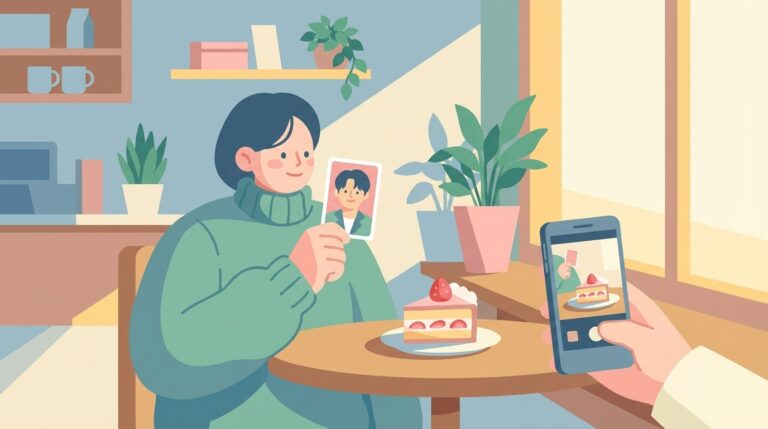
Picture this: You are sitting in a trendy, bustling cafe in Seongsu-dong, Seoul. The girl at the next table gets her iced Americano and a beautiful slice of strawberry cake. But before she takes a bite, she pulls a small, plastic-sleeved photo of a K-Pop idol out of her wallet, holds it up next to the cake, and snaps a picture with her phone. Then, you head to an idol pop-up store, and you see groups of fans holding up similar cards, asking each other things in rapid-fire Korean.
What exactly is going on?
Welcome to the intense, passionate, and incredibly fun world of K-Pop Photocards! If you are a K-Pop fan traveling to Korea, buying albums, or attending events, knowing the “textbook Korean” won’t help you here. You need the real, street-level fandom slang to trade for your favorite member, make Korean fan friends, and experience the culture like a true insider.
This guide is created based on the real experiences of our beginner (A1) students who felt totally lost at concert venues. Don’t worry—by the end of this post, you’ll be trading like a pro!
Phase 2: Core Expressions Deep Dive
Let’s learn the 4 absolute essential phrases you need for your photocard journey.
1. 포카 (Poka)
- Pronunciation: [po-ka]
- Meaning: Literal: None. Real nuance: An abbreviation of “Photocard” (포토카드).
- K-Culture Moment: You are at Myeongdong underground shopping center. Instead of asking for a “sajin” (photo), you ask the shop owner, “포카 있어요?” (Do you have pokas?). They instantly know you mean business.
- Editor’s Insight: Koreans love to abbreviate words to two syllables! Using “포카” instead of the full English word instantly makes you sound like a local fan.
- Situation Spectrum:
[🚫 Formal] ———— [⚠️ Semi-formal] ———— [✅ Casual]
- Friends/Other Fans (Casual): ✅
- Shop Owners (Semi-formal): ✅
- Boss/Work (Formal): 🚫
- 🤔 Think About It: Why do Koreans love shortening words (like Poka)? It reflects the “Pali-pali” (hurry up) culture—getting straight to the point efficiently!
2. 최애 (Choeae)
- Pronunciation: [chwe-ae] (The ‘choe’ sounds like “chweh” – rhyming with “meh” but with a W).
- Meaning: Literal: Most loved. Real nuance: Your ultimate bias / number one favorite member.
- K-Culture Moment: Meeting a new Korean fan. The icebreaker is always asking this question to find out if you share the same favorite member.
- Editor’s Insight: This word is so powerful that it escaped fandom culture. Koreans now use it for everything! “My choeae food is Tteokbokki!”
- Situation Spectrum:
[🚫 Formal] ———— [⚠️ Semi-formal] ———— [✅ Casual]
- Friends/Other Fans (Casual): ✅
- 🤔 Think About It: How do you say “favorite” in your language? In Korean, “최애” carries a strong emotional weight of dedication, not just preference.
3. 누구 나왔어요? (Nugu nawasseoyo?)
- Pronunciation: [noo-goo / nah-wah-ssuh-yo?]
- Meaning: Literal: Who came out? Real nuance: Which member’s card did you pull from the album?
- K-Culture Moment: You are unboxing an album with friends at a cafe. As soon as you open it, your friend leans in and excitedly asks this.
- Editor’s Insight: We don’t say “Who did you get?” in Korean. We say “Who came out?” as if the idol physically popped out of the album!
- Situation Spectrum:
[🚫 Formal] ———— [⚠️ Semi-formal] ———— [✅ Casual]
- Friends/Other Fans (Casual): ✅
4. 교환해요? (Gyohwanhaeyo?)
- Pronunciation: [gyo-hwan-hae-yo?]
- Meaning: Literal: Do you exchange? Real nuance: Do you want to trade photocards?
- K-Culture Moment: Standing outside a concert venue, holding your duplicate card, approaching someone who has the card you desperately need.
- Editor’s Insight: Add a slight upward tone at the end to make it a polite question. It’s short, sweet, and gets the job done.
- Situation Spectrum:
[🚫 Formal] ———— [⚠️ Semi-formal] ———— [✅ Casual]
- Strangers at a concert (Semi-formal): ✅
Phase 3: Textbook vs. Real Korean
| Situation | 📖 Textbook Korean | 🗣️ Real Korean | 💡 Why is it different? |
|---|---|---|---|
| Asking about a favorite member | 좋아하는 가수가 누구입니까? (Who is the singer you like?) | 최애가 누구예요? (Who is your bias?) | Fandoms use specific slang to create a sense of belonging and intimacy. |
| Calling the item | 사진 카드 (Photo card) | 포카 (Poka) | Koreans shorten frequently used words to 2 syllables for speed. |
| Offering a trade | 카드를 바꾸시겠습니까? (Would you like to change cards?) | 포카 교환해요? (Trade poka?) | In busy places like concerts, short and polite phrases are preferred. |
Phase 4: Cultural Context — K-Culture Deep Dive
4-1. Non-Verbal Etiquette (The Unspoken Rules)
When trading a “Poka,” never touch the other person’s card without permission, and never touch the bare card surface! Fans keep them pristine in plastic sleeves (Toploaders). When handing over a card for a trade, use both hands or support your right arm with your left hand. It’s a sign of deep respect in Korean culture, applied here to precious K-Pop merchandise.
4-2. K-Food Connection: “Poka Yejeol” (포카 예절)
Remember the girl in the cafe from our intro? That action is called “포카 예절” (Poka Yejeol – Photocard Etiquette). It’s a huge trend where fans take pictures of delicious food with their bias’s photocard. It symbolically means, “I am eating something great, and I’m thinking of you.” If you go to a famous restaurant in Seoul, you’ll likely spot someone doing this. Try it out next time you eat Korean BBQ!
Phase 5: Real-Life Roleplay Scenario
Setting: A sunny Saturday afternoon at a cafe in Hongdae. You just bought a new K-Pop album from a nearby store and are unboxing it at your table. A friendly Korean fan sitting next to you notices the album.
Characters:
– YOU: A foreign fan visiting Korea, excited to unbox your album.
– Minji (22): A Korean college student and huge K-Pop fan, very outgoing.
Dialogue:
Minji: 헉! 그 앨범 샀어요?
(Heok! Geu aelbeom sasseoyo?)
[Gasp! Did you buy that album?]
(🎭 Stage Direction: Minji looks at your table with sparkling eyes)
YOU: 네! 방금 샀어요.
(Ne! Banggeum sasseoyo.)
[Yes! I just bought it.]
Minji: 오~ 누구 나왔어요?
(O~ Nugu nawasseoyo?)
[Oh~ Who did you get?]
YOU: (Opening the album) 아… 리더 나왔어요.
(Ah… Lideo nawasseoyo.)
[Ah… I got the leader.]
Minji: 아쉽네요. 최애가 누구예요?
(Aswimneyo. Choe-ae-ga nuguyeyo?)
[That’s a shame. Who is your bias?]
🔀 Your Turn! How should you respond and offer a trade?
– A) “제 좋아하는 가수는 막내입니다.” (Very robotic and textbook)
– B) “막내요! 혹시… 막내 포카 있어요? 교환해요?” (Natural and proactive)
– C) “막내! 포카 줘!” (Too aggressive and rude!)✅ Best Choice: B — Reason: You naturally state your bias (“Maknae” – youngest) and politely suggest a trade (“Gyohwanhaeyo?”). It’s friendly and respectful!
Minji: 어! 저 막내 포카 두 장 있어요. 교환해요!
(Eo! Jeo maknae poka du jang isseoyo. Gyohwanhaeyo!)
[Oh! I have two Maknae photocards. Let’s trade!]
(🎭 Stage Direction: You successfully trade and make a new Korean friend!)
Phase 6: 10-Second Shadowing Drill
Practice this sentence out loud to master the rhythm and tone!
😊 저기요, / 혹시 / 막내 포카 / 있어요?
(jeogiyo, / hoksi / maknae poka / isseoyo?)
Excuse me, / by any chance / do you have the Maknae’s photocard?
(Tip: Pause slightly at the slashes. Raise your pitch at “isseoyo?” to sound polite and hopeful!)
Phase 7: K-Culture Mini Dictionary
| Korean | Romanization | English | Context |
|---|---|---|---|
| 포카 | poka | Photocard | The most important collectible for K-pop fans. |
| 최애 | choe-ae | Ultimate Bias | Your absolute favorite member in a group. |
| 차애 | cha-ae | Second Bias | Your second favorite member. |
| 탑꾸 | tapkku | Toploader Decoration | The art of decorating the plastic sleeve holding the card with stickers. |
| 덕질 | deokjil | Fangirling/Fanboying | The act of doing fan activities. |
Phase 8: Traveler Survival Kit
Are you heading to Myeongdong or a Pop-up store to hunt for photocards? Here are your survival phrases!
🆘 Survival Phrases for K-Pop Shopping
– 🇰🇷 “이거 얼마예요?” (igeo eolmayeyo?)
– 🗣️ Pronunciation: [ee-geo / ohl-mah-yeh-yo?]
– 📍 Where to use: Underground shopping malls, record stores.
– 💡 Meaning: “How much is this?”
- 🇰🇷 “이거 주세요.” (igeo juseyo.)
- 🗣️ Pronunciation: [ee-geo / joo-seh-yo]
- 📍 Where to use: When you finally find your bias’s card and want to buy it.
- 💡 Meaning: “I will take this. / Please give me this.”
📌 Editor’s Travel Note
– Finding Trades: Korean fans heavily use Twitter (X) to find trades. Search your group’s name + “포카 교환” (poka gyohwan).
– Cash is King in Markets: While Korea is a card-heavy country, if you are buying photocards from small vendors in Myeongdong station, having cash might get you a slightly better deal or is sometimes required.
Phase 9: Critical Thinking — “A Step Deeper”
Language & Fandom Communities
Have you ever wondered why fandoms have so many unique slang words like Choeae or Poka? In Korean culture, language is heavily tied to “소속감” (Sosokgam), or a sense of belonging. Using the exact same abbreviations and slang as local fans isn’t just about saving time; it’s a social password. When you use the word “최애” instead of a textbook phrase, you are telling Korean fans: “I understand your culture. I am one of you.” It breaks the ice instantly.
💬 Your Turn: Does your country’s fandom culture have unique slang words that outsiders wouldn’t understand? Share them in the comments!
Phase 10: FAQ & Avoiding Misunderstandings
Q: Can I use “최애 (Choeae)” in normal daily life, not just for K-Pop?
Yes! It is extremely common now. You can say “제 최애 영화예요” (It’s my favorite movie) to your friends.
Q: Can I ask an older person “누구 나왔어요?”?
If they are a fan you met at an event, yes! The “~요” ending makes it polite enough for strangers.
❌ Common Mistake #1: Calling it “사진 (Sajin)” instead of “포카 (Poka)”.
✅ Do this instead: If you say “Sajin,” Koreans will think you want to take a selfie with them. Always use “포카” when referring to the merchandise!
Phase 11: Summary & Action Items
One-Liner Summary: Master the words “Poka” (Photocard), “Choeae” (Bias), and “Gyohwan” (Trade) to connect with Korean fans and upgrade your K-Pop journey!
Action Mission:
– 🥉 Bronze: Say “내 최애는 [Name]이에요” (My bias is…) out loud 3 times right now.
– 🥈 Silver: Search “포카 예절” on Instagram or Twitter and see how Korean fans take pictures with their cards.
– 🥇 Gold (For travelers!): Take your bias’s photocard to a Korean cafe, take a “Poka Yejeol” photo with your drink, and ask a fan nearby, “누구 나왔어요?”
Phase 12: Interactive Quiz
1. Situational Judgment: You are at a concert and want to trade your photocard with someone holding a sign. What is the most natural thing to say?
– A) 제 카드를 가져가세요. (Take my card.)
– B) 포카 교환해요? (Trade poka?)
– C) 이름이 뭐예요? (What is your name?)
2. Fill in the Blank:
“Wow! You bought the new album! Who did you get? ( _____ 나왔어요? )”
3. True or False – K-Culture Edition:
When trading a photocard with a Korean fan, it is totally fine to grab their bare photocard with one hand to inspect it. (T/F)
(Answers: 1. B, 2. 누구, 3. False – Always ask permission and handle with extreme care using two hands!)
Frequently Asked Questions (FAQ)
Q: What does "포카 (Poka)" mean in Korean and how do you pronounce it?
A: In Korean, "포카 (Poka)" is pronounced [po-ka] and means: Literal: None. Real nuance: An abbreviation of "Photocard" (포토카드).
Q: What does "최애 (Choeae)" mean in Korean and how do you pronounce it?
A: In Korean, "최애 (Choeae)" is pronounced [chwe-ae] and means: Literal: Most loved. Real nuance: Your ultimate bias / number one favorite member.
Q: What does "누구 나왔어요? (Nugu nawasseoyo?)" mean in Korean and how do you pronounce it?
A: In Korean, "누구 나왔어요? (Nugu nawasseoyo?)" is pronounced [noo-goo / nah-wah-ssuh-yo?] and means: Literal: Who came out? Real nuance: Which member's card did you pull from the album?
Q: What does "교환해요? (Gyohwanhaeyo?)" mean in Korean and how do you pronounce it?
A: In Korean, "교환해요? (Gyohwanhaeyo?)" is pronounced [gyo-hwan-hae-yo?] and means: Literal: Do you exchange? Real nuance: Do you want to trade photocards?







