

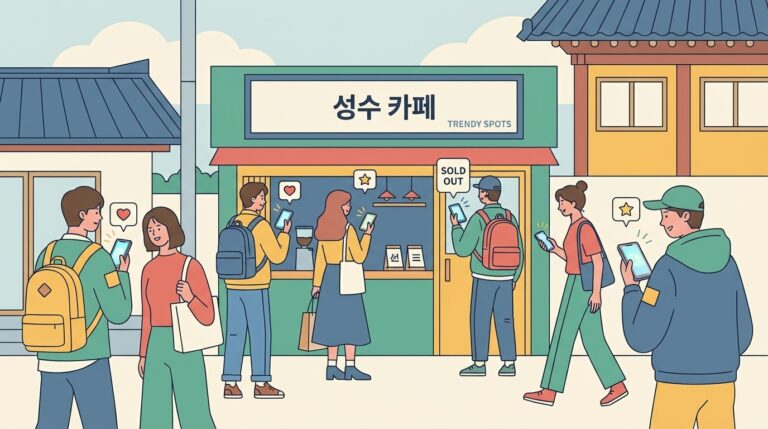
Phase 1: Empathy & Immersion — Welcome to the Speed of K-Trends
Hello! I’m your Daily Hangul Editor.
Imagine this: You are walking down the vibrant streets of Seongsu-dong (the “Brooklyn of Seoul”). You spot a massive line winding around the block for a tiny, unmarked cafe. Nobody is holding an advertisement flyer; there are no billboards. Yet, somehow, hundreds of people knew exactly where to be at 8:00 AM on a Tuesday. How?
Welcome to the hyper-connected, lighting-fast world of Korean consumer culture.
In Korea, traditional marketing often takes a back seat to the undeniable power of 입소문 (ip-so-mun), or word-of-mouth. If you are a business professional, a marketer, or even just a savvy traveler wanting to experience the absolute cutting-edge of K-Culture, relying on textbook vocabulary won’t cut it. You need to speak the language of the algorithms, the Naver blogs, and the Instagram stories.
This guide is crafted for advanced (C2) learners who want to understand not just what Koreans say, but why a single viral post can empty out a store’s inventory nationwide in under an hour. Let’s dive into the authentic vocabulary of K-Marketing.
Phase 2: Core Expressions Deep Dive
Here are the three foundational pillars of Korean viral marketing vocabulary.
1. 입소문을 타다 (To ride the word of mouth / To go viral)
- Pronunciation: ip-so-mu-neul ta-da [Sounds like: eep-so-moo-neul tah-dah]
- Meaning: (Literal) To ride the mouth-rumor. (Real Nuance) To go viral organically through word of mouth.
- K-Culture Moment: Picture an indie K-beauty brand that couldn’t afford TV ads. One day, a famous makeup artist mentions it on YouTube. Suddenly, it “rides the word of mouth” and dominates Olive Young’s bestseller shelves.
- Editor’s Insight: Notice the verb 타다 (to ride). In Korean, we “ride” trends, rhythms, and rumors, much like a surfer rides a wave. It implies you don’t force it; you catch the momentum.
- Situation Spectrum:
[🚫 절대 금지] ———— [⚠️ 주의] ———— [✅ 자유롭게]
- Casual with friends: ✅
- Semi-formal with colleagues: ✅
- Formal with superiors: ✅ (Very common in business reports!)
- 🤔 Think About It: Why is “mouth” (입) connected to “rumor” (소문)? In a highly dense society like Korea, oral transmission of information historically carried immense power. How does your native language express a rumor spreading?
2. 품절 대란 (The Sold-Out Craze)
- Pronunciation: pum-jeol dae-ran [Sounds like: poom-jull dae-rahn]
- Meaning: (Literal) Sold-out great rebellion/chaos. (Real Nuance) A massive national shortage due to viral popularity.
- K-Culture Moment: Remember the Honey Butter Chip craze of 2014? Or the Pokémon Bread phenomenon? People were literally tracking delivery trucks and bribing convenience store owners. That absolute chaos is a 품절 대란.
- Editor’s Insight: The word 대란 (大亂) is historically used for wars or massive crises. Using it for sold-out snacks shows the Korean flair for dramatic, sensational language in marketing.
- Situation Spectrum:
[🚫 절대 금지] ———— [⚠️ 주의] ———— [✅ 자유롭게]
- Casual with friends: ✅
- Semi-formal with colleagues: ✅
- Formal with superiors: ✅
- 🤔 Think About It: Does describing a product shortage as a “great rebellion” reflect a society’s FOMO (Fear Of Missing Out)?
3. 내돈내산 (Bought with my own money)
- Pronunciation: nae-don-nae-san [Sounds like: neh-dohn-neh-sahn]
- Meaning: (Literal) My money, my mountain(purchase). An abbreviation of 내 돈 주고 내가 산 (Bought it with my own money).
- K-Culture Moment: You are scrolling through Naver blogs for a restaurant review. You specifically look for the hashtag #내돈내산 to ensure the reviewer wasn’t secretly paid by the restaurant.
- Editor’s Insight: Around 2020, Korea had a massive “뒷광고” (backdoor advertising) scandal where top YouTubers were caught pretending sponsored products were personal purchases. This phrase became a vital proof of authenticity.
- Situation Spectrum:
[🚫 절대 금지] ———— [⚠️ 주의] ———— [✅ 자유롭게]
- Casual with friends: ✅
- Semi-formal with colleagues: ✅ (Great for marketing brainstorms)
- Formal with superiors: ⚠️ (Slightly informal, but understood in marketing contexts)
- 🤔 Think About It: What does the necessity of this exact acronym tell you about the trust dynamics between consumers and influencers in the digital age?
Phase 3: Textbook vs Real Korean
| Situation | 📖 Textbook Korean | 🗣️ Real Korean | 💡 Why the difference? |
|---|---|---|---|
| A product becomes very popular | 이 제품이 아주 유명해졌어요. (This product became very famous.) | 이 제품 완전 떡상했어요! (This product skyrocketed!) | “떡상” (rice cake rising) originally comes from crypto/stocks but is now the ultimate slang for skyrocketing success. |
| Realizing a review is sponsored | 이 글은 스폰서를 받았습니다. (This post received a sponsor.) | 아, 이거 숙제네. (Ah, this is homework.) | Streamers and influencers jokingly call paid promotions “homework” (숙제), making the commercial transaction sound relatable. |
| Buying a highly anticipated item | 아침 일찍 가서 샀습니다. (I went early in the morning and bought it.) | 오늘 아침에 오픈런 뛰었어요. (I did an open run this morning.) | “Open run” (Konglish) reflects the intense competition to buy limited-edition items the second the store opens. |
Bottom Note: At a C2 level, using words like “떡상” or “오픈런” smoothly in a casual business conversation will immediately elevate you from “foreign learner” to “industry insider.”
Phase 4: Cultural Deep Dive — The Mechanics of K-Marketing
4-1. Non-verbal Context: The Speed of Nunchi
In Korean marketing, timing is everything. If a meme or a phrase goes viral, brands have exactly 48 hours to capitalize on it before the public cringes. This requires intense 눈치 (Nunchi)—the ability to read the room. When you discuss a viral trend with Korean colleagues, speak with a sense of urgency and excitement. Prolonged analysis kills the vibe of a trend.
4-2. K-Culture Connection: The Cult of Social Proof (K-Food & Apps)
Why do Koreans line up for two hours for a bagel? It is intrinsically linked to Social Proof. In Korea’s highly collective society, if a restaurant is trending on Instagram Reels or has a high rating on CatchTable (the premier dining app), not having tried it implies you are falling behind the cultural zeitgeist.
Critical View: While this creates incredibly dynamic and innovative food scenes, it also leads to the “냄비 근성” (Pot temperament)—trends heat up boiling hot in seconds, but cool down just as fast. A dessert that caused a 품절 대란 last month might go bankrupt next year.
Phase 5: Real-Life Roleplay Scenario
Setting: 2:00 PM, a sleek marketing agency conference room in Gangnam. You are the Expat Marketing Director. Your team is struggling to launch a new vegan skincare serum in an oversaturated market.
Characters:
– YOU: The brilliant, culturally adaptive Marketing Director.
– Jimin (28): Gen-Z trend analyst. Fast-talking, lives on TikTok.
– Team Leader Choi (45): Old-school marketer, loves TV commercials.
Dialogue:
Team Leader Choi: 이번 신제품 반응이 너무 느립니다. TV 광고 예산을 더 늘려야 할까요? 📺
(Ibeon sinjepum baneung-i neomu neurimnida. TV gwanggo yesaneul deo neullyeoya halkkayo?)
[The response to the new product is too slow. Should we increase the TV ad budget?]
Jimin: 팀장님, 요즘 20대들은 TV 안 봐요. 인스타나 유튜브 숏츠에서 입소문을 타야 해요! 📱
(Timjangnim, yojeum isipdaedeureun TV an bwayo. Inseutana yutyubeu syocheueseo ipsomuneul taya haeyo!)
[Team Leader, people in their 20s don’t watch TV these days. It needs to go viral on Insta or YouTube Shorts!]
Team Leader Choi: 입소문? 그게 마음대로 됩니까? 확실한 매체가 필요해요.
(Ipsomun? Geuge maeumdaero doemnikka? Hwaksilhan maechega piryohaeyo.)
[Word of mouth? Does that happen just because we want it to? We need a definite medium.]
Jimin: 뷰티 유튜버들한테 제품만 돌릴까요? 요즘은 대놓고 광고하면 오히려 역효과 나요.
(Byuti yutyubeodeulhante jepumman dollilkkayo? Yojeumeun daenoko gwanggohamyeon ohiryeo yeokhyogwa nayo.)
[Should we just send the products to beauty YouTubers? Blatant advertising backfires these days.]
🔀 Your Turn! How do you, the Director, resolve this?
– A) “최 팀장님 말이 맞아요. 안전하게 유명 배우를 모델로 씁시다.” (Team Leader Choi is right. Let’s safely hire a famous actor.)
– B) “지민 씨, 유튜버들이 내돈내산인 것처럼 자연스럽게 리뷰하도록 기획해 볼까요?” (Jimin, shall we plan it so YouTubers review it naturally as if it’s bought with their own money?)
– C) “그냥 가격을 반값으로 깎아서 당근마켓에 올리죠!” (Let’s just cut the price in half and put it on Karrot Market!)✅ Best Choice: B — Why: It bridges the gap. It utilizes Jimin’s understanding of authentic marketing (내돈내산) while creating a strategic plan.
⚠️ Choice A Analysis: Safe, but ignores the realities of modern K-Beauty viral marketing.
Phase 6: 10-Second Shadowing Drill
Speak aloud and match the native intonation! Pay attention to the pauses (/) and the emotional tags.
😲 아, 그 크림요? / 요즘 인스타에서 / 완전 입소문을 타서 / 전국구 품절 대란이래요!
(Ah, geu keurimyo? / yojeum inseuta-eseo / wanjeon ipsomuneul taseo / jeongukgu pumjeol daeraniraeyo!)
[Ah, that cream? / Lately on Instagram / it totally went viral so / there’s a nationwide sold-out craze!]
Phase 7: K-Culture Mini Dictionary
| Korean | Romanization | English | Contextual Meaning |
|---|---|---|---|
| 역주행 | yeok-ju-haeng | Reverse driving | When an old song or product suddenly climbs the charts years after release due to a viral video or word of mouth. |
| 어그로 | eo-geu-ro | Aggro | Doing something provocative solely to draw attention or clicks. “어그로 끌지 마!” (Don’t bait for attention!) |
| 떡상 | tteok-sang | Skyrocketing | Originally from crypto, used when a video’s views, a business, or popularity shoots straight up. |
| 바이럴 타다 | ba-i-reol ta-da | To ride the viral | Konglish equivalent of 입소문을 타다. Very common in ad agencies. |
Phase 8: Traveler Survival Kit (The “Open Run” Edition)
Viral marketing directly impacts travelers! Have you tried getting into London Bagel Museum or buying a limited-edition Starbucks tumbler? You’re participating in K-viral culture.
🆘 Survival Expression #1: Checking Stock
– 🇰🇷 “혹시 이거 재고 있나요? / 다 나갔나요?” (Hoksi igeo jaego innayo? / Da nagannayo?)
– 🗣️ English Guide: [Hok-shee ee-geo jae-go in-nah-yo? / Dah nah-gahn-nah-yo?]
– 📍 Where to use: Olive Young, convenience stores, bakeries.
– 💡 Pro Tip: If you show a screenshot from Instagram, just say “이거 있어요?” (Do you have this?).🆘 Survival Expression #2: The Waitlist
– 🇰🇷 “지금 웨이팅 얼마나 걸려요?” (Jigeum weiting eolmana geollyeoyo?)
– 📍 Where to use: Any viral restaurant.
– 💡 Pro Tip: Many places use an iPad system called CatchTable (캐치테이블) or Tabling (테이블링). You need a Korean phone number. If you don’t have one, politely ask the staff: “외국인인데 번호가 없어요. 어떻게 대기하나요?” (I’m a foreigner without a number. How can I wait?)
Phase 9: Critical Thinking Corner — “One Step Deeper”
🧠 Think Deeper: Media vs Reality (The Illusion of the Trend)
In Korean media and marketing, there is a hyper-focus on the Trendy (트렌디한 것). Phrases like “품절 대란” create a magnificent illusion that everyone in the country is doing, eating, or wearing this one thing. This reflects a highly interconnected, collectivist society where shared cultural touchstones are vital for social bonding. However, for a C2 learner, it is crucial to recognize that this “viral reality” is often a heavily engineered echo chamber by marketers. The everyday reality of many Koreans involves quiet local diners (백반집) and steady routines, untouched by the chaotic “open run” culture of Instagram.
💬 Your Turn: In your culture, when something goes “viral,” is it viewed with skepticism or blind enthusiasm? Share your thoughts in the comments!
Phase 10: FAQ & Avoiding Mistakes
Q: Can I use “내돈내산” in a formal corporate presentation?
Yes, absolutely! It has transcended slang and become a recognized marketing concept representing “authentic consumer behavior.” Using it in a PowerPoint presentation shows deep market insight.
Q: What is the difference between 소문 (rumor) and 입소문 (word of mouth)?
Great question! “소문” often has a negative or scandalous connotation (e.g., rumors about a celebrity). “입소문” almost always implies positive, organic marketing recommendations among consumers.
❌ Common Mistake #1: Saying “유명해졌어요” (became famous) for a product that had a sudden spike on TikTok.
✅ Do This Instead: Say “요즘 바이럴 탔어요” (It rode the viral wave recently). It captures the specific digital momentum perfectly.
Phase 11: Summary & Action Items
🎯 One-Liner Summary: To master Korean marketing, you must understand the organic power of 입소문 (word of mouth) and the relentless pursuit of authenticity (내돈내산).
Action Mission 3 Steps:
– 🥉 Bronze (Solo): Stand in front of a mirror and say “요즘 이게 입소문을 타서 품절 대란이래요!” with a dramatic gasp.
– 🥈 Silver (Online): Go to YouTube, search for a Korean food review, and try to spot the word “내돈내산” in the title or thumbnail.
– 🥇 Gold (Real Life): Walk into an Olive Young in Korea, show the staff a product on your phone, and ask, “이거 혹시 품절 대란인가요? 재고 있어요?”
🌟 K-Culture Mission: Download the CatchTable app or look at a trending Korean cafe on Instagram. See how many people are tagging their friends. That’s 입소문 in real-time action!
Phase 12: Quiz — Interactive Challenge
1. Situational Judgment: Your friend bought a fancy camera and wants to brag on Instagram that they didn’t get sponsored, but actually saved up for it. Which hashtag should they use?
– A) #협찬환영 (Sponsorships welcome)
– B) #오픈런 (Open run)
– C) #내돈내산 (Bought with my money)
2. Fill in the Blank:
“그 인디 밴드 노래가 3년 만에 유튜브에서 _______을 타서 결국 음원 차트 1위를 했어요!”
(That indie band’s song rode the _______ on YouTube after 3 years and finally hit #1 on the charts!)
3. True or False – K-Culture Edition:
In Korea, a “품절 대란” (sold-out craze) is usually kept quiet by companies because it makes them look bad for not having enough stock. (T/F)
👀 Click here for Answers!
- C) #내돈내산 – It proves absolute authenticity and financial independence regarding the review.
- 입소문 – Riding the word of mouth (입소문을 타다).
- False – Companies absolutely LOVE a 품절 대란! They often proudly announce it with PR articles because the FOMO drives even more future sales.
Frequently Asked Questions (FAQ)
Q: What does "입소문을 타다 (To ride the word of mouth / To go viral)" mean in Korean and how do you pronounce it?
A: In Korean, "입소문을 타다 (To ride the word of mouth / To go viral)" is pronounced [ip-so-mu-neul ta-da [Sounds like: eep-so-moo-neul tah-dah] and means: (Literal) To ride the mouth-rumor. (Real Nuance) To go viral organically through word of mouth.
Q: What does "품절 대란 (The Sold-Out Craze)" mean in Korean and how do you pronounce it?
A: In Korean, "품절 대란 (The Sold-Out Craze)" is pronounced [pum-jeol dae-ran [Sounds like: poom-jull dae-rahn] and means: (Literal) Sold-out great rebellion/chaos. (Real Nuance) A massive national shortage due to viral popularity.
Q: What does "내돈내산 (Bought with my own money)" mean in Korean and how do you pronounce it?
A: In Korean, "내돈내산 (Bought with my own money)" is pronounced [nae-don-nae-san [Sounds like: neh-dohn-neh-sahn] and means: (Literal) My money, my mountain(purchase). An abbreviation of 내 돈 주고 내가 산 (Bought it with my own money).







