

Phase 1: Empathy (The K-Drama Cold Open)
Hello! I’m your Daily Hangul Editor.
Have you ever watched a K-Drama and noticed a scene like this? A character rushes into a hospital basement wearing a black suit. The atmosphere is heavy. They bow deeply in front of a portrait, hand over a white envelope, and then… they sit down at a long table with other people, eating a bowl of bright red soup and drinking Soju. Sometimes, people are even playing cards in the corner!
If you’re from a culture where funerals are brief, quiet, and solemn ceremonies held in a church or funeral home, this bustling, almost ‘restaurant-like’ scene might feel a bit confusing. Why are they eating? And why specifically that red soup?
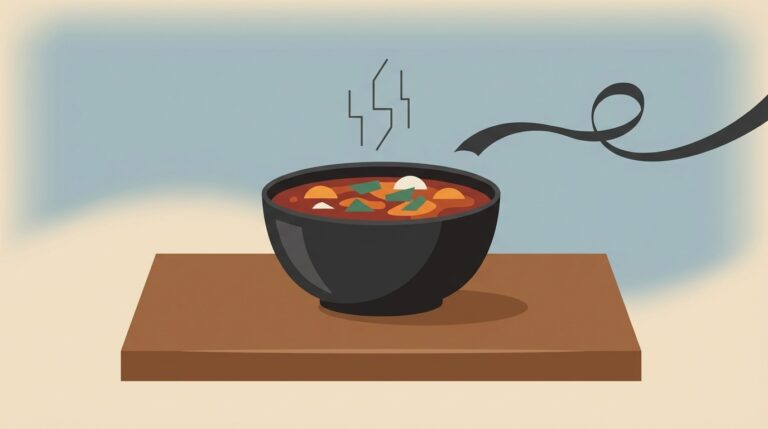
Today, we are diving deep into the heart of Korean Funeral Culture and the unique tradition of eating 육개장 (Yukgaejang – Spicy Beef Soup). If you ever live or work in Korea, attending a colleague’s or friend’s family funeral is a profound way to show respect. Knowing what to say, what to wear, and how to eat the soup will not only save you from awkward mistakes but also show your Korean friends that you truly understand their culture. Let’s explore!
Phase 2: Core Expressions Deep Dive
When you enter a Korean funeral, silence and body language speak louder than words. However, knowing a few key phrases is essential.
1. 삼가 고인의 명복을 빕니다
- Pronunciation: Samga goin-ui myeongbogeul bimnida. (Sounds like: sahm-gah go-in-ay myung-bohg-eul beem-nee-dah)
- Meaning: (Literal) I respectfully pray for the deceased’s soul in the afterlife. / (Real nuance) May they rest in peace.
- K-Culture Moment: You’ll see this phrase printed on funeral wreaths (화환) in K-Dramas, or written on the front of the condolence money envelope (조의금). You usually write this rather than saying it out loud to the family, though you can.
- Editor’s Insight: This phrase feels very heavy and traditional. It’s the ultimate expression of respect for the dead.
- Situation Spectrum:
[🚫 Never] ———— [⚠️ Be Careful] ———— [✅ Freely]
- Close Friends (Casual): 🚫 (Too formal to say casually, but used on envelopes)
- Co-workers (Semi-formal): ✅
- Boss/Elders (Formal): ✅
- 🤔 Think About It: Why does Korean have such a long, specific, and poetic phrase for ‘Rest in Peace’? How do you express respect for the deceased in your culture?
2. 상심이 크시겠습니다
- Pronunciation: Sangsimi keusigetseumnida. (sang-sheem-ee koo-she-get-soom-nee-dah)
- Meaning: (Literal) Your heartbreak must be great. / (Real nuance) My deepest condolences for your loss.
- K-Culture Moment: After you bow to the portrait and then bow to the family members, you can quietly say this to them as you hold their hands.
- Editor’s Insight: This focuses on the feelings of the living (the grieving family). It shows empathy without overstepping.
- Situation Spectrum:
[🚫 Never] ———— [⚠️ Be Careful] ———— [✅ Freely]
- Close Friends (Casual): ⚠️ (Friends might just say “많이 힘들지?” – Is it very hard?)
- Co-workers/Boss (Formal): ✅
3. 육개장 좀 드시고 가세요
- Pronunciation: Yukgaejang jom deushigo gaseyo. (yook-gae-jang johm doo-she-go gah-seh-yo)
- Meaning: Please have some Yukgaejang before you go.
- K-Culture Moment: After greeting the family, the chief mourner (상주) will guide you to the dining area and say this. It is a sign of hospitality even in grief.
- Editor’s Insight: Refusing this offer outright is considered slightly impolite. Even if you aren’t hungry, sitting down and having a few bites is the Korean way of showing support.
- 🤔 Think About It: Why is feeding guests considered so important in Korea that it remains a priority even during the most sorrowful times?
Phase 3: Textbook vs. Real Korean
| Situation | 📖 Textbook Korean | 🗣️ Real Korean | 💡 Why the difference? |
|---|---|---|---|
| Expressing condolences | “유감입니다” (I am sorry/regretful) | “얼마나 상심이 크십니까” or Just a silent, deep bow | “유감입니다” sounds like a politician’s formal apology. Real sympathy in Korea is often expressed through silence and physical presence. |
| Comforting a friend | “정말 슬프겠어요” (You must be sad) | “내가 뭐 도와줄 일 있으면 언제든 연락해” (Call me anytime if you need help) | Koreans prefer offering practical help and solidarity over just stating emotional observations. |
| Receiving the food | “감사합니다” (Thank you) | “네, 조금 먹고 가겠습니다” (Yes, I will eat a little before I go) | A quiet acknowledgment is preferred over a cheerful “Thank you!” in a somber setting. |
Bottom Note: At B1 level, it’s crucial to match your tone to the atmosphere. Over-speaking is a common mistake; in Korean funerals, less is often more.
Phase 4: Cultural Context — K-Culture Deep Dive
4-1. Non-verbal Etiquette (The Unspoken Rules)
Korean funerals are a test of 눈치 (Nunchi – social awareness).
– Clothing: Black suits or dark, muted colors. Crucial: Always wear black socks! You must take off your shoes to enter the mourning room, and showing bare feet is considered highly disrespectful.
– Bowing (절): You do a full traditional bow to the floor twice, followed by one half-bow (standing nod) to the portrait. Then, you bow once to the family.
4-2. K-Food Connection: Why Yukgaejang? 🍲
If you watch a Korean movie or drama, the funeral food is almost always the same: 육개장 (Spicy Beef Soup), jeon (pancakes), boiled pork, and Soju. Why?
1. The Color Red: In traditional Korean shamanism and folklore, the color red is believed to ward off evil spirits (귀신). Serving red soup protects the guests and the spirit of the deceased.
2. Practicality: Funerals last for 3 days and nights. Guests arrive at unpredictable times. Yukgaejang is a dish that actually tastes better the longer you boil it in a massive pot, making it perfect for feeding hundreds of sudden guests.
3. Comfort and Warmth: Staying up all night in a hospital basement is physically draining. The spicy, hearty, and hot beef soup gives mourners the energy to stay awake and keep the family company.
Phase 5: Real-Life Roleplay Scenario
Setting: Friday evening, 8:00 PM. A university hospital funeral hall in Seoul. The smell of incense and spicy beef soup fills the air. You just arrived to pay respects to your Korean colleague, Minsu, whose father has passed away.
Characters:
– YOU: An expat working in Korea for 2 years.
– Minsu (32): Your coworker. He is wearing a black suit with a black armband (the sign of the chief mourner).
Dialogue:
YOU: (Handing the white envelope with two hands and bowing slightly)
민수 대리님… 상심이 크시겠습니다. 😢
(Minsu daerinim… sangsimi keusigetseumnida.)
[Assistant Manager Minsu… my deepest condolences.]
Minsu: 바쁘신데 와주셔서 정말 감사합니다. 저쪽으로 가셔서 식사하시고 가세요.
(Bappeusinde wajusyeoseo jeongmal gamsahamnida. Jeojjogeuro gasyeoseo siksahasigo gaseyo.)
[Thank you so much for coming despite being busy. Please go over there and have a meal before you leave.]
YOU: 네, 알겠습니다. 기운 내세요.
(Ne, algetseumnida. Giun naeseyo.)
[Yes, I understand. Please stay strong.]
(🎭 Stage Direction: You move to the dining area. Minsu’s uncle, who has been drinking to ease his grief, approaches you and pours you a glass of Soju.)
Uncle: 우리 민수 동료분이시구나. 자, 소주 한잔 받으세요.
(Uri Minsu dongnyobunisiguna. Ja, soju hanjan badeuseyo.)
[Ah, you’re Minsu’s coworker. Here, take a glass of Soju.]
🔀 Your Turn! How should you respond after receiving the Soju?
– A) Raise your glass and say, “위하여! (Cheers!)”
– B) Quietly hold your glass out, let him pour, and drink it without clinking glasses.
– C) Refuse the drink, saying, “장례식이라서 술은 안 마십니다” (I don’t drink because it’s a funeral).✅ Best Choice: B — Never, ever clink glasses (건배 – Geonbae) at a Korean funeral. Clinking glasses is for celebrating. At a funeral, you pour drinks for each other and drink quietly to share the sorrow.
⚠️ Choice A Analysis: This is the biggest taboo. It implies you are happy about the death!
Phase 6: 10-Second Shadowing Drill
Practice this somber, respectful tone. Speak slightly slower and softer than your usual speaking voice.
😔 민수 씨, / 얼마나 / 상심이 / 크십니까.
(Minsu ssi, / eolmana / sangsimi / keusimnikka.)
Minsu… how great your heartbreak must be.😔 삼가 / 고인의 / 명복을 / 빕니다.
(Samga / goin-ui / myeongbogeul / bimnida.)
May they rest in peace.
Phase 7: K-Culture Mini Dictionary
| Korean | Romanization | English | Contextual Meaning |
|---|---|---|---|
| 장례식장 | jangnyesikjang | Funeral Hall | Usually located in the basement or annex of major hospitals in Korea. |
| 조의금 | jouigeum | Condolence Money | Given in a white envelope to help the family with funeral costs. |
| 상주 | sangju | Chief Mourner | The primary family member organizing the funeral (usually the eldest son). |
| 밤을 새우다 | bameul saeuda | To stay up all night | Close friends stay all night playing cards so the family isn’t lonely. |
| 건배 금지 | geonbae geumji | No clinking glasses | The absolute golden rule of drinking at a funeral. |
Phase 8: Traveler / Resident Survival Kit
Even if you are just traveling or staying in Korea short-term, you might need to prepare an envelope for a Korean friend.
🆘 Survival Tips for Condolence Money (조의금)
– 🇰🇷 “조의금 봉투는 어디 있나요?” (Jouigeum bongtuneun eodi innayo?) – “Where are the condolence envelopes?”
– 📍 Where to use: Convenience stores, banks, or the funeral hall entrance.
– 💡 Pro Tip: How much should you give? In Korea, you must give an odd number (symbolizing positive energy/yang). Usually, 50,000 KRW is standard for acquaintances, and 100,000 KRW for close friends.📌 Editor’s Note on ATMs:
Nearly every hospital funeral hall has an ATM near the entrance specifically so guests can withdraw cash for the envelope. Don’t worry if you forgot to bring cash!
Phase 9: Critical Thinking — “A Step Deeper”
Food & Identity: Healing through ‘Jeong’ (정)
🧠 Think Deeper:
In many Western cultures, a funeral is a brief ceremony followed perhaps by a quiet reception. In Korea, a funeral is a 3-day marathon of mourning, feeding, and socializing. The family, despite their immense grief, feels a deep obligation to feed every single guest a hot bowl of Yukgaejang. This reflects the Korean concept of 정 (Jeong – deep communal attachment). Food is not just sustenance; it is the ultimate tool for communal healing. By eating together, staying awake together, and sharing a spicy, warming soup, the community absorbs the family’s shock and sorrow, ensuring they don’t have to face the darkness alone.💬 Your Turn: Does your culture have specific foods associated with mourning or healing? How does your community support grieving families? Share in the comments!
Phase 10: FAQ & Common Mistakes
Q: Do I really have to eat the soup if I’m not hungry or if it’s too spicy?
Yes and no. You don’t have to finish the whole bowl, but it is proper etiquette to sit at the table, have a few sips of the broth, or eat some side dishes. It’s about participating in the communal act of sharing food.
Q: Is it okay to laugh at a Korean funeral?
Surprisingly, yes! While the mourning room (where the portrait is) is very solemn, the dining area where people eat Yukgaejang can sometimes get quite loud. Close friends purposely share funny memories of the deceased or play games to lighten the family’s heavy hearts.
❌ Common Mistake #1: Wearing bright colors or heavy makeup.
✅ Do this: Stick to black or dark navy. Avoid flashy jewelry and red lipstick.❌ Common Mistake #2: Showing bare feet.
✅ Do this: Always wear black socks. Buy a pair at a convenience store before entering if you are wearing sandals!
Phase 11: Summary & Action Items
- One-Liner Summary: At a Korean funeral, show your respect through quiet bows, black socks, and by sharing a warm bowl of Yukgaejang without clinking your Soju glasses.
-
Action Mission:
- 🥉 Bronze: Stand in front of a mirror and practice saying “삼가 고인의 명복을 빕니다” with a respectful, somber tone.
- 🥈 Silver: Search “Korean Funeral Etiquette” on YouTube and watch how Koreans perform the traditional bow (절).
- 🥇 Gold: Next time you eat at a Korean restaurant, order a bowl of Yukgaejang (육개장). Taste it and feel how comforting and warming it is, imagining its cultural significance.
Phase 12: Quiz — Interactive Challenge
1. Situational Judgment: You are sitting at the dining table at a funeral. A friend pours you a glass of beer. What should you do before drinking?
– A) Say “건배!” and clink glasses loudly.
– B) Say “감사합니다” cheerfully and tap the table.
– C) Quietly drink the beer without clinking glasses with anyone.
2. Fill in the Blank:
When expressing condolences to a Korean coworker, you should say: “얼마나 _____이 크십니까.” (Hint: Heartbreak/Grief)
3. True or False — K-Culture Edition:
– At a Korean funeral, it is strictly forbidden for anyone to smile or talk loudly in the dining area. (T/F)
– You should prepare your condolence money in an even number, like 40,000 KRW. (T/F)
(Answers: 1: C – Never clink glasses. 2: 상심 (Sangsim). 3: False – The dining area can be somewhat lively to comfort the family. False – Always use odd numbers like 30k, 50k, or 100k, as even numbers and specifically ‘4’ bring bad luck!)
Frequently Asked Questions (FAQ)
Q: What does "삼가 고인의 명복을 빕니다" mean in Korean and how do you pronounce it?
A: In Korean, "삼가 고인의 명복을 빕니다" is pronounced [Samga goin-ui myeongbogeul bimnida. (Sounds like: sahm-gah go-in-ay myung-bohg-eul beem-nee-dah] and means: (Literal) I respectfully pray for the deceased's soul in the afterlife. / (Real nuance) May they rest in peace.
Q: What does "상심이 크시겠습니다" mean in Korean and how do you pronounce it?
A: In Korean, "상심이 크시겠습니다" is pronounced [Sangsimi keusigetseumnida. (sang-sheem-ee koo-she-get-soom-nee-dah] and means: (Literal) Your heartbreak must be great. / (Real nuance) My deepest condolences for your loss.
Q: What does "육개장 좀 드시고 가세요" mean in Korean and how do you pronounce it?
A: In Korean, "육개장 좀 드시고 가세요" is pronounced [Yukgaejang jom deushigo gaseyo. (yook-gae-jang johm doo-she-go gah-seh-yo] and means: Please have some Yukgaejang before you go.







