

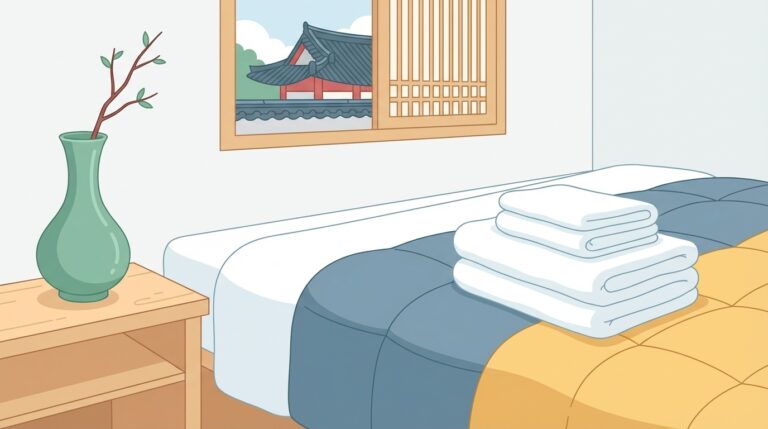
Phase 1: Empathy (The “Wait, I need a towel!” Moment)
Hello! I’m the Lead Editor at Daily Hangul.
Imagine this: You’ve just finished a long, exciting day exploring the vibrant streets of Hongdae or shopping in Myeongdong. You get back to your hotel, hop into the shower, and just as you step out, you realize… there’s only one tiny hand towel left in the bathroom. Panic sets in!
In a K-Drama, this might be the moment the main character calls the front desk and a handsome hotel manager magically appears at the door. But in reality, you’re standing there shivering, staring at the hotel phone. You know how to say “Hello” (안녕하세요), but how do you actually ask for a towel?
Don’t worry! This guide is based on real SOS messages from my beginner students who found themselves exactly in this situation. By the end of this post, you’ll know exactly how to call the front desk and get what you need—like a true local!
Phase 2: Core Expressions Deep Dive
Let’s learn the most natural ways to save your post-shower crisis.
1. 수건 좀 더 주시겠어요?
- Pronunciation: sugeon jom deo jusigesseoyo?
- Sound-alike guide: ‘수’ (su) sounds like ‘soup’ without the ‘p’. ‘건’ (geon) sounds like ‘gun’. ‘좀’ (jom) sounds like ‘dome’ with a ‘j’.
- Meaning: Could you please give me some more towels? (Literal: Towel, a little, more, would you give?)
- K-Culture Moment: This is the standard, polite phrase you hear in K-Dramas when a character respectfully asks for something from a service worker.
- Editor’s Insight: The word ‘좀’ (jom) literally means ‘a little’, but Koreans use it all the time to soften a request. Without ‘좀’, it can sound like an order. Adding it makes you sound incredibly polite and culturally aware!
- Situation Spectrum:
[🚫 절대 금지] ———— [⚠️ 주의] ———— [✅ 자유롭게]
- Friends (Casual): 🚫 (Too formal! Just say “수건 줘”)
- Hotel Staff / Strangers (Formal): ✅
- 🤔 Think About It: Why do Koreans use ‘a little’ (좀) even when asking for physical items? Do you have filler words in your language that make requests sound softer?
2. 수건 하나 더 주세요.
- Pronunciation: sugeon hana deo juseyo.
- Meaning: Please give me one more towel.
- Editor’s Insight: This is slightly more direct but perfectly acceptable and very common. If the grammar of the first phrase is too long for you to remember, just use this! ‘하나’ (hana) means ‘one’. You can change it to ‘두 개’ (du gae – two) if you need more.
- Situation Spectrum:
[🚫 절대 금지] ———— [⚠️ 주의] ———— [✅ 자유롭게]
- Friends (Casual): ⚠️ (Friends prefer 반말/casual speech)
- Hotel Staff / Restaurant Staff: ✅
Phase 3: Textbook vs. Real Korean
| Situation | 📖 Textbook Korean | 🗣️ Real Korean | 💡 Why the difference? |
|---|---|---|---|
| Calling the front desk | 수건을 더 주시겠습니까? (sugeoneul deo jusigesseumnikka?) | 수건 좀 더 주시겠어요? (sugeon jom deo jusigesseoyo?) | The textbook ‘-습니까’ is very military/news-anchor style. Modern Koreans prefer the softer ‘-요’ ending for service interactions. |
| Asking for 2 towels | 수건 두 개를 부탁합니다. (sugeon du gaereul butakhamnida.) | 수건 두 개만 더 주세요~ (sugeon du gaeman deo juseyo~) | Dropping particles (를) and adding ‘만’ (only) makes the request sound less burdensome to the staff. |
Bottom Note: As an A2 learner, stick to the ~주세요 (Please give me) pattern. It’s safe, polite, and works everywhere!
Phase 4: Cultural Context — K-Culture Deep Dive
4-1. Non-verbal Nuances
When speaking on the phone to the front desk, obviously they can’t see you. However, Koreans often use a “smiling voice” (솔톤 – Sol tone, meaning speaking at the pitch of the musical note ‘G’). You don’t need to overdo it, but sounding gentle rather than demanding goes a long way.
4-2. The “Jjimjilbang” Towel Economy (K-Travel Connection)
If you travel to Korea, you MUST visit a Jjimjilbang (Korean traditional sauna). Have you seen the K-Drama scenes where characters wear towels on their heads rolled up like Princess Leia buns? That’s the Yangmeori (양머리 – sheep head) style!
But here’s a crucial cultural difference: While hotels give you big bath towels and you can ask for more, Jjimjilbangs usually hand you exactly two small hand towels at the entrance. In Korean saunas, towels are strictly counted! So the phrase “수건 좀 더 주시겠어요?” might actually get you a polite “No” at a sauna, but it works perfectly at a hotel.
Phase 5: Real-Life Roleplay Scenario
Setting: 10:00 PM. A boutique hotel in Gangnam. You just washed your face and realized you need an extra towel for your hair. You pick up the room phone and press ‘0’.
Characters:
– YOU: A tired but polite traveler.
– Staff: Front desk employee (Friendly, but busy).
Dialogue:
Staff: 네, 프런트입니다.
(Ne, peureonteu-imnida.)
[Yes, this is the front desk.]
YOU: 안녕하세요, 302호인데요.
(Annyeonghaseyo, sam-baek-i-ho-indeyo.)
[Hello, this is room 302.]
Staff: 네, 고객님. 무엇을 도와드릴까요?
(Ne, gogaengnim. Mueoseul dowadeurilkkayo?)
[Yes, dear customer. How may I help you?]
🔀 Your Turn! How should you respond?
– A) “빨리 수건 줘!” (Quickly give towel!)
– B) “수건 좀 더 주시겠어요?”
– C) “수건 어디 있어요?” (Where is the towel?)✅ Best Choice: B — It perfectly balances politeness and clarity.
⚠️ Choice A Analysis: This is Banmal (casual speech) and very rude to a service worker. You might get kicked out of the hotel!
YOU: 수건 좀 더 주시겠어요?
(Sugeon jom deo jusigesseoyo?)
[Could you please give me some more towels?]
Staff: 네, 바로 올려드리겠습니다.
(Ne, baro ollyeodeurigetseumnida.)
[Yes, I will send them up right away.]
YOU: 감사합니다!
(Gamsahamnida!)
[Thank you!]
Phase 6: 10-Second Shadowing Drill
Let’s practice the magic phrase. Pay attention to the pauses!
😊 수건 좀 / 더 / 주시겠어요~? (sugeon jom / deo / jusigesseoyo~?)
Pro tip: Lift your pitch slightly at the end to make it a polite question!
Phase 7: K-Culture Mini Dictionary
| 한국어 | Romanization | English | Context |
|---|---|---|---|
| 프런트 | peureonteu | Front Desk | Konglish! Usually dialed by pressing ‘0’. |
| 객실 | gaeksil | Guest Room | Formal word for your hotel room. |
| 수건 | sugeon | Towel | Usually refers to smaller face/hair towels in Korea. |
| 바스타월 | baseutawol | Bath Towel | Konglish for the large body towels. |
| 찜질방 | jjimjilbang | Korean Sauna | A 24-hour public bathhouse. Great for budget travel! |
Phase 8: Traveler’s Survival Kit
If you’re staying in a Korean hotel, you need these phrases in your arsenal:
🆘 Survival Expression #1: Wi-Fi
– 🇰🇷 “와이파이 비밀번호가 뭐예요?” (waipai bimilbeonhoga mwoyeyo?)
– 🗣️ Meaning: What is the Wi-Fi password?
– 📍 Where to use: Hotels, cafes, restaurants.🆘 Survival Expression #2: Broken things
– 🇰🇷 “에어컨이 안 켜져요.” (eeokeoni an kyeojyeoyo.)
– 🗣️ Meaning: The AC won’t turn on.
– 📍 Where to use: Hotel rooms during Korea’s hot summers!📌 Editor’s Travel Note
– Tipping Culture: Do you need to tip the staff member who brings the towel to your room? NO! Korea is a strictly no-tip culture. If you try to hand them cash, they will look confused and politely refuse. A warm “감사합니다” (Thank you) with a slight bow of the head is all you need!
Phase 9: Critical Thinking Corner — “A Step Deeper”
Language & Service Culture: The End of “The Customer is King”
In the past, Korea had an extreme “The customer is king” (손님은 왕이다) culture, often leading to service workers enduring rude speech (Banmal) from older customers. However, modern Korea has strongly pushed back against this. Now, you will see signs in cafes and hotels reminding people to use polite language with staff. Asking “수건 좀 더 주시겠어요?” instead of just demanding it isn’t just about grammar—it reflects Korea’s evolving social consciousness toward mutual respect in the service industry.
💬 Your Turn: How is the service culture in your home country? Is it casual, highly formal, or somewhere in between? Let me know in the comments!
Phase 10: FAQ & Avoiding Mistakes
Q: Do I need to use formal language (존댓말) to the hotel staff even if I am older than them?
Yes, absolutely! In a business or service setting, age doesn’t matter. Always use polite Korean.
Q: What if I need toilet paper instead of a towel?
Simply swap the word! “휴지 좀 더 주시겠어요?” (hyuji jom deo jusigesseoyo? – Could you give me more toilet paper?)
❌ Common Mistake: Shouting “여기요!” (Over here!) into the hotel phone.
✅ Do this instead: “여기요” is for busy restaurants to get a waiter’s attention. On the phone, just start with “안녕하세요” (Hello).
Phase 11: Summary & Action Items
One-Liner Summary: When you need an extra towel, just remember the polite magic phrase: “수건 좀 더 주시겠어요?” (sugeon jom deo jusigesseoyo?).
Your Missions for Today:
– 🥉 Bronze (Solo): Stand in your bathroom, look in the mirror, and ask for a towel in Korean 3 times aloud.
– 🥈 Silver (Online): Leave a comment below translating this: “Hello, this is room 204. Could I get one more towel please?”
– 🥇 Gold (Real Life): Next time you are in Korea, call the front desk and ask for an extra towel using only Korean!
Phase 12: Quiz — Interactive Challenge
1. Fill in the blank:
수건 _____ 더 주시겠어요?
(Hint: the word that makes the request sound softer, meaning ‘a little’)
A) 많이 (many)
B) 좀 (a little)
C) 빨리 (quickly)
2. True or False – K-Culture Edition:
When the hotel staff brings the towel to your room, you should give them a 2,000 KRW tip for their trouble.
3. Situational Judgment:
You called the front desk. They answered. What is the BEST first sentence?
A) 수건 줘! (Give towel!)
B) 안녕하세요, 501호인데요. (Hello, this is room 501.)
C) 여기요! (Over here!)
(Answers: 1: B, 2: False – No tipping in Korea!, 3: B)
Frequently Asked Questions (FAQ)
Q: What does "수건 좀 더 주시겠어요?" mean in Korean and how do you pronounce it?
A: In Korean, "수건 좀 더 주시겠어요?" is pronounced [sugeon jom deo jusigesseoyo?] and means: a key conversational Korean expression covered in this lesson.
Q: What does "수건 하나 더 주세요." mean in Korean and how do you pronounce it?
A: In Korean, "수건 하나 더 주세요." is pronounced [sugeon hana deo juseyo.] and means: Please give me one more towel.






