

Phase 1: Empathy & Immersion (The Cold Open)
Hello! This is the Lead Editor of Daily Hangul.
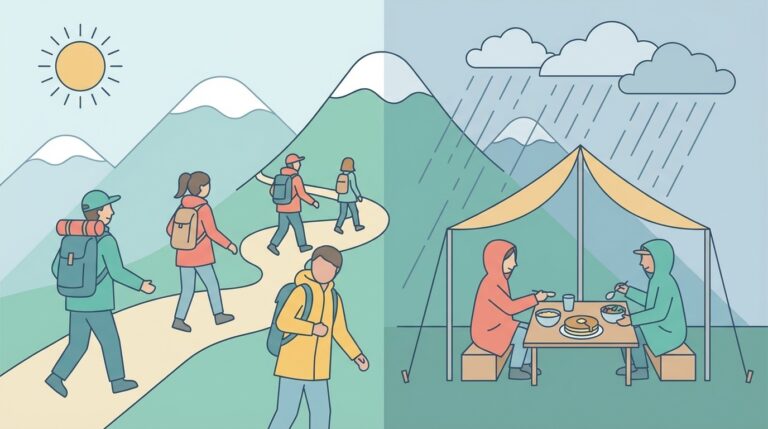
Imagine you are watching a classic slice-of-life K-Drama. The main characters are sitting outside a convenience store, sipping on canned coffee. One of them looks up at the cloudy sky, sighs, and says, “If it rains tomorrow, let’s just eat Pajeon (scallion pancakes) and drink Makgeolli. But… 비가 안 오면 등산 가자 (If it doesn’t rain, let’s go hiking).”
Have you ever wondered how Koreans seamlessly plan their weekends around the unpredictable summer monsoon season or the sudden spring showers?
For B1 (Intermediate) learners, understanding how to express conditions using ‘-(으)면’ (if) is a massive game-changer. It takes you from simply stating facts (“It rains. We hike.”) to actually negotiating plans, setting conditions, and sounding like a true local who knows exactly what to do when the weather shifts.
Trust me, I’ve spent over 10 years in Seoul teaching expats. The moment my students master this conditional phrase, their weekend plans suddenly become 10 times more exciting. This guide is built entirely from those “Ah-ha!” moments in my classroom.
Phase 2: Core Expressions Deep Dive
Let’s break down the magic phrase and its components.
1. 비가 안 오면 (If it doesn’t rain)
- Pronunciation: bi-ga an o-myeon [sounds like: bee-gah ahn oh-myun]
- Meaning: Literal: If rain does not come. / Real nuance: Assuming the weather clears up.
- K-Culture Moment: You’ll hear this constantly in Korean offices on a Friday afternoon. Everyone is checking the Naver Weather app, trying to decide if they should book a campsite or make indoor dinner plans.
- Editor’s Insight: The ending
-(으)면is the backbone of Korean conditions. Attached to the verb 오다 (to come), it becomes 오면. We use ‘안’ right before the verb to make it negative. It sounds much softer and more natural than forming a complex, rigid sentence.- Situation Spectrum:
[🚫 절대 금지] ———— [⚠️ 주의] ———— [✅ 자유롭게]
- 친구 사이(Casual): ✅
- 직장 동료(Semi-formal): ✅ (Perfectly fine if you end the following sentence politely)
- 직장 상사·어른(Formal): ✅
- 🤔 Think About It: Why do Koreans say “rain comes” (비가 오다) instead of “it is raining”? Could it be related to an agrarian society’s perspective of waiting for rain to arrive as a guest?
2. 등산 가자 (Let’s go hiking)
- Pronunciation: deung-san ga-ja [sounds like: deung-sahn gah-jah]
- Meaning: Let’s go hiking.
- K-Culture Moment: Hiking (등산) is arguably the unofficial national weekend sport of Korea. From colorful outdoor gear (등산복) on the subway to sharing cucumbers and kimbap at the peak, it’s a huge cultural bonding activity.
- Editor’s Insight: The
-자ending is powerful but dangerous. It means “Let’s,” but it is strictly casual (반말). It carries a fun, energetic vibe, like grabbing your friend’s arm and pulling them along.- Situation Spectrum:
[🚫 절대 금지] ———— [⚠️ 주의] ———— [✅ 자유롭게]
- 친구 사이(Casual): ✅
- 직장 동료(Semi-formal): ⚠️ (Only if you are the same age or very close)
- 직장 상사·어른(Formal): 🚫 (Never use -자 with a boss! Use
가시죠or갈까요?instead.)- 🤔 Think About It: In your culture, is hiking considered a strenuous sport for the fit, or a weekend social gathering with food and drinks like it is in Korea?
3. 만약에 (By any chance / If)
- Pronunciation: man-ya-ge [sounds like: mahn-yah-geh]
- Meaning: If / By any chance
- K-Culture Moment: Often used in K-Pop lyrics and romantic K-Dramas to set up a hypothetical scenario. E.g., Taeyeon’s famous OST “만약에 (If)”.
- Editor’s Insight: You can just use
-(으)면, but putting만약에at the very beginning of the sentence is like turning on a flashing sign that says, “Hey, I’m about to set a condition!” It helps the listener prepare for a hypothetical situation.- Situation Spectrum:
[🚫 절대 금지] ———— [⚠️ 주의] ———— [✅ 자유롭게]
- 친구 사이(Casual): ✅
- 직장 동료(Semi-formal): ✅
- 직장 상사·어른(Formal): ✅
Phase 3: Textbook vs. Real Korean
Let’s see how standard textbook Korean transforms in the streets of Seoul.
| 상황 (Situation) | 📖 교과서 한국어 (Textbook) | 🗣️ 진짜 한국어 (Real Korean) | 💡 왜 다를까? (Why the difference?) |
|---|---|---|---|
| Suggesting a plan if the weather is good | 만약에 비가 오지 않으면, 등산을 갑시다. | 내일 비 안 오면 등산 갈래? / 가자! | Koreans prefer the shorter ‘안’ over ‘-지 않다’ in spoken language for speed and casualty. |
| Suggesting an alternative if it rains | 만약에 비가 오면, 파전을 먹으러 갑시다. | 비 오면 그냥 파전이나 먹자. | ‘이나’ (just / something like) adds a laid-back, “let’s just go with the flow” vibe. |
| Asking about the plan | 내일 비가 오면 어떻게 할까요? | 낼 비 오면 어떡해? | ‘어떡해’ is the ultimate spoken contraction of ‘어떻게 해’, essential for everyday survival. |
(Bottom Note: As a B1 learner, start dropping the rigid “-(으)ㅂ시다” with friends and use “-(으)ㄹ래(요)?” for a much softer, natural suggestion!)
Phase 4: Cultural Context — K-Culture Deep Dive
4-1. Non-verbal Nunchi (눈치) for Weekend Plans
When making plans with conditions, body language matters. If a Korean friend suggests hiking, but they keep checking the weather app and sighing, their Nunchi might be telling you: “I actually hope it rains so we can just eat and drink inside.” Pay attention to their tone. A bright “가자!” means they are excited. A hesitant “가…자…” means they want you to suggest an indoor alternative!
4-2. The “Rain = Pajeon & Makgeolli” Equation (K-Food & K-Culture)
In Korean culture, “비가 오면” (If it rains) triggers an almost automatic, Pavlovian response: 파전 (Scallion pancakes) and 막걸리 (Rice wine).
Why? There are a few theories. The most popular one is that the sound of rain hitting the ground or windows sounds exactly like the sizzling sound of batter frying in a hot oiled pan. Another theory is that in older agricultural times, rainy days meant farmers couldn’t work in the fields, so they would stay home, use the green onions they grew, and brew rice wine.
So, when you say “비가 안 오면 등산 가자”, the unspoken second half of that sentence in a Korean’s mind is usually, “…and if it DOES rain, we are definitely drinking makgeolli.”
Phase 5: Real-Life Roleplay Scenario
Setting: Friday evening, 7:00 PM. A lively BBQ restaurant near Gangnam Station. The smell of grilled pork belly fills the air. You are having dinner with your Korean coworkers, discussing weekend plans.
Characters:
– YOU (The Reader): An expat working in Seoul, level B1 Korean. You want to make a good impression but also want a fun weekend.
– Min-su (32): Your friendly Korean coworker who loves outdoor activities.
Dialogue:
민수: 주말에 뭐 할 거예요? 약속 있어요?
(Ju-ma-re mwo hal geo-ye-yo? Yak-sok i-sseo-yo?)
[What are you doing this weekend? Do you have plans?]
YOU: 아직 없어요. 집에서 쉴 것 같아요.
(A-jik eop-seo-yo. Ji-be-seo swil geot ga-ta-yo.)
[Not yet. I think I’ll just rest at home.]
민수: 에이~ 날씨도 좋은데 집에만 있지 마요!
(E-i~ nal-ssi-do jo-eun-de ji-be-man it-ji ma-yo!)
[Hey~ The weather is nice, don’t just stay at home!]
YOU: 그럼 뭐 재미있는 거 할까요?
(Geu-reom mwo jae-mi-in-neun geo hal-kka-yo?)
[Then should we do something fun?]
민수: 우리 내일 관악산 갈까요? 저랑 지훈 씨도 갈 거예요.
(U-ri nae-il Gwa-nak-san gal-kka-yo? Jeo-rang Ji-hun ssi-do gal geo-ye-yo.)
[Should we go to Gwanaksan (Mountain) tomorrow? Ji-hoon and I are going.]
YOU: 오, 등산이요? 좋아요! 근데 내일 오후에 비 온다고 들었어요.
(O, deung-sa-ni-yo? Jo-a-yo! Geun-de nae-il o-hu-e bi on-da-go deu-reo-sseo-yo.)
[Oh, hiking? Sounds good! But I heard it’s going to rain tomorrow afternoon.]
민수: 아, 맞다. 일기예보 보니까 비가 올 수도 있겠네요.
(A, mat-da. Il-gi-ye-bo bo-ni-kka bi-ga ol su-do it-gen-ne-yo.)
[Ah, right. Looking at the forecast, it might rain.]
(🎭 Stage Direction: Min-su checks his phone, looking slightly disappointed but then his face brightens up.)
민수: 그럼 이렇게 해요. 내일 아침에 일어나서…
(Geu-reom i-reo-ke hae-yo. Nae-il a-chi-me i-reo-na-seo…)
[Then let’s do this. Tomorrow morning when we wake up…]
🔀 Your Turn! How should YOU finish the sentence?
– A) “비가 안 오면 등산 가자!” (If it doesn’t rain, let’s go hiking!)
– B) “비가 안 오면 등산 갈까요? 비 오면 파전 먹어요!” (Shall we go hiking if it doesn’t rain? If it rains, let’s eat pajeon!)
– C) “비가 오지 않으면 산에 등반합시다.” (If rain does not come, let us ascend the mountain.)✅ Best Choice: B — Why? Min-su is your coworker (semi-formal). Choice A uses “-가자” (casual), which might be a bit too informal unless you are very close. Choice B uses polite suggestions and perfectly integrates the K-Culture ‘pajeon’ rule. He will be incredibly impressed!
⚠️ Choice C Analysis: It sounds like a military general giving orders from a textbook. “등반하다” is too formal for a casual weekend hike.
민수: 와, 파전! 진짜 한국 사람 다 됐네요! 그럼 내일 아침에 연락할게요!
(Wa, pa-jeon! Jin-jja Han-guk sa-ram da dwaen-ne-yo! Geu-reom nae-il a-chi-me yeol-la-kal-ge-yo!)
[Wow, pajeon! You’ve become a true Korean! I’ll contact you tomorrow morning then!]
Phase 6: 10-Second Shadowing Drill
Speak out loud to get the muscle memory! Pay attention to the pauses (/) and emotions.
😊 (Brightly & Suggestive)
만약에 / 내일 비가 안 오면 / 우리 등산 갈래요?
(ma-nya-ge / nae-il bi-ga an o-myeon / u-ri deung-san gal-lae-yo?)
😤 (Determined & Hungry)
비가 오면 / 무조건 / 파전 먹으러 가요!
(bi-ga o-myeon / mu-jo-geon / pa-jeon meo-geu-reo ga-yo!)
mu-jo-geon = unconditionally / absolutely
Phase 7: K-Culture Mini Dictionary
| 한국어 (Korean) | Romanization | 영어 (English) | 맥락 설명 (Context) |
|---|---|---|---|
| 등산복 | deung-san-bok | Hiking clothes | Koreans take hiking fashion very seriously. Think bright neon windbreakers and high-tech boots, even for a small hill! |
| 무조건 | mu-jo-geon | Unconditionally / No matter what | Used to express strong determination. “If it rains, we are unconditionally eating pajeon.” |
| 일기예보 | il-gi-ye-bo | Weather forecast | A crucial word for planning. Koreans constantly check this during monsoon season. |
| 파전 | pa-jeon | Scallion pancake | The ultimate rainy day comfort food, usually paired with Makgeolli (Korean rice wine). |
Phase 8: Traveler Survival Kit 🎒
Even if you are just visiting Korea for a week, weather dictates your travel plans. Here are the top survival phrases and tips you need.
🆘 Survival Phrases for Changing Plans
– 🇰🇷 “오늘 비 와요?” (o-neul bi wa-yo?)
– 🗣️ English: Is it raining today?
– 📍 Where to use: Asking hotel concierges or friends.
- 🇰🇷 “비 오면 실내로 가요.” (bi o-myeon sil-nae-ro ga-yo.)
- 🗣️ English: If it rains, let’s go indoors.
- 📍 Where to use: Changing itinerary with your travel buddies.
📌 Editor’s Travel Note:
– Weather App: Don’t rely solely on global weather apps. Download Naver Weather (네이버 날씨) for the most accurate, hyper-local radar in Korea.
– Umbrella Culture: If it rains suddenly, don’t panic! You can buy a transparent umbrella (투명 우산) at literally any convenience store for about 4,000 to 5,000 KRW.
Phase 9: Critical Thinking Corner — “One Step Deeper”
Food & Identity: The Rainy Day Ritual
🧠 Think Deeper:
Why is the rule “Rain = Pajeon & Makgeolli” so unbreakable in Korea? Beyond just the sizzling sound of the pan, Korean food culture is deeply tied to community resilience. Rain historically disrupted outdoor labor, which could be frustrating. By creating a special food ritual specifically for bad weather, Koreans transformed a disappointing day into a festive excuse to gather, eat, and bond. It turns “We can’t work/play today” into “Great, we get to drink makgeolli today!”💬 Your Turn:
How does weather affect food choices in your culture? Is there a specific dish you must eat when it rains or snows? Let me know in the comments!
Phase 10: FAQ & Mistake Prevention
Q: Can I use “-자” (Let’s) with my language exchange partner if we just met?
A: No! Even if they are the same age, wait until you both agree to drop formalities (말을 놓다). Until then, use “-(으)실래요?” or “-(으)ㄹ까요?” (Shall we…?).
Q: Is hiking in Korea actually difficult?
A: It depends! Mountains like Bukhansan have rocky peaks requiring proper shoes, while Namsan is basically a paved walking trail. Always check the route difficulty first!
❌ Common Mistake #1: Confusing “-(으)면” (If) with “-(으)ㄹ 때” (When).
– Wrong: 내일 비가 올 때 파전 먹자. (Let’s eat pajeon when the rain comes tomorrow – sounds like you are absolutely certain it will rain).
– Right: 내일 비가 오면 파전 먹자. (If it rains tomorrow…)❌ Common Mistake #2: Using “안” after the verb instead of before.
– Wrong: 비가 오안면…
– Right: 비가 안 오면…
Phase 11: Summary & Action Items
🎯 One-Liner Summary: Use “비가 안 오면 [Action]” to sound like a local when making conditional plans, and remember to prepare a rainy-day food backup!
🔥 Action Mission 3 Steps:
– 🥉 Bronze (Solo): Look out your window right now. Say “(비가 / 눈이) 안 오면…” and state one thing you want to do today.
– 🥈 Silver (Online): Drop a comment below using -(으)면. E.g., “한국에 가면 ~ 하고 싶어요” (If I go to Korea, I want to…)
– 🥇 Gold (Real World): Next time your Korean friend suggests a plan, ask them playfully: “만약에 비 오면요?” (What if it rains?)
🏕️ K-Culture Mission:
Open Google Maps or Naver Map and search for “Bukhansan” (북한산). Look at the street view near the entrance. You will spot dozens of colorful outdoor clothing stores and restaurants selling Makgeolli. Imagine you are there!
Phase 12: Quiz — Interactive Challenge
Test your B1 survival skills!
1. Fill in the Blank (Situational):
You want to suggest going to a café IF you are tired.
“피곤하( ___ ) 카페 갈래요?”
(Hint: Drop the ‘다’ from 피곤하다 and add the condition)
2. True or False – K-Culture Edition:
“If you suggest eating Pajeon on a sunny Tuesday morning, a Korean person will think it’s the perfect, normal time for it.”
3. Situational Judgment:
You are talking to your boss about the company picnic. You want to say, “If it rains tomorrow, shall we do it indoors?”
– A) 부장님, 내일 비 안 오면 밖에서 하자!
– B) 부장님, 내일 비가 오면 실내에서 할까요?
(Scroll down for answers)
Answers (Click to reveal)
- 피곤하면 (If you are tired). Because ‘피곤하’ ends in a vowel, just add ‘면’.
- False. Pajeon is heavily associated with rainy days. Eating it on a sunny morning might get you some funny looks, though no one will stop you!
- B. Choice A uses informal 반말 (-하자), which is a huge NO with a boss. Choice B uses polite conditions and suggestions (-할까요?).
Frequently Asked Questions (FAQ)
Q: What does "비가 안 오면 (If it doesn't rain)" mean in Korean and how do you pronounce it?
A: In Korean, "비가 안 오면 (If it doesn't rain)" is pronounced [bi-ga an o-myeon [sounds like: bee-gah ahn oh-myun] and means: Literal: If rain does not come. / Real nuance: Assuming the weather clears up.
Q: What does "등산 가자 (Let's go hiking)" mean in Korean and how do you pronounce it?
A: In Korean, "등산 가자 (Let's go hiking)" is pronounced [deung-san ga-ja [sounds like: deung-sahn gah-jah] and means: Let's go hiking.
Q: What does "만약에 (By any chance / If)" mean in Korean and how do you pronounce it?
A: In Korean, "만약에 (By any chance / If)" is pronounced [man-ya-ge [sounds like: mahn-yah-geh] and means: If / By any chance







