

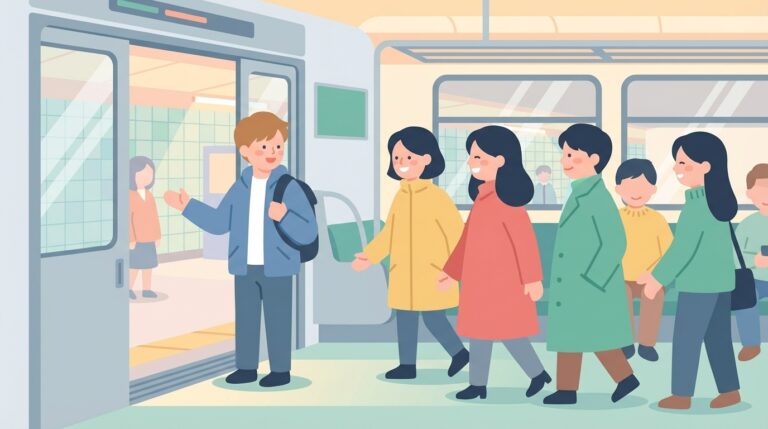
Surviving the Seoul Subway: The Magic Words to Get Off Safely and Politely
Phase 1: The Daily Hangul Editor’s Welcome
Hello! This is your Daily Hangul Editor. 🙋♀️
Picture this: It’s 6:00 PM on a Friday. You’re squeezed into Seoul Subway Line 2, heading toward Gangnam. It’s like a scene straight out of a K-Drama—except there’s no romantic slow-motion, just the harsh reality of the legendary Jiokcheol (지옥철, Hell Train). Your stop is next. The doors are about to open, but there’s a solid wall of people between you and freedom.
In textbooks, you might have learned to say, “실례합니다 (Excuse me).” But if you say that softly in a crowded Korean subway… no one will move.
Today, we’re tackling the golden rule of Korean public transit: 내리는 사람 먼저 (Letting people off first). Whether you’re rushing to a K-Pop concert or trying to find that viral restaurant in Myeongdong, knowing how to navigate the physical and verbal etiquette of Korean transit will save you from missing your stop—and earn you some serious local respect!
This guide is packed with real-life survival tips from my years of watching foreign friends ride past their stops in silent panic. Let’s dive in!
Phase 2: Core Expressions — The “Moses Miracle” Words
Here are the actual phrases Koreans use to part the Red Sea of commuters.
1. 잠시만요! (Wait a moment / Excuse me)
- Pronunciation: [jam-si-man-yo] (Sound analogy: ‘jam’ like fruit jam, ‘si’ like she but sharper, ‘man’ like superhero, ‘yo’ is a soft yo-yo without the second yo)
- Meaning: Literal: Wait a little bit. Real nuance: “Excuse me, I’m coming through!”
- K-Culture Moment: This is the ultimate transit survival word. In a crowded bus, a high schooler will yell this from the very back just as the driver is about to close the doors. The moment people hear “잠시만요!”, they instinctively pull their shoulders in to make a path.
- Editor’s Insight: Forget “실례합니다 (Excuse me)” for getting through crowds. “잠시만요” is an action-oriented phrase. It tells people an event is happening right now and they need to pause and adjust.
- Situation Spectrum:
[🚫 절대 금지] ———— [⚠️ 주의] ———— [✅ 자유롭게]
- Casual (Friends): ✅
- Semi-formal (Strangers on subway): ✅
- Formal (Elders/Bosses): ✅ (It’s universally accepted in transit!)
- 🤔 Think About It: Why does Korean use a phrase related to time (wait a moment) to ask for physical space? How do you ask for space in your native language?
2. 저 내릴게요! (I’m getting off!)
- Pronunciation: [jeo nae-ril-ge-yo] (‘nae’ sounds like net without the t, ‘ril’ is a soft R/L tap on the roof of your mouth)
- Meaning: Literal: I will get off. Real nuance: “Please make way, this is my stop!”
- K-Culture Moment: You’ll hear this on a packed bus when someone is trapped near the window seat and the person next to them has earphones in, completely oblivious to the world.
- Editor’s Insight: The ending “-ㄹ게요” expresses your strong intention while subtly asking for the listener’s cooperation. It’s not just a statement; it’s a polite warning!
- Situation Spectrum:
[🚫 절대 금지] ———— [⚠️ 주의] ———— [✅ 자유롭게]
- Casual: ✅
- Semi-formal (Strangers): ✅
- Formal (Elders): ⚠️ (Add “잠시만요” first to soften it: “잠시만요, 내릴게요!”)
- 🤔 Think About It: Korean grammar often implies a relationship between the speaker and listener. How does announcing your future action (“I will get off”) feel different from giving a command (“Move, please”)?
3. 먼저 내리세요 (Please get off first)
- Pronunciation: [meon-jeo nae-ri-se-yo] (‘meon’ sounds like ‘mun’ in mundane)
- Meaning: Literal & Real nuance: Please get off first. (After you!)
- K-Culture Moment: You’re waiting for the elevator at your office building or stepping off the subway. You step aside, do a slight hand gesture, and say this to an elderly person or a colleague.
- Editor’s Insight: This embodies the core etiquette of “내리는 사람 먼저”. It shows you have great Nunchi (social awareness).
- Situation Spectrum:
[🚫 절대 금지] ———— [⚠️ 주의] ———— [✅ 자유롭게]
- Casual: ⚠️ (To close friends, just say “먼저 내려” without the -세요)
- Semi-formal: ✅
- Formal: ✅
Phase 3: Textbook vs. Real Korean
Let’s compare what you studied with what you’ll actually hear on the streets of Seoul.
| Situation | 📖 Textbook Korean | 🗣️ Real Korean | 💡 Why is it different? |
|---|---|---|---|
| Trying to get past someone | 실례합니다. 지나가겠습니다. (Excuse me. I will pass.) | 아, 잠시만요! (Ah, just a second!) | “실례합니다” sounds too formal and slow for the fast-paced Pali-Pali culture. |
| Asking someone blocking the door | 비켜주세요. (Please move.) | 내릴게요! (I’m getting off!) | Koreans prefer announcing their own action rather than directly commanding a stranger. |
| Offering your seat | 제 자리에 앉으십시오. (Please sit in my seat.) | 여기 앉으세요~ (Please sit here~) | Modern spoken Korean relies on softer, friendlier endings (-세요) rather than stiff military-style endings (-십시오). |
Bottom Note for B1 Learners: When in doubt, a slightly urgent “잠시만요!” accompanied by a gentle bowing motion of the head works like magic 100% of the time.
Phase 4: Cultural Context — K-Culture Deep Dive
4-1. Non-Verbal Cues: The Art of the “Backpack Hug” & “Shoulder Dip”
Words are only half the battle. If you want to master 내리는 사람 먼저 (Those getting off first), you must master the body language.
– The Shoulder Dip: When saying “잠시만요”, Koreans will often dip one shoulder forward and angle their body sideways to take up less space while passing.
– The Backpack Hug: If you’re wearing a backpack on a crowded bus, it is a massive faux pas to keep it on your back. You must wear it on your front like a baby carrier or put it by your feet.
4-2. The “Nunchi” of Subway Boarding
Have you ever seen a K-Drama where a character tries to board the subway, but a massive crowd surges out, pushing them back onto the platform?
In Korea, there is a strict, unspoken law: You must stand to the side of the subway doors and wait until EVERY SINGLE PERSON has gotten off before you step in. If you try to push your way in while people are still exiting, you will experience the full force of Korean Nunchi—angry glares, clicking tongues (쯧쯧), or even a firm physical block from an Ajumma (middle-aged lady). It’s all about collective efficiency!
Phase 5: Real-Life Roleplay Scenario
Setting: It’s 8:30 AM on a Tuesday. You are on Seoul Subway Line 9 (the infamous Express train). The train is packed shoulder-to-shoulder. You’re squeezed in the middle, holding onto the top rail. Your stop, Yeouido, is approaching. You need to get to the door.
Characters:
– YOU: A B1 Korean learner, on your way to an important business meeting.
– Office Worker (NPC 1): A tired man in a suit, listening to music, blocking your path.
– Ajumma (NPC 2): A lady holding a shopping bag, standing right in front of the door.
Dialogue:
(The automated announcement chimes: “이번 역은 여의도, 여의도 역입니다.”)
YOU: (Realizing you need to move)
앗, 이번 역에서 내려야 해!
(At, ibeon yeogeseo naeryeoya hae!)
[Oh, I need to get off at this station!]
Office Worker: (Doesn’t notice you, staring at his phone)
YOU: 저기요…
(Jeogiyo…)
[Excuse me…]
Office Worker: (Still doesn’t hear you over his music)
🔀 Your Turn! How do you handle this?
– A) Tap his shoulder and say loudly: “비키세요!” (Move!)
– B) Gently nudge your way forward while saying: “아, 잠시만요! 내릴게요!”
– C) Say “Excuse me” in English and wait for him to move.✅ Best Choice: B — “아, 잠시만요! 내릴게요!” (Ah, excuse me! I’m getting off!).
Why? It combines the magic attention-grabber with your intent. Gently making physical contact (like a light touch on the arm or back while passing) is culturally acceptable in crowded transits in Korea.
⚠️ Choice A Analysis: “비키세요” is too aggressive and rude for a stranger.
⚠️ Choice C Analysis: If you wait, the doors will close, and you will end up at the next station!
(You choose B and squeeze past the office worker. Now you face the Ajumma at the door.)
YOU: 잠시만요, 먼저 내리겠습니다!
(Jamsimanyo, meonjeo naerigesseumnida!)
[Excuse me, I will get off first!]
Ajumma: 아유, 네네.
(Ayu, nene.)
[Oh my, yes yes.]
(She steps out onto the platform momentarily to let you pass, then steps back in.)
Phase 6: 10-Second Shadowing Drill
Let’s practice the rhythm! Pay attention to the pauses (/) and emotions.
🥺 아 / 잠시만요! / 저 내릴게요! (ah / jam-si-man-yo! / jeo nae-ril-ge-yo!)
(Desperate, high-pitched: use this when you are trapped in the back)
😊 먼저 / 내리세요~ (meon-jeo / nae-ri-se-yo~)
(Warm, friendly: use this when stepping aside for someone)
😤 잠시만 / 지나갈게요! (jam-si-man / ji-na-gal-ge-yo!)
(Firm but polite: “Excuse me, passing through!” – use this when the crowd won’t budge)
Phase 7: K-Culture Mini Dictionary
| Korean Word | Romanization | English | Cultural Context |
|---|---|---|---|
| 지옥철 | jiokcheol | Hell Train | A portmanteau of 지옥 (hell) and 지하철 (subway). Refers to the wildly crowded rush-hour subways. |
| 출퇴근 시간 | chultoegeun sigan | Rush Hour | The hours of commuting to (출근) and from (퇴근) work. Avoid Lines 2 and 9 during these times if possible! |
| 눈치 | nunchi | Social awareness / Tact | The ability to read the room. Knowing to step off the train to let others out is basic Nunchi. |
| 양보 | yangbo | Yielding / Concession | Offering your seat to the elderly, pregnant women, or children. Highly valued in Korean society. |
| 환승 | hwanseung | Transfer | Changing subway lines or switching between bus and subway (often free with a T-money card!). |
Phase 8: Traveler’s Survival Kit
If you are traveling in Korea, navigating transit is your #1 mission. Here are the top survival phrases you need.
🆘 Survival Phrase #1: Confirming your destination
– 🇰🇷 “이 역 가는 거 맞아요?” (i yeok ganeun geo majayo?)
– 🗣️ Meaning: Does this train go to [this] station?
– 📍 Where to use: When you jump onto a train but aren’t sure if it’s heading the right way.🆘 Survival Phrase #2: The Door is Closing!
– 🇰🇷 “문 닫힙니다!” (mun dachimnida!)
– 🗣️ Meaning: The doors are closing!
– 📍 Where to use: You won’t say this, but you will hear it. When you hear this, do not run for the door!
📌 Editor’s Travel Note:
– Must-have Apps: KakaoMetro or Naver Map. Google Maps does not provide walking directions or accurate transit times in Korea!
– T-Money Card: Buy this at any convenience store. Tap it when you get ON and when you get OFF the bus to get free transfers.
– The Pink Seats: You will see bright pink seats on the subway. These are exclusively for pregnant women. Even if the train is packed and the seat is empty, Koreans usually leave it open out of respect.
Phase 9: Critical Thinking — “One Step Deeper”
🧠 Think Deeper: The “Pali-Pali” (Hurry Hurry) Culture vs. Order
Korea is world-famous for its Pali-Pali (빨리빨리) culture—everything must be fast, efficient, and immediate. You might assume that this desire for speed would cause chaos on public transit. Yet, Seoul’s transit system is incredibly orderly. Why? Because Koreans understand that collective rules create the fastest outcome for everyone.
The rule of “내리는 사람 먼저” (Letting people off first) isn’t just about being polite; it’s a social contract. If people boarding block the exits, the train gets delayed, and everyone is late. By adhering strictly to transit etiquette, the Pali-Pali culture transforms from individual impatience into a highly coordinated social dance.
💬 Your Turn: How is public transit etiquette in your home country? Is efficiency prioritized over personal space, or vice versa? Share your thoughts below!
Phase 10: FAQ & Avoiding Misunderstandings
Q: Can I just gently push past people without saying anything?
No. While physical contact is expected in crowded Korean transits, pushing silently is considered rude. Saying “잠시만요” acts as a verbal turn signal. Once you say it, pushing past gently becomes completely acceptable.
Q: Can I offer my seat to an older person by pointing and saying “Sit”?
No. Simply saying “앉으세요” (Sit down) can sound like an order. Better to gesture politely with two hands and say, “여기 앉으세요” (Please sit here) or “먼저 앉으세요” (Please sit first).
❌ Common Mistake #1: Saying “Excuse me” in English expecting people to understand and move.
✅ Do this instead: Most locals will freeze or panic if a foreigner suddenly speaks English to them. A confident “잠시만요!” will get them to move instantly.❌ Common Mistake #2: Standing right in the middle of the subway doors while waiting to board.
✅ Do this instead: Stand on the left or right side of the doors, forming two neat lines, allowing a clear path down the middle for those exiting.
Phase 11: Summary & Action Items
🔥 One-Liner Summary: To survive the Seoul rush hour, always remember “내리는 사람 먼저” (let people off first) and part the crowds with a confident “잠시만요, 내릴게요!”.
🎯 Action Missions:
– 🥉 Bronze (Solo): Stand in front of a mirror, pretend you are squished in a crowd, and say “아, 잠시만요! 내릴게요!” three times.
– 🥈 Silver (Online): Go to YouTube, search for a “Seoul Subway Rush Hour” vlog, and see if you can spot people doing the “Shoulder Dip” or holding their backpacks in the front.
– 🥇 Gold (Real World): The next time you are on public transit—even in your home country—practice saying “잠시만요” under your breath as you navigate the crowd!
🎬 K-Culture Mission: Watch a modern K-Drama set in Seoul (like My Liberation Notes). Pay close attention to the transit scenes. Do they wait for people to get off? Do they tap their transit cards? You’ll be amazed at the details you notice now!
Did you ever miss your stop because you were too shy to speak up? Tell me your funniest transit stories in the comments! 👇
Phase 12: Interactive Quiz — Test Your Nunchi!
1. Situational Judgment: You are on a crowded bus. Your stop is coming up, but a student with a giant backpack is blocking the aisle. What is the most natural Korean phrase to use?
– A) 비켜주세요. (Move please.)
– B) 실례합니다. 지나갈게요. (Excuse me. I will pass.)
– C) 잠시만요! 내릴게요! (Wait a moment! I’m getting off!)
2. True or False – K-Culture Edition:
– “It is perfectly fine to keep your large backpack on your back while standing on a crowded Seoul subway.” (T / F)
3. Fill in the Blank:
– If you want to let someone get off the elevator before you, you step aside and say: “______ 내리세요.” (Please get off first.)
4. Roleplay Outcome: In Phase 5, if you chose Option A (yelling “비키세요!” – Move!), what would most likely happen?
– A) They would apologize and quickly move.
– B) They would look at you with shock, anger, and think you have terrible manners.
– C) They would offer you their seat.
(Toggle for Answers)
Click to reveal answers!
1. C (A is rude, B is too textbook. C is the survival phrase!)
2. False (You should hold it in your hands, put it on your front, or place it on the overhead rack if available.)
3. 먼저 (Meonjeo – First)
4. B (Direct commands are highly frowned upon in Korean society. Always use intention-based phrases like “내릴게요”.)
Frequently Asked Questions (FAQ)
Q: What does "잠시만요! (Wait a moment / Excuse me)" mean in Korean and how do you pronounce it?
A: In Korean, "잠시만요! (Wait a moment / Excuse me)" is pronounced [jam-si-man-yo] and means: Literal: Wait a little bit. Real nuance: "Excuse me, I'm coming through!"
Q: What does "저 내릴게요! (I'm getting off!)" mean in Korean and how do you pronounce it?
A: In Korean, "저 내릴게요! (I'm getting off!)" is pronounced [jeo nae-ril-ge-yo] and means: Literal: I will get off. Real nuance: "Please make way, this is my stop!"
Q: What does "먼저 내리세요 (Please get off first)" mean in Korean and how do you pronounce it?
A: In Korean, "먼저 내리세요 (Please get off first)" is pronounced [meon-jeo nae-ri-se-yo] and means: Literal & Real nuance: Please get off first. (After you!)







