

Hello! I’m the Senior Editor of Daily Hangul.
Picture this classic K-Drama scene: The protagonist is running frantically through a crowded Seoul subway station, patting their pockets in slow motion as dramatic music swells. Or, let’s look at a real-life scenario: You’re in Myeongdong, surrounded by the mouth-watering smell of hotteok (sweet pancakes). You reach into your bag to pay, and suddenly… your heart drops. Your wallet is gone.
As a veteran Korean tutor who has received more than a few panicked text messages from students, I know exactly how terrifying this moment is. But here’s the secret: losing your wallet in Korea isn’t the absolute disaster it might be elsewhere. Thanks to Korea’s unique high-trust culture, your chances of getting it back are surprisingly high—if you know what to say.
Today, we’re going to learn how to confidently navigate the Lost and Found (분실물 센터) and say, “I lost my wallet.” Let’s turn that panic into a proactive mission!
Phase 2: Core Expressions Deep Dive
1. 지갑을 잃어버렸어요.
- Pronunciation: jigabeul ileobeoryeosseoyo. [Ji-gap-eul / ee-raw-baw-ryaw-sso-yo]
- Sound-alike guide: ‘지갑’ sounds a bit like “G-gap”. ‘잃어버렸어요’ sounds like “Erase a berry, so yo.”
- Meaning: I lost my wallet.
- K-Culture Moment: You’ll hear this exact phrase when someone realizes they left their wallet on a cafe table. Everyone immediately stops what they are doing to help retrace steps.
- Editor’s Insight: This is your core survival phrase. The verb 잃어버리다 means “to lose (an object).” Say it with a worried expression, and Koreans will immediately activate their helpful mode.
- Situation Spectrum:
[🚫 0%] ———— [⚠️ 50%] ———— [✅ 100%]
- Close Friends (Casual): ✅ (Say: 지갑 잃어버렸어! – Drop the ‘요’)
- Strangers/Staff (Standard polite): ✅ (Use this exact phrase)
- Formal/Elders: ✅
- 🤔 Think About It: In Korean, the object marker ‘을’ clearly points out what suffered the action. Why do you think Korean uses specific markers instead of just word order like English?
2. 분실물 센터가 어디예요?
- Pronunciation: bunsilmul senteoga eodiyeyo? [Boon-shil-mool sen-tuh-ga / uh-dee-ye-yo?]
- Meaning: Where is the lost and found center?
- K-Culture Moment: In large places like COEX mall, K-Pop concert venues, or subway stations, finding the ‘분실물 센터’ is your first quest. It’s usually tucked away near customer service.
- Editor’s Insight: “어디예요?” (Where is it?) is the most useful question you will learn at the A2 level. Just attach any location in front of it!
- Situation Spectrum:
[🚫 0%] ———— [⚠️ 50%] ———— [✅ 100%]
- To subway staff/security: ✅
- 🤔 Think About It: ‘센터’ (Center) is an English loanword (Konglish). How many English words do you think are used in everyday Korean life?
3. 제 지갑 보셨어요?
- Pronunciation: je jigap bosyeosseoyo? [Jeh ji-gap / bo-shyuh-sso-yo?]
- Meaning: Did you see my wallet?
- K-Culture Moment: Asking the owner of a tteokbokki street stall if they noticed the wallet you left behind 10 minutes ago.
- Editor’s Insight: ‘보셨어요?’ is the polite way of asking “Did you see?” It shows respect to the person you are asking, which makes them more willing to help.
- Situation Spectrum:
[🚫 0%] ———— [⚠️ 50%] ———— [✅ 100%]
- Asking a restaurant owner: ✅
- Asking a close friend: ⚠️ (Say: 내 지갑 봤어?)
Phase 3: Textbook vs. Real Korean
| Situation | 📖 Textbook Korean | 🗣️ Real Korean | 💡 Why the difference? |
|---|---|---|---|
| Formal statement of loss | 지갑을 분실했습니다. (I have lost my wallet.) | 지갑 잃어버렸어요. (I lost my wallet.) | “분실하다” is very formal (used in police reports). People use “잃어버리다” in speaking. |
| Left it somewhere | 지갑을 식당에 두고 왔습니다. (I left my wallet at the restaurant.) | 지갑 놓고 왔어요. (I left my wallet behind.) | “놓고 오다” (to put and come) is the most natural way to say you forgot an item somewhere. |
| Asking for help | 도와주시겠습니까? (Would you please help me?) | 저기요, 도와주세요. (Excuse me, please help.) | Textbooks teach highly formal structures, but “도와주세요” is perfectly polite and much quicker! |
Phase 4: Cultural Context — K-Culture Deep Dive
4-1. Non-Verbal Cues: The Art of Asking for Help
When asking for help in Korea, especially from older staff members (like subway workers or police officers), Nunchi (눈치) is key.
– Approach slightly hunched to show urgency and humility.
– Start with a slight bow and “저기요…” (Excuse me…).
– Looking genuinely distressed is okay! Koreans are very empathetic (정 – Jeong) and will often go out of their way to make phone calls for you.
4-2. K-Travel Connection: The “CCTV Country”
Korea is world-famous for being a country where you can leave your laptop and wallet on a cafe table while you go to the restroom, and no one will touch it. Why? It’s a mix of strong social trust and the fact that there are CCTVs everywhere.
If you drop your wallet in a taxi or subway, it is highly likely that a citizen handed it over to the driver or the station’s Lost and Found. So, when you say “지갑을 잃어버렸어요,” the reaction you’ll get isn’t usually “Oh well, it’s gone forever,” but rather, “Okay, let’s track down the CCTV or call the center!”
Phase 5: Real-Life Roleplay Scenario
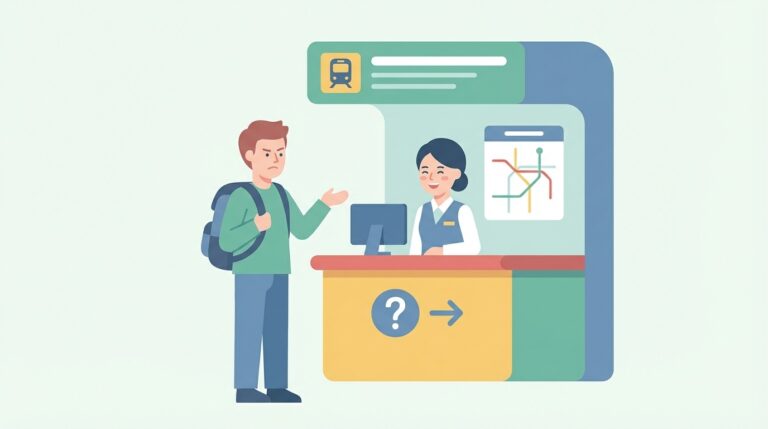
Setting: Friday night, 9:00 PM. The Customer Safety Office (고객안전실) at Gangnam Subway Station. The neon lights buzz outside, but inside the office, it’s quiet.
Characters:
– YOU: A traveler who just realized your wallet is missing after getting off the train.
– Station Staff (역무원 아저씨): A friendly man in his 50s wearing a blue uniform.
역무원: 무슨 일 있으신가요?
(museun il isseusingayo?)
(English) Is something wrong?
(🎭 Stage Direction: He looks up from his desk, noticing your worried face.)
YOU: 저기요… 제가 지갑을 잃어버렸어요.
(jeogiyo… jega jigabeul ileobeoryeosseoyo.)
(English) Excuse me… I lost my wallet.
역무원: 아이고, 어디서 잃어버리셨어요? 지하철 안에서요?
(aigo, eodiseo ileobeorisyeosseoyo? jihacheol aneseoyo?)
(English) Oh no, where did you lose it? Inside the subway?
YOU: 네, 방금 내렸는데 지갑이 없어요.
(ne, banggeum naeryeonneunde jigabi eopseoyo.)
(English) Yes, I just got off, but my wallet isn’t here.
역무원: 지갑 색깔이 뭐예요?
(jigap saekkkari mwoyeyo?)
(English) What color is the wallet?
🔀 Your Turn! How do you answer?
– A) 검은색이에요. (geomeunsaegieyo. / It’s black.)
– B) 안 예뻐요. (an yeppeoyo. / It’s not pretty.)
– C) 돈이 많아요. (doni manayo. / It has a lot of money.)✅ Best Choice: A — You need to describe the appearance clearly! Knowing basic colors in Korean (검은색-Black, 갈색-Brown, 빨간색-Red) is vital for lost items.
⚠️ Choice B & C Analysis: While amusing, this won’t help the staff identify your wallet on their security cameras!
역무원: (Checking his computer) 아, 검은색 지갑요? 잠시만 기다려보세요. 확인해 볼게요.
(a, geomeunsaek jigabyo? jamsiman gidaryeoboseyo. hwaginhae bolgeyo.)
(English) Ah, a black wallet? Please wait a moment. I’ll check.
Phase 6: 10-Second Shadowing Drill
Let’s practice the panic-saver sentence. Pay attention to the pauses!
🥺 저기요, / 제가 지갑을 / 잃어버렸어요.
(jeogiyo, / jega jigabeul / ileobeoryeosseoyo.)
Emotion Tag: Look slightly distressed, soften your voice.
🙏 분실물 센터가 / 어디예요?
(bunsilmul senteoga / eodiyeyo?)
Emotion Tag: Polite, seeking help.
Phase 7: K-Culture Mini Dictionary
| Korean | Romanization | English | Context |
|---|---|---|---|
| 지갑 | jigap | Wallet | Essential travel item. |
| 분실물 센터 | bunsilmul senteo | Lost and Found | Found in stations, malls, and police stations. |
| 신용카드 | sinyongkadeu | Credit Card | Korea is a cashless society; you’ll need to cancel this fast! |
| 경찰서 | gyeongchalseo | Police Station | Korean police stations are very approachable and helpful for lost items. |
| 눈치 | nunchi | Social awareness | Reading the room. Approaching staff politely when they aren’t overly busy. |
Phase 8: Traveler’s Survival Kit
🆘 Survival Phrases TOP 3
– 🇰🇷 “역무실이 어디예요?” (yeongmusiri eodiyeyo?)
– 🗣️ English: Where is the station office?
– 📍 Where to use: Subway stations.
– 🇰🇷 “여기에 지갑 놓고 왔어요.” (yeogie jigap noko wasseoyo.)
– 🗣️ English: I left my wallet here.
– 📍 Where to use: Cafes, restaurants, taxis.
– 🇰🇷 “경찰을 불러주세요.” (gyeongchareul bulleojuseyo.)
– 🗣️ English: Please call the police.
– 📍 Where to use: Extreme emergencies.📌 Editor’s Travel Note
– LOST112: Korea has a centralized national lost and found website/app called ‘LOST112’. If someone turns your wallet into the police, it gets registered here!
– Cards vs Cash: Korea is a card heaven. If you lose your card, call your bank immediately. Apple Pay/Samsung Pay is widely accepted, so your phone can save you if your physical wallet is gone.
Phase 9: Critical Thinking Corner — “One Step Deeper”
Media vs Reality: The Myth of the “Perfect” High-Trust Society
🧠 Think Deeper:
You’ve probably seen viral videos of foreigners leaving their laptops on cafe tables in Seoul. While it’s true that Korea is incredibly safe regarding personal belongings, it’s not just about “good morals.” It’s heavily reinforced by a dense network of CCTVs. In Korea, stealing a wallet left in a cafe means you will almost certainly be caught on camera. However, there is an unspoken rule: while laptops are safe, bicycles and umbrellas are mysteriously fair game!💬 Your Turn: Have you ever lost something in a foreign country? How does the lost-and-found culture in your home country compare to Korea’s? Let us know in the comments!
Phase 10: FAQ & Avoiding Mistakes
Q: Will I actually get my wallet back if I lose it in a Korean taxi?
Yes, very often! If you paid with a credit card, the taxi company can track the specific car you were in. Call the “120 Dasan Call Center” (they have English operators) for help.
❌ Common Mistake #1: Confusing 잊어버리다 and 잃어버리다.
– 잊어버리다 (ijeobeorida): To forget (a fact, a memory).
– 잃어버리다 (ileobeorida): To lose (a physical object).
✅ Do this: If you say “지갑을 잊어버렸어요” (I forgot my wallet), people might think you just left it at home, not that it is missing! Make sure to say “잃어버렸어요.”
Phase 11: Summary & Action Items
- One-Liner Summary: When panic strikes, remember: “지갑을 잃어버렸어요” (I lost my wallet) and head straight to the “분실물 센터” (Lost and Found).
-
Action Mission 3 Steps:
- 🥉 Bronze (Solo): Stand in front of a mirror, look worried, and say “제가 지갑을 잃어버렸어요” 3 times.
- 🥈 Silver (Online): Write down three items you carry every day and look up their Korean names (e.g., 여권 – passport, 핸드폰 – phone).
- 🥇 Gold (Action): Next time you are at a Korean subway station or mall, try to spot the sign that says “분실물 센터”!
- K-Culture Mission:
Watch a K-Drama this week. Try to catch the moment a character says “잃어버렸어!” (I lost it!) when they realize they’ve misplaced something important.
Phase 12: Quiz — Interactive Challenge
1. Situational Judgment: You just finished eating at a Korean BBQ place. You walk outside and realize your wallet is still on the table. You run back in. What do you say to the boss?
– A) 분실물 센터가 어디예요?
– B) 여기에 지갑 놓고 왔어요.
– C) 경찰을 불러주세요.
2. Fill in the Blank:
Excuse me, I lost my wallet.
저기요, 제가 지갑을 [ _________ ]어요.
3. True or False — K-Culture Edition:
In Korea, it is generally considered safe to leave your phone on a cafe table while you go order your drink. (T/F)
(Answers: 1. B – because you left it behind, 2. 잃어버렸, 3. True – thanks to high social trust and CCTVs!)
Frequently Asked Questions (FAQ)
Q: What does "지갑을 잃어버렸어요." mean in Korean and how do you pronounce it?
A: In Korean, "지갑을 잃어버렸어요." is pronounced [jigabeul ileobeoryeosseoyo. [Ji-gap-eul / ee-raw-baw-ryaw-sso-yo] and means: a key conversational Korean expression covered in this lesson.
Q: What does "분실물 센터가 어디예요?" mean in Korean and how do you pronounce it?
A: In Korean, "분실물 센터가 어디예요?" is pronounced [bunsilmul senteoga eodiyeyo? [Boon-shil-mool sen-tuh-ga / uh-dee-ye-yo?] and means: Where is the lost and found center?
Q: What does "제 지갑 보셨어요?" mean in Korean and how do you pronounce it?
A: In Korean, "제 지갑 보셨어요?" is pronounced [je jigap bosyeosseoyo? [Jeh ji-gap / bo-shyuh-sso-yo?] and means: Did you see my wallet?






