Phase 1: Empathy (Immersive Opening)
Hello! I’m the Senior Editor at Daily Hangul.
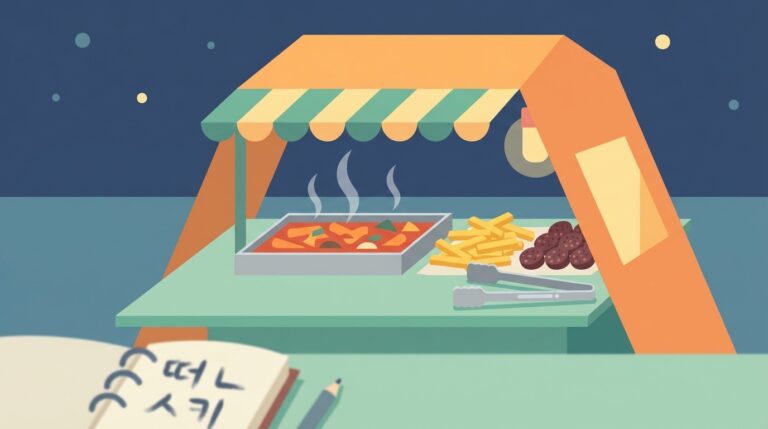
Imagine this: It’s 11 PM in Seoul. You’ve just finished exploring Hongdae, or maybe you’re walking out of an exhilarating K-Pop concert. The night air is slightly chilly, and suddenly, you see it. A glowing orange tent—a Pojangmacha (포장마차)—emitting clouds of warm steam and the irresistible, spicy-sweet aroma of Korean street food.
You step inside. To your left, bubbling red sauce. To your right, crispy golden fries. In K-Dramas, this is exactly where the main characters come to vent about their bosses over a quick bite. You want to order the legendary holy trinity of Korean street food: Tteokbokki (Spicy Rice Cakes), Twigim (Fries), and Sundae (Blood Sausage). But as the busy stall owner looks at you, expecting a rapid-fire order, you freeze.
‘Uh… Tteokbokki one, Twigim one…?’
If you’ve ever felt this panic, you are not alone! Many of my B1 students tell me they just point and nod because street food Korean is so fast-paced. Today, I’ll teach you how to order the iconic ‘Tteok-Twi-Sun’ combo like a true Seoul local. You won’t just get food; you’ll get the ‘insider’ nod of approval from the owner!
Phase 2: Core Expressions Deep Dive
Let’s master the three essential sentences you need under that orange tent.
1. 떡튀순 1인분 주세요 (One serving of Tteok-Twi-Sun, please)
- Pronunciation: tteok-twi-sun il-in-bun ju-se-yo (Say ‘tteok’ like a short ‘duck’ with a tight, hard ‘tt’, ‘twi’ like ‘twee’, and ‘sun’ like ‘soon’)
- Meaning: Literal: Give me one person’s portion of Tteokbokki, Tempura, and Blood Sausage. Real: I want the ultimate street food combo set!
- K-Culture Moment: You say this to the Imo (Auntie) when you sit down. By combining the first syllables of the three foods, you instantly sound like a local who knows what they’re doing.
- Editor’s Insight: Saying the full names separately (‘Tteokbokki, Twigim, Sundae’) screams ‘tourist.’ Koreans love efficiency, especially when hungry!
- Situation Spectrum:
[🚫 Absolutely Not] ———— [⚠️ Caution] ———— [✅ Freely]
- Casual (Friends): ✅ (Just drop ‘juseyo’)
- Semi-formal (Street vendor): ✅
- Formal (Boss/Elders): 🚫 (Too slangy for a formal dinner)
- 🤔 Think About It: Why do Koreans love abbreviating food names so much (like Chi-maek for Chicken & Maekju)? Does your language have food abbreviations?
2. 튀김은 떡볶이 국물에 묻혀주세요 (Please coat the fries in Tteokbokki sauce)
- Pronunciation: twi-gim-eun tteok-bok-kki gung-mul-e mu-chyeo-ju-se-yo (‘muchyeo’ sounds like ‘moo-chuh’)
- Meaning: Literal: Smear the fried food in Tteokbokki broth. Real: Mix the fried food into the spicy sauce for me!
- K-Culture Moment: This is the ultimate K-Food preference test. Some people want their fries clean and crispy. Others want them soaked in the magical red sauce.
- Editor’s Insight: Notice we use the word ‘Gungmul’ (broth/soup) for the Tteokbokki sauce instead of ‘sosu’ (sauce). It just feels more authentic and hearty!
- Situation Spectrum:
- Casual: ✅
- Semi-formal (Street vendor): ✅
- Formal: 🚫
- 🤔 Think About It: Why is sharing sauces or mixing different foods together so common in Korean dining?
3. 순대는 간 빼고 주세요 (Please give me Sundae without the liver)
- Pronunciation: sun-dae-neun gan ppae-go ju-se-yo (‘ppae’ sounds like ‘ppeh’ with a sharp, explosive ‘p’)
- Meaning: Literal: As for Sundae, remove the liver and give. Real: I’ll take the blood sausage, but hold the liver.
- K-Culture Moment: When you order Sundae, it naturally comes with boiled offal—mostly liver (gan) and lungs (heopa). The liver is notoriously dry, and many foreigners (and some Koreans!) find the texture tough to swallow.
- Editor’s Insight: Using ‘~ ppaego juseyo’ (please take out ~) is a golden survival phrase for any food allergy or preference in Korea.
- Situation Spectrum:
- Casual: ✅
- Semi-formal (Street vendor): ✅
- Formal: 🚫
- 🤔 Think About It: In your culture, do you eat offal? How does food texture affect what we consider ‘delicious’?
Phase 3: Textbook vs. Real Korean
| Situation | 📖 Textbook Korean | 🗣️ Real Korean | 💡 Why is it different? |
|---|---|---|---|
| Ordering the three foods | 떡볶이와 튀김과 순대를 주세요. | 떡튀순 1인분요. | Efficiency! Koreans love abbreviating commonly paired items (줄임말). |
| Asking for sauce separately | 소스를 따로 주실 수 있나요? | 국물 따로 주세요. / 찍먹할게요. | ‘Jjik-meok’ (dipping) is a modern cultural slang that perfectly captures the preference. |
| Asking for soup | 어묵 국물을 마셔도 됩니까? | 이모, 오뎅 국물 좀 먹을게요~ | ‘Odeng gungmul’ is free and self-serve. A casual, friendly tone works best at a Pojangmacha. |
Bottom Note: At a B1 level, throwing in a casual ‘Jjik-meok-halgeyo’ (I’ll be dipping) will make the vendor smile!
Phase 4: Cultural Context — K-Culture Deep Dive
4-1. Non-Verbal Pro Tips at the Pojangmacha
When ordering your Twigim (fries), do not point with your fingers or pick them up with your hands! There are always metal tongs resting on the fry tray. You use those tongs to pick the specific pieces you want (like seaweed rolls or sweet potato) and put them in a small basket or hand them directly to the vendor.
4-2. The ‘Bunsik’ Soul Food Connection
Tteok-Twi-Sun falls under the category of Bunsik (분식). Originally meaning ‘flour-based meals’ promoted by the government after the Korean War due to rice shortages, Bunsik has evolved into the ultimate comfort food. In K-Dramas, when high schoolers finish exams or detectives pull an all-nighter, they don’t go to a fancy steakhouse. They go to a Bunsik stall.
Critical View: Have you noticed how red and spicy Korean street food is? Historically, spicy foods became massively popular in Korea during periods of rapid economic growth and high social stress. The capsaicin rush is literally a culturally ingrained stress-relief mechanism!
Phase 5: Real-life Roleplay Scenario
Setting: Friday, 11:30 PM. Outside Exit 9 of Hongdae Station. The biting wind makes you crave something hot. You step into a warm, orange-tented stall. Steam is rising from the fish cake skewers.
Characters:
– YOU: A hungry traveler who knows what they want.
– IMO (이모): The stall owner. 50s, warm but moves at lightning speed.
Dialogue:
IMO: 어서 오세요! 뭐 줄까? 😊
(eoseo oseyo! mwo julkka?)
[Welcome! What can I get you?]
YOU: 안녕하세요! 이모님, 떡튀순 1인분 주세요.
(annyeonghaseyo! imonim, tteok-twi-sun il-in-bun juseyo.)
[Hello! Auntie, one serving of Tteok-Twi-Sun, please.]
IMO: 튀김은 거기 집게로 골라봐요.
(twigim-eun geogi jipge-ro golla-bwayo.)
[Use the tongs over there to pick your fries.]
(🎭 Stage Direction: You pick up a seaweed roll, a squid fry, and a sweet potato fry.)
IMO: 튀김은 떡볶이 국물에 묻혀줄까?
(twigim-eun tteok-bok-kki gung-mul-e mu-chyeo-julkka?)
[Should I coat the fries in the Tteokbokki sauce?]
🔀 Your Turn! How will you answer?
– A) 네, 듬뿍 묻혀주세요! (Yes, coat them generously!)
– B) 아뇨, 따로 주세요. 찍먹할게요! (No, give it separately. I’m going to dip!)
– C) 국물이 뭐예요? (What is soup?)✅ Best Choice: A or B! Depending on your preference. B is a great way to show off your cultural slang knowledge (‘Jjik-meok’).
⚠️ Choice C Analysis: Asking ‘what is broth’ will confuse the fast-paced Imo. Remember, in Bunsik, ‘gungmul’ means the spicy red sauce!
YOU: (Choosing B) 아뇨, 따로 주세요. 찍먹할게요!
(anyo, ttaro juseyo. jjik-meok-halgeyo!)
[No, give it separately. I’ll dip!]
IMO: (Laughs) 알았어. 순대는 내장 다 섞어?
(arasseo. sundae-neun nae-jang da seokkeo?)
[Got it. For the Sundae, should I mix all the offal?]
YOU: 아, 순대는 간 빼고 주세요. 퍽퍽해서요.
(ah, sundae-neun gan ppae-go juseyo. peok-peok-haeseoyo.)
[Ah, for the Sundae, please leave out the liver. It’s too dry.]
IMO: 오케이~ 오뎅 국물은 저기서 종이컵에 떠 먹어요!
(okey~ odeng gungmul-eun jeogi-seo jong-i-keob-e tteo meogeo!)
[Okay~ You can scoop the fish cake soup into a paper cup over there!]
YOU: 네, 잘 먹겠습니다!
(ne, jal meokgesseumnida!)
[Yes, I will eat well!]
Phase 6: 10-Second Shadowing Drill
Speak out loud! Pay attention to the pauses (/) and the feeling.
😊 이모님! / 떡튀순 1인분 / 국물 많이 해서 / 주세요~
(i-mo-nim! / tteok-twi-sun i-rin-bun / gung-mul ma-ni hae-seo / ju-se-yo~)
Tip: Say it brightly, like you’ve been craving this all day! Make the ‘tteok’ sharp and bouncy.
Phase 7: K-Culture Mini Dictionary
| Korean | Romanization | English | Contextual Meaning |
|---|---|---|---|
| 이모님 | imonim | Auntie | Polite, affectionate term for female restaurant staff. Don’t use it in high-end places! |
| 찍먹 / 부먹 | jjik-meok / bu-meok | Dip / Pour | The great Korean debate: Dipping crispy food into sauce vs. Pouring sauce over it. |
| 오뎅 국물 | odeng gungmul | Fish cake broth | Always free at Pojangmacha. Drink it from a paper cup to warm up! |
| 퍽퍽하다 | peok-peok-hada | Dry/Chalky | The exact adjective used to describe the texture of Sundae liver or boiled egg yolks. |
| 포장마차 | pojangmacha | Street food tent | Literally ‘covered wagon’. The heart of Korea’s late-night drinking and snacking culture. |
Phase 8: Traveler Survival Kit
If you’re freezing on the streets of Seoul, remember these lifeline phrases:
🆘 Survival Expression #1: Takeout!
– 🇰🇷 ‘포장해 주세요’ (pojang-hae juseyo)
– 📍 Where to use: Any food stall or restaurant.
– 💡 Pro Tip: Street food is perfectly fine to eat standing up, but if you want to eat in your hotel, just say ‘Pojang!’🆘 Survival Expression #2: Checking the heat
– 🇰🇷 ‘이거 많이 매워요?’ (igeo mani maewoyo?)
– 📍 Where to use: Before committing to that dark red Tteokbokki.🆘 Survival Expression #3: The Free Soup
– 🇰🇷 ‘오뎅 국물 좀 먹어도 돼요?’ (odeng gungmul jom meogeodo dwaeyo?)
– 📍 Where to use: When you want that hot broth. (Usually, you can just take it yourself, but it’s polite to ask first!)
📌 Editor’s Travel Note:
– Payment: While Korea is a cashless society, small street vendors often prefer cash or bank transfers (계좌이체). Always keep a crisp 10,000 KRW bill in your pocket for emergencies!
– Tipping: ZERO. Do not tip the Imo. She will chase you down the street thinking you left your change behind.
Phase 9: Critical Thinking Corner — ‘A Step Deeper’
Food & Identity: The Shared Plate
Why do Koreans love ‘Tteok-Twi-Sun’ served all mixed together on one plate, with everyone dipping their forks into the same red sauce? This isn’t just about saving dishes. It perfectly reflects the Korean concept of Jeong (정) and communal identity (공동체 의식). In Western dining, boundaries between ‘my food’ and ‘your food’ are clear. In Korea, sharing a single messy plate of street food breaks down social barriers and builds intimacy. When you dip your fry into my Tteokbokki sauce, we are no longer just acquaintances; we are ‘We’ (우리).
💬 Your Turn: Does your culture have a dish that is specifically designed to be shared from one big plate? How do people feel about sharing dipping sauces? Let me know in the comments!
Phase 10: FAQ & Avoiding Common Mistakes
Q: Can I call any female staff ‘Imo’?
Mostly yes in casual places like Pojangmacha or BBQ joints, especially if they are middle-aged. However, if they look young or if you’re in a fancy cafe/restaurant, use ‘Sajang-nim’ (Boss) or ‘Jeogiyo’ (Excuse me) instead.
Q: Do I have to pay for the Odeng broth?
No! It’s the best freebie in Korea. You just grab a paper cup and a ladle.
❌ Common Mistake #1: Picking up the Twigim (fries) with your bare hands.
✅ Do this instead: Always use the provided metal tongs to select your food for hygiene reasons.
❌ Common Mistake #2: Asking for ‘half a portion’ (0.5 in-bun).
✅ Do this instead: Street food is cheap, so the minimum is almost always 1-in-bun (1 portion). If you’re full, just order one item instead of the combo.
Phase 11: Summary & Action Items
One-Liner Summary: To rule the Korean street food scene, confidently order ‘Tteok-Twi-Sun 1-in-bun’, customize your sauce, and enjoy the free hot soup!
Action Mission:
– 🥉 Bronze (Solo): Stand in front of a mirror and practice saying ‘Tteok-twi-sun il-in-bun juseyo’ three times with confidence.
– 🥈 Silver (Online): Post on a Korean learning forum or Twitter: ‘I just learned what Tteok-Twi-Sun means! Are you Team 찍먹 or Team 부먹?’
– 🥇 Gold (Real World): Visit a Korean grocery store or K-Town, buy Tteokbokki and Fries, and proudly announce your order!
🇰🇷 K-Culture Mission:
Go on YouTube and search for ‘Tteokbokki Mukbang’ (떡볶이 먹방). Watch how they dip the Twigim into the sauce. Listen carefully—can you hear them say ‘Gungmul’ or ‘Jjik-meok’?
Phase 12: Interactive Quiz
Ready to test your street smarts?
1. Situational Judgment: You love your fried squid super crispy, and you hate soggy food. What should you say to the vendor?
– A) 떡볶이 국물에 묻혀주세요.
– B) 국물 따로 주세요. 찍먹할게요.
– C) 오뎅 국물 주세요.
2. Fill in the Blank: You want the blood sausage, but you really dislike the dry liver.
– ‘순대는 [ ] 빼고 주세요.’
3. True or False – K-Culture Edition:
– ‘It is considered rude to drink the fish cake soup (Odeng gungmul) without paying for it.’ (T / F)
(Answers below!)
Click to reveal answers
1. B (You want it separate so you can dip ‘Jjik-meok’ and keep it crispy! A means ‘coat it in sauce’.)
2. 간 (gan) (Liver! If you say this, you sound like a true local.)
3. False (It is 100% free and expected for you to drink it!)
Frequently Asked Questions (FAQ)
Q: What does "떡튀순 1인분 주세요 (One serving of Tteok-Twi-Sun, please)" mean in Korean and how do you pronounce it?
A: In Korean, "떡튀순 1인분 주세요 (One serving of Tteok-Twi-Sun, please)" is pronounced [tteok-twi-sun il-in-bun ju-se-yo (Say 'tteok' like a short 'duck' with a tight, hard 'tt', 'twi' like 'twee', and 'sun' like 'soon'] and means: Literal: Give me one person's portion of Tteokbokki, Tempura, and Blood Sausage. Real: I want the ultimate street food combo set!
Q: What does "튀김은 떡볶이 국물에 묻혀주세요 (Please coat the fries in Tteokbokki sauce)" mean in Korean and how do you pronounce it?
A: In Korean, "튀김은 떡볶이 국물에 묻혀주세요 (Please coat the fries in Tteokbokki sauce)" is pronounced [twi-gim-eun tteok-bok-kki gung-mul-e mu-chyeo-ju-se-yo ('muchyeo' sounds like 'moo-chuh'] and means: Literal: Smear the fried food in Tteokbokki broth. Real: Mix the fried food into the spicy sauce for me!
Q: What does "순대는 간 빼고 주세요 (Please give me Sundae without the liver)" mean in Korean and how do you pronounce it?
A: In Korean, "순대는 간 빼고 주세요 (Please give me Sundae without the liver)" is pronounced [sun-dae-neun gan ppae-go ju-se-yo ('ppae' sounds like 'ppeh' with a sharp, explosive 'p'] and means: Literal: As for Sundae, remove the liver and give. Real: I'll take the blood sausage, but hold the liver.