

Phase 1: Empathy & Immersion
Hello! Daily Hangul Editor here.
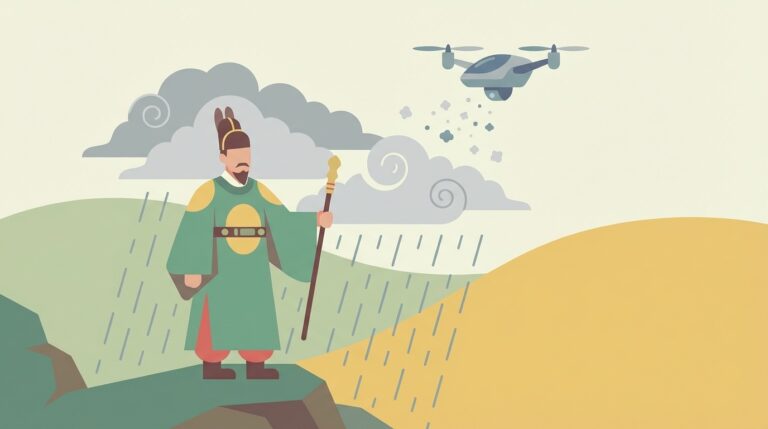
Picture this: You’re watching an epic historical K-Drama. The King, dressed in plain white robes, is kneeling on the parched earth under a scorching sun. He’s begging the heavens for rain to save his starving people. This traditional rain-making ritual is called a 기우제 (Giuje).
Fast forward to 2024. If a severe spring drought hits Korea today, you won’t see the President climbing a mountain to pray. Instead, you’ll see news anchors reporting on high-tech drones and aircraft shooting silver iodide into the clouds. Welcome to the era of 인공강우 (Cloud Seeding / Artificial Rain).
At a C2 (Advanced) level, you already know how to say “비가 안 와서 걱정이에요” (I’m worried because it’s not raining). But to truly integrate into high-level Korean society—whether you’re working at a green-tech NGO in Seoul, debating in a university classroom, or just having a deep, late-night discussion with Korean intellectuals over some Makgeolli—you need the sophisticated vocabulary that native professionals use. You need to grasp the socio-economic impact behind the weather, from skyrocketing Kimchi prices to the relentless battle against fine dust. Let’s upgrade your Korean to master the complex discourse of climate and technology!
Phase 2: Deep Dive into Core Expressions
1. 인공강우 (Artificial Rain / Cloud Seeding)
- Pronunciation: [in-gong-gang-u] (The ‘gong’ and ‘gang’ sound like the ringing of a deep bell, keep the nasal ‘ng’ strong)
- Meaning: Artificial precipitation / Cloud seeding
- K-Culture Moment: You’ll hear this constantly on KBS or JTBC news during the dry spring months. Interestingly, in Korea, artificial rain is often discussed not just to solve droughts, but as a desperate attempt to wash away severe 미세먼지 (Fine Dust) from the atmosphere.
- Editor’s Insight: This is a purely technical and formal term. You wouldn’t use it poetically. It carries a nuance of modern scientific intervention.
- Situation Spectrum:
[🚫 절대 금지] ———— [⚠️ 주의] ———— [✅ 자유롭게]- Casual Chat: ⚠️ (A bit too formal unless you’re debating news)
- Professional Debate/News: ✅
- Academic Writing: ✅
- 🤔 Think About It: Koreans heavily rely on tech to solve environmental issues. Does your country rely more on technological interventions (like cloud seeding) or behavioral changes (like water rationing) during a drought?
2. 가뭄이 해갈되다 (The drought is relieved/quenched)
- Pronunciation: [ga-mu-mi hae-gal-doe-da]
- Meaning: Literally, “thirst is quenched.” Used to mean the drought is resolved.
- K-Culture Moment: Imagine a rural farmer on a documentary, wiping tears of joy as the first heavy rain falls in months. “드디어 가뭄이 해갈되었습니다!”
- Editor’s Insight: 해갈 (解渴) is an advanced Sino-Korean word. While it literally means quenching thirst, it is almost exclusively used for large-scale societal or agricultural relief (like a drought), or metaphorically for a deep psychological relief (e.g., “My curiosity was completely quenched”).
- Situation Spectrum:
[🚫 절대 금지] ———— [⚠️ 주의] ———— [✅ 자유롭게]- Casual Chat: ⚠️ (Too dramatic for everyday thirst)
- Formal Writing/News: ✅
3. 미봉책에 불과하다 (It is merely a stopgap measure)
- Pronunciation: [mi-bong-chae-ge bul-gwa-ha-da]
- Meaning: It’s just a temporary fix / a band-aid solution.
- K-Culture Moment: You’ll see this phrase dominating the comment sections of Naver News or YouTube documentaries when netizens argue about whether cloud seeding is actually solving global warming or just delaying the inevitable.
- Editor’s Insight: This is a powerhouse expression for C2 learners. It instantly elevates your argument. It shows you can critically analyze a policy, not just describe it.
- Situation Spectrum:
[🚫 절대 금지] ———— [⚠️ 주의] ———— [✅ 자유롭게]- Casual: ⚠️ (Too academic)
- Professional/Debate: ✅ (Perfect for striking a critical tone)
Phase 3: Textbook vs. Real Korean
| Situation | 📖 Textbook Korean | 🗣️ Real Korean (C2 Level) | 💡 Why the difference? |
|---|---|---|---|
| Explaining the tech | 과학자들이 비를 만듭니다. (Scientists make rain.) | 인공강우 기술이 실용화 단계에 접어들었습니다. (Cloud seeding tech has entered the commercialization phase.) | C2 speakers use Sino-Korean terms (실용화) to discuss societal applications objectively. |
| Expressing relief | 비가 와서 가뭄이 끝났어요. (It rained so the drought ended.) | 단비가 내려 오랜 가뭄이 해갈되었습니다. (Sweet rain fell, quenching the long drought.) | “단비” (sweet rain) and “해갈” evoke deep emotional and agricultural relief. |
| Criticizing the policy | 이건 좋은 방법이 아닙니다. (This is not a good method.) | 인공강우는 근본적 대책이 아닌 미봉책에 불과합니다. (Cloud seeding is merely a stopgap, not a fundamental solution.) | Using contrasting advanced vocabulary (근본적 대책 vs 미봉책) creates a persuasive, logical argument. |
Bottom Note: At the C2 level, your goal is to master Sino-Korean (Hanja) vocabulary. It transforms your speech from “just communicating” to “commanding respect.”
Phase 4: Cultural Context — K-Culture Deep Dive
4-1. The “Gold Cabbage” Phenomenon (K-Food Connection)
Why do Koreans care so much about droughts? It’s not just about drinking water; it’s about national identity: Kimchi. When a severe drought hits, the cabbage (배추) crop fails. Prices skyrocket. Suddenly, cabbage is so expensive the media dubs it 금배추 (Geum-baechu / Gold Cabbage). You’ll hear people at restaurants sighing, “상추 추가 안 된대, 요즘 금값이잖아” (They won’t give extra lettuce, it’s worth its weight in gold these days). Understanding weather in Korea means understanding the immediate ripple effect on the dining table.
4-2. The Dual Purpose of Rain (Environmental Anxiety)
In many countries, rain is just weather. In Korea, rain is often eagerly anticipated as a natural air purifier. In spring, when the 황사 (Yellow Dust) from the Gobi Desert and 미세먼지 (Fine Dust) blanket the peninsula, Koreans look to the sky praying for a downpour. This is why the debate around cloud seeding isn’t just about agriculture—it’s heavily tied to the intense public demand for clean air.
Phase 5: Real-Life Roleplay Scenario
Setting: A sleek, eco-friendly cafe in Yeouido. It’s 10:00 AM. You’re having a coffee meeting with your Korean colleague, Min-ji, from a Green-Tech startup. You are discussing an article about China and Korea’s recent joint cloud-seeding experiments.
Characters:
– YOU: A foreign expat working as a policy analyst. You have strong opinions on climate change.
– Min-ji (34): A sharp, pragmatic Korean researcher who favors technological solutions.
Dialogue:
Min-ji: (Showing her tablet) 팀장님, 오늘 아침 뉴스 보셨어요? 서해상에서 인공강우 실험을 또 한대요.
(Timjangnim, oneul achim nyuseu bosyeosseoyo? Seohaesaeng-eseo in-gong-gang-u silheomeul tto handaeyo.)
[Did you see the news this morning, team leader? They’re doing another cloud-seeding experiment over the West Sea.]
YOU: 네, 봤어요. 가뭄 해갈이랑 미세먼지 저감이 목적이라고 하더군요.
(Ne, bwasseoyo. Gamum haegalirang misemeonji jeogami mokjeogirago hadeogunyo.)
[Yes, I saw it. I heard the goal is to quench the drought and reduce fine dust.]
Min-ji: 맞아요. 작년 봄 가뭄 때 농가 피해가 워낙 컸잖아요. 기술이 더 발전하면 기후 통제도 어느 정도 가능해질 것 같아요.
(Majayo. Jaknyeon bom gamum ttae nong-ga pihaega wonak keotjanayo. Gisuri deo baljeonhamyeon gihu tongjedo eoneu jeongdo ganeunghaejil geot gatayo.)
[Exactly. The damage to farms during last spring’s drought was massive. If the tech develops further, climate control might become somewhat possible.]
🔀 Your Turn! How do you respond to show your C2 critical thinking skills?
– A) “와, 한국 기술 정말 대단하네요!” (Wow, Korean tech is really amazing! – Too basic and passive.)
– B) “하지만 인공강우는 미봉책에 불과해요. 생태계 교란 같은 부작용도 고려해야 합니다.”
– C) “비 좀 안 온다고 유난이네요.” (You guys are making a fuss over no rain. – Rude and culturally insensitive!)✅ Best Choice: B — “But cloud seeding is merely a stopgap measure. We must also consider side effects like ecosystem disruption.” This response uses advanced vocabulary (미봉책, 생태계 교란) and perfectly sets up a high-level intellectual debate, proving your C2 fluency.
Min-ji: (Nodding seriously) 확실히 은제오딘화물(Silver Iodide)의 환경 오염 논란도 무시할 순 없죠. 딜레마네요 정말.
(Hwaksilhi eunjeodin-hwamul-ui hwangyeong oyeom nollando musihal sun eopjyo. Dillemaneyo jeongmal.)
[Definitely. The controversy over silver iodide’s environmental pollution can’t be ignored. It’s a real dilemma.]
Phase 6: 10-Second Shadowing Drill
Master the pacing and intonation of a professional debate. Follow the pauses (/) and the emotional tone.
😤 단호하고 전문적으로 (Firmly and professionally)
인공강우가 / 가뭄 해갈에 / 도움이 될 수는 있지만, / 궁극적인 해결책은 / 아니라고 봅니다.
(in-gong-gang-u-ga / gamum haegale / doumi doel suneun itjiman, / gunggeukjeogin haegyeolchaegeun / anirago bomnida.)
[Cloud seeding may help relieve the drought, but I do not view it as the ultimate solution.]
Phase 7: K-Culture Mini Dictionary
| 한국어 | Romanization | 영어 | 맥락 설명 |
|---|---|---|---|
| 기우제 | giuje | Rain ritual | A traditional shamanistic or royal ritual praying for rain. Used jokingly today when someone wishes hard for something. |
| 금배추 | geum-baechu | Gold cabbage | Cabbage that has become extremely expensive due to poor harvests caused by extreme weather like droughts or typhoons. |
| 미세먼지 | mise-meonji | Fine dust | Particulate matter pollution. A massive socio-environmental issue in Korea, often linked to the desire for artificial rain. |
| 기상 이변 | gisang ibyeon | Extreme weather events | Abnormal climate phenomena. A key buzzword in Korean environmental policy discussions. |
| 단비 | danbi | Sweet rain | A highly poetic term for welcome rain after a long dry spell. |
Phase 8: Traveler’s Survival Kit
While you might be discussing macro-environmental policies, extreme weather directly impacts everyday life and travel in Korea.
🆘 Survival Expressions for Extreme Weather
– 🇰🇷 “오늘 미세먼지 수치 어때요?” (oneul misemeonji suchi eottaeyo?)
– 🗣️ Meaning: “How is the fine dust level today?”
– 📍 Where to use: Asking hotel staff or Korean friends before planning outdoor activities.
– 💡 Pro Tip: Download the 미세미세 (MiseMise) app. It gives you hyper-local air quality readings using intuitive emojis. If the app shows a black demon face, do not go hiking!📌 Editor’s Travel Note
During severe weather (heatwaves, heavy rain, or severe fine dust), your phone will blare with a 재난문자 (Emergency Alert Text). Don’t panic! It’s an automated system. Just use a translation app to scan it—usually, it’s just advising you to stay indoors or wear a KF94 mask.
Phase 9: Critical Thinking Corner — “One Step Deeper”
🧠 Think Deeper: The “Pali-Pali” Approach to Climate Change
Korean culture is globally famous for its “빨리빨리” (Pali-Pali / hurry up) mindset. This efficiency drives their miraculous economic growth, but how does it reflect in environmental policy? The heavy investment in 인공강우 (cloud seeding) reveals a societal desire for immediate, visible, and technologically driven results. Instead of waiting decades for carbon reduction policies to show effects, the impulse is to “engineer” a solution now. This sparks a fascinating debate between environmental purists who advocate for systemic ecological healing and tech-optimists who believe innovation is the only practical survival tool.
💬 Your Turn: Does your culture prefer slow, fundamental changes (like behavioral shifts) or rapid, high-tech interventions to solve environmental crises? Let me know in the comments!
Phase 10: FAQ & Mistake Prevention
- Q: Can I use “해갈되다” when I am really thirsty after a workout?
- A: 🚫 No! It will sound hilarious, like a king announcing his royal thirst has been quenched by the gods. For personal thirst, just say “갈증이 풀리다” (galjeung-i pullida).
- Q: How do I disagree politely but firmly in a Korean debate?
- A: Never just say “틀렸어요” (You’re wrong). Use the sandwich method: Acknowledge their point with “일리 있는 말씀입니다만…” (That’s a valid point, however…), then deliver your counter-argument using advanced words like “미봉책” (stopgap).
❌ Common Mistake #1: Saying “비를 만들다” (make rain) in an academic setting.
✅ Do this instead: Use “인공강우를 유도하다” (induce artificial rain). It sounds infinitely more professional.
Phase 11: Summary & Action Items
- One-Liner Summary: Elevate your environmental debates by swapping basic descriptions for analytical Sino-Korean terms like 인공강우 (cloud seeding) and 미봉책 (stopgap measure).
-
Action Mission 3 Steps:
- 🥉 Bronze: Read the Shadowing Drill out loud 3 times, focusing on a confident, news-anchor tone.
- 🥈 Silver: Find a Korean YouTube news clip about 기후변화 (climate change) and write a comment using “미봉책”.
- 🥇 Gold: Initiate a conversation with a Korean friend or tutor about the recent weather, asking them if they think tech can solve climate issues.
- K-Culture Mission: Next time you go to a Korean restaurant, check the price of Kimchi or lettuce. If it’s unusually high, casually mention to your Korean friend, “요즘 가뭄이라 완전 금배추네요!” (It’s a drought lately, so it’s totally gold cabbage!). Watch their jaw drop at your cultural fluency.
Phase 12: Quiz — Interactive Challenge
1. Situational Judgment: You are watching a news report about a newly built dam that only holds water for a month before drying up again. What is the most C2-appropriate way to criticize this?
– A) 댐이 안 좋아요. (The dam is not good.)
– B) 이 댐은 가뭄 해갈에 미봉책에 불과합니다. (This dam is merely a stopgap for relieving the drought.)
– C) 비를 더 만들어야 합니다. (We need to make more rain.)
2. True or False — K-Culture Edition:
– In Korea, rain is often seen as a positive event in the spring because it washes away the “Fine Dust” (미세먼지). (T/F)
👀 Click for Answers
- B – “미봉책에 불과합니다” perfectly critiques the inefficiency of the short-term solution.
- True – Spring rains are highly celebrated as they clear the air of severe particulate pollution, often referred to as 단비 (sweet rain).
Frequently Asked Questions (FAQ)
Q: What does "인공강우 (Artificial Rain / Cloud Seeding)" mean in Korean and how do you pronounce it?
A: In Korean, "인공강우 (Artificial Rain / Cloud Seeding)" is pronounced [in-gong-gang-u] and means: Artificial precipitation / Cloud seeding
Q: What does "가뭄이 해갈되다 (The drought is relieved/quenched)" mean in Korean and how do you pronounce it?
A: In Korean, "가뭄이 해갈되다 (The drought is relieved/quenched)" is pronounced [ga-mu-mi hae-gal-doe-da] and means: Literally, "thirst is quenched." Used to mean the drought is resolved.
Q: What does "미봉책에 불과하다 (It is merely a stopgap measure)" mean in Korean and how do you pronounce it?
A: In Korean, "미봉책에 불과하다 (It is merely a stopgap measure)" is pronounced [mi-bong-chae-ge bul-gwa-ha-da] and means: It's just a temporary fix / a band-aid solution.







