

Hello! I am the Lead Editor of Daily Hangul, your veteran tutor and local cultural navigator here in Seoul.
Phase 1: Empathy (Immersive Open)
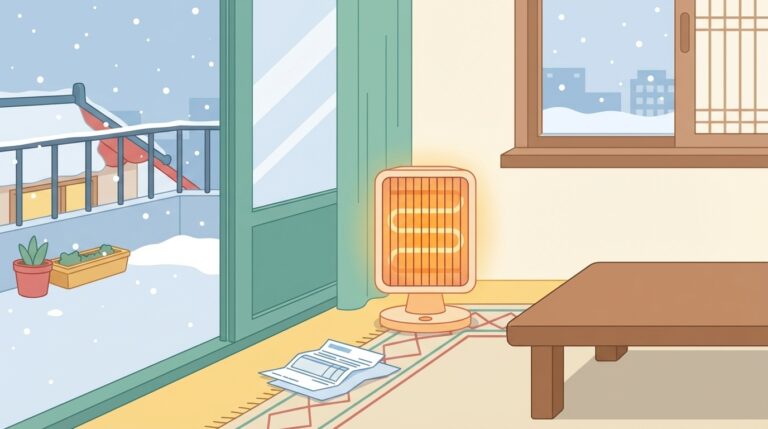
Picture this classic K-Drama scene: The struggling but optimistic protagonist lives in a tiny rooftop room (옥탑방). It’s the middle of a brutal Korean winter, yet they are wearing a giant padded jacket indoors, vigorously rubbing their hands together. Why? They stare at a small piece of paper that just arrived in the mail, letting out a deep sigh.
Is it a rejection letter? A breakup note? No. It’s the dreaded 관리비 명세서 (Utility bill statement).
If you’re studying Korean at a C2 level, you’re no longer just ordering lattes or asking for directions. You are reading Korean news, debating with Korean colleagues, and diving deep into the socio-economic realities of the country. Recently, one of the most hotly debated topics in South Korea is 에너지 정책 (Energy Policy), specifically the 전기 요금 현실화 (normalization of electricity rates) to resolve the massive deficits of public enterprises like KEPCO (Korea Electric Power Corporation).
Why does this matter to you? Because understanding these terms isn’t just about reading the news—it’s about understanding why the air conditioning at your Korean office is strictly locked at 26°C, why your favorite mom-and-pop restaurant raised their prices, and how political language operates in Korea. Let’s dive into the language of real life!
Phase 2: Core Expressions Deep Dive
1. 전기 요금을 현실화하다
- Pronunciation: [jeongi yogeumeul hyeonsilhwahada] + [juhn-gee yo-geum-eul hyun-sheel-hwa-ha-da]
- Meaning: Literal: To make electricity rates realistic. / Real nuance: To raise electricity prices to reflect actual production costs.
- K-Culture Moment: You’ll hear this on every 9 PM news broadcast. Politicians and news anchors use this term when discussing the staggering deficit of KEPCO. It’s a classic political euphemism to avoid the harsh-sounding word “인상” (increase).
- Editor’s Insight: This is top-tier C2 vocabulary. By using “현실화” (realization/normalization), the speaker implies that the current low prices are an “unrealistic” illusion that must be corrected. It sounds objective and inevitable.
- Situation Spectrum:
[🚫 절대 금지] ———— [⚠️ 주의] ———— [✅ 자유롭게]
- Casual with friends: ⚠️ (A bit too formal, unless you’re having a serious debate)
- Semi-formal colleagues: ✅
- Formal/News/Debate: ✅
- 🤔 Think About It: Why do governments worldwide, including Korea, use words like “normalization” instead of “price hike”? Does your native language have a similar euphemism for raising taxes or utility bills?
2. 요금 폭탄을 맞다
- Pronunciation: [yogeum poktaneul matda] + [yo-geum poke-tahn-eul maht-da]
- Meaning: Literal: To be hit by a rate bomb. / Real nuance: To receive an unexpectedly and shockingly high utility bill.
- K-Culture Moment: In August, when the heatwave breaks, Korean internet forums are flooded with posts titled “에어컨 틀었는데 요금 폭탄 맞았어요” (I ran the AC and got hit with a bill bomb). It’s the colloquial, emotional counterpart to the sterile news vocabulary.
- Editor’s Insight: “폭탄” (bomb) is frequently used in Korean to describe sudden, overwhelming influxes of something bad (e.g., 과제 폭탄 – homework bomb, 세금 폭탄 – tax bomb). It perfectly captures the visceral shock of checking your mailbox.
- Situation Spectrum:
[🚫 절대 금지] ———— [⚠️ 주의] ———— [✅ 자유롭게]
- Casual with friends: ✅
- Semi-formal colleagues: ✅
- Formal/Elders: ⚠️ (A bit dramatic for a formal presentation, but fine in conversation)
- 🤔 Think About It: Koreans love dramatic metaphors involving physical impact (맞다 – to be hit). What does this say about how economic pressures are felt on a personal level?
3. 공기업 적자를 메우다 / 해소하다
- Pronunciation: [gonggieop jeokjareul meuda / haesohada] + [gong-gee-up juk-ja-reul meh-oo-da / hae-so-ha-da]
- Meaning: Literal: To fill/resolve the deficit of a public enterprise.
- K-Culture Moment: When K-Pop mega-concerts light up Seoul stadiums, they draw massive power. But the company supplying that power, KEPCO (한국전력), is drowning in “적자” (deficit) because they’ve historically sold electricity below cost to support the “서민 경제” (working-class economy).
- Editor’s Insight: “메우다” means to fill a hole or gap, visualizing the deficit as a physical pit. “해소하다” is slightly more formal, meaning to dissolve or resolve a problem entirely.
- Situation Spectrum:
[🚫 절대 금지] ———— [⚠️ 주의] ———— [✅ 자유롭게]
- Casual with friends: ⚠️ (Too academic for a pub chat)
- Semi-formal colleagues: ✅
- Formal/Business/News: ✅
Phase 3: Textbook vs. Real Korean
| Situation | 📖 Textbook Korean | 🗣️ Real Korean | 💡 Why the difference? |
|---|---|---|---|
| Government announcing a price hike | 정부가 전기 요금을 인상합니다. | 정부가 전기 요금을 현실화합니다. | “현실화” softens the blow, making the hike sound like a logical, unavoidable correction rather than a burden. |
| Getting a huge bill | 전기 요금이 많이 나왔습니다. | 아, 이번 달 전기세 폭탄 맞았어! | Koreans often incorrectly say 전기세 (electricity tax) instead of 요금 (fee), viewing it as an unavoidable state tax. “폭탄” adds dramatic flair! |
| Asking a cafe owner to turn up the AC | 에어컨 좀 강하게 틀어주세요. | 사장님, 에어컨 온도 좀 낮춰주실 수 있나요? | At a C2 level, you know directly demanding things is rude. Always phrase it as a polite question regarding the temperature, not the machine’s power. |
Bottom Note for C2 Learners: Notice how everyday speakers blend economic terms with emotional slang. Mastering this mix is the key to ultimate fluency.
Phase 4: Cultural Context — K-Culture Deep Dive
4-1. Non-verbal Nuance: The “Nunchi” of the AC Controller
In Korean shared spaces—especially offices—the AC remote is an object of intense 눈치 (Nunchi). During summer, the government often issues energy-saving mandates (에너지 절약 지침) requiring public buildings and major corporations to keep indoor temperatures at 26°C to prevent nationwide power grid failures (블랙아웃) and resolve deficits. If you’re sweating, sighing loudly and demanding to lower the AC can be seen as lacking community awareness. You must read the room.
4-2. The K-Food Survival: Restaurants and Utility Costs
If you love K-Food, you’ve probably noticed that traditional Korean restaurants serve endless free side dishes (반찬) and keep massive commercial refrigerators running 24/7 for Kimchi and ingredients. When 전기 요금 현실화 happens, these small business owners (소상공인) take the hardest hit. Often, they won’t raise the price of the main dish (to avoid scaring off loyal customers), but suddenly the “free” soft drink service disappears, or the price of a bottle of Soju jumps from 4,000 to 6,000 won. Energy policy directly dictates the K-Food dining experience.
Phase 5: Practical Role-play Scenario
Scenario A: The Office Dinner Debate
- Setting: Friday evening, 7 PM. A bustling Samgyeopsal restaurant near Gangnam Station. The AC is on, but the doors are wide open, letting the humid summer air in. You are sweating.
- Characters:
- YOU (The Reader): A foreign expat working at a Korean tech firm, currently sweating profusely.
- Min-su (32): Your Korean colleague. Fast-talker, highly opinionated about the news.
- Manager Kim (45): Your boss. Worries a lot about the economy.
Manager Kim: 아유, 날씨가 왜 이렇게 덥냐. 사장님! 여기 에어컨 온도 좀 낮춰주시면 안 될까요?
(Ayu, nalssiga wae ireoke deomnya. Sajangnim! Yeogi eoeokeon ondo jom natchwojusimyeon an doelkkayo?)
[Sigh, why is the weather so hot. Boss! Could you lower the AC temperature a bit here?]
Min-su: 부장님, 요즘 식당들 전기 요금 폭탄 맞아서 에어컨 세게 못 틀어요. 한전 적자 때문에 요금 또 올랐잖아요.
(Bujangnim, yojeum sikdangdeul jeongi yogeum poktan majaseo eoeokeon sege mot teureoyo. Hanjeon jeokja ttaemune yogeum tto ollatjanayo.)
[Manager, restaurants are getting hit with electricity bill bombs these days, so they can’t crank up the AC. The rates went up again because of KEPCO’s deficit, you know.]
Manager Kim: 그놈의 요금 현실화! 적자 메우는 건 이해하는데, 서민 경제가 다 죽게 생겼어.
(Geunomui yogeum hyeonsilhwa! Jeokja meuneun geon ihaehaneunde, seomin gyeongjega da jukge saenggyeosseo.)
[That damn rate normalization! I understand covering the deficit, but the working-class economy is going to die.]
🔀 Your Turn! How do you respond to show off your C2 fluency and empathy?
– A) “맞아요. 한국전력의 재무 상태가 심각합니다.” (True, KEPCO’s financial status is serious.)
– B) “그러게 말이에요. 이번 달 저희 집 관리비 명세서 보고 저도 기절하는 줄 알았어요.”
– C) “더워 죽겠는데 정부가 문제네요!”✅ Best Choice: B — “You’re telling me! I almost passed out looking at my utility bill this month.” This shows high-level empathy, uses natural conversational flow (그러게 말이에요), and grounds the macro-economic policy into a relatable personal K-Culture experience (관리비 명세서).
⚠️ Choice A Analysis: Grammatically perfect, but sounds like a news anchor. Kills the casual dinner vibe.
⚠️ Choice C Analysis: Too aggressive and political for a work dinner. Keep it light and relatable.
Scenario B: Airbnb Survival
You rented a cute K-Drama-style rooftop Airbnb for a month in Seoul.
Host: 외출하실 때는 보일러 꼭 ‘외출’로 돌려주세요. 안 그러면 요금 폭탄 나와요~!
(Oechulhasil ttaeneun boilleo kkok ‘oechul’lo dollyeojuseyo. An geureomyeon yogeum poktan nawayo~!)
[When you go out, make sure to set the boiler to ‘Away’ mode. Otherwise, you’ll get a bill bomb~!]
YOU: 아, 네! 명심할게요. 혹시 관리비는 방세에 포함인가요?
(Ah, ne! Myeongsimhalgeyo. Hoksi gwallibineun bangse-e pohamingayo?)
[Ah, yes! I’ll keep that in mind. By the way, are the utility/maintenance fees included in the rent?]
Phase 6: 10-Second Shadowing Drill
Master the rhythm and emotion of a C2 Korean speaker.
😤 이번 / 전기 요금 현실화로 인해 / 서민 경제가 / 큰 타격을 / 입을 것으로 보입니다.
(ibeon / jeongi yogeum hyeonsilhwaro inhae / seomin gyeongjega / keun tagyeogeul / ibeul geoseuro boimnida.)
“Due to this normalization of electricity rates, the working-class economy is expected to take a heavy hit.”
Editor’s Tip: Pause exactly at the slashes. Emphasize 현실화 and 타격 to sound like a professional news pundit.
Phase 7: K-Culture Mini Dictionary
| 한국어 | Romanization | English | Context |
|---|---|---|---|
| 누진세 | nujinse | Progressive tax/rate | The system where the more electricity you use, the exponentially higher the rate per kilowatt becomes. The ultimate fear of Koreans in summer. |
| 한전 | Hanjeon | KEPCO | Abbreviation for 한국전력공사 (Korea Electric Power Corp). Often the main subject of news regarding utility deficits. |
| 관리비 | gwallibi | Maintenance/Utility fee | Paid monthly in apartments and officetels. Includes electricity, water, internet, and building upkeep. |
| 짠테크 | jjanteukeu | Penny-pinching tech | A modern slang combining ‘짠’ (stingy) and ‘재테크’ (investment). Unplugging appliances to save 1,000 won a month is a form of 짠테크. |
Phase 8: Traveler Survival Kit
Even if you’re just visiting, energy policies affect your stay!
🆘 Survival Expression #1: Dealing with Airbnbs
– 🇰🇷 “보일러 외출 모드는 어떻게 설정하나요?” (boilleo oechul modeuneun eotteoke seoljeonghanayo?)
– 🗣️ Sound-alike: [bo-il-ler oh-chool mo-deu-neun uh-tuh-keh sul-jung-ha-na-yo?]
– 📍 Where to use: Texting your Airbnb host.
– 💡 Pro Tip: Korean floor heating (온돌 – Ondol) is amazing, but leaving it on full blast while you’re touring Myeongdong will result in a furious host who got a “요금 폭탄.”📌 Editor’s Travel Note
– Cafe Culture: In summer, if you sit right under the AC in a cafe, it might be freezing. Don’t ask them to turn it off completely; ask if they have a “담요” (blanket). Most Korean cafes provide them for free!
Phase 9: Critical Thinking Corner — “A Step Deeper”
🧠 Think Deeper: Language & Power (The Euphemism of Policy)
At a C2 level, you must analyze how language is used to wield power. The term 전기 요금 현실화 (Normalization/Realization of electricity rates) is a prime example of political framing. By calling an outright price hike a “realization,” the government distances itself from the blame. It subtly implies to the public: “The prices you were enjoying were artificially low; we are merely returning things to reality.” It shifts the narrative from a punitive ‘tax increase’ to an inevitable ‘economic correction.’ Mastering advanced Korean means not just understanding the dictionary definition, but seeing the invisible political shields built into words.
💬 Your Turn: Does your country’s government use specific words to soften the blow of price hikes or budget cuts? Share them in the comments!
Phase 10: FAQ & Avoiding Misunderstandings
Q: Can I use “폭탄을 맞다” (hit by a bomb) in a corporate email?
A: No. While it’s common in speech, in formal writing, it sounds highly unprofessional. Use “요금이 급증하다” (rates surged) instead.
Q: Why do Koreans say “전기세” (electricity tax) when it’s actually “전기 요금” (electricity fee)?
A: Great observation! Historically, public utilities were heavily state-controlled, so people mentally categorized them alongside taxes. While “요금” is technically correct, 90% of Koreans say “전기세” in daily life.
❌ Common Mistake: Complaining to a store clerk about the AC temperature by saying, “에어컨 좀 켜!” (Turn on the AC!)
✅ Do This Instead: Say, “실례하지만, 에어컨 온도 좀 낮춰주실 수 있나요?” (Excuse me, could you lower the AC temperature?). Store clerks often have strict guidelines from the owner regarding utility costs, so be polite!
Phase 11: Summary & Action Items
One-Liner Summary: To master advanced Korean, understand how economic policies like “전기 요금 현실화” manifest in everyday life as “요금 폭탄.”
Action Mission 3 Steps:
– 🥉 Bronze (Solo): Read the 10-second shadowing sentence aloud 3 times, focusing on the serious “news anchor” tone.
– 🥈 Silver (Online): Go to Naver News, search “한전 적자” (KEPCO deficit), and read the headline of one article.
– 🥇 Gold (Real Life): Next time you pay a bill or see an expensive price, playfully say to a Korean friend, “완전 폭탄 맞았어!” (I totally got hit with a bomb!).
K-Culture Mission: Watch any K-Drama featuring a protagonist who is struggling financially. Pay close attention to scenes where they look at mail or talk to their landlord. You will 100% hear the word “관리비” (maintenance fee) or “밀렸다” (overdue)!
Phase 12: Quiz — Interactive Challenge
1. Fill in the Blank:
정부가 한전의 ( ____ )를 메우기 위해 전기 요금 ( ____ ) 방안을 발표했습니다.
A) 적자 / 현실화
B) 흑자 / 인하
C) 요금 / 폭탄
2. Situational Judgment:
You received your first utility bill for your Seoul apartment in August, and it’s 300,000 won! What is the most natural, native-like text to send your Korean friend?
A) 나의 전기 요금이 비현실적입니다.
B) 한국전력공사의 적자가 심각하네요.
C) 야, 나 이번 달 전기세 폭탄 맞았어 ㅠㅠ
3. True or False (K-Culture Edition):
“누진세” (Progressive tax) means that electricity gets cheaper the more you use it, encouraging mass consumption.
(Answers: 1. A, 2. C, 3. False – 누진세 means the rate jumps significantly as you use more, which is why Koreans are terrified of leaving the AC on!)
Frequently Asked Questions (FAQ)
Q: What does "전기 요금을 현실화하다" mean in Korean and how do you pronounce it?
A: In Korean, "전기 요금을 현실화하다" is pronounced [jeongi yogeumeul hyeonsilhwahada] and means: Literal: To make electricity rates realistic. / Real nuance: To raise electricity prices to reflect actual production costs.
Q: What does "요금 폭탄을 맞다" mean in Korean and how do you pronounce it?
A: In Korean, "요금 폭탄을 맞다" is pronounced [yogeum poktaneul matda] and means: Literal: To be hit by a rate bomb. / Real nuance: To receive an unexpectedly and shockingly high utility bill.
Q: What does "공기업 적자를 메우다 / 해소하다" mean in Korean and how do you pronounce it?
A: In Korean, "공기업 적자를 메우다 / 해소하다" is pronounced [gonggieop jeokjareul meuda / haesohada] and means: Literal: To fill/resolve the deficit of a public enterprise.







