

Phase 1: Empathy (Immersive Open)
Hello! I’m the lead editor of Daily Hangul. Welcome back to another deep dive into the Korean language!
Imagine this: You are watching a Korean League of Legends stream or a Chzzk (Naver’s streaming platform) broadcast. The streamer pulls off an impossible play, the Nexus explodes, and the chat goes absolutely ballistic. A text-to-speech voice rings out with a donation message, and the streamer screams in excitement. Or perhaps you are a digital marketer trying to negotiate a sponsorship deal with a major Korean MCN (Multi-Channel Network) agency. You open their media kit, and instead of standard business Korean, you are hit with words that look entirely alien.
As a C1 (Upper-Intermediate/Advanced) learner, you’ve probably mastered textbook business Korean and polite forms. But the Korean e-sports, game streaming, and MCN industries operate on an entirely different linguistic frequency. It’s a fast-paced world where internet subculture dictates mainstream trends. If you try to use textbook vocabulary here, you might sound like a news anchor at a hip-hop concert.
Today, we are going to bridge that gap. This guide is built on real questions from advanced learners who wanted to understand the hyper-dynamic world of Korean digital creators. Let’s level up!
Phase 2: Core Expressions Deep Dive
Let’s unpack the essential vocabulary that drives the Korean streaming and MCN economy.
1. 도네를 쏘다 / 별풍을 쏘다
- Pronunciation: done-reul ssoda / byeolpung-eul ssoda [sounds like: do-neh-rul sso-dah]
- Meaning: (Literal) To shoot a donation / to shoot a star balloon. (Real nuance) To send a monetary tip or Super Chat to a streamer.
- K-Culture Moment: You’re watching a stream, and a viewer sends 100,000 won. The chat fills with “오오오!” and the streamer bows deeply to the camera.
- Editor’s Insight: Why “shoot” (쏘다)? In Korean, “쏘다” is the same dynamic verb used when treating someone to a meal (e.g., “오늘 저녁은 내가 쏠게!” – I’ll shoot/treat tonight’s dinner!). It implies an active, generous, and slightly showy action. “별풍(선)” refers to Star Balloons, the original tipping currency of AfreecaTV, which revolutionized Korean internet broadcasting.
- Situation Spectrum:
[🚫 Formal] ———— [⚠️ Semi-formal] ———— [✅ Casual]
- Chatting with gaming friends: ✅
- Marketing meeting with MCN (referring to audience behavior): ⚠️ (Use “후원하다” instead)
- Official corporate press release: 🚫
- 🤔 Think About It: Does your native language use a dynamic verb like “shoot” for digital tipping, or something more passive like “give” or “donate”? What does this say about the ‘performative’ nature of tipping in Korean streams?
2. 합방 (합동 방송)
- Pronunciation: hap-bang [sounds like: hap-bahng]
- Meaning: (Literal) Joint broadcast. (Real nuance) A collaboration stream where two or more creators broadcast together.
- K-Culture Moment: Two rival gaming streamers suddenly announce a “합방” to play a horror game together. The fans from both sides flood the chat, bringing massive synergy.
- Editor’s Insight: This is the lifeblood of MCN agencies. While corporate settings use terms like “협업” (collaboration) or “제휴” (partnership), the creator world exclusively uses “합방.” It originally meant ‘sharing a room’ but has been entirely repurposed for the digital age.
- Situation Spectrum:
[🚫 Formal Business outside MCN] ———— [✅ MCN Agency Meeting] ———— [✅ Casual]
- Fans talking about creators: ✅
- MCN pitch to a game company: ✅ (Industry standard term)
- Traditional corporate email (e.g., Samsung & Hyundai partnering): 🚫
- 🤔 Think About It: Korean loves abbreviating four-syllable concepts into two syllables for efficiency (합동 방송 -> 합방). Can you think of other Korean abbreviations you’ve encountered?
3. 채팅창 민심
- Pronunciation: chaeting-chang min-sim [sounds like: cheh-ting-chang meen-sheem]
- Meaning: (Literal) The public sentiment of the chat window. (Real nuance) The overall mood, reaction, or approval rating of the live viewers.
- K-Culture Moment: A streamer makes a controversial joke, and the chat instantly floods with question marks (????). The streamer realizes their mistake and says, “아, 채팅창 민심 안 좋네요. 죄송합니다!” (Ah, the chat’s sentiment is bad. I apologize!)
- Editor’s Insight: This is my favorite C1 expression. “민심” (Min-sim) is a heavy, historical word meaning “the hearts of the people,” traditionally used to describe a king’s or politician’s approval rating. Using this grand political term for a Twitch/Chzzk chat room is a hilarious, uniquely Korean internet exaggeration that shows how much power viewers hold.
- Situation Spectrum:
[🚫 Formal] ———— [⚠️ Semi-formal] ———— [✅ Casual]- 🤔 Think About It: Why do you think Korean streamers treat their chat room like a political constituency? How does this reflect the “Nunchi” culture in Korea?
4. 숙제 방송 (숙제방)
- Pronunciation: suk-je bang-song [sounds like: sook-jeh bahng-song]
- Meaning: (Literal) Homework broadcast. (Real nuance) A sponsored/paid promotional stream.
- K-Culture Moment: A popular RPG streamer turns on the camera wearing a specific energy drink brand’s t-shirt. The title of the stream is “[숙제] 몬스터 사냥” ([Homework] Monster Hunting).
- Editor’s Insight: Streamers call sponsored streams “homework” because it’s an obligatory task they must complete to earn their paycheck, much like schoolwork. Viewers lovingly accept this because they want their favorite creator to make money, often commenting “숙제 열심히 해라!” (Do your homework well!).
- Situation Spectrum:
[🚫 Official Contracts] ———— [✅ Casual/Stream titles] ———— [✅ Casual]
Phase 3: Textbook vs. Real Korean in MCN Business
When you step into a Korean MCN agency or talk to a creator, the vocabulary shifts dramatically.
| Situation | 📖 Textbook / Traditional Business | 🗣️ Real Creator / MCN Industry | 💡 Why the difference? |
|---|---|---|---|
| Sponsored Content | 스폰서십 방송 (Sponsorship broadcast) | 숙제 방송 (Homework stream) | “Homework” adds a relatable, self-deprecating humor, removing the cold corporate feel. |
| Collaboration | 협업 / 콜라보레이션 (Collaboration) | 합방 (Collab stream) | Efficiency. The fast-paced digital world prefers two-syllable punchy words. |
| Exaggerated Marketing | 과장 광고 (Exaggerated ad) | 어그로 끌기 (Pulling aggro) | Adopted from MMORPG gaming mechanics (drawing monster aggro) to mean “clickbait.” |
| Earning Revenue | 수익 창출 (Revenue generation) | 수금 타임 (Money collection time) | Streamers joke about “collecting taxes/money” from fans to create a playful dynamic. |
| Viewer Reaction | 시청자 반응 (Viewer reaction) | 채팅창 민심 (Chat sentiment) | Elevates the viewer’s status to “the public,” showing deep respect for community mood. |
Bottom Note for C1 Learners: In an MCN business meeting, you can freely use “합방” and “어그로,” but use “숙제” with caution. It’s better to use “브랜디드 콘텐츠” (Branded Content) in formal documents.
Phase 4: Cultural Context — K-Culture Deep Dive
4-1. The Non-Verbal “Nunchi” of Live Streaming
Live streaming in Korea is an extreme sport of 눈치 (Nunchi). A successful streamer must read the “민심” (sentiment) of thousands of people in real-time. If the chat is moving too fast, or if the “물타기” (bandwagoning—when everyone suddenly agrees on one joke or criticism) turns negative, the streamer must instantly change their tone, apologize, or shift the topic. It’s micro-nunchi on a macro scale.
4-2. The PC Bang Root of E-Sports
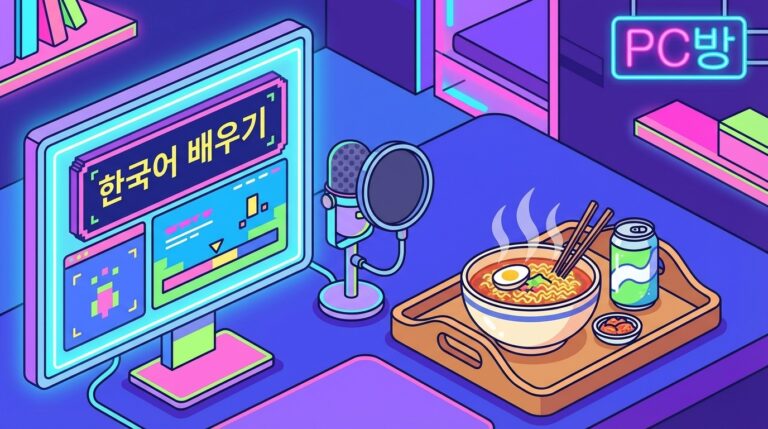
Korean gaming and streaming culture cannot be explained without the PC 방 (PC Bang / Internet Cafe). Unlike Western gamers who traditionally played in isolated bedrooms, Korean gaming grew in the highly social, competitive, and loud environments of PC Bangs. This is why Korean streamers are so loud, highly energetic (“저세상 텐션” – out-of-this-world tension), and constantly interacting. The stream is simply a digital extension of the PC Bang where friends sit shoulder-to-shoulder, eating Ramyeon, and shouting at the monitor.
Phase 5: Real-World Roleplay Scenario
Setting: A sleek MCN agency meeting room in Gangnam. Iced Americanos are on the table. You are the Global Marketing Manager for a new mobile game, looking to sponsor a top Korean streamer.
Characters:
– YOU (The Reader): Confident, Korean-speaking expat marketer.
– Team Leader Park (박 팀장): A 35-year-old Korean MCN representative. Sharp, friendly, but a tough negotiator.
Dialogue:
박 팀장: 먼 길 오시느라 고생하셨습니다. 이번 신작 게임, 반응이 아주 뜨겁더라고요!
(meon gil osineura gosaenghaseotseumnida. ibeon sinjak geim, baneung-i aju tteugeopdeoragoyo!)
[English] Thank you for coming all this way. I heard the response to your new game is very hot!
YOU: 감사합니다. 그래서 저희가 이번에 ‘김게이머’ 님과 꼭 브랜디드 콘텐츠를 진행하고 싶어서요.
(gamsahamnida. geuraeseo jeohuiga ibeon-e ‘Kim-gamer’ nim-gwa kkok beuraendideu kontencheu-reul jinhaenghago sipeoseoyo.)
[English] Thank you. That’s why we really want to proceed with branded content with ‘Kim-gamer’.
박 팀장: 아, 김게이머 님이 요즘 폼이 미쳤죠. 텐션도 좋고, 채팅창 민심도 최고입니다.
(a, Kim-gamer nim-i yojeum pom-i micheotjyo. tensyeon-do jotgo, chaeting-chang minsim-do choego-imnida.)
[English] Ah, Kim-gamer is in crazy form these days. His energy is great, and the chat sentiment is the best.
YOU: 맞아요. 저희 게임 타겟층이랑 딱 맞습니다. 혹시 다른 스트리머 분과 합방도 가능할까요?
(majayo. jeohui geim taget-cheung-irang ttak matseumnida. hoksi dareun seuteurimeo bun-gwa hapbang-do ganeunghalkkayo?)
[English] Exactly. He perfectly fits our game’s target audience. By any chance, is a collab stream with another streamer possible?
박 팀장: 합방 좋죠! 시너지 효과가 엄청날 겁니다. 그런데 숙제 방송이라서 단가가 조금 높습니다.
(hapbang jotjyo! sineoji hyogwa-ga eomcheongnal geomnida. geureonde sukje bangsong-iraseo danga-ga jogeum nopseumnida.)
[English] A collab stream is great! The synergy will be massive. However, since it’s a sponsored (homework) stream, the unit price is a bit high.
YOU: 대략적인 견적이 어떻게 될까요?
(daeryakjeog-in gyeonjeog-i eotteoke doelkkayo?)
[English] What would be the rough estimate?
박 팀장: 2시간 합방 기준으로 3천만 원 생각하시면 됩니다.
(2-sigan hapbang gijun-euro 3-cheonman won saenggakasimyeon domnida.)
[English] For a 2-hour collab stream, you should expect around 30 million won.
🔀 Your Turn! It’s slightly over budget. How do you respond politely but firmly?
– A) “너무 비싸요! 깎아주세요.” (Too expensive! Give me a discount.)
– B) “예산이 조금 오버되네요. 혹시 유튜브 하이라이트 편집본 포함해서 그 가격에 맞춰주실 수 있나요?”
– C) “그냥 안 할게요. 다음에 뵙겠습니다.”✅ Best Choice: B — “The budget is a bit over. Could you possibly include a YouTube highlight edited version for that price?”
Why? In Korean B2B negotiations, directly saying “it’s too expensive” (A) or walking away instantly (C) kills the vibe. Asking for “value adds” (like YouTube VOD rights) while acknowledging their price is the C1-level “Pro” move.
YOU: (You chose B) 예산이 조금 오버되네요. 혹시 유튜브 하이라이트 편집본 업로드까지 포함해서 그 가격에 맞춰주실 수 있나요?
(yesan-i jogeum obeodoeneyo. hoksi yutyubeu hairait-eu pyeonjip-bon eomnocheu-kkaji pohamhaeseo geu gagyeok-e matchwojusil su itnayo?)
박 팀장: (Smiling) 역시 협상의 달인이시네요. 좋습니다. 저작권 문제만 깔끔하게 정리하면 그렇게 가시죠.
(yeoksi hyeopsang-ui darin-isineyo. jotseumnida. jeojakgwon munje-man kkalkkeumhage jeongrihamyeon geureoke gasijyo.)
[English] As expected, you are a master of negotiation. Sounds good. As long as we clear up the copyright issues, let’s go with that.
YOU: 완벽합니다. 그럼 계약서 초안 보내드리겠습니다!
(wanbyeokamnida. geureom gyeyakseo choan bonaedeurigetseumnida!)
[English] Perfect. I will send over the draft contract then!
Phase 6: 10-Second Shadowing Drill
Let’s practice pitching an idea like a true Korean MCN executive. Pay attention to the pauses (/) and the energy!
😊 저희 / 크리에이터 분들 / 텐션이 / 장~~난 아니거든요!
(jeohui / keurieiteo bundeul / tensyeon-i / jangnan anigeodeunyo!)” to emphasize how great it is, and say it with bright, persuasive energy.
Our creators’ energy level is absolute~~~ly insane!
Tip: Stretch out the “장
Phase 7: K-Culture Mini Dictionary
Must-know streamer and MCN vocabulary for the digital age:
| Korean | Romanization | English | Context |
|---|---|---|---|
| 어그로 | eogeuro | Aggro / Clickbait | Originally from gaming (drawing monster aggro), now used to mean doing something provocative to get attention. |
| 떡상 | tteoksang | Skyrocketing | When a channel’s subscribers or a video’s views suddenly explode. (Opposite: 떡락 – plunging). |
| 뇌절 | noejeol | Crossing the line / Overdoing a joke | A gaming term (from Naruto) now used when someone repeats a joke until it becomes annoying. |
| 방종 | bangjong | Stream End | Short for 방송 종료 (Broadcast end). Fans type “방종 ㅂㅂ” when the stream is over. |
| 소통 방송 | sotong bangsong | Just Chatting | A stream dedicated solely to reading the chat and talking with viewers. |
Phase 8: Traveler Survival Kit (PC Bang Edition)
If you want to understand Korean e-sports, you MUST visit a PC Bang. Here is your C1 survival kit for navigating Korea’s legendary gaming cafes.
🆘 Survival Expression #1: Asking for Time
– 🇰🇷 “여기 비회원으로 로그인 어떻게 해요?” (yeogi bihoewon-euro rogeuin eotteoke haeyo?)
– 🗣️ Meaning: How do I log in as a non-member here?
– 📍 Usage: Kiosks at the PC Bang entrance.🆘 Survival Expression #2: Food Ordering
– 🇰🇷 “사장님, 자리에서 음식 주문하면 가져다주시나요?” (sajangnim, jari-eseo eumsik jumunhamyeon gajyeodajusinayo?)
– 🗣️ Meaning: Boss, if I order food from my seat, do you bring it over?
– 💡 Pro Tip: In modern PC Bangs, you order everything (Ramyeon, iced tea, hotdogs) directly through the PC screen interface. No need to walk to the counter!📌 Editor’s Travel Note
– Create an Account: If you plan to go often, ask a Korean friend to help you make an account (회원). Member prices are significantly cheaper than non-member (비회원) prices.
– Voice Chat: It’s totally fine to talk loudly on Discord/voice chat in a PC Bang. In fact, it’s expected! Just don’t scream profanities.
Phase 9: Critical Thinking — “One Step Deeper”
Global Era: The Mainstreaming of Subculture Slang
🧠 Think Deeper:
In the past, Korean language authorities strictly separated “standard broadcast language” (표준어) from “internet slang” (인터넷 은어). However, with the massive success of YouTube and Twitch/Chzzk, the lines have blurred. Terms like “어그로” (Aggro), “텐션” (Tension/Energy), and “폼 미쳤다” (Crazy form) are now regularly used by celebrities on national television networks like KBS and MBC. This shows a massive shift in linguistic power: language is no longer dictated top-down by the government or news anchors, but bottom-up by gamers, streamers, and their communities. It raises a fascinating debate: Does incorporating gaming slang enrich the Korean language with modern creativity, or does it erode the polite, structural beauty of traditional Korean?💬 Your Turn: Does internet and gaming slang make its way onto national TV in your country? Do people complain about it, or is it embraced? Share your thoughts in the comments!
Phase 10: FAQ & Mistake Prevention
Q: Can I use “숙제” (Homework) in a normal business meeting to mean ‘sponsored project’?
No! If you are at Samsung talking about a marketing project, do NOT call it “숙제.” They will think you are treating the job like a middle school assignment. It is ONLY used in the MCN and creator industry.
Q: If I meet a famous streamer, can I speak to them in Banmal (informal language) like I do in the chat room?
No. The chat room has a unique parasocial dynamic where viewers use Banmal to feel close. However, in real life (오프라인), you must treat them like a normal stranger and use polite language (존댓말).
❌ Common Mistake #1: Translating the English gaming insult “Troll” directly.
✅ Do this instead: Koreans don’t usually say “트롤” (though some do in LoL). They prefer “빌런” (Villain) or “트롤링하다” (To be trolling). In streaming, a viewer who causes trouble is often called an “어그로꾼” (Aggro-puller).
Phase 11: Summary & Action Items
One-Liner Summary: To master Korean MCN and streaming business, you must speak the language of the chat room—embracing words like 합방 (Collab), 어그로 (Aggro), and 민심 (Sentiment).
Action Mission 3-Step:
– 🥉 Bronze: Say “저세상 텐션!” out loud when you drink your morning coffee today.
– 🥈 Silver: Go to a Korean YouTube gaming video and read the comments. Try to spot the word “합방” or “숙제.”
– 🥇 Gold: Use “합방” or “시너지” in your next conversation when discussing a collaboration or group project with your Korean peers.
K-Culture Mission:
Visit Chzzk (Naver’s streaming platform) or AfreecaTV. Click on any top stream with thousands of viewers. Spend 5 minutes just watching the chat scroll by. Can you sense the “민심”?
Phase 12: Quiz — Interactive Challenge
1. Situational Judgment: You are an MCN manager. Your creator just made a terrible joke on stream, and the viewers are angry. What should you text your creator?
– A) “빨리 방종하세요!” (End the stream quickly!)
– B) “숙제 열심히 하세요!” (Do your homework!)
– C) “채팅창 민심이 안 좋아요. 빨리 사과하세요!” (Chat sentiment is bad. Apologize quickly!)
(Answer: C – You need to warn them about the Min-sim.)
2. Fill in the Blank:
“이번에 A유튜버와 B유튜버가 같이 방송한대! 완전 역대급 _____이/가 될 것 같아!”
– A) 어그로 (Aggro)
– B) 합방 (Collab)
– C) 방종 (Stream end)
(Answer: B – Joint broadcast/collaboration is called 합방.)
3. True or False – K-Culture Edition:
In a Korean PC Bang, you must walk to the front counter to order your Ramyeon and pay in cash.
(Answer: False. Modern PC Bangs let you order everything directly from your computer screen, and you pay either via an app or when you leave!)
Frequently Asked Questions (FAQ)
Q: What does "도네를 쏘다 / 별풍을 쏘다" mean in Korean and how do you pronounce it?
A: In Korean, "도네를 쏘다 / 별풍을 쏘다" is pronounced [done-reul ssoda / byeolpung-eul ssoda [sounds like: do-neh-rul sso-dah] and means: (Literal) To shoot a donation / to shoot a star balloon. (Real nuance) To send a monetary tip or Super Chat to a streamer.
Q: What does "합방 (합동 방송)" mean in Korean and how do you pronounce it?
A: In Korean, "합방 (합동 방송)" is pronounced [hap-bang [sounds like: hap-bahng] and means: (Literal) Joint broadcast. (Real nuance) A collaboration stream where two or more creators broadcast together.
Q: What does "채팅창 민심" mean in Korean and how do you pronounce it?
A: In Korean, "채팅창 민심" is pronounced [chaeting-chang min-sim [sounds like: cheh-ting-chang meen-sheem] and means: (Literal) The public sentiment of the chat window. (Real nuance) The overall mood, reaction, or approval rating of the live viewers.
Q: What does "숙제 방송 (숙제방)" mean in Korean and how do you pronounce it?
A: In Korean, "숙제 방송 (숙제방)" is pronounced [suk-je bang-song [sounds like: sook-jeh bahng-song] and means: (Literal) Homework broadcast. (Real nuance) A sponsored/paid promotional stream.







