

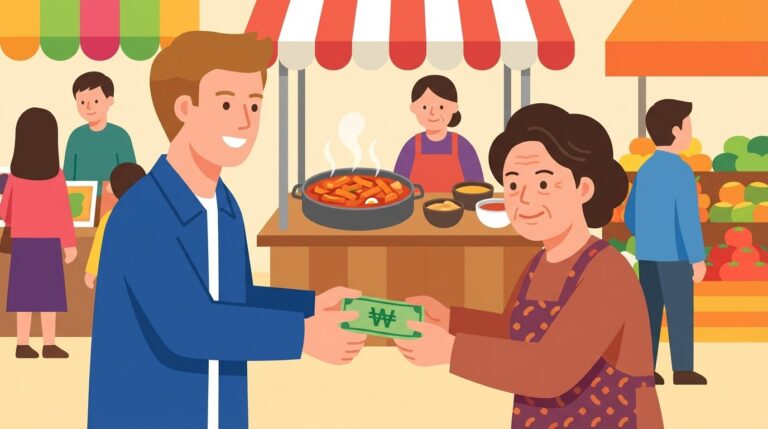
Hello! I am your Daily Hangul Editor.\n\nHave you ever seen this classic K-Drama scene? The main characters are wandering through a bustling traditional market (like Gwangjang or Namdaemun). They stop at a steaming street food stall, grab a skewer of fish cake (eomuk), and the protagonist coolly pulls out a crumpled 10,000 won bill to pay the smiling ‘Imo’ (Auntie). \n\nAs a tourist, you might think: “Wait, I heard Korea is a completely cashless society! Can I just use my credit card?” \n\nWell, yes and no! While Korea is incredibly high-tech, Traditional Markets (전통 시장) are the one place where cash is still king. If you try to hand a credit card for a 2,000 won (about $1.50) twisted doughnut, you might get a slightly panicked or awkward look from the vendor. But don’t worry! I’ve lived in Seoul for over 10 years, and today, I’ll teach you exactly how to navigate this situation like a true local.\n\n—\n\n### Phase 2: Core Expressions – Deep Dive\n\nLet’s learn the top 3 phrases you need when your stomach is rumbling at a Korean market!\n\n> ### 1. 현금으로 할게요 (I’ll pay with cash)\n> \n> – Pronunciation: hyeongeum-euro halgeyo [sounds like: ‘hyeon’ (like Hyundai without ‘dai’) + ‘geum’ (like bubble gum) + euro hal-ge-yo]\n> – Meaning: I will pay in cash.\n> – K-Culture Moment: Imagine you are buying souvenir socks in Myeongdong. The sign says 1,500 won, but if you say this phrase, the vendor might suddenly say, “If you pay cash, I’ll give you 11 pairs for 10,000 won!”\n> – Editor’s Insight: This isn’t just a statement of fact. In a market, saying this implies, “I know how things work here.” It immediately makes the vendor relax, and sometimes, it unlocks a hidden ‘cash discount’!\n> – Situation Spectrum:\n> [🚫 Do not use] ———— [⚠️ Caution] ———— [✅ Freely use]\n> – Casual (Friends): 🚫 (You wouldn’t say this to a friend)\n> – Semi-formal (Market vendors, cafes): ✅\n> – Formal (High-end department stores): ⚠️ (They expect cards anyway)\n> – 🤔 Think About It: Why do you think small vendors prefer cash or bank transfers in a country famous for being a ‘cashless society’? Does your country have a similar dynamic for small businesses?\n\n> ### 2. 이거 얼마예요? (How much is this?)\n> \n> – Pronunciation: igeo eolmayeyo? [sounds like: ee-goh uhl-mah-yeh-yo?]\n> – Meaning: How much is this?\n> – K-Culture Moment: You are pointing at a delicious-looking red, spicy rice cake (Tteokbokki). There are no price tags anywhere. You look at the vendor and ask this magic question.\n> – Editor’s Insight: Prices at traditional markets are often not written down. You must ask! Don’t be shy. Pointing with your index finger is perfectly fine here.\n> – Situation Spectrum:\n> [🚫 Do not use] ———— [⚠️ Caution] ———— [✅ Freely use]\n> – Casual (Friends): 🚫 \n> – Semi-formal (Market vendors, shops): ✅\n> – Formal (Boss/Elders): 🚫\n> – 🤔 Think About It: In your home country, are prices always clearly displayed, or is asking for the price a normal part of the shopping experience?\n\n> ### 3. 깎아주세요~ (Please give me a discount~)\n> \n> – Pronunciation: kkakkajuseyo~ [sounds like: kkah-kkah joo-seh-yo]\n> – Meaning: Please lower the price / discount it.\n> – K-Culture Moment: You are buying 3 vintage jackets at Dongmyo Flea Market. You smile brightly, use a slightly cute voice (Aegyo), and say this phrase. The vendor laughs and knocks off 5,000 won.\n> – Editor’s Insight: This is the ultimate “Insider” phrase. But beware! You can’t use this at a supermarket or for cheap food (like a 1,000 won snack). Use it only when buying multiple items like clothes or souvenirs.\n> – Situation Spectrum:\n> [🚫 Do not use] ———— [⚠️ Caution] ———— [✅ Freely use]\n> – Department Stores / Franchise Cafes: 🚫 (Never!)\n> – Buying food at a market: ⚠️ (Usually fixed price)\n> – Buying clothes/souvenirs in bulk at a market: ✅\n> – 🤔 Think About It: Bargaining isn’t just about saving money in Korea; it’s a social interaction. How does playful bargaining build ‘Jeong’ (affection/connection) between strangers?\n\n—\n\n### Phase 3: Textbook vs. Real Korean\n\n| Situation | 📖 Textbook Korean | 🗣️ Real Korean | 💡 Why is it different? |\n|—|—|—|—|\n| Asking to pay | 카드로 계산하시겠습니까? (Would you like to pay by card?) | 현금 줘~ / 계좌이체 해~ (Give me cash / Transfer it) | Market vendors prefer quick, direct language over formal retail talk. |\n| Asking for price | 이 물건의 가격은 얼마입니까? (What is the price of this item?) | 사장님, 이거 얼마예요? (Boss, how much is this?) | Real Korean relies heavily on titles like ‘Sajang-nim’ (Boss) to show respect politely. |\n| Getting change | 거스름돈 여기 있습니다. (Here is your change.) | 자, 잔돈! (Here, your change!) | Markets are fast-paced! Shortened words save time. |\n\n—\n\n### Phase 4: Cultural Context — K-Culture Deep Dive\n\n#### 4-1. The Non-Verbal Secret: The ‘Two-Hand’ Rule\nIn Korea, hands speak louder than words! When you hand your cash to the vendor, and when you receive your change, always use two hands, or support your right arm with your left hand. It’s a sign of respect. \n\nAlso, let’s talk about Nunchi (눈치 – reading the room): If you buy a 1,000 won snack and hand the vendor a 50,000 won bill (the yellow one with Shin Saimdang on it), you will break their change drawer and their heart. Try to carry 1,000 and 10,000 won bills!\n\n#### 4-2. The ‘Bank Transfer’ Phenomenon\nEven if you don’t have physical cash, you will see pieces of cardboard with bank names and 14-digit numbers written in sharpie at every stall. This is 계좌이체 (gyejwa-iche – Bank Transfer). Koreans love speed, and with mobile banking apps, transferring money takes 3 seconds. While tourists might not have a Korean bank account, it’s fascinating to see how high-tech banking meets the oldest traditional markets!\n\n—\n\n### Phase 5: Interactive Roleplay Scenario\n\nSetting: It’s a crisp Saturday afternoon at Gwangjang Market. The sound of sizzling oil fills the air. You’ve just finished eating a massive, crispy Mung Bean Pancake (Bindaetteok). \n\nCharacters:\n- YOU: A hungry traveler exploring Seoul.\n- Imo (이모 – Auntie): A warm, busy vendor wearing a colorful apron.\n\nDialogue:\n\nImo: 다 먹었어요? 맛있게 먹었어? 😊 \n(da meogeosseoyo? masitge meogeosseo?) \n[Did you finish? Did you eat well?]\n\nYOU: 네! 진짜 맛있어요. 이거 얼마예요? 🥞\n(ne! jinjja masisseoyo. igeo eolmayeyo?)\n[Yes! It’s really delicious. How much is this?]\n\nImo: 빈대떡 오천 원이에요. \n(bindaetteok ocheon wonieyo.)\n[The Bindaetteok is 5,000 won.]\n\n> 🔀 YOUR TURN! It’s time to pay. What do you do?\n> \n> – A) Silently hand her your foreign credit card.\n> – B) Hand her a 50,000 won bill and wait for 45,000 won in change.\n> – C) Say “현금으로 할게요!” (hyeongeum-euro halgeyo!) and hand her a 10,000 won bill with two hands.\n> \n> ✅ Best Choice: C! \n> – Why? You used the magic phrase, gave a reasonable bill, and used two hands. She will definitely smile and give you your 5,000 won change happily! \n> – Why not A? Many small stalls don’t have card machines.\n> – Why not B? She might not have enough small change, which causes a slight panic (Nunchi fail!).\n\n—\n\n### Phase 6: 10-Second Shadowing Drill\n\nPractice speaking out loud! Pay attention to the pauses (/) and emotions.\n\n😊 사장님! / 이거 / 얼마예요? \n(sajangnim! / igeo / eolmayeyo?) \n[Boss! / This / How much is it?]\n\n😉 저 / 현금으로 / 할게요! \n(jeo / hyeongeumeuro / halgeyo!)\n[I / with cash / will do (pay)!]\n\n—\n\n### Phase 7: K-Culture Mini Dictionary\n\n| Korean | Romanization | English | Context |\n|—|—|—|—|\n| 현금 | hyeongeum | Cash | The physical money. Essential for markets and street food. |\n| 잔돈 | jandon | Change (coins/small bills) | What you receive back after paying. |\n| 사장님 | sajangnim | Boss / Owner | The safest, most polite way to call any shop owner or vendor! |\n| 이모 | imo | Aunt | Used affectionately for middle-aged female vendors (mostly at food stalls). |\n| 정 | jeong | Affection / Connection | The invisible bond of warmth in Korean culture. Giving extra food is a sign of ‘Jeong’. |\n\n—\n\n### Phase 8: Traveler’s Survival Kit\n\n> 🆘 Survival Phrases for the Market\n> – 🇰🇷 “영수증은 괜찮아요.” (yeongsujeungeun gwaenchanayo.)\n> – 🗣️ Pronunciation: [young-soo-jeung-eun gwen-chah-nah-yo]\n> – 📍 Meaning: I don’t need a receipt. (Say this after paying cash!)\n> – 💡 Pro Tip: If you don’t know Korean numbers well, simply open the calculator app on your phone and show it to the vendor. They will happily type the price for you!\n\n📌 Editor’s Travel Note:\n- ATMs: Look for “Global ATM” machines inside convenience stores (CU, GS25) to withdraw cash using a foreign card before hitting the market.\n- T-Money: Your transit card (T-Money) can be used to pay at convenience stores, but not at traditional market stalls!\n- Tipping: Do NOT leave a tip. There is no tipping culture in Korea. If you leave coins on the table, the vendor will chase you down the street thinking you forgot your money!\n\n—\n\n### Phase 9: Critical Thinking Corner — “Think Deeper”\n\n🧠 Think Deeper: Modern Tech vs. Traditional ‘Jeong’ (정)\nKorea is arguably the most cashless society on Earth. You can pay for a 1,000 won water bottle at a convenience store with a credit card without any guilt. Yet, traditional markets stubbornly hold onto cash and bank transfers. Why? It’s partly to avoid high credit card fees for elderly vendors with tiny profit margins. But more importantly, cash transactions in markets are tied to the concept of ‘Jeong’ (정)—human connection. When you hand over physical cash, a quick conversation happens. Maybe they give you an extra dumpling, or a warm smile. The inconvenience of cash actually preserves the human touch that modern self-kiosks have erased.\n\n💬 Your Turn: Does your country still have places where cash is preferred? How does the atmosphere there differ from modern supermarkets? Share in the comments!\n\n—\n\n### Phase 10: FAQ & Avoiding Common Mistakes\n\nQ: Can I use “이모” (Imo/Auntie) for a male vendor?\nA: No! “이모” is exclusively for older women. For male vendors, always use “사장님” (Sajangnim / Boss).\n\nQ: Is it rude to bargain at a traditional market?\nA: Not rude, but context matters. Bargaining for fresh produce, a single meal, or a 2,000 won snack is a big NO. But if you are buying 5 pairs of socks or a leather jacket, playfully asking “조금만 깎아주세요~” is totally fine!\n\n> ❌ Common Mistake: Handing money to the vendor with one hand while looking at your phone.\n> ✅ Do This Instead: Make eye contact, smile, and hand the cash over using both hands. Good manners transcend language barriers!\n\n—\n\n### Phase 11: Summary & Action Items\n\nOne-Liner Summary: To survive a Korean traditional market, ask “얼마예요?” (How much is it?), declare “현금으로 할게요” (I’ll pay in cash), and always use two hands!\n\nAction Mission:\n- 🥉 Bronze (Solo): Stand in front of a mirror, hold an imaginary bill with two hands, and say “이거 얼마예요?”\n- 🥈 Silver (Online): Find a YouTube walking tour of Gwangjang Market and try to spot the physical cardboard signs with bank account numbers on them!\n- 🥇 Gold (Real Life): Visit a local Korean market (or your local farmer’s market), buy a small snack with cash, and thank the vendor with a bright smile!\n\nEngagement: What is the first Korean street food you want to buy with cash? Tteokbokki? Hotteok? Let me know below!\n\n—\n\n### Phase 12: Quiz — Interactive Challenge\n\n1. You want to buy a 3,000 won twisted doughnut (Kkwabaegi). What is the best way to pay?\nA) A 50,000 won bill.\nB) A foreign credit card.\nC) Three 1,000 won bills handed over with two hands.\n(Answer: C. Exact change or small bills with two hands is the ultimate polite move!)\n\n2. True or False – K-Culture Edition:\n”If a market vendor gives me great service and extra food, I should leave a 10% tip on the table.”\n(Answer: False! Tipping is not practiced in Korea. Showing your appreciation by saying “진짜 맛있어요!” (It’s really delicious!) is the best tip you can give!)\n\n3. Fill in the Blank:\nYou want to pay with cash. You say: “_____으로 할게요!”\n(Answer: 현금 / hyeongeum)”
Frequently Asked Questions (FAQ)
Q: What does "계좌이체" mean in Korean and how do you pronounce it?
A: In Korean, "계좌이체" is pronounced [gyejwa-iche - Bank Transfer] and means: . Koreans love speed, and with mobile banking apps, transferring money takes 3 seconds. While tourists might not have a Korean bank account, it's fascinating to see how high-tech banking meets the oldest traditional markets!\n\n---\n\n### Phase 5: Interactive Roleplay Scenario\n\n






