

Phase 1: Empathy (The K-Drama Cafe Moment)
Hello there! This is the Lead Editor of Daily Hangul.
Picture this: You are in the heart of Seoul. It is 1 PM, right after lunch. You walk into a sleek, bustling cafe. Everyone around you is holding their plastic cups of ‘Ah-Ah’ (Iced Americano), chatting away like a scene from your favorite K-Drama. But wait—you are a smart, eco-conscious traveler. You brought your own stylish tumbler! You want to save the Earth, get that sweet 300 KRW discount, and feel like a true local.
But as you approach the counter, the barista fires a rapid string of Korean at you. Panic sets in. Do you just point at your cup? Do you just say ‘Americano’ and hope for the best?
Don’t worry! I have been tutoring foreign students for years, and ordering at a Korean cafe is one of their biggest fears. By the end of this guide, you will not only know exactly what to say, but you will also understand the unique, fast-paced cafe culture of Korea. Let’s dive in!
Phase 2: Core Phrases Deep Dive
1. 여기에 담아 주세요. (Please put it in here.)
- Pronunciation: yeogi-e dama juseyo. [‘dama’ sounds like ‘comma’ but with a D]
- Meaning: Put it in here (Literal) vs. Please serve my drink in this tumbler (Real nuance)
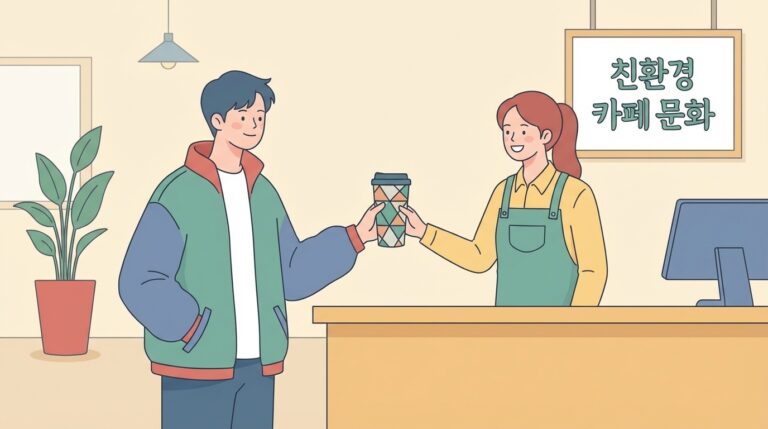
- K-Culture Moment: You place your tumbler on the counter and say this with a warm smile. It is the ultimate insider move. You are not just pointing; you are speaking the cafe lingo.
- Editor’s Insight: This phrase feels very natural and polite. It is much better than saying ‘use my cup’ because ‘담다’ (to put into a container) sounds gentle and caring.
- Situation Spectrum:
[🚫 Never] ———— [⚠️ Caution] ———— [✅ Freely]
- Close Friends (Casual): 🚫 (Too formal for friends)
- Cafe Staff/Strangers (Formal): ✅
- 🤔 Think About It: Why do Koreans use ‘담다’ (to carefully place inside a container) instead of ‘넣다’ (to simply put in)? It shows a level of care and respect for the food or drink being prepared. Does your language have a specific verb for putting liquids into a vessel?
2. 개인 컵 할인 되나요? (Is there a personal cup discount?)
- Pronunciation: gaein keop harin doenayo?
- Meaning: Does personal cup discount become? (Literal) vs. Do you offer a tumbler discount? (Real nuance)
- K-Culture Moment: Experiencing ‘소확행’ (Small but certain happiness). Getting 300 won off your coffee might not buy you a house, but it feels like a little victory in your daily life!
- Editor’s Insight: Notice the verb ‘되나요?’ (Is it possible? / Does it become?). Koreans love using passive voice for requests because it sounds less aggressive than asking ‘Do you give a discount?’
- Situation Spectrum:
[🚫 Never] ———— [⚠️ Caution] ———— [✅ Freely]
- Franchise Cafes: ✅
- Small Indie Cafes: ⚠️ (They might not have a discount system, so ask politely!)
- 🤔 Think About It: Using the passive voice softens the question. It implies ‘Does the system allow this?’ rather than ‘Are you going to give me money?’ How do you politely ask for discounts in your country?
3. 영수증은 버려 주세요. (Please throw away the receipt.)
- Pronunciation: yeongsujeung-eun beoryeo juseyo.
- Meaning: As for the receipt, throw it away please (Literal) vs. I don’t need the receipt (Real nuance)
- K-Culture Moment: You just saved a plastic cup, now you are saving paper! Eco-friendly points: +100. This is the perfect ending to a smooth cafe transaction.
- Editor’s Insight: You can also say ‘영수증 괜찮아요’ (The receipt is okay/I don’t need it), but ‘버려 주세요’ is very clear and commonly used by locals to save time.
- Situation Spectrum:
[🚫 Never] ———— [⚠️ Caution] ———— [✅ Freely]
- Any store/cafe: ✅
Phase 3: Textbook vs. Real Korean
| Situation | 📖 Textbook Korean | 🗣️ Real Korean | 💡 Why the difference? |
|---|---|---|---|
| Ordering with a tumbler | 텀블러를 가져왔는데, 여기에 커피를 주시겠습니까? (I brought a tumbler, would you give me coffee here?) | 텀블러에 담아 주세요. (Please put it in the tumbler.) | ‘빨리빨리’ (Hurry, hurry) culture! Cafe lines move fast. Shorter is always better. |
| Asking for a discount | 할인을 받을 수 있습니까? (Can I receive a discount?) | 개인 컵 할인 되죠? (Personal cup discount works, right?) | Ending with ‘~죠?’ implies you already know the vibe and just want to confirm casually. |
| Refusing the receipt | 영수증은 필요 없습니다. (I have no need for the receipt.) | 영수증 버려주세요. / 영수증 괜찮아요. (Throw it away / It’s fine.) | ‘괜찮아요’ (It’s okay) is the magical Korean word for polite refusal. |
Bottom Note: As a B1 learner, try to drop the robotic textbook phrases. Using ‘여기에 담아 주세요’ will immediately make the barista think, ‘Oh, this person knows Korean!’
Phase 4: Cultural Deep Dive — K-Culture Connection
4-1. Non-verbal ‘Nunchi’ (Sense)
When handing over your tumbler, there is a golden rule of cafe ‘Nunchi’ (social awareness): Always take the lid off before handing it to the barista. Korean cafe workers are incredibly fast. Handing them a closed tumbler slows them down. Open the lid, hold the cup with both hands (or one hand with the other supporting your elbow for politeness), and smile.
4-2. The ‘Ah-Ah’ and Eco-friendly Paradox
If you watch K-Dramas, you will notice office workers returning from lunch with plastic cups full of ice. This is the ‘Ah-Ah’ (Iced Americano) culture. However, South Korea has very strict recycling laws. Recently, a law was passed banning the use of disposable plastic cups if you are drinking inside the cafe. Because of this ESG (Environmental, Social, and Governance) trend, K-Pop idols and actors frequently post selfies with their huge branded tumblers to show a good influence. Using a tumbler is not just cheap; it is trendy!
Phase 5: Real-Life Roleplay Scenario
Setting: It is 12:30 PM at a busy franchise cafe near Gangnam Station. The line is long, the espresso machines are hissing, and everyone is moving fast. It is your turn to order.
Characters:
– YOU: An eco-conscious traveler craving an Iced Americano.
– Barista (Min-ji, 20s): Fast, efficient, but very polite.
Barista: 주문하시겠어요? (May I take your order?)
jumun-hasigesseoyo?
YOU: 아이스 아메리카노 한 잔 주세요. (One iced Americano, please.)
aiseu amerikano han jan juseyo.
Barista: 드시고 가시나요? (Are you having it here?)
deusigo gasinayo?
(🎭 Stage Direction: This is a crucial question due to the plastic cup ban!)
YOU: 아, 테이크아웃이요. 그런데 여기에 담아 주세요. (Ah, takeout. But please put it in here.)
a, teikeua-usiyo. geureonde yeogi-e dama juseyo.
(🎭 Stage Direction: You proudly hand over your open tumbler.)
Barista: 네, 개인 컵 할인 300원 도와드릴게요. 결제 도와드리겠습니다.
(Yes, I will help you with a 300 won personal cup discount. I will process your payment.)
ne, gaein keop harin sambaeg-won dowadeurilgeyo. gyeolje dowadeurigesseumnida.
Barista: 영수증 필요하신가요?
(Do you need the receipt?)
yeongsujeung piryohasingayo?
🔀 Your Turn! How should you reply?
– A) “아니요, 필요 없습니다!” (No, I have no need!)
– B) “영수증은 버려 주세요.” (Please throw the receipt away.)
– C) “싫어요.” (I hate it / I don’t want it.)✅ Best Choice: B — It is natural, polite, and perfectly fits the fast-paced cafe vibe. You could also say “괜찮아요” (It’s okay).
⚠️ Choice C Analysis: NEVER say ‘싫어요’ to a barista! It sounds like a grumpy child refusing vegetables.
Phase 6: 10-Second Shadowing Drill
Let’s practice the rhythm! Read out loud, pausing at the slashes (/).
😊 아이스 아메리카노 한 잔 / 여기에 / 담아 주세요!
(aiseu amerikano han jan / yeogi-e / dama juseyo!)
Tone: Bright, polite, and confident.
👍 개인 컵 할인 / 되나요?
(gaein keop harin / doenayo?)
Tone: Curious, with a slight upward inflection at the end.
Phase 7: K-Culture Mini Dictionary
| Korean | Romanization | English | Context |
|---|---|---|---|
| 얼죽아 | eoljuga | ‘Iced Americano even if I freeze to death’ | A popular slang acronym showing Koreans’ absolute obsession with iced drinks, even in winter. |
| 소확행 | sohwakhaeng | Small but certain happiness | The feeling you get when you save 300 won with your tumbler. |
| 다회용 컵 | dahoeyong keop | Reusable cup | The formal term for tumblers or mugs used in eco-friendly campaigns. |
| 매장 | maejang | Store / Inside the cafe | You will hear this a lot: “매장 내 일회용 컵 금지” (Disposable cups banned inside the store). |
Phase 8: Traveler’s Survival Kit
If you are visiting a cafe in Korea, you MUST know these expressions. Due to environmental laws, the first thing they ask is where you will drink it.
🆘 Survival Phrases for Korean Cafes
– 🇰🇷 “드시고 가시나요?” (deusigo gasinayo?) – Are you dining in?
– 🇰🇷 “테이크아웃 할게요.” (teikeu-aut halgeyo.) – I will take it out.
– 🇰🇷 “따뜻한 걸로 주세요.” (ttatteuthan geollo juseyo.) – Please give me a hot one.📌 Editor’s Travel Note:
– The Plastic Law: If you say ‘takeout’ and get a plastic cup, but then sit down at a table inside, the staff will ask you to leave or pour it into a mug. The cafe gets heavily fined by the government if inspectors catch you!
– Payment: Korea is a cashless society. Samsung Pay, Apple Pay, or credit cards are preferred over cash.
Phase 9: Critical Thinking — “One Step Deeper”
Media vs Reality: The Eco-Friendly Paradox of Korea
🧠 Think Deeper:
South Korea presents an interesting paradox when it comes to the environment. On one hand, it has one of the strictest garbage sorting (분리수거 – bunrisugeo) systems in the world, and cafes legally ban indoor plastic cups. However, it is also the land of extreme convenience—where a single cookie delivered to your door might be wrapped in three layers of plastic. As the country pushes for a more eco-friendly global image (like K-Pop albums offering ‘digital-only’ versions to save paper), this tension between ‘quick convenience’ and ‘environmental responsibility’ is highly visible in daily life.💬 Your Turn: Does your country have strict recycling rules for cafes? How do people react to bringing their own cups? Share your thoughts in the comments!
Phase 10: FAQ & Common Mistakes
Q: Can I ask the barista to wash my tumbler before putting coffee in it?
A: 🚫 No! During busy hours, asking them to wash your cup is considered a bit rude (lack of Nunchi). Always bring a clean, washed tumbler.
Q: Do all cafes give a tumbler discount?
A: Most big franchises (Starbucks, Mega Coffee, Ediya) do! Small, independent neighborhood cafes might not have a discount system, but they will happily use your cup if you ask.
❌ Common Mistake #1: Handing over the tumbler with the lid tightly closed.
✅ Do this instead: Unscrew the lid and hand them just the main cup. Keep the lid with you until they give the cup back!
Phase 11: Summary & Action Items
One-Liner Summary: Hand over your open tumbler, smile, and say “여기에 담아 주세요” (Please put it in here) to save money and the Earth like a Korean local!
Action Mission 3 Steps:
– 🥉 Bronze (Solo): Stand in front of a mirror with your favorite cup and practice saying “여기에 담아 주세요” three times.
– 🥈 Silver (Online): Comment on this post using the phrase: “저는 내일 카페에서 [여기에 담아 주세요]라고 말할 거예요!” (I will say [phrase] at the cafe tomorrow!)
– 🥇 Gold (Real-world): Go to a Korean cafe (or a Korean-owned cafe in your area) and actually order your drink using your personal cup!
🌍 K-Culture Mission:
Next time you watch a modern K-Drama, look closely at the cafe scenes. Count how many people are using plastic cups versus personal tumblers or mugs. You will notice the cultural shift!
Phase 12: Interactive Quiz
1. Situational Judgment: You are at a busy cafe in Seoul. You want to use your tumbler for your Iced Americano. What is the BEST way to do this?
– A) Hand them the closed tumbler and say “내 컵 쓰세요” (Use my cup).
– B) Open the lid, hand them the cup, and say “여기에 담아 주세요” (Please put it in here).
– C) Wait until they make the coffee in a plastic cup, then pour it into your tumbler.
Answer: B! A sounds slightly bossy, and C defeats the purpose of saving plastic!
2. Fill in the Blank:
Barista: 영수증 드릴까요? (Shall I give you the receipt?)
You: 아니요, 영수증은 ________ 주세요. (No, please throw the receipt away.)
Answer: 버려 (beoryeo)
3. True or False – K-Culture Edition:
“You can order your drink in a disposable plastic cup and sit inside the Korean cafe to study for 2 hours.”
Answer: FALSE! It is legally prohibited in South Korea to use disposable plastic cups while dining inside a cafe. You must order it in a mug or use your tumbler!
Frequently Asked Questions (FAQ)
Q: What does "여기에 담아 주세요. (Please put it in here.)" mean in Korean and how do you pronounce it?
A: In Korean, "여기에 담아 주세요. (Please put it in here.)" is pronounced [yeogi-e dama juseyo. ['dama' sounds like 'comma' but with a D] and means: Put it in here (Literal) vs. Please serve my drink in this tumbler (Real nuance)
Q: What does "개인 컵 할인 되나요? (Is there a personal cup discount?)" mean in Korean and how do you pronounce it?
A: In Korean, "개인 컵 할인 되나요? (Is there a personal cup discount?)" is pronounced [gaein keop harin doenayo?] and means: Does personal cup discount become? (Literal) vs. Do you offer a tumbler discount? (Real nuance)
Q: What does "영수증은 버려 주세요. (Please throw away the receipt.)" mean in Korean and how do you pronounce it?
A: In Korean, "영수증은 버려 주세요. (Please throw away the receipt.)" is pronounced [yeongsujeung-eun beoryeo juseyo.] and means: As for the receipt, throw it away please (Literal) vs. I don't need the receipt (Real nuance)







