

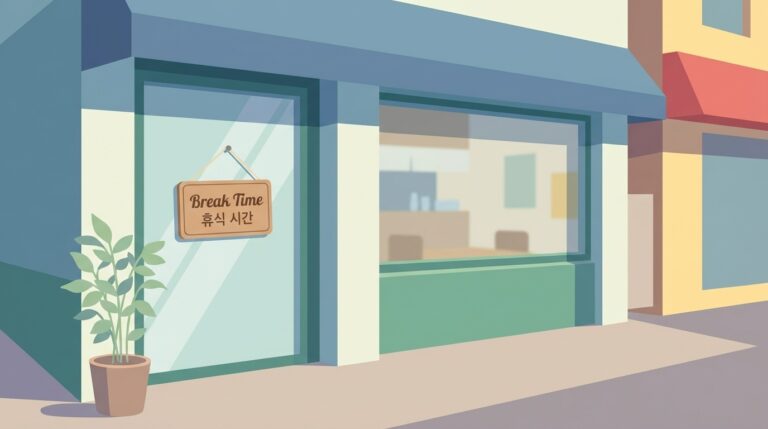
Phase 1: Empathy (The “Hungry in Seoul” Moment)
Hello! I’m the Lead Editor of Daily Hangul, your Korean tutor and local culture navigator.
Picture this: You’ve just finished a long morning of sightseeing in Seoul. You’re starving, and you finally track down that legendary Samgyeopsal (pork belly) restaurant you saw in your favorite K-Drama. It’s 3:30 PM. The door is unlocked, so you excitedly push it open.
But wait… the lights are half-dimmed. The tables are empty of customers, and in the corner, the staff are sitting around a table, quietly eating their own meal. Suddenly, everyone stops and stares at you. Cue the awkward silence.
Did they close early? Are they out of business? Do you just turn around and run away?
Don’t panic! You’ve just stumbled into the sacred Korean “Break Time” (브레이크 타임). Knowing how to navigate this moment is the difference between awkwardly standing in the doorway and smoothly securing a table for the evening like a true Seoulite. Let’s learn exactly what to say when you find yourself in this situation!
Phase 2: Deep Dive into Core Expressions
Here are the top 3 lifesaver phrases you need when you’re not sure if a restaurant is open.
1. 지금 브레이크 타임이에요?
- Pronunciation: [jigeum beureikeu taim-ieyo?] / Sounds like: jee-geum boo-ray-koo tah-eem ee-eh-yo?
- Meaning: (Literal) Is it break time now? / (Real nuance) Are you on a break right now?
- K-Culture Moment: You’ll see this Konglish word (Break Time) everywhere in Korea. If you peek into a famous restaurant and the staff are resting, gently opening the door and asking this shows you understand local dining culture.
- Editor’s Insight: It sounds just like English, but make sure to add the “-ieyo” at the end to make it polite. It’s a soft, considerate way to ask if they are closed for the afternoon.
- Situation Spectrum:
[🚫 Never] ———— [⚠️ Caution] ———— [✅ Freely]
- Close Friends (Casual): ✅ (Drop the -yo: 지금 브레이크 타임이야?)
- Restaurant Staff (Formal/Polite): ✅
- 🤔 Think About It: Why do Koreans use the English phrase “Break Time” instead of a pure Korean word? Many modern service industry terms in Korea are adopted from English, blending into everyday slang!
2. 지금 식사 되나요?
- Pronunciation: [jigeum siksa doenayo?] / Sounds like: jee-geum shik-sah dweh-nah-yo?
- Meaning: (Literal) Is a meal possible now? / (Real nuance) Can we eat here right now?
- K-Culture Moment: This is the #1 most natural phrase locals use. Imagine a K-Drama character walking into a quiet Gukbap (soup and rice) shop. They won’t say “Can I eat?” They will ask “Is a meal possible?”
- Editor’s Insight: This phrase is magic. It’s incredibly polite and sounds like a native speaker. It shifts the focus from “I want to eat” to “Is the situation possible for you to serve us?”
- Situation Spectrum:
[🚫 Never] ———— [⚠️ Caution] ———— [✅ Freely]
- Any Restaurant/Cafe Staff: ✅
- 🤔 Think About It: Notice the passive voice? “Is a meal possible?” Korean culture highly values humility and not imposing on others. How would you ask this in your native language?
3. 몇 시에 다시 열어요?
- Pronunciation: [myeot sie dasi yeoreoyo?] / Sounds like: myut she-eh dah-she yuh-ruh-yo?
- Meaning: (Literal) At what time do you open again? / (Real nuance) When does the break time end?
- K-Culture Moment: You really want to eat at this specific spot. You’re willing to wait. You ask this to the owner who is wiping down tables, so you can go grab a coffee and come right back.
- Editor’s Insight: It’s direct but polite. If you want to sound even softer, you can say “몇 시부터 식사 되나요?” (From what time is a meal possible?).
- Situation Spectrum:
[🚫 Never] ———— [⚠️ Caution] ———— [✅ Freely]
- Any Restaurant Staff: ✅
Phase 3: Textbook vs. Real Korean
| Situation | 📖 Textbook Korean | 🗣️ Real Korean | 💡 Why is it different? |
|---|---|---|---|
| Checking if open | 영업시간이 어떻게 됩니까? (What are your business hours?) | 지금 식사 돼요? (Can we eat now?) | Real life favors quick, practical questions over formal inquiries about the whole schedule. |
| Asking when they reopen | 언제 영업을 재개합니까? (When do you resume business?) | 몇 시부터 다시 하세요? (From what time do you do [business] again?) | Using the verb “하다” (to do) is a universal, casual way to refer to opening/operating in spoken Korean. |
| Reading the sign | 휴식 시간 (Rest time) | 브레이크 타임 (Break Time) / 준비 중 (Preparing) | Restaurants prefer the trendy Konglish “Break Time” or the polite “Preparing” sign. |
Phase 4: Cultural Context — K-Culture Deep Dive
4-1. Non-Verbal “Nunchi” (눈치)
Before you even speak, you need to use your Nunchi (the Korean art of reading the room). How do you spot a Break Time without asking?
1. The Sign: Look for a small wooden sign hanging on the door handle that says “준비 중” (Preparing) or “Break Time”.
2. The Lights: If the main overhead lights are off but the kitchen lights are on, they are resting.
3. Staff Meal: If you see the staff eating together at a customer table, do not interrupt. This is their only time to rest before the chaotic dinner rush!
4-2. The Evolution of K-Food Culture
A decade ago, many Korean restaurants were proudly open 24/7. However, as the culture shifted to prioritize workers’ rights and 워라밸 (Work-Life Balance), Break Times (usually from 3:00 PM to 5:00 PM) became the absolute standard. During this time, they prep ingredients for the evening and have their staff meal. It’s a crucial part of the K-Food ecosystem!
Phase 5: Real-Life Roleplay Scenario
Setting: A famous Tonkatsu restaurant in Yeonnam-dong. It’s 3:45 PM. The lights are slightly dim, and there’s a sign on the door, but you can’t read it. You and your Korean friend Min-su are starving.
Characters:
– YOU: A hungry traveler who just learned some Korean.
– Min-su: Your local friend (28, always knows the best food spots).
– Owner: A busy restaurant owner inside.
Min-su: 아, 배고파. 여기 진짜 맛집이야. 들어가자!
(Ah, baegopa. Yeogi jinjja matjibiya. Deureogaja!)
[Ah, I’m hungry. This place is a real hot spot. Let’s go in!]
YOU: Wait, the lights look dim. Are they open?
Min-su: 어? 진짜네. 한번 물어봐 줄래?
(Eo? Jinjjane. Hanbeon mureoba jullae?)
[Oh? You’re right. Could you ask them for me?]
(🎭 Stage Direction: You carefully open the door. The owner looks up from wiping a table.)
🔀 Your Turn! How should you ask?
– A) “사장님, 저 배고파요. 밥 주세요!” (Boss, I’m hungry. Give me rice!)
– B) “지금 식사 되나요?”
– C) “영업시간이 어떻게 됩니까?”✅ Best Choice: B — It’s the most natural, polite way to ask if you can eat right now.
⚠️ Choice A Analysis: This sounds like a demanding child! While a friendly owner might laugh, it’s considered very rude for an adult to speak this way.
Owner: 아, 죄송해요. 지금 브레이크 타임이에요.
(A, joesonghaeyo. Jigeum beureikeu taimieyo.)
[Ah, I’m sorry. It’s break time right now.]
YOU: 아, 그렇군요. 몇 시에 다시 열어요?
(A, geureokunyo. Myeot sie dasi yeoreoyo?)
[Ah, I see. What time do you open again?]
Owner: 5시부터 저녁 식사 가능합니다.
(Daseot-sibuteo jeonyeok siksa ganeunghamnida.)
[Dinner service is possible from 5 o’clock.]
YOU: 네, 감사합니다! 이따 올게요.
(Ne, gamsahamnida! Itta olgeyo.)
[Okay, thank you! We’ll come back later.]
Phase 6: 10-Second Shadowing Drill
Practice this sentence until it rolls off your tongue. Follow the pauses (/) and the emotion tags!
🥺 저기요… / 지금 / 식사 / 되나요?
(jeogiyo… / jigeum / siksa / doenayo?)
[Excuse me… is a meal possible right now?]
(Say it softly, slightly raising the end of the sentence like you are asking for a small favor!)
Phase 7: K-Culture Mini Dictionary
| Korean | Romanization | English | Context |
|---|---|---|---|
| 눈치 | nunchi | Social awareness | The crucial Korean skill of reading the room and sensing if it’s Break Time. |
| 브레이크 타임 | beureikeu taim | Break time | Usually 3 PM – 5 PM. Staff rest and prep for dinner. |
| 준비 중 | junbi jung | Preparing | The sign you’ll see on the door during Break Time. |
| 재료 소진 | jaeryo sojin | Ingredients sold out | The saddest sign. It means they’ve sold out for the day and are closing early! |
Phase 8: Traveler’s Survival Kit
🆘 Survival Phrases for K-Food Explorers
– 🇰🇷 “여기 브레이크 타임 있어요?” (yeogi beureikeu taim isseoyo?)
– 🗣️ Meaning: Do you have a break time here?
– 📍 Where to use: When you’re making a reservation or calling ahead.
- 🇰🇷 “근처에 지금 여는 식당 있나요?” (geuncheoe jigeum yeoneun sikdang innayo?)
- 🗣️ Meaning: Are there any restaurants open right now nearby?
- 📍 Where to use: When your original spot is closed and you need a local’s recommendation.
📌 Editor’s Travel Note: The Power of Apps
– Naver Maps & KakaoMap: These are your best friends in Korea (Google Maps doesn’t work well here). Always check the restaurant’s profile. They clearly list 브레이크타임 (Break Time) and 라스트오더 (Last Order).
– Cafes: Good news! Cafes in Korea almost never have break times. If a restaurant is closed, head to a nearby cafe to wait it out.
Phase 9: Critical Thinking — “One Step Deeper”
🧠 Think Deeper: Food, Identity, and Workers’ Rest
Why are Break Times so strict in Korea now? Historically, the Korean ethos was “Pali-Pali” (hurry, hurry), with 24-hour diners everywhere to serve busy workers. But as society modernized, a huge cultural shift occurred. Koreans realized that providing excellent hospitality during dinner requires respecting the staff’s right to rest in the afternoon. The “Staff Meal” is also a core part of Korean restaurant culture—eating together builds Jeong (affection/bond) among the workers. By respecting their Break Time, you’re actually respecting their community!💬 Your Turn: Does your country have a culture of restaurants closing in the afternoon (like a Siesta)? Share your experience in the comments!
Phase 10: FAQ & Avoiding Common Mistakes
Q: “Can we just sit inside at a table and wait until Break Time is over?”
No! This is a big cultural faux pas. Break Time is strictly for the staff to rest, clean, and eat without feeling “watched.” Always wait outside or go to a cafe.
Q: “Does ‘Last Order’ mean Break Time?”
Not exactly. If a restaurant says “Break Time 3 PM – 5 PM”, their “Last Order” for lunch will usually be around 2:30 PM. If you arrive at 2:40 PM, you won’t be able to order.
❌ Common Mistake: Ignoring the “준비 중” (Preparing) sign on the door and aggressively trying to pull the locked door open.
✅ Do This Instead: Check Naver Maps first. If you must ask, knock very lightly, open the door just a crack, and politely ask: “지금 브레이크 타임이에요?”
Phase 11: Summary & Action Items
One-Liner Summary: To avoid starving during the afternoon lull, politely ask “지금 식사 되나요?” (Is a meal possible now?) to respect the Korean Break Time culture.
Action Mission 3 Steps:
– 🥉 Bronze (Solo): Look at the clock. If it’s between 3 PM and 5 PM, practice saying “지금 브레이크 타임이에요?” out loud 3 times.
– 🥈 Silver (Online): Look up a famous Korean restaurant on Naver Maps (web version) and try to spot the word “브레이크타임” in their hours.
– 🥇 Gold (Real Life): Next time you travel to Korea or visit a local Koreatown, use “지금 식사 되나요?” when walking into a restaurant!
K-Culture Mission: Watch an episode of a Korean drama involving food (like Let’s Eat or Itaewon Class). Can you spot a scene where the restaurant is empty and the staff are eating their own meal together?
Phase 12: Quiz — Interactive Challenge
1. You arrive at a famous Tteokbokki shop at 3:15 PM. The lights are dim, and staff are eating. What is the most polite thing to say if you peek inside?
A) 빨리 밥 주세요! (Give me food quickly!)
B) 영업시간이 어떻게 됩니까? (What are your business hours?)
C) 지금 식사 되나요? (Is a meal possible right now?)
2. True or False: If a restaurant is on Break Time, it is perfectly fine to sit at an empty table inside and wait for them to finish resting.
3. Fill in the blank: If you want to know when they reopen, you ask: “몇 시에 다시 _____?” (myeot sie dasi _____?)
A) 먹어요 (eat)
B) 열어요 (open)
C) 가요 (go)
(Answers: 1: C, 2: False – wait outside, 3: B)
Frequently Asked Questions (FAQ)
Q: What does "지금 브레이크 타임이에요?" mean in Korean and how do you pronounce it?
A: In Korean, "지금 브레이크 타임이에요?" is pronounced [jigeum beureikeu taim-ieyo?] and means: (Literal) Is it break time now? / (Real nuance) Are you on a break right now?
Q: What does "지금 식사 되나요?" mean in Korean and how do you pronounce it?
A: In Korean, "지금 식사 되나요?" is pronounced [jigeum siksa doenayo?] and means: (Literal) Is a meal possible now? / (Real nuance) Can we eat here right now?
Q: What does "몇 시에 다시 열어요?" mean in Korean and how do you pronounce it?
A: In Korean, "몇 시에 다시 열어요?" is pronounced [myeot sie dasi yeoreoyo?] and means: (Literal) At what time do you open again? / (Real nuance) When does the break time end?







