

Phase 1: Empathy (Welcome to the High Life)
Hello! This is your Daily Hangul Editor.
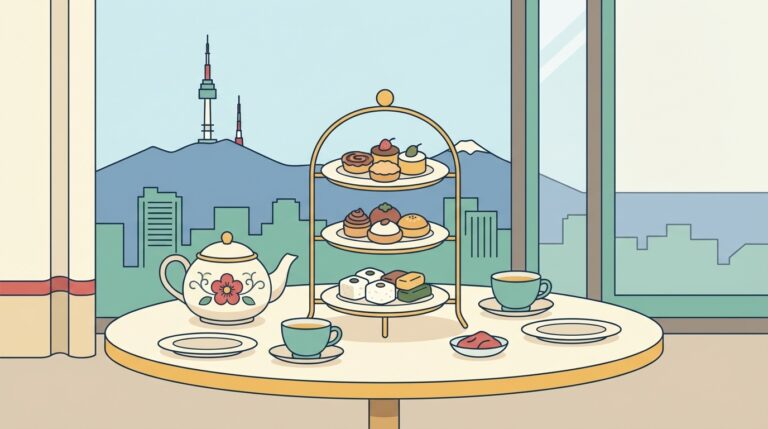
Picture this: A breathtaking view of the Seoul skyline from a 70th-floor hotel lounge. A pristine, three-tiered tray of exquisite desserts sits between you and your friend. In a K-Drama, this is usually the exact moment the chaebol (conglomerate) mother slides an envelope of cash across the table and tells the protagonist to “leave her son.”
But in reality? This is the battleground for modern Koreans seeking the perfect weekend Instagram shot. Afternoon tea in Seoul isn’t just about drinking Earl Grey; it’s a window into Korea’s massive ‘Small Luxury’ (스몰 럭셔리) trend.
As a C1-level learner, simply saying “아메리카노 주세요” (Americano, please) won’t cut it in these sophisticated spaces. To truly immerse yourself in this culture and get the ‘insider’ treatment, you need vocabulary that matches the elegance of the venue. Let’s dive into the refined language of Korean high tea!
Phase 2: Core Expressions Deep Dive
1. 차 종류가 많은데, 시향해 볼 수 있을까요?
- Pronunciation: cha jongnyuga maneunde, sihyanghae bol su isseulkkayo? [Sounds like: cha jong-nyu-ga ma-neun-deh, she-hyang-hae bol su eess-eul-kka-yo?]
- Meaning: (Literal) There are many tea types, can I try smelling the fragrance? / (Real nuance) May I smell the tea samples?
- K-Culture Moment: Upscale tea houses in Korea (like TWG or Osulloc) and luxury lounges always offer a premium tea sample box. Asking this shows you are a connoisseur, not just a casual cafe-goer.
- Editor’s Insight: The word 시향 (sihyang) is a beautifully advanced C1 vocabulary word meaning “testing the fragrance.” It gives off a highly educated, elegant vibe.
- Situation Spectrum:
[🚫 절대 금지] ———— [⚠️ 주의] ———— [✅ 자유롭게]
- Casual Cafe (Starbucks): 🚫 (They don’t have samples, you’ll just confuse them)
- Upscale Cafe/Lounge: ✅
- 🤔 Think About It: Notice the use of ~해 볼 수 있을까요? (Could I possibly try…). Why do Koreans prefer this indirect, soft questioning in high-end service settings rather than a direct “I want to smell them”?
2. 입가심하기 좋은 깔끔한 차로 추천해 주시겠어요?
- Pronunciation: ipgasimhagi joeun kkalkeumhan charo chucheonhae jusigesseoyo? [Sounds like: eep-gah-sheem-ha-gee jo-eun kkal-kkeum-han cha-ro chu-cheon-hae joo-she-gess-uh-yo?]
- Meaning: (Literal) Could you recommend a clean tea good for palate cleansing? / (Real nuance) I need a refreshing tea to balance out these sweet desserts; what do you recommend?
- K-Culture Moment: When faced with a 3-tiered tray of heavy, buttercream-filled macarons and scones, you need something refreshing. Koreans love flavors that are 깔끔하다 (clean/neat/refreshing) after eating rich food.
- Editor’s Insight: 입가심 (ipgasim) is a fantastic native Korean word. It means “cleansing one’s mouth” or “refreshing the palate.” Using this word immediately signals fluency.
- Situation Spectrum:
[🚫 절대 금지] ———— [⚠️ 주의] ———— [✅ 자유롭게]
- Friends (Casual): ⚠️ (To a friend, you’d just say “단 거 먹으니까 쓴 거 땡긴다” – Sweets make me crave bitter things)
- Formal/Service: ✅
3. 디저트는 아래층부터 순서대로 드시면 됩니다.
- Pronunciation: dijeoteuneun araecheungbuteo sunseodaero deusimyeon doemnida.
- Meaning: (Literal) As for the desserts, if you eat them in order from the bottom tier, it becomes okay. / (Real nuance) Please enjoy the desserts starting from the bottom tier.
- K-Culture Moment: You won’t say this, but you MUST understand it. The server will explain the menu with extreme politeness.
- Editor’s Insight: Pay attention to ~드시면 됩니다. This structure (Honorific verb + ~면 되다) is the absolute standard formula for polite instructions in Korean hospitality. It feels much softer than saying “Eat it this way.”
- Situation Spectrum:
[🚫 절대 금지] ———— [⚠️ 주의] ———— [✅ 자유롭게]
- Service Staff to Customer: ✅
- Customer to Customer: 🚫
Phase 3: Textbook vs. Real Korean
| Situation | 📖 Textbook Korean | 🗣️ Real Korean | 💡 Why different? |
|---|---|---|---|
| Asking for a tea recommendation | 어떤 차가 제일 맛있습니까? (Which tea is the most delicious?) | 디저트랑 페어링하기 좋은 차 추천 부탁드려요. (Please recommend a tea good for pairing with desserts.) | “Pairing” (페어링) is a trendy loanword used heavily in Korea’s modern fine dining and luxury cafe scenes. |
| Stopping the server to take photos | 사진을 찍겠습니다. (I will take a picture.) | 사진 찍게 세팅 잠깐 그대로 두시겠어요? (Could you leave the setup as is for a moment so I can take photos?) | Instagram culture dictates that the layout must remain perfectly untouched until the injeungsyat (proof shot) is taken! |
Phase 4: Cultural Context — K-Culture Deep Dive
4-1. Non-verbal Cues: The Elegance of ‘Nunchi’
In luxury lounges, Nunchi (눈치) applies heavily to ambiance. Keep your voice low. When receiving the tea pot, even if the server is pouring it for you, a slight nod of the head and a quiet “감사합니다” (Thank you) acknowledges their service. You don’t need to hold the cup while they pour (unlike pouring alcohol with friends or elders).
4-2. The K-Drama Chaebol Aesthetic & “Flex” Culture
In dramas like Queen of Tears or The Glory, high tea scenes are used to establish immense wealth and status. But for everyday 20s and 30s Koreans, visiting a 5-star hotel lounge (like the Shilla or Signiel) is a “Flex” (플렉스)—a conscious splurge to treat oneself. It’s heavily tied to the desire for an aesthetic escape from a hyper-competitive work culture. By understanding this, you realize that paying $100 for tea isn’t just about the beverage; it’s about renting a slice of a K-Drama life for two hours.
Phase 5: Real-Life Roleplay Scenarios
Scenario A: The Signiel Lounge “Flex”
- Setting: A bright, opulent hotel lounge on the 79th floor in Jamsil, overlooking the Han River. Soft classical music is playing. You are treating your Korean coworker to celebrate her promotion.
- Characters:
- YOU: Expat working in Seoul, treating your friend.
- Minji (29): Your stylish coworker who loves cafe-hopping and Instagram.
- Server: Extremely polite, soft-spoken hotel staff.
Server: 안녕하십니까. 오늘 준비된 티(Tea) 샘플입니다. 시향해 보시겠습니까?
(annyeonghasimnikka. oneul junbideon ti saempeurimnida. sihyanghae bosigesseumnikka?)
[Hello. These are the tea samples prepared for today. Would you like to smell them?]
(🎭 Stage Direction: The server opens a polished wooden box with 6 tea varieties)
YOU: 네, 감사합니다. 음… 향이 다 좋네요. 민지 씨는 뭐 고를 거예요?
(ne, gamsahamnida. eum… hyangi da jonneyo. minji ssineun mwo goreul geoyeyo?)
[Yes, thank you. Hmm… they all smell great. Minji, what are you going to choose?]
Minji: 저는 디저트가 달달하니까, 입가심하기 좋은 우롱차로 할게요.
(jeoneun dijeoteuga daldalhanikka, ipgasimhagi joeun urongcharo halgeyo.)
[Since the desserts are sweet, I’ll go with an Oolong tea to cleanse my palate.]
🔀 Your Turn! How do you ask the server for a recommendation based on Minji’s choice?
– A) “저도 그거 주세요.” (Just give me that too.)
– B) “가장 비싼 차가 뭡니까?” (What is the most expensive tea?)
– C) “저도 깔끔한 차를 원하는데, 우롱차 말고 다른 차 추천해 주시겠어요?”✅ Best Choice: C. It brilliantly utilizes the advanced vocabulary (깔끔하다) and politely asks for an alternative using ~아/어 주시겠어요.
⚠️ Choice B Analysis: This sounds exactly like an arrogant K-Drama villain showing off. Avoid!
Server: 그렇다면 약간의 산미가 있는 다즐링은 어떠신가요?
(geureotamyeon yagganui sanmiga inneun dajeulling-eun eotteosingayo?)
[In that case, how about Darjeeling, which has a slight acidity?]
YOU: 아, 좋네요. 그걸로 할게요.
(a, jonneyo. geugeollo halgeyo.)
[Ah, sounds good. I’ll have that.]
(🎭 Fast forward: The magnificent 3-tier tray arrives)
Server: 디저트는 아래층의 샌드위치부터 순서대로 드시면 됩니다.
(dijeoteuneun araecheung-ui saendeuwichibuteo sunseodaero deusimyeon doemnida.)
[You may enjoy the desserts in order, starting from the sandwiches on the bottom tier.]
Minji: 우와, 너무 예뻐요! 잠깐만, 먹기 전에 사진부터 찍고요!
(uwa, neomu yeppeoyo! jamkkanman, meokgi jeone sajinbuteo jjiggoyo!)
[Wow, it’s so pretty! Wait, let me take a picture before we eat!]
YOU: 네, 마음껏 찍으세요. 제가 조명 잘 나오게 비켜드릴게요.
(ne, maeumkkeot jjigeuseyo. jega jomyeong jal naoge bikyeodeurilgeyo.)
[Yes, take as many as you want. I’ll move out of the way so the lighting is good.]
Minji: 센스 최고! 인스타에 바로 올려야겠어요.
(senseu choego! inseutae baro ollyeyagesseoyo.)
[You have the best sense! I need to post this on Insta right away.]
Scenario B: The Traditional Contrast (Insadong Teahouse)
Afternoon tea isn’t just European! Let’s visit a traditional Hanok teahouse.
Owner: 어서 오세요. 따뜻한 온돌방으로 안내해 드릴까요?
(Welcome. Shall I guide you to the warm ondol floor room?)
YOU: 네, 좋아요. 혹시 여기서 제일 향이 진한 전통차가 뭔가요?
(Yes, please. By the way, what is the traditional tea with the strongest fragrance here?)
Owner: 쌍화차가 향도 진하고 감기 예방에도 아주 좋답니다.
(Ssanghwa-cha has a deep fragrance and is great for preventing colds.)
YOU: 그럼 그걸로 두 잔 부탁드립니다. 입가심할 한과도 같이 주세요.
(Then two cups of that, please. Please also give us some Hangwa to cleanse our palates.)
Phase 6: 10-Second Shadowing Drill
Follow the intonation guide. Speak softly and elegantly!
😊 디저트랑 / 페어링하기 좋은 차 / 추천 부탁드려요~
(dijeoteurang / peeoring-hagi joeun cha / chucheon butakdeuryeoyo~)
[Polite, bright, and slightly extended at the end for friendliness]
Phase 7: K-Culture Mini Dictionary
| 한국어 | Romanization | 영어 | 맥락 설명 |
|---|---|---|---|
| 스몰 럭셔리 | seumol reoksyeori | Small Luxury | Spending a premium on small items (like a $100 tea set) to gain high psychological satisfaction in a stressful society. |
| 가심비 | gasimbi | Cost-to-psychological-satisfaction | Unlike 가성비 (cost-effectiveness), this justifies expensive purchases because they make your heart (심) feel great. |
| 인증샷 | injeungsyat | Proof shot | Taking aesthetic photos to prove you visited a trendy or exclusive place for social media. |
| 다과 | dagwa | Tea and refreshments | A highly traditional and elegant word for tea and snacks. |
Phase 8: Traveler Survival Kit (Lounge Edition)
🆘 Survival Expressions TOP 3
– 🇰🇷 “창가 자리로 예약할 수 있을까요?” (chang-ga jariro yeyakhal su isseulkkayo?)
– 🗣️ Meaning: Can I reserve a window seat?
– 📍 Use: Over the phone or app. Window seats are the most coveted in Seoul’s high-rises!
- 🇰🇷 “디카페인으로 변경 가능한가요?” (dikapein-euro byeong-gyeong ganeunghangayo?)
- 🗣️ Meaning: Is it possible to change this to decaf?
- 📍 Use: When you want the aesthetic, but not the caffeine jitters.
🇰🇷 “남은 디저트 포장해 주시겠어요?” (nameun dijeoteu pojanghae jusigesseoyo?)
- 🗣️ Meaning: Could you pack up the remaining desserts?
- 📍 Use: Yes, luxury hotels will beautifully box up what you couldn’t finish!
📌 Editor’s Travel Note
– Must-have App: ‘캐치테이블’ (CatchTable). You cannot simply walk into a luxury hotel lounge for afternoon tea in Seoul. You must reserve weeks in advance using this app.
– Dress Code: While Korea is quite casual, high-end hotel lounges often prohibit flip-flops and athletic wear. Smart casual is your best bet.
Phase 9: Critical Thinking — “One Step Deeper”
🧠 Think Deeper: Media vs Reality & The Rise of “Small Luxury”
Why are young Koreans, facing a tough job market and soaring housing prices, spending a day’s wages on an afternoon tea set? This phenomenon reflects a profound shift in social values. When saving up for a house in Seoul feels statistically impossible, younger generations invest in experiences that provide immediate, tangible joy—a concept known as 소확행 (Small but certain happiness) and driven by 가심비. While older generations might view this as frivolous K-Drama emulation, for many young Koreans, it’s a carefully curated, necessary psychological escape from the extreme pressures of modern society.💬 Your Turn: Does your culture have a concept similar to “Small Luxury”? How do young people in your country reward themselves when macro-economic goals feel out of reach? Let me know in the comments!
Phase 10: FAQ & Avoiding Misunderstandings
- Q: Should I tip the server if they explained the tea beautifully?
- A: NO! Korea has a strict no-tipping culture. Trying to tip at a luxury lounge might confuse the staff and make them uncomfortable. Exceptional service is a given, and a 10% service charge is already baked into hotel bills.
- Q: Can I use 반말 (casual language) if the server looks much younger than me?
- A: Absolutely not. In service settings, especially high-end ones, strict honorifics are maintained regardless of age.
❌ Common Mistake #1: Saying “너” (You) to the server to get their attention.
✅ Do this instead: Never use “You.” Make polite eye contact, raise your hand slightly, and softly say “저기요~” (Excuse me) or wait for them to approach.
Phase 11: Summary & Action Items
- One-Liner Summary: Elevate your Korean to VIP status by using elegant C1 vocabulary like “시향” (fragrance tasting) and “입가심” (palate cleansing).
-
Action Mission 3 Steps:
- 🥉 Bronze: Practice pronouncing “입가심하기 좋은 깔끔한 차” 3 times in front of the mirror.
- 🥈 Silver: Leave a comment below sharing your favorite dessert pairing in Korean!
- 🥇 Gold: Next time you visit a cafe, ask the barista for a recommendation using “페어링하기 좋은 차 추천 부탁드려요.”
- K-Culture Mission: Download the CatchTable app, search for “애프터눈 티” (Afternoon Tea), and browse the menus. Try to spot the advanced words we learned today!
Phase 12: Quiz — Interactive Challenge
1. Situational Judgment: You just finished eating very rich, buttery scones. Which phrase should you use to ask the server for a refreshing tea?
– A) 제일 단 차로 주세요. (Please give me the sweetest tea.)
– B) 입가심하기 좋은 차 추천해 주세요. (Please recommend a good palate-cleansing tea.)
– C) 우유 많이 들어간 차 주세요. (Please give me a tea with lots of milk.)
Check Answer
✅ B! A and C will only make your palate feel heavier.
2. True or False — K-Culture Edition:
“In Korea, it’s considered polite to tip the hotel lounge staff if they provide excellent tea service.”
Check Answer
❌ False! Tipping is not practiced in Korea and may cause awkwardness. A polite ‘감사합니다’ is enough.
3. Fill in the Blank:
“디저트는 ______부터 순서대로 드시면 됩니다.” (You may eat the desserts in order from the bottom tier).
Check Answer
아래층 (Bottom tier)
Frequently Asked Questions (FAQ)
Q: What does "차 종류가 많은데, 시향해 볼 수 있을까요?" mean in Korean and how do you pronounce it?
A: In Korean, "차 종류가 많은데, 시향해 볼 수 있을까요?" is pronounced [cha jongnyuga maneunde, sihyanghae bol su isseulkkayo? [Sounds like: cha jong-nyu-ga ma-neun-deh, she-hyang-hae bol su eess-eul-kka-yo?] and means: (Literal) There are many tea types, can I try smelling the fragrance? / (Real nuance) May I smell the tea samples?
Q: What does "입가심하기 좋은 깔끔한 차로 추천해 주시겠어요?" mean in Korean and how do you pronounce it?
A: In Korean, "입가심하기 좋은 깔끔한 차로 추천해 주시겠어요?" is pronounced [ipgasimhagi joeun kkalkeumhan charo chucheonhae jusigesseoyo? [Sounds like: eep-gah-sheem-ha-gee jo-eun kkal-kkeum-han cha-ro chu-cheon-hae joo-she-gess-uh-yo?] and means: (Literal) Could you recommend a clean tea good for palate cleansing? / (Real nuance) I need a refreshing tea to balance out these sweet desserts; what do you recommend?
Q: What does "디저트는 아래층부터 순서대로 드시면 됩니다." mean in Korean and how do you pronounce it?
A: In Korean, "디저트는 아래층부터 순서대로 드시면 됩니다." is pronounced [dijeoteuneun araecheungbuteo sunseodaero deusimyeon doemnida.] and means: (Literal) As for the desserts, if you eat them in order from the bottom tier, it becomes okay. / (Real nuance) Please enjoy the desserts starting from the bottom tier.







