

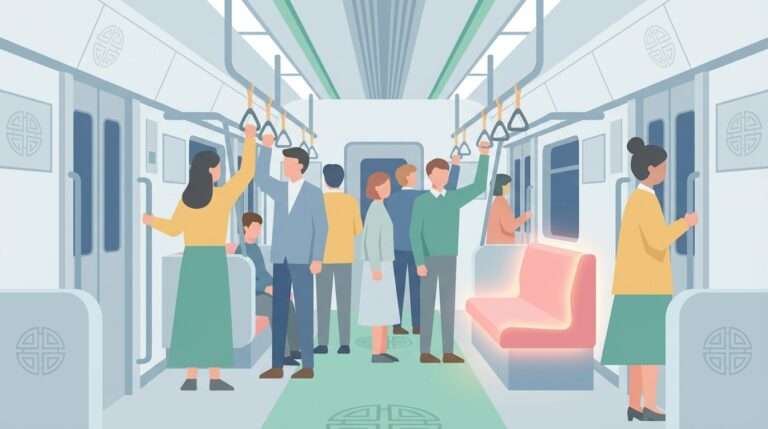
Phase 1: Welcome to the ‘Jiokcheol’ (Hell Subway) 🚇
Hello! I’m your Daily Hangul Editor, your personal guide to not just speaking Korean, but surviving and thriving in Korea.
Picture this: You’re watching a K-Drama. The main character is running late, sprinting down the stairs into a packed subway car. The doors close, they let out a deep sigh, and look around. Not a single empty seat. They just mumble something and grab the handle.
If you’ve ever ridden the Seoul subway during rush hour—famously dubbed ‘지옥철’ (Jiokcheol, meaning ‘Hell Subway’)—you know exactly how overwhelming it can be. As an A1 beginner, you might think you only need to know how to buy a ticket. But what happens when you need to navigate a sea of people, offer your seat to an elder, or simply express that there’s nowhere to sit?
Today, we are going to learn the most crucial survival phrases for the Korean subway. These are the real, everyday words you’ll hear echoing through the underground tunnels of Seoul. Let’s dive in!
Phase 2: Essential Expressions Deep Dive
Here are the top 3 phrases you absolutely need when navigating Korean public transport.
1. 자리가 없어요 (There are no seats)
- Pronunciation: ja-ri-ga eop-seo-yo
(Sound guide: ‘ja-ri’ sounds like ‘Jolly’ but with a flat A. ‘eop’ sounds like ‘up’ but cut off sharply before the P. ‘seo-yo’ sounds like ‘so-yo’.) - Meaning: Literal: ‘Seat does not exist.’ / Real nuance: ‘There are no empty seats.’ or ‘It’s completely full.’
- K-Culture Moment: You board Line 2 at Gangnam Station with your Korean friend. They look down the aisle, sigh, and say, “아, 자리가 없어요.” (Ah, there are no seats.) It’s a phrase of shared disappointment.
- Editor’s Insight: This phrase isn’t just for the subway! You can use it at a packed cafe or a busy restaurant when you walk in and see no empty tables.
- Situation Spectrum:
[🚫 절대 금지] ———— [⚠️ 주의] ———— [✅ 자유롭게]- Talking to yourself or a friend (Casual): ✅
- Informing a colleague (Semi-formal): ✅
- Informing your boss (Formal): ⚠️ (Better to add “죄송하지만…” – “I’m sorry, but…”)
- 🤔 Think About It: Notice how Koreans say “The seat doesn’t exist” rather than “I can’t find a seat”? Korean language often focuses on the state of the situation rather than placing the ‘I’ (subject) at the center. How does your native language phrase this?
2. 여기 앉으세요 (Please sit here)
- Pronunciation: yeo-gi an-jeu-se-yo
(Sound guide: ‘yeo-gi’ sounds like ‘yo-ghee’. ‘an-jeu’ sounds like ‘Ahn-juh’.) - Meaning: Literal/Real nuance: ‘Please sit here.’
- K-Culture Moment: You are sitting on the subway, and an elderly woman carrying heavy grocery bags from the traditional market boards the train. You stand up, point to your seat, and say this with a warm smile.
- Editor’s Insight: Offering your seat to elders is a HUGE part of Korean culture. Using this phrase will instantly earn you immense respect and warm smiles from locals. Always use two hands to gesture toward the seat!
- Situation Spectrum:
[🚫 절대 금지] ———— [⚠️ 주의] ———— [✅ 자유롭게]- To friends (Casual): 🚫 (Too formal! Just say “여기 앉아” yeo-gi an-ja)
- To elders/strangers (Formal): ✅
- 🤔 Think About It: Why is giving up a seat so deeply ingrained in Korea? It comes from Confucian values of respecting elders. Do you have a similar public transport etiquette in your country?
3. 잠시만요! (Excuse me / Just a moment!)
- Pronunciation: jam-si-man-yo
(Sound guide: ‘jam-shee-mahn-yo’) - Meaning: Literal: ‘Just a moment.’ / Real nuance: ‘Excuse me, I need to pass through!’
- K-Culture Moment: Your stop is coming up. There’s a wall of people between you and the door. If you stay quiet, you will miss your stop. You must channel your inner warrior and loudly declare, “잠시만요!” while gently squeezing past.
- Editor’s Insight: This is the most powerful magic word in Korea. It parts the Red Sea of crowds. Never use “비켜주세요” (Move out of the way)—that sounds very rude!
- Situation Spectrum:
[🚫 절대 금지] ———— [⚠️ 주의] ———— [✅ 자유롭게]- Used universally in crowds: ✅
Phase 3: Textbook vs. Real Korean
Let’s look at how textbook phrases differ from what you actually hear on the subway.
| 상황 (Situation) | 📖 교과서 한국어 (Textbook) | 🗣️ 진짜 한국어 (Real Korean) | 💡 왜 다를까? (Why the difference?) |
|---|---|---|---|
| Pushing through the crowd to get off | 실례합니다. 지나가겠습니다. (Excuse me. I will pass.) | 아, 잠시만요! / 내릴게요! (Ah, just a moment! / I’m getting off!) | Speed and urgency! People use shorter, direct exclamations in crowded, rushed spaces. |
| Seeing a full train | 빈 좌석이 없습니다. (There are no empty seats.) | 아, 자리 없네. (Ah, no seats.) | In casual speech, Koreans drop particles and use shorter verb endings to express spontaneous thoughts. |
| Offering a seat | 제 자리에 앉으십시오. (Please sit in my seat.) | 여기 앉으세요~ (Please sit here~) | “~십시오” is too robotic. “~세요” is the standard, polite, and warm way to speak to strangers. |
Bottom Note: As an A1 beginner, stick to “잠시만요” (Excuse me) and “여기 앉으세요” (Sit here). They are polite, safe, and universally understood!
Phase 4: Cultural Context — K-Culture Deep Dive
4-1. Non-Verbal Cues on the Subway
When you say “자리가 없어요” and end up standing, remember the Korean concept of Nunchi (눈치)—the subtle art of reading the room. On a Korean subway, people generally avoid direct eye contact. Everyone is either looking at their phones or closing their eyes. If you stare at someone who is sitting, it might make them uncomfortable!
4-2. The K-Drama Subway Tropes vs. Reality
K-Drama Connection:
We’ve all seen that classic romantic K-Drama scene: The female lead falls asleep on the subway, her head slowly nodding until it rests gently on the handsome male lead’s shoulder. He looks surprised, then smiles softly and lets her sleep.
Critical View (Reality Check):
Please do not try this in real life! In reality, if you fall asleep on a stranger’s shoulder in Seoul, they will likely stiffen up, awkwardly shuffle away, or politely nudge you awake. Personal space is highly valued, especially among strangers. If you are very tired, cross your arms and tuck your chin down to avoid the ‘shoulder lean’!
Phase 5: Interactive Roleplay Scenario
Setting: Friday evening, 6:30 PM. Line 2 (The Green Line), heading towards Hongdae. The train is packed shoulder-to-shoulder. You are with your Korean language exchange partner, Min-su.
Characters:
– YOU: A beginner Korean learner, slightly overwhelmed by the crowd but eager to practice.
– Min-su (28): Your friendly, energetic Korean friend who talks a bit too fast.
(🎭 Stage Direction: The train doors open, and you both get pushed inside by the crowd behind you. You grab a handle.)
Min-su: 와, 오늘 사람 진짜 많네요! 🚇
(wa, oneul saram jinjja manne-yo!)
[Wow, there are so many people today!]
YOU: 네… 자리가 없어요. 😢
(ne… ja-ri-ga eop-seo-yo.)
[Yes… there are no seats.]
Min-su: 저기 끝에 자리 하나 났어요! 아, 저기 노약자석이네요.
(jeo-gi kkeu-te ja-ri ha-na na-sseo-yo! a, jeo-gi no-yak-ja-seo-gi-ne-yo.)
[A seat just opened up at the end! Ah, it’s the priority seating.]
(🎭 Stage Direction: You look over and see an empty seat at the far ends of the train car. It has a special sign above it.)
🔀 Your Turn! What do you do?
– A) Run to the seat and sit down immediately. You’re exhausted!
– B) Shake your head and say, “아니에요, 괜찮아요.” (No, it’s okay.)
– C) Ask Min-su, “제가 앉아도 돼요?” (Can I sit there?)✅ Best Choice: B or C.
Why? In Korea, the seats at the very ends of the train car (노약자석 – Priority Seating) are strictly reserved for the elderly, disabled, or injured. Even if the train is completely packed, young and healthy people will leave those seats completely empty. It’s an unspoken rule of respect.
Bonus Note: Watch out for the Pink Seats (임산부 배려석)! These are reserved for pregnant women.
Min-su: 맞아요, 저기는 그냥 비워두는 게 좋아요. 조금만 참아요!
(ma-ja-yo, jeo-gi-neun geu-nyang bi-wo-du-neun ge jo-a-yo. jo-geum-man cha-ma-yo!)
[Right, it’s better to just leave that empty. Hang in there a bit!]
Phase 6: 10-Second Shadowing Drill
Let’s practice the most urgent phrase you’ll need. Speak out loud and follow the pauses!
😤 아, / 잠시만요! / 내릴게요!
(a, / jam-si-man-yo! / nae-ril-kke-yo!)
[Ah, / excuse me! / I’m getting off!]
Emotion Tag: 😤 Urgent but polite. Project your voice slightly so people wearing earbuds can hear you!
Phase 7: K-Culture Mini Dictionary
| 한국어 (Korean) | Romanization | Meaning | Context |
|---|---|---|---|
| 눈치 | nunchi | Social sense | The ability to read the atmosphere. Crucial when deciding where to stand or sit. |
| 노약자석 | noyakjaseok | Priority seating | Seats at the ends of the train for elders and disabled persons. Leave them empty! |
| 지옥철 | jiokcheol | Hell subway | A slang term for the subway during morning and evening rush hours. |
| 임산부석 | imsanbuseok | Pregnancy seat | The pink seats. Usually left empty for pregnant women, even if they aren’t visibly pregnant. |
| 양보 | yangbo | Yielding / Conceding | The act of giving up your seat to someone who needs it more. |
Phase 8: Traveler Survival Kit
Taking the subway in Seoul is the best way to travel, but it can be intimidating. Keep these expressions and tips handy!
🆘 Survival Phrases for the Subway
– 🇰🇷 “이거 서울역 가요?” (i-geo seoul-yeok ga-yo?)
– 🗣️ Pronunciation: ee-guh soul-yuhk ga-yo?
– 📍 Meaning: “Does this go to Seoul Station?” (Replace ‘Seoul Station’ with your destination).
– 🇰🇷 “교통카드 충전해 주세요.” (gyo-tong-ka-deu chung-jeon-hae ju-se-yo.)
– 🗣️ Pronunciation: gyo-tong-ka-deu choong-jun-hae joo-seh-yo.
– 📍 Meaning: “Please recharge my transit card.” (Use this at convenience stores).📌 Editor’s Travel Note
– Must-Have Apps: Download KakaoMetro or Naver Map. Google Maps does not work perfectly for walking/transit directions in Korea due to local security laws.
– T-Money Card: Buy a T-Money card at any convenience store. You can use it for subways, buses, and even taxis! You must ‘tap on’ AND ‘tap off’ when leaving the station.
– Silence is Golden: Koreans generally do not talk on the phone loudly on the subway. If you must answer a call, cover your mouth and whisper!
Phase 9: Critical Thinking Corner — “One Step Deeper”
Language & Power (Space & Respect)
🧠 Think Deeper:
Have you noticed how physical space on the Korean subway reflects social hierarchy and values? Even during the most brutal rush hour, the ‘노약자석’ (Priority Seats for elders) often remain completely empty. A tired 20-something will stand right in front of an empty priority seat without sitting down. This physical manifestation of respect shows how deeply Confucian values—respecting those older or weaker than you—are embedded in daily life, far beyond just the polite grammar forms of the Korean language.💬 Your Turn: Does your culture have a similar rule for public transport? If an empty priority seat is available, would people in your country sit in it until an elderly person boards, or leave it empty entirely? Share in the comments!
Phase 10: FAQ & Avoiding Mistakes
Q: If the train is completely empty, can I sit in the Pink Seat (Pregnancy Seat)?
Maybe, but highly discouraged. Even if it’s empty, Koreans generally leave the pink seats empty just in case a pregnant woman boards (since early pregnancy isn’t visible). It’s best to find a regular seat.
Q: I want to give my seat to an elder, but I don’t know Korean well. What do I do?
Action speaks louder than words! Just make eye contact, stand up, point to the seat with your whole hand (not one finger), and bow slightly. A simple “여기…” (Here…) is enough!
❌ Common Mistake #1: Saying “비켜주세요” (Move) to get past someone.
✅ Do this instead: Say “잠시만요!” (Just a moment / Excuse me). “비켜주세요” sounds aggressive, like “Get out of my way!”
Phase 11: Summary & Action Items
One-Liner Summary: When the subway is packed, simply state “자리가 없어요” to express the situation, and use “잠시만요” to politely navigate through the crowd!
Your Action Missions for Today:
– 🥉 Bronze (Solo): Stand in front of a mirror and practice saying “아, 잠시만요! 내릴게요!” 3 times with a slightly urgent voice.
– 🥈 Silver (Online): Find a photo of a crowded place on Instagram, and comment “아, 자리가 없어요 😢” (Ah, there are no seats) to practice the spelling.
– 🥇 Gold (Real World): If you are in Korea, ride the subway and successfully use “잠시만요” to get off at your stop!
🚇 K-Culture Mission: Next time you watch a K-Drama set in Seoul, look closely at the ends of the subway cars. Can you spot the priority seating and the pink pregnancy seats? Notice who sits there!
Phase 12: Quiz — Interactive Challenge
Test your subway survival skills!
1. Situational Judgment: You are trying to get off at Myeongdong Station, but there are five people blocking the door. What is the BEST thing to shout politely?
– A) 실례합니다! 지나가겠습니다!
– B) 잠시만요! 내릴게요!
– C) 자리가 없어요!
2. True or False — K-Culture Edition:
– “It is perfectly acceptable to talk loudly on FaceTime while riding the Seoul subway, as long as you have a seat.”
3. Fill in the Blank:
You want to offer your seat to a grandpa. You stand up, point to the seat, and say: “여기 ____________.”
(Scroll down for answers!)
Click to see answers!
- B) 잠시만요! 내릴게요! (A is too textbook and long for an urgent situation. C means “There are no seats”.)
- False. Koreans value a quiet subway environment. Phone calls should be brief and quiet. Video calls without earphones are a huge faux pas!
- 앉으세요 (an-jeu-se-yo). “여기 앉으세요” means “Please sit here.”
Did you enjoy today’s lesson? Have you ever experienced the ‘Jiokcheol’ in Seoul? Let me know your subway stories in the comments below!
Frequently Asked Questions (FAQ)
Q: What does "자리가 없어요 (There are no seats)" mean in Korean and how do you pronounce it?
A: In Korean, "자리가 없어요 (There are no seats)" is pronounced [ja-ri-ga eop-seo-yo] and means: Literal: 'Seat does not exist.' / Real nuance: 'There are no empty seats.' or 'It's completely full.'
Q: What does "여기 앉으세요 (Please sit here)" mean in Korean and how do you pronounce it?
A: In Korean, "여기 앉으세요 (Please sit here)" is pronounced [yeo-gi an-jeu-se-yo] and means: Literal/Real nuance: 'Please sit here.'
Q: What does "잠시만요! (Excuse me / Just a moment!)" mean in Korean and how do you pronounce it?
A: In Korean, "잠시만요! (Excuse me / Just a moment!)" is pronounced [jam-si-man-yo] and means: Literal: 'Just a moment.' / Real nuance: 'Excuse me, I need to pass through!'







